Football and Artificial Intelligence: The Next Frontier of the Beautiful Game: Technology in Football
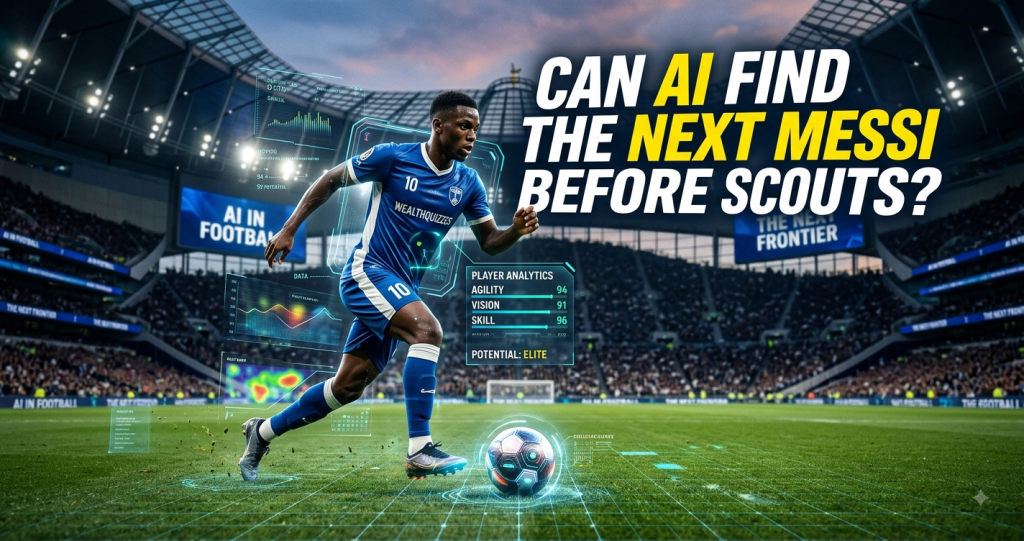
Can AI Discover the Next Lionel Messi Before Scouts Do?
Football has always been a game of human judgement. A scout watches a teenager and sees something special. A coach notices an unusual movement that statistics cannot immediately explain. A manager trusts a player’s temperament in a difficult match. A technical director decides that an apparently ordinary prospect has the potential to become extraordinary.
But football is entering an era in which another observer is increasingly joining the process: artificial intelligence.
AI is already changing how matches are analysed, how players are tracked, how opponents are studied, how injuries and workloads are monitored, how refereeing decisions are supported and how football organisations search for talent. The question is no longer whether artificial intelligence will influence football. It already does.
The more intriguing question is whether AI will eventually become capable of identifying the next Lionel Messi, Cristiano Ronaldo, Kylian Mbappé or another generational superstar before traditional scouting networks recognise the talent.
The answer is complicated.
AI may become exceptionally good at identifying patterns associated with elite performance. It can process vastly more information than a human scout and can compare thousands of players across leagues, competitions and age groups. But discovering a future superstar is not merely a statistical exercise. Footballers develop unpredictably, and qualities such as personality, adaptability, motivation, resilience, creativity and response to pressure remain difficult to capture completely through data.
The future of football is therefore unlikely to be AI versus scouts.
It is much more likely to be AI working with scouts.
Football Has Become a Data-Rich Sport
Modern football generates an extraordinary quantity of information.
Every match can produce event data, positional data, physical-performance data, video footage and contextual information.
Players can be tracked across the pitch.
Their movements can be measured.
Passing networks can be reconstructed.
Pressing patterns can be analysed.
Running loads can be monitored.
Shooting locations can be recorded.
The problem is no longer simply obtaining information.
The problem is making sense of it.
This is precisely where artificial intelligence becomes valuable.
A 2026 bibliometric study examining 1,112 peer-reviewed publications on artificial intelligence, machine learning and deep learning in football found rapidly expanding research activity across tactical analysis, performance optimisation, injury prediction and talent identification.
Football is moving from an era of collecting data to an era of interpreting it intelligently.
FIFA’s World Cup 2026 Experiment
The FIFA World Cup 2026 provided one of the clearest demonstrations of how artificial intelligence is entering elite football.
FIFA and Lenovo introduced Football AI Pro, an AI-powered post-match analysis assistant designed for match analysts and coaching staffs.
The system combines structured match data, tracking information, video and FIFA’s specialised football language model to produce tactical insights, performance analysis and strategic recommendations.
More significantly, FIFA made the system available to all 48 participating teams at the 2026 World Cup.
According to FIFA, Football AI Pro analysed hundreds of millions of football data points and could generate insights through text, video, graphs and three-dimensional visualisations.
FIFA subsequently reported that all 48 teams interacted with the tool during the tournament, with the system used in 15 languages.
This is strategically significant.
Historically, wealthy football nations and elite clubs could afford larger analytical departments, expensive data subscriptions and sophisticated technology.
AI potentially changes that equation.
A national team with fewer analysts can gain access to powerful analytical capabilities that previously required substantial resources.
The technology does not eliminate inequality, but it can reduce one part of the information gap.
Can AI Discover the Next Messi?
This is where the discussion becomes particularly fascinating.
Imagine an AI system analysing 100,000 young footballers.
It could examine:
- Ball progression.
- Passing efficiency.
- Dribbling success.
- Acceleration.
- Spatial awareness.
- Decision-making.
- Defensive actions.
- Shot creation.
- Movement patterns.
- Physical development.
- Age-relative performance.
- Positional behaviour.
The system could then compare each player against historical profiles of successful professionals.
Instead of asking simply, “Who is the best teenager today?”, the algorithm could ask:
“Which young players display combinations of characteristics historically associated with elite development?”
That is a much more sophisticated question.
Recent academic research supports the potential of this approach. A 2026 critical review by Joseph Baker and colleagues examined AI in athlete identification, selection and development and concluded that AI technologies have potential value in assessment, selection and athlete development, while stressing the need for critical evaluation and balanced implementation.
A separate systematic review examining machine learning and multi-criteria decision-making in football player selection identified a growing body of research using computational methods to support recruitment and performance prediction.
The technology is therefore moving beyond theoretical speculation.
It is becoming an active area of sports science.
But Messi Was Not Just a Statistical Profile
There is an important limitation.
Suppose an algorithm had analysed Lionel Messi at age 13.
Would it necessarily have predicted that he would become Lionel Messi?
Possibly not.
Football’s greatest talents possess characteristics that are difficult to measure.
Messi’s extraordinary ability to perceive space.
His improvisational creativity.
His anticipation.
His confidence.
His ability to make decisions at extreme speed.
His capacity to produce solutions that defenders do not anticipate.
These qualities can produce measurable outcomes, but the underlying human characteristics are considerably harder to quantify.
This is why AI should not be confused with prophecy.
An algorithm can identify probability.
It cannot guarantee destiny.
The Problem of “Potential”
Football scouts have always struggled with one question:
What does potential actually mean?
A teenager may dominate youth football but fail to transition successfully into the senior game.
Another may appear physically ordinary at 16 and develop dramatically between 18 and 21.
Some players mature earlier.
Others mature later.
Some flourish under one coach and struggle under another.
Some perform brilliantly in one tactical system but become ineffective in another.
A systematic review of talent identification and development in sport published in Heliyon emphasised that detection, identification, development and selection are interconnected stages rather than isolated processes.
This is crucial.
AI may identify talent.
But talent still has to be developed.
AI Could Reduce Human Bias
One of AI’s most promising applications is reducing certain forms of scouting bias.
Human scouts are not machines.
They have preferences.
They may unconsciously favour players who resemble successful footballers they already know.
They may be influenced by reputation, nationality, physical appearance, playing style or the environment in which a player performs.
A 2025 study published in Personnel Review examined “blind scouting” using AI-anonymised football footage and investigated whether technology could reduce bias in player assessment. The research specifically explored how AI could coexist with human recruiters rather than simply replace them.
This could be transformative.
Imagine evaluating a player without knowing his name, club, nationality or transfer-market reputation.
The scout initially sees only the football.
AI can facilitate this kind of blind assessment.
It cannot eliminate human bias completely, but it can help expose and reduce some forms of it.
AI and Tactical Analysis
The influence of AI extends far beyond recruitment.
A modern coach may want to know:
Where does the opponent create numerical superiority?
Which defender is most vulnerable when pressed?
Which passing lane repeatedly opens?
Where does the opposition full-back move when possession changes?
How does a team defend corners?
Which player creates the most dangerous transitions?
These questions can require hours of video analysis.
AI can accelerate the process.
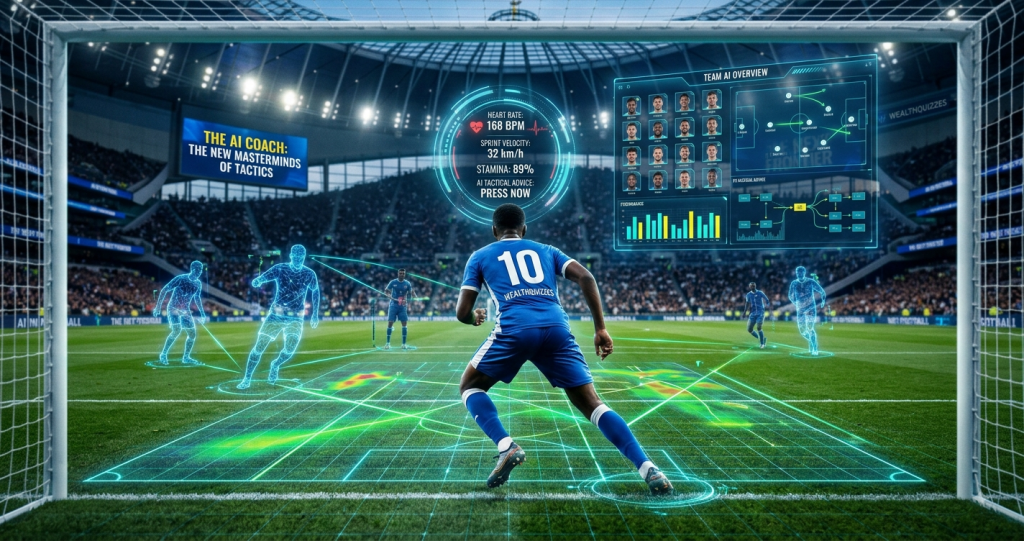
FIFA’s Football AI Pro is explicitly designed to turn structured match data and video into tactical insights and strategic recommendations.
Instead of analysts manually searching through hours of footage, AI can help identify relevant sequences and patterns.
The human analyst then interprets them.
This distinction is important.
AI can find the pattern.
The coach decides what the pattern means.
AI Is Also Changing Refereeing
Artificial intelligence is increasingly involved in officiating.
FIFA’s semi-automated offside technology uses player tracking and ball data to assist officials.
The system developed for the 2022 World Cup used dedicated tracking cameras to monitor the ball and 29 data points on each player at 50 times per second, while connected-ball technology helped identify the precise kick point. AI was used to generate automated offside alerts for the video match officials.
By the 2026 World Cup, FIFA introduced an advanced version designed to accelerate the process further.
FIFA announced that clear offside situations could generate direct alerts to match officials, reducing delays while retaining human oversight for complex decisions.
This demonstrates an important principle of AI in football:
Automation does not necessarily mean removing humans.
Instead, AI can provide information while humans retain authority.
Player Tracking and Performance
Artificial intelligence is also transforming physical analysis.
Computer vision can identify players from video and estimate their positions and movement.
This creates possibilities for measuring:
- Sprinting.
- Distance covered.
- Acceleration.
- Deceleration.
- Positional discipline.
- Team shape.
- Defensive compactness.
- Pressing intensity.
However, AI-generated tracking is not perfect.
A 2025 study comparing commercially available computer-vision and AI tracking systems with high-definition multi-camera tracking found meaningful variation in positional and speed accuracy between providers. The research demonstrated both the usefulness and limitations of AI-based tracking from broadcast footage.
That is a crucial warning.
More data does not automatically mean better decisions.
Bad data processed by sophisticated algorithms can still produce bad conclusions.
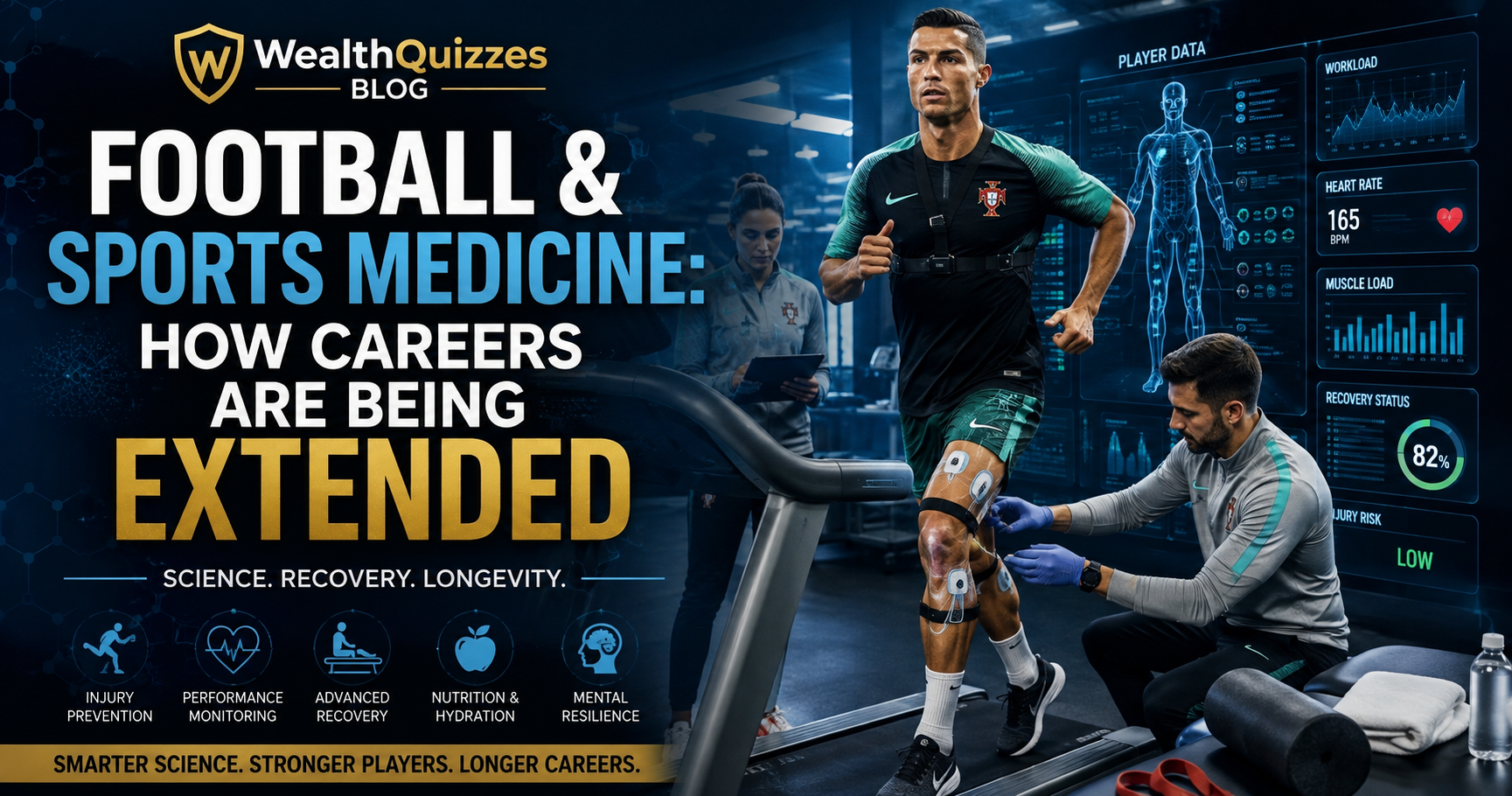
AI and Injury Prevention
One of the most commercially significant applications may be injury prediction.
Professional football clubs invest enormous amounts in players.
An injury to a key footballer can cost a club millions in wages, medical treatment and lost sporting performance.
AI can analyse combinations of:
- Training load.
- Match minutes.
- Sprint exposure.
- Recovery.
- Previous injuries.
- Sleep.
- Physical workload.
- Movement patterns.
The objective is not necessarily to predict the exact day an injury will occur.
It is to identify elevated risk.
If a player’s workload profile indicates unusual stress, medical and performance staff can intervene before a problem becomes serious.
Recent reviews of AI in athlete development identify injury and performance optimisation among the rapidly expanding areas of sports-AI research.
The New Football Scout
The traditional scout is unlikely to disappear.
Instead, the profession may evolve.
Tomorrow’s scout may spend less time simply watching matches and more time interrogating data.
Instead of saying:
“I like this player.”
The scout might say:
“The model has identified this player as statistically unusual for his age group. I want to investigate why.”
The scout then watches the player.
The AI provides the starting point.
The human provides the context.
This combination may prove far more powerful than either approach alone.
The Danger of Algorithmic Football
AI also presents serious risks.
If every club uses similar models, recruitment could become increasingly homogenised.
Everyone may identify the same players.
Everyone may chase the same statistical profiles.
Transfer prices could rise.
Clubs may overlook unconventional talents who do not fit established models.
There is also the problem of algorithmic bias.
An AI system trained on historical data may reproduce the biases contained within that data.
If successful footballers historically came disproportionately from certain environments, the model could incorrectly interpret those characteristics as essential to future success.
Technology does not automatically produce objectivity.
It can simply automate existing assumptions.
The Human Qualities AI Cannot Easily Measure
There is another reason scouts will remain important.
Football is played by human beings.
A player’s character matters.
So does resilience.
So does leadership.
So does adaptability.
So does how a player responds after making a mistake.
So does whether he can handle 70,000 supporters demanding victory.
So does whether he can accept tactical instructions.
These qualities can be observed but are difficult to reduce to a single number.
This is where experienced coaches and scouts remain invaluable.
A 2019 systematic review of coach knowledge in talent identification concluded that experiential knowledge remains an important source of information in identifying future elite athletes.
AI therefore should not be viewed as the death of expertise.
It may become an instrument that makes expertise more powerful.
The Democratisation of Football Intelligence
Perhaps the most important development at the 2026 World Cup was not simply that AI existed.
It was that FIFA deliberately sought to make advanced analytical capability available to all 48 participating teams.
FIFA described Football AI Pro as part of an effort to democratise access to football intelligence.
This could have major implications for the global game.
A smaller football nation may not possess the same financial resources as a traditional powerhouse.
But if its coaching staff can interrogate sophisticated match data rapidly, it can potentially prepare more intelligently.
The result may be greater tactical competitiveness.
AI could therefore become not merely a weapon of rich football institutions but an instrument for levelling aspects of the competitive field.
What Football Will Look Like in the AI Era
The next decade may produce a football environment in which almost every major decision is supported by computational intelligence.
Scouting departments will use predictive models.
Coaches will receive automated tactical reports.
Medical teams will monitor injury-risk indicators.
Recruitment departments will model transfer value.
Referees will receive increasingly sophisticated technological assistance.
Broadcasters will generate personalised analysis.
Fans will receive AI-generated explanations of tactical events.
Clubs may eventually develop digital simulations of opponents before matches.
The possibilities are enormous.
But football must preserve something equally important:
human judgement.
Because football’s beauty has always come partly from its unpredictability.
A player can ignore the obvious pass.
A teenager can exceed every prediction.
A goalkeeper can produce an impossible save.
A manager can make an unexpected tactical change.
A team can defeat an opponent that statistics said it should not defeat.
Algorithms can calculate probabilities.
Football still creates surprises.
Conclusion: AI May Find the Next Messi—but Humans Will Still Have to Develop Him
Can AI discover the next Lionel Messi before scouts do?
It may help identify the probability that a young player possesses extraordinary potential, perhaps earlier and across a much larger population than traditional scouting alone can manage. But it cannot guarantee that the player will become the next Messi.
That distinction matters.
AI is extraordinarily good at processing information.
Humans remain extraordinarily good at interpreting context.
The future of football will therefore probably belong neither to the algorithm nor to the traditional scout operating alone.
It will belong to the hybrid intelligence model: machines processing enormous quantities of information while coaches, scouts, psychologists, doctors and sporting directors apply experience, judgement and human understanding.
The 2026 FIFA World Cup provided a glimpse of that future. FIFA’s deployment of Football AI Pro across all 48 participating teams demonstrated that artificial intelligence has moved from an experimental concept into the operational infrastructure of elite football.
The next revolution may therefore not be about replacing football’s experts.
It may be about giving them a second set of eyes—ones capable of seeing millions of patterns that no human could possibly examine alone.
And somewhere among those millions of patterns could be a 15-year-old whose numbers look unusual, whose movement is extraordinary and whose potential is almost impossible to explain.
The scout may see a promising teenager.
The algorithm may see an anomaly.
And football may eventually discover that the anomaly is its next superstar.