The Greatest Underdog Stories in Football History
Hope, Resilience and the Beautiful Game’s Greatest Miracles
Football has always been a game of giants and dreamers. The giants arrive with history, money, famous players, sophisticated facilities and the expectation of victory. The dreamers arrive with something less tangible: belief.
That is why some of football’s most enduring stories have not been written by the richest clubs, the most celebrated nations or the players whose names were already engraved in history. They have been written by teams that were expected to lose—and somehow refused to do so.
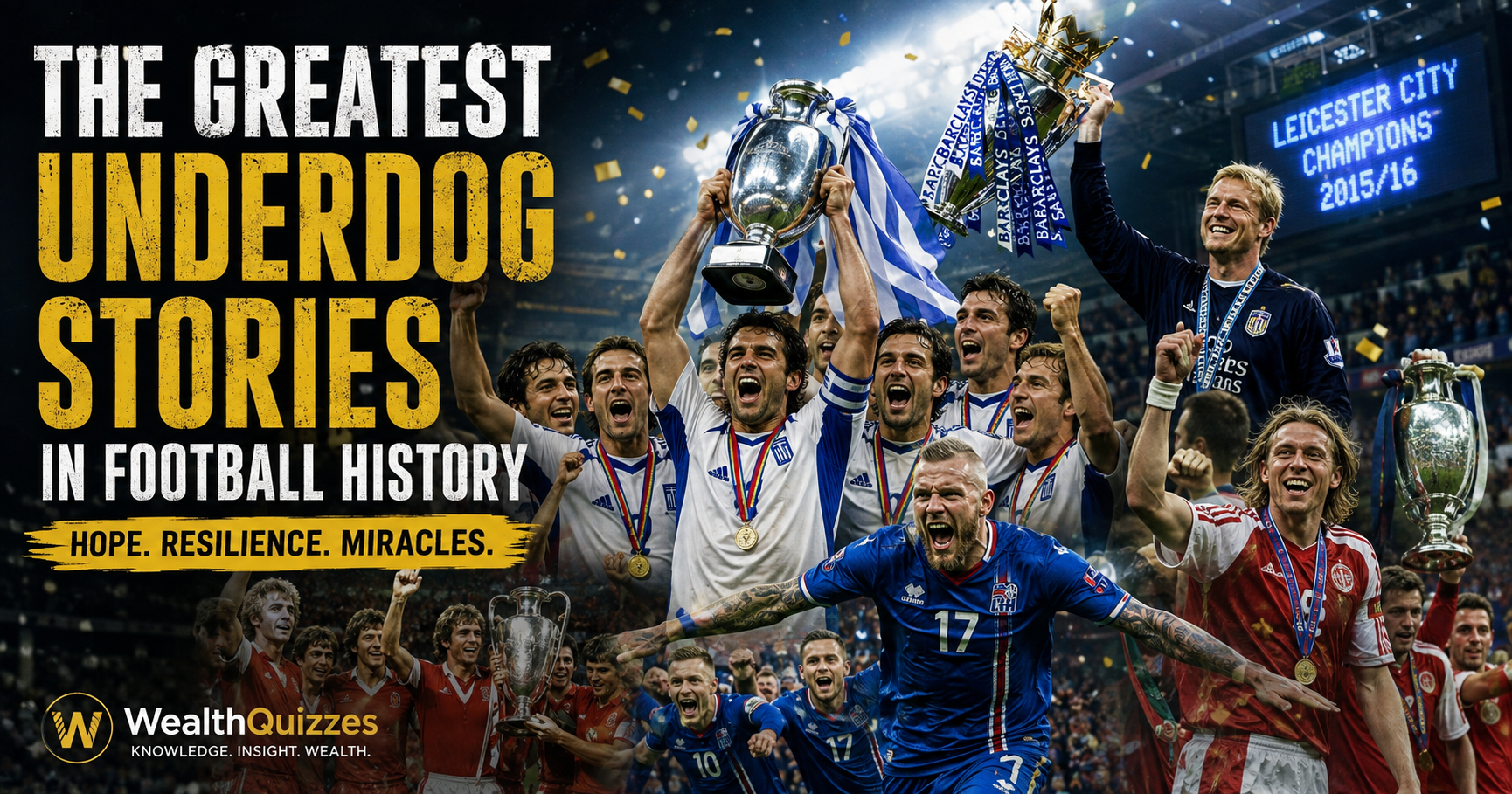
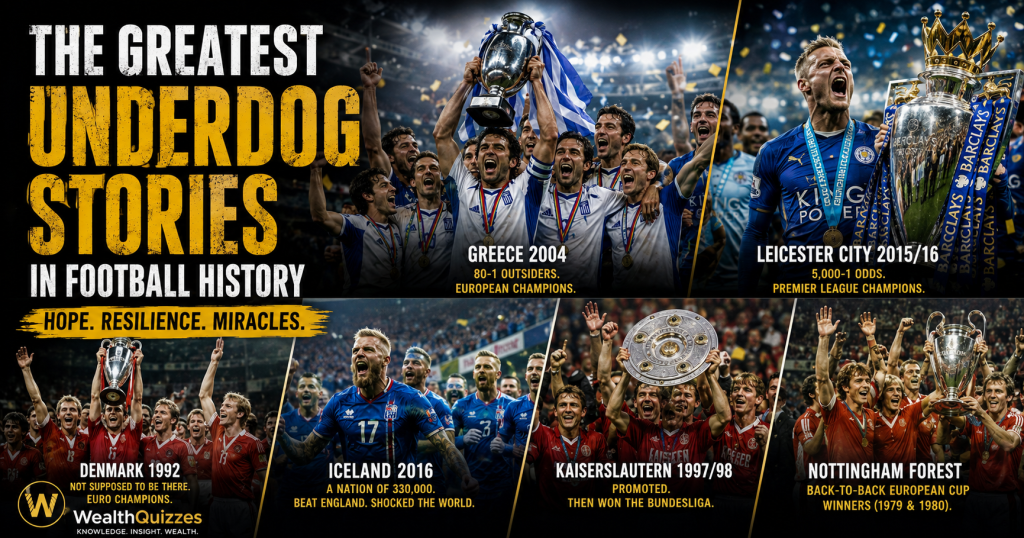
From Greece’s extraordinary triumph at UEFA EURO 2004 to Leicester City’s almost unbelievable Premier League title in 2016, from Denmark’s improvised European Championship campaign in 1992 to Iceland’s stunning elimination of England at EURO 2016, football has repeatedly demonstrated its capacity to overturn expectations.
But why does football appear to produce so many miracles?
The answer lies partly in the nature of the sport itself. Football is a low-scoring game in which a single goal can transform an entire contest. Its relatively small number of scoring events means that tactical discipline, defensive organisation, individual errors, set pieces, goalkeeping, psychology and sheer fortune can exert enormous influence on the final result. In knockout competitions, this uncertainty becomes even more powerful.
Yet statistics alone cannot explain why an underdog victory can become a national memory.
For that, we must look at something deeper: hope.
Greece 2004: When Nobody Believed
Few football stories illustrate the power of the underdog better than Greece at UEFA EURO 2004.
Before the tournament, Greece were hardly regarded as serious contenders. UEFA records that they entered the competition as 80-1 outsiders. They had never previously won a match at a major championship. Their squad contained no global superstar comparable to Zinedine Zidane, Luís Figo or the emerging Cristiano Ronaldo. (UEFA.com)
Then came Portugal.
Greece defeated the hosts 2–1 in the opening match, immediately announcing that they were not simply participating. They were capable of upsetting the established order.
The Greeks subsequently defeated defending champions France in the quarter-finals. In the semi-final, they eliminated the Czech Republic with Traianos Dellas scoring the decisive silver goal in extra time.
And then came Lisbon.
Portugal had home advantage, immense attacking talent and a generation of players expected to deliver European glory. Greece had discipline, organisation and an extraordinary belief in their system.
Angelos Charisteas headed the only goal of the final.
Greece were European champions.
UEFA describes the achievement as one of the greatest shocks in European Championship history. Remarkably, Greece won all three of their knockout matches 1–0. Their triumph was not built around spectacular attacking football but around organisation, defensive discipline, collective commitment and tactical execution. (UEFA.com)
Their achievement offers one of the most important lessons in football: an underdog does not have to become the favourite to win; it only has to become good enough to defeat the favourite.
Leicester City: The 5,000-1 Miracle
If Greece represented the international underdog story, Leicester City provided its club equivalent.
At the beginning of the 2015/16 Premier League season, Leicester were given odds of 5,000-1 to win the title. The previous season they had appeared destined for relegation before an extraordinary late escape.
The Premier League itself describes Leicester’s eventual triumph as one of the most monumental upsets in sporting history. (Premier League)
The achievement becomes even more extraordinary when the circumstances are considered.
Leicester did not simply win a short knockout tournament. They had to perform consistently across 38 league matches.
And they did.
Claudio Ranieri’s team finished first with 81 points, winning 23 matches, drawing 12 and losing only three. Arsenal finished second with 71 points and Tottenham third with 70. Jamie Vardy scored 24 league goals, while Wes Morgan, Kasper Schmeichel and Marc Albrighton were among the players who played all 38 matches. (Premier League)
There was no single explanation.
Leicester combined Vardy’s extraordinary finishing and pace, Riyad Mahrez’s creativity, N’Golo Kanté’s midfield energy, Morgan’s leadership, Schmeichel’s goalkeeping and Ranieri’s ability to create a disciplined collective.
The mathematics of the achievement made it astonishing. But the human story made it unforgettable.
These were players who had not entered the season expecting to become immortal.
They simply kept winning.
UEFA called Leicester’s achievement one of the greatest sporting fairy tales of all time, noting that the club had started the campaign as 5,000-1 outsiders and had been close to relegation only a year earlier. (UEFA.com)
That is the essence of an underdog story: the distance between expectation and achievement becomes the source of the legend.
Denmark 1992: The Team That Wasn’t Supposed to Be There
Perhaps the purest expression of football’s unpredictability came at EURO 1992.
Denmark had not originally qualified for the tournament in the conventional sense. Their presence came after Yugoslavia were excluded amid the political and security crisis surrounding the breakup of the country.
Denmark were suddenly invited into a tournament for which they had not been preparing in the normal way.
Instead of treating their unexpected opportunity as an obligation, they embraced it.
They defeated reigning European champions Netherlands on penalties in the semi-final before facing Germany in the final.
Denmark won 2–0.
The story became one of football’s great examples of opportunity meeting readiness.
It also illustrates an important distinction. An underdog is not necessarily an inferior team. Sometimes it is simply a team whose circumstances, reputation or expectations place it below the established hierarchy.
Football history is full of such teams.
Iceland 2016: When a Nation Refused to Be Intimidated
At UEFA EURO 2016, Iceland produced another unforgettable chapter.
The Icelandic national team was making its debut at the European Championship. Its population was tiny compared with the footballing giants it faced.
Yet Iceland progressed from the group stage and reached the round of 16.
Then came England.
England took the lead through Wayne Rooney’s fourth-minute penalty. Under ordinary expectations, the match appeared to be moving in the anticipated direction.
Instead, Iceland responded almost immediately.
Ragnar Sigurdsson equalised less than two minutes later, and Kolbeinn Sigthórsson put Iceland ahead.
They held on.
England were eliminated.
UEFA subsequently included England’s 1–2 defeat to Iceland among the greatest shocks in European Championship history. (UEFA.com)
The significance went beyond the scoreline.
Iceland demonstrated that football’s hierarchy is psychological as much as financial. A famous opponent can carry enormous reputation, but reputation cannot tackle, pass or score.
Players must still play the match.
Kaiserslautern: The Promoted Club That Became Champion
The underdog phenomenon is not restricted to international football.
In Germany, 1. FC Kaiserslautern created one of the most extraordinary league stories of the modern era.
After relegation in 1996, the club returned immediately to the Bundesliga. Then, in the 1997/98 season, newly promoted Kaiserslautern won the Bundesliga title.
According to Bundesliga’s historical records, they remain the only promoted club to win the Bundesliga championship immediately after promotion. They finished with 68 points, two ahead of Bayern Munich. (Bundesliga)
The architect was Otto Rehhagel.
The same Rehhagel would later lead Greece to the EURO 2004 title.
Kaiserslautern’s story therefore reveals something fascinating about underdog success: sometimes the decisive advantage is not resources but clarity.
A team that understands its strengths can compete against a richer opponent by making the contest about qualities it possesses.
Nottingham Forest: From English Champions to European Kings
Brian Clough’s Nottingham Forest belong in any serious discussion of football’s great improbable achievements.
Forest won the European Cup in 1979 after defeating Malmö 1–0 in the final.
Then they did something even more remarkable.
They defended the trophy the following year.
In the 1979/80 European Cup, Forest defeated Hamburg 1–0 in the final at Madrid’s Santiago Bernabéu. John Robertson scored the decisive goal, while goalkeeper Peter Shilton produced a celebrated performance. UEFA records Forest as back-to-back European champions in 1979 and 1980. (UEFA.com)
Forest’s story is especially powerful because it demonstrates that an underdog miracle does not necessarily have to end after one extraordinary night.
Sometimes the miracle becomes a dynasty.
Clough’s achievement was not simply about defeating superior opponents. It was about constructing a team capable of competing repeatedly at the highest level.
Why Does Football Produce Such Miracles?
The question in our hook deserves serious consideration.
Why does football seem to produce so many unforgettable underdog victories?
1. Football is a low-scoring sport
In basketball, a superior team can accumulate points repeatedly, giving its greater quality many opportunities to assert itself.
Football is different.
A match can be decided by one goal.
That makes defensive organisation extraordinarily valuable. A team that cannot match an opponent’s attacking talent can sometimes neutralise it.
Greece understood this perfectly in 2004.
2. The clock creates psychological pressure
Football has a fixed 90-minute structure.
As the match progresses, the psychological environment changes.
An underdog still level after 70 minutes begins to believe.
The favourite begins to worry.
A goal in the 85th minute can completely reverse the emotional balance.
3. One mistake can change everything
A misplaced pass.
A deflection.
A goalkeeper’s error.
A penalty.
A corner.
A moment of brilliance.
Football provides relatively few scoring opportunities, so individual incidents can carry disproportionate importance.
4. Tactical organisation can reduce the gap
Money buys players, but money does not automatically create cohesion.
A disciplined team can restrict space, defend compactly, counterattack intelligently and exploit weaknesses.
That is why managers remain so important in football.
Otto Rehhagel’s Greece is perhaps the classic example.
5. Belief changes behaviour
This may be the most important factor.
An underdog that believes it belongs on the same pitch behaves differently from one that has already accepted defeat.
Iceland did not enter against England believing the match was already lost.
Leicester did not approach each Premier League fixture believing their opponents were entitled to victory.
Greece did not surrender to Portugal’s home advantage.
Belief does not guarantee victory.
But without belief, extraordinary victory becomes almost impossible.
The Psychology of the Underdog
Sports psychologist Jim Taylor, among others, has written extensively about the psychological dimensions of athletic performance, including confidence, concentration and competitive pressure.
The underdog possesses an unusual psychological advantage: freedom from expectation.
The favourite has something to lose.
The underdog often has something to prove.
That distinction can affect risk-taking and emotional control.
The favourite may begin protecting its reputation.
The underdog is often trying to create one.
This is why the greatest underdog victories frequently produce a particular emotional reaction among neutral supporters. People identify with the team because the story mirrors ordinary life.
Most people are not the richest.
Most people are not the most powerful.
Most people do not begin every challenge as favourites.
But they understand the desire to overcome expectations.
Football transforms that human experience into ninety minutes.
The Miracle Is Never Just Luck
It is tempting to reduce underdog victories to luck.
That would be a mistake.
Luck matters enormously in football, particularly in single matches. But luck alone cannot explain Leicester’s 38-match Premier League campaign, Greece’s disciplined progression through EURO 2004, Kaiserslautern’s Bundesliga title or Nottingham Forest’s consecutive European Cups.
The most enduring miracles combine several elements:
Preparation. Organisation. Leadership. Tactical intelligence. Collective belief. Resilience. Opportunity. And, inevitably, some degree of fortune.
The miracle occurs when those ingredients arrive together.
What Underdog Football Teaches Us
The greatest lesson is not that anyone can beat anyone at any time.
That would be romantic but inaccurate.
Football still has hierarchies. Resources matter. Talent matters. Infrastructure matters. Squad depth matters. Long-term planning matters.
The lesson is subtler.
Probability is not destiny.
A team may have a smaller budget and fewer famous players and still win a particular match.
A nation may have fewer resources and still create a generation capable of extraordinary achievement.
A club may be considered a relegation candidate and still become champion.
That is why Leicester’s 5,000-1 triumph remains so powerful. It did not abolish the logic of football economics; it demonstrated that the logic has exceptions. (Premier League)
And exceptions are where legends are born.
The Beautiful Game’s Greatest Gift
Football’s greatest gift may not be the trophy.
It may be possibility.
The possibility that a team written off before kick-off can still compete.
The possibility that a nation without a history of success can suddenly find itself on the biggest stage.
The possibility that a late goal can transform despair into celebration.
The possibility that a player unknown to the world on Monday can become a national hero by Sunday.
That is why the greatest underdog stories endure long after the statistics have faded.
People remember Greece because nobody believed.
They remember Leicester because the numbers seemed absurd.
They remember Iceland because England were expected to win.
They remember Kaiserslautern because promotion was supposed to be the achievement—not the beginning of a championship.
And they remember Nottingham Forest because Brian Clough’s remarkable side did not merely enter European football’s elite; it conquered it twice.
Perhaps that is why football produces what supporters call miracles.
The sport does not promise that the underdog will win.
It merely refuses to guarantee that the favourite will.
And in that small space between expectation and possibility lies the magic of football.
The scoreboard does not know reputation. The pitch does not know wealth. The goal does not know history.
For ninety minutes, everyone begins with the same ball.
And sometimes, against every expectation, the dreamers win.