The Global Football Fan: How Supporters Shape the Beautiful Game
Would football be the same without its passionate supporters?
Football can be played without a crowd. A match can be broadcast without a stadium full of spectators. A goal can be scored in an empty arena. But the football most people understand—the football of chants, colours, rivalries, flags, tears, celebrations, arguments, memories and generations—is inseparable from its supporters.
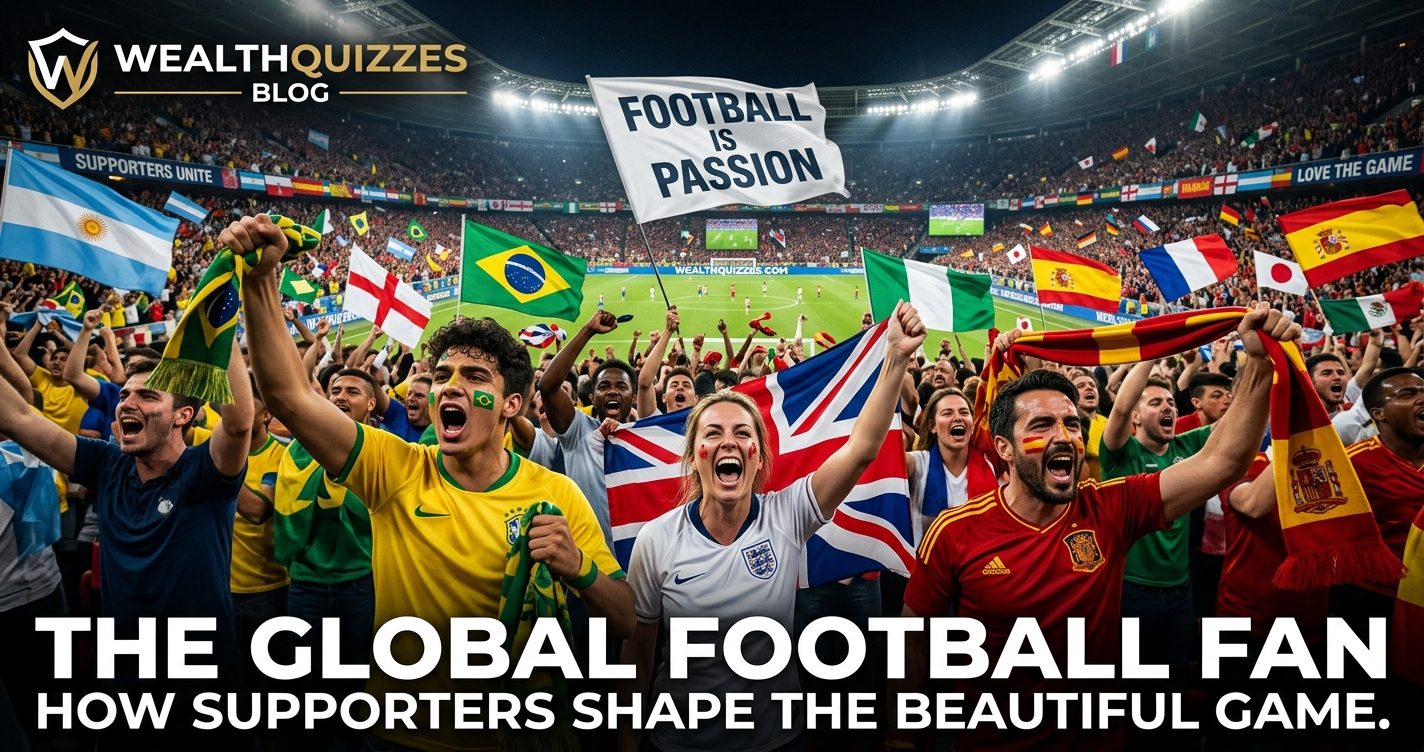
The modern football fan is far more than a spectator. Supporters are consumers, broadcasters, content creators, cultural ambassadors, social communities and, increasingly, stakeholders whose collective behaviour can influence the commercial and institutional direction of the sport. From the packed terraces of Europe and South America to viewing centres in Nigeria, fan parks in Africa, supporters’ clubs in Asia and digital communities scattered across the world, football has developed an extraordinary ability to turn strangers into members of the same imagined community.
FIFA itself has described football as a global ecosystem whose appeal extends from broadcasting and sponsorship to club ownership and the international origins of its players. In its football landscape report, FIFA estimated that there were about five billion football fans worldwide, with Latin America, the Middle East and Africa among the largest fan bases. (FIFA Publications) That figure illustrates the extraordinary scale of the game’s audience, but numbers alone cannot explain why football inspires such remarkable loyalty.
The deeper explanation lies in identity.
Football Is About Belonging
One of football’s greatest strengths is its capacity to create belonging. A supporter does not merely watch a club; he or she becomes part of a community.
The sociologist Richard Giulianotti, whose work on football fandom has been influential in the study of sport and society, has examined how football supporters develop different forms of identity and relationships with clubs. Football fandom can involve local attachment, family tradition, social status, consumer behaviour and increasingly global identification.
This explains why a person in Lagos can passionately support a club thousands of kilometres away in Manchester, Madrid, Barcelona, Milan or Paris despite never having visited the city where that club is based.
The relationship is not necessarily irrational. Football provides symbols through which people express who they are and where they belong.
A club shirt can communicate identity. A scarf can represent family tradition. A song can connect generations. A stadium can become a sacred social space.
Recent academic research reinforces this point. Research published in Soccer & Society examining Indonesian football supporters found that stadiums can function as symbolic and ritual spaces, while chants, choreography and jerseys become expressions of loyalty and identity. (Taylor & Francis Online)
This phenomenon is not confined to Indonesia. It can be observed in virtually every football culture.
The Stadium Belongs to the Supporters Too
There is something extraordinary about the transformation that occurs when thousands of people enter a football stadium.
Before kick-off, it may be nothing more than concrete, steel, grass and seats. Once supporters arrive, it becomes something else.
It acquires a voice.
Supporters create the atmosphere through songs, chants, flags, coordinated displays and collective reactions. They celebrate together, suffer together and sometimes attempt to psychologically influence the contest.
Research on football fan identity has specifically challenged the simplistic stereotype that supporters are primarily defined by hooliganism. Ethnographic research in an English football stadium found considerable variation in supporter identities and highlighted behaviours such as chanting, singing, swaying, displaying colours and participating in collective rituals. (Taylor & Francis Online)
That distinction matters.
The football supporter is not simply the person sitting in a seat watching 22 players. The supporter is part of the spectacle.
The crowd itself becomes an element of the football experience.
This is why clubs invest heavily in stadium design, supporter engagement, matchday entertainment and hospitality. The objective is not merely to accommodate spectators; it is to create an environment in which supporters feel emotionally connected to the club.
Fans Are an Economic Force
Passion eventually becomes economics.
A football club’s commercial value depends heavily on its ability to attract and retain supporters. Fans buy tickets, shirts, scarves and other merchandise. They subscribe to broadcasting platforms. They purchase club memberships. They consume digital content. They travel to matches. They attend fan events. They interact with sponsors.
In other words, the supporter sits at the centre of football’s commercial ecosystem.
UEFA’s latest European Club Finance and Investment Landscape demonstrates the extraordinary scale of this economy. European top-division club revenues are projected to exceed €30 billion for 2025, following €28.6 billion in 2024. UEFA identifies broadcasting, commercial partnerships, gate receipts and competition revenues among the principal drivers of this growth. (UEFA.com)
Fans are embedded in virtually all of those revenue streams.
There is an important distinction here. Supporters do not always hand money directly to clubs. A television viewer may never purchase a ticket. Yet millions of viewers make broadcasting rights valuable. Large audiences make sponsorship attractive. Global recognition makes merchandise commercially powerful.
The fan therefore creates economic value even when he or she is not physically inside the stadium.
UEFA’s financial research has previously described supporter loyalty as one of the underlying strengths behind European football’s extraordinary revenue growth. (UEFA.com)
The modern football economy is, in many respects, an economy built around attention.
And football supporters provide enormous quantities of it.
The Globalisation of Fandom
Perhaps the greatest transformation in football fandom has been geographical.
Historically, supporting a football club was predominantly a local experience. A family might live near a stadium, attend matches regularly and pass its allegiance from one generation to another.
Globalisation changed the equation.
Television allowed supporters to watch foreign leagues. Satellite broadcasting expanded access across continents. The internet eliminated geographical barriers. Social media subsequently transformed supporters from passive consumers into active participants in football’s global conversation.
Today, a supporter can wake up in Lagos, follow European football news throughout the day, watch a Premier League match in the afternoon, discuss it with friends online and then watch a La Liga or Champions League fixture at night.
The club may be thousands of kilometres away, but psychologically it can feel remarkably close.
FIFA recognised this phenomenon when it described fans as supporting combinations of national teams, local clubs, global clubs and individual players. (FIFA Publications)
That is one of the defining characteristics of contemporary football.
A supporter can simultaneously be Nigerian, support the Super Eagles, follow a Nigerian Premier League club and passionately support a European club.
These identities do not necessarily conflict. They coexist.
The Rise of the Digital Fan
Social media has fundamentally altered the relationship between football clubs and their supporters.
Previously, clubs controlled much of the information reaching supporters through newspapers, radio, television and official publications. Today, a supporter can receive information directly from the club, players, journalists, fan accounts and fellow supporters within seconds.
A goal can generate millions of reactions almost immediately.
A transfer rumour can become an international story before the club has officially commented.
A player’s social-media post can become news.
A controversial refereeing decision can trigger a worldwide debate within minutes.
The supporter has therefore become a participant in football’s information economy.
This has enormous commercial consequences. Clubs can reach international audiences without relying entirely on traditional media organisations. Players can develop personal brands independent of their clubs. Sponsors can communicate directly with supporters.
UEFA has previously documented the emergence of powerful player brands, noting that leading players could command enormous social-media followings of their own. (UEFA.com)
The modern footballer is therefore sometimes both athlete and media property.
And the supporter is simultaneously fan, audience and distributor.
Fans Can Influence Clubs
Supporters also possess something that money alone cannot easily purchase: legitimacy.
Football clubs are unusual businesses because their customers often regard themselves as members of a community rather than ordinary consumers.
A dissatisfied customer can stop buying a product.
A dissatisfied football supporter may continue supporting the club for life while protesting against its owners, management or policies.
This creates a unique relationship between clubs and supporters.
Across football history, supporters have organised campaigns concerning ticket prices, club ownership, stadium relocations, competition structures, governance and other issues.
The famous “12th man” idea is therefore about more than noise. It reflects the broader understanding that supporters can influence the environment in which football is played.
But influence comes with responsibility.
Fan culture can create solidarity and joy, but it can also produce racism, discrimination, violence, online abuse and intolerance. Academic research increasingly emphasises the diversity of football supporter cultures rather than treating fans as a single social category. (Taylor & Francis Online)
The challenge for modern football is therefore not to suppress supporter passion, but to ensure that passion does not become a justification for abuse.
National Teams: When Millions Become One
Club football creates powerful identities, but international football can produce an even more extraordinary phenomenon.
When a national team plays at a major tournament, football can temporarily transcend club rivalries, political divisions and social differences.
The national jersey becomes a common symbol.
This is why major international tournaments generate such powerful emotional reactions. A goal scored by a national team can produce celebrations in homes, streets, bars, viewing centres and public spaces simultaneously.
In countries such as Nigeria, football has a particularly strong capacity to create communal experiences. A Super Eagles match can become a national conversation, with supporters gathering in viewing centres, homes and public spaces to experience the contest together.
The significance goes beyond the result.
For many supporters, the national team represents the country’s identity on an international stage.
The same phenomenon can be observed across Africa, South America, Europe, Asia and elsewhere.
Football does not eliminate national differences.
It gives nations a common language through which those differences can be expressed.
The Fan Is Also Part of Football’s Future
As football becomes increasingly commercialised, the question of the supporter will become even more important.
The sport’s financial growth is extraordinary. UEFA’s latest data indicates that European top-division club revenues are on course to pass €30 billion, while the broader football ecosystem continues to attract investors, sponsors and international audiences. (UEFA.com)
But commercial growth cannot be sustained without emotional attachment.
A television contract is ultimately valuable because people want to watch.
A shirt is valuable because someone wants to wear it.
A sponsorship is valuable because supporters recognise and engage with the brand.
A stadium is valuable because people want to experience football inside it.
A club’s global brand is valuable because millions of people care about what happens to it.
At the centre of all these relationships is the supporter.
That is why football cannot afford to treat fans merely as revenue sources.
The strongest football institutions understand that supporters are custodians of history. They preserve songs, stories, rivalries, traditions and memories that cannot be manufactured by a marketing department.
The Beautiful Game Needs Its People
Football has evolved dramatically.
The tactics have changed. The balls have changed. Stadiums have changed. Broadcasting has changed. Technology has transformed refereeing and performance analysis. Transfer fees have reached extraordinary levels. Clubs have become multinational commercial enterprises.
Yet one thing remains remarkably constant.
People care.
They care when their team wins.
They care when it loses.
They care about players who become legends.
They care about rivals.
They care about shirts.
They care about stadiums.
They care about memories.
And, ultimately, that is why football became more than a sport.
The global football fan has transformed the game from a ninety-minute contest into a permanent cultural phenomenon. Supporters give clubs their identities, competitions their atmosphere and great matches their emotional significance. They create economic value, preserve traditions, drive digital conversations and carry football across borders.
The football industry may increasingly speak the language of revenues, media rights, commercial partnerships, sponsorships, data and investment. Those things matter. UEFA’s financial figures make that unmistakable. (UEFA.com)
But beneath the billions is something much simpler.
A person watching a match.
A child wearing a jersey for the first time.
A father explaining to his son why a particular club matters.
Friends gathering around a screen.
Thousands of voices singing in a stadium.
Millions of people celebrating one goal at the same moment.
That is the real power of the global football fan.
Without supporters, football would still be a game. With them, it becomes a culture, an economy, an identity and a shared human experience.
And perhaps that is the greatest secret of the beautiful game: the players create the moments, but the supporters give those moments a life beyond the final whistle.