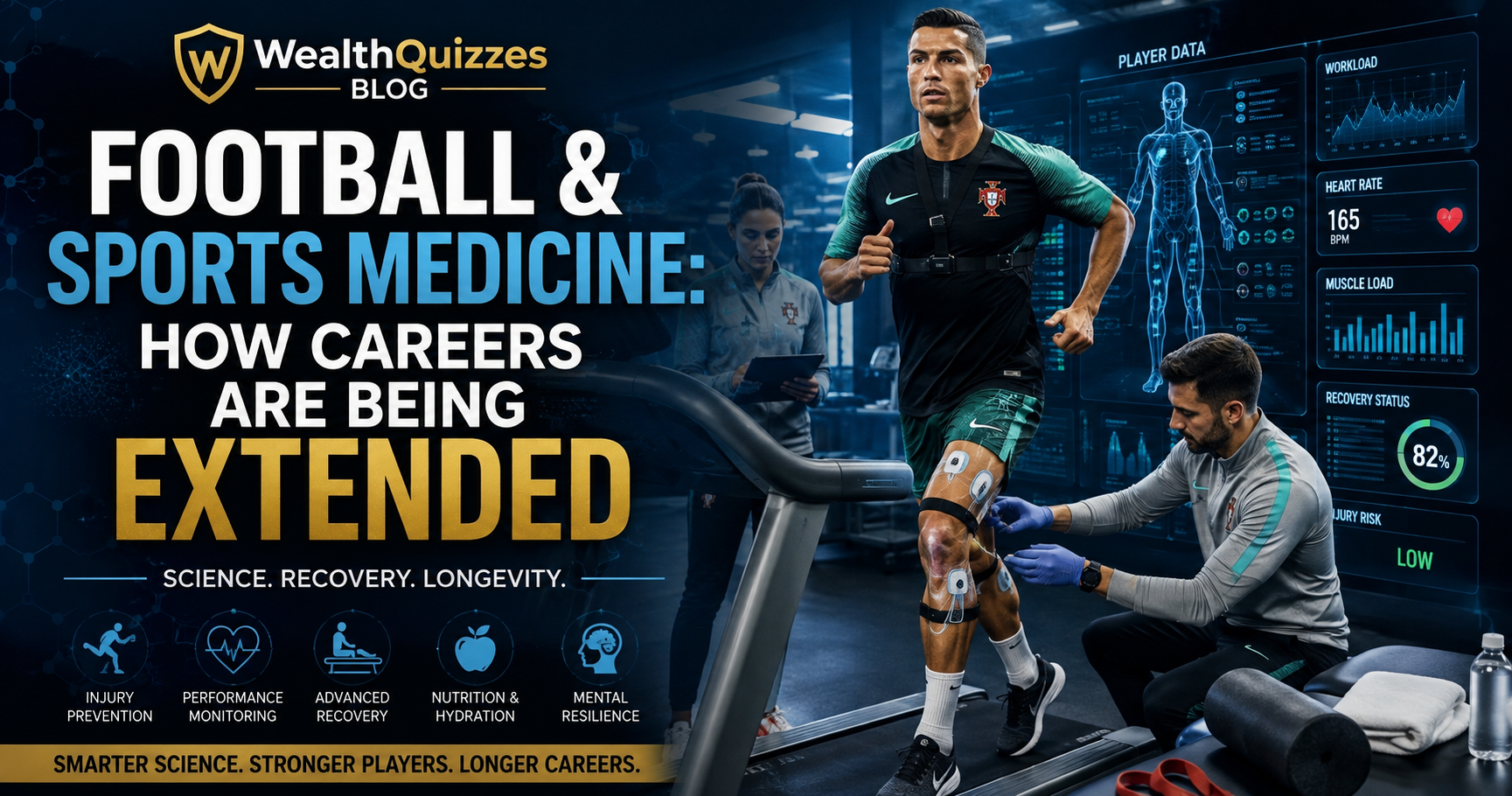
Football and Sports Medicine: How Careers Are Being Extended: Medical science
Why are elite footballers playing at the highest level well into their late 30s?
There was a time when a professional footballer approaching his mid-30s was generally regarded as being close to the end of his career. The modern game has challenged that assumption. Today, it is no longer extraordinary to see elite players competing at the highest level at 35, 36, 37 or beyond.
The explanation is not simply that modern players are more talented or more disciplined. A major part of the answer lies in the transformation of sports medicine, rehabilitation, nutrition, physical conditioning, injury prevention, recovery science and performance monitoring.
Football has become a laboratory for human performance. Clubs no longer treat injured players merely when something goes wrong. Increasingly, medical and performance departments seek to identify risks before injuries occur, manage workload before fatigue becomes dangerous and individualise training so that players can maintain performance for longer.
The result is a profound change in football: medical science is helping to turn career longevity from an accident into something that can be deliberately managed.
The Ageing Footballer: What Actually Changes?
Age inevitably affects athletic performance. Research does not suggest that sports medicine has somehow stopped ageing. Instead, it has made it possible to manage the consequences of ageing more intelligently.
A longitudinal study of 154 La Liga players involving more than 14,000 match observations found that total distance covered declined by approximately 0.56% for every additional year of age, while high-intensity efforts and high-intensity running also declined. Interestingly, however, passing accuracy improved with age. (PubMed)
A separate large-scale Bundesliga study reached a similar conclusion. Players over 30 generally covered less total distance and performed fewer fast runs and sprints than younger players, but their successful passing increased with age. (PubMed)
This distinction is crucial.
A 36-year-old midfielder may no longer possess the explosive acceleration he had at 24, but he may compensate through anticipation, positioning, technical efficiency, tactical intelligence and decision-making.
Consequently, longevity is not necessarily about preserving a player’s physical condition exactly as it was in his twenties. It is about maximising what remains physically available while making better use of experience and efficiency.
From Injury Treatment to Injury Prevention
Perhaps the greatest transformation in football medicine is the shift from simply treating injuries to preventing them.
The UEFA Elite Club Injury Study, initiated in 2001 under the leadership of renowned football injury researcher Professor Jan Ekstrand, created a systematic framework for collecting injury and player-exposure data across elite European football. Its purpose includes examining injury risk, severity, circumstances, patterns and trends. (UEFA.com)
That approach has fundamentally changed how clubs think.
Instead of asking only:
“How do we treat this injury?”
medical teams increasingly ask:
“Why did this injury happen, and what can we change so it does not happen again?”
That distinction can determine whether a player misses three weeks, three months or potentially the remainder of a career.
The UEFA study now has 25 years of accumulated experience and research, reflecting how deeply injury surveillance has become embedded in elite football. UEFA describes the programme as one of the most comprehensive collaborative bodies of football injury research in Europe. (UEFA.com)
The Hamstring Problem
Few injuries illustrate the importance of modern football medicine better than hamstring injuries.
Hamstring problems are particularly significant because football requires repeated acceleration, deceleration, sprinting and rapid changes of direction. A player may recover sufficiently to walk or jog normally long before he is ready to withstand the extreme demands of elite competition.
A British Journal of Sports Medicine Delphi consensus study involving professional football experts noted that hamstring muscle injury is the most common injury in professional football and carries a substantial risk of recurrence. It also emphasised that return-to-play decisions require defined criteria rather than simply relying on whether an athlete “feels better.” (British Journal of Sports Medicine)
This has produced a more sophisticated rehabilitation philosophy.
A player recovering from injury may undergo progressive strength work, running exposure, change-of-direction drills, football-specific movements and increasingly intense training before being cleared for competition.
The objective is not merely healing.
It is restoring capacity.
Rehabilitation Has Become a Science
Modern rehabilitation is vastly different from the traditional approach of rest, massage and a gradual return to training.
Today, multidisciplinary teams can include sports physicians, physiotherapists, strength and conditioning coaches, nutritionists, psychologists, biomechanists and performance analysts.
Each professional contributes a different piece of the recovery puzzle.
The British Journal of Sports Medicine’s international consensus on return-to-sport decision-making describes return to sport as a complex, multifactorial process involving risk management and collaboration between clinicians, athletes and coaches. It stresses that successful return is not simply the moment an athlete enters the pitch again; sustained participation, performance and prevention of subsequent injury also matter. (British Journal of Sports Medicine)
This is a major conceptual shift.
The question is no longer:
“Can he play?”
It is:
“Can he play repeatedly, at the required intensity, without creating an unacceptable risk of further injury?”
That is a much more sophisticated question.
Load Management: Protecting the Player From Too Much Football
Modern footballers face an extraordinary calendar.
League matches, domestic cups, continental competitions, international fixtures, preseason tours and commercial obligations can create enormous physical and psychological demands.
Consequently, load management has become one of the central concerns of contemporary sports medicine.
UEFA announced a major joint player-load study in 2025 involving UEFA, the European Club Association, European Leagues and FIFPRO Europe. The initiative seeks to define load more precisely and examine its relationship with injury, performance and player welfare. (UEFA.com)
This illustrates an important point: there is no universally correct training load.
Two players can complete the same training session and experience very different physiological stresses.
Age, previous injuries, playing position, fitness, recovery, sleep, travel, match minutes and individual physiology can all affect how an athlete responds.
Modern clubs therefore increasingly attempt to individualise workload rather than simply impose identical workloads on every player.
GPS, Wearables and the Quantification of Fatigue
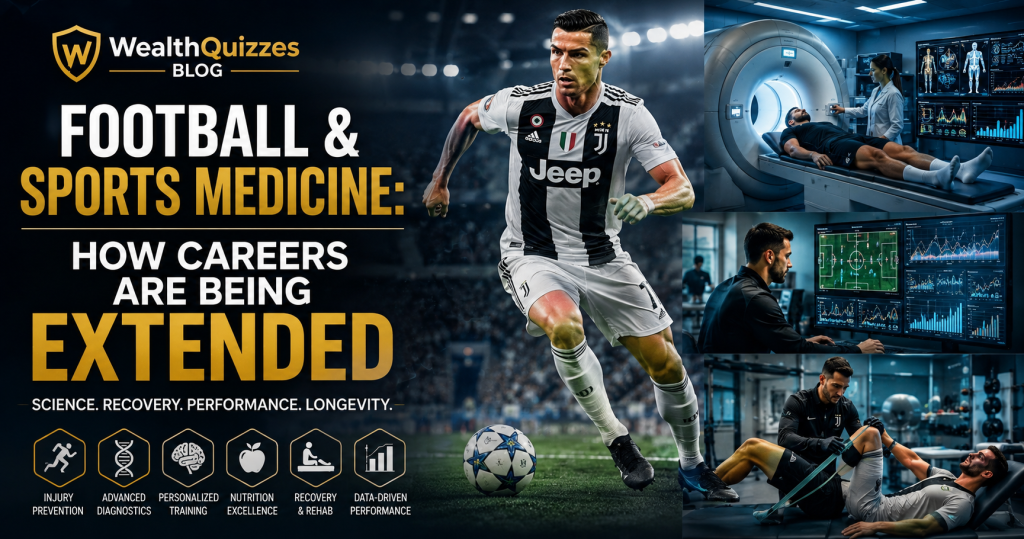
Technology has transformed the medical department into a data-rich environment.
GPS and tracking systems can measure distances covered, high-speed running, acceleration, deceleration and other movement variables. Heart-rate monitoring and other physiological measures can provide additional information, while wellness questionnaires can capture subjective indicators such as fatigue, sleep quality and perceived recovery.
The significance is not that one measurement can predict an injury with certainty.
It cannot.
Rather, multiple data points can help medical and performance staff identify changes from a player’s normal pattern.
If a player who normally trains at a particular intensity suddenly displays reduced running capacity, unusual fatigue or altered movement patterns, the staff may investigate before placing him through another maximal session.
This is the essence of modern preventive medicine: detect problems early enough to act before they become serious.
Nutrition: Fueling Longevity
Nutrition is another area in which football has undergone a remarkable transformation.
Elite players now receive carefully structured nutritional support designed around training, competition, recovery and individual requirements.
Carbohydrate availability can be manipulated around exercise demands. Protein supports muscle repair and adaptation. Hydration strategies help maintain physiological function. Micronutrient deficiencies can be identified and addressed where clinically appropriate.
The objective is not simply to make a player lean.
It is to ensure that the body has the resources required to train, recover, adapt and perform repeatedly.
Over a career lasting 15 or 20 years, those small advantages can become enormous.
Sleep and Recovery: The Invisible Training Session
Recovery has also become part of performance preparation.
Sleep is particularly important because physical restoration, cognitive function and psychological wellbeing are closely connected to adequate sleep.
Elite football clubs increasingly monitor sleep and recovery patterns, especially around congested schedules and international travel.
The underlying principle is simple:
Training creates the stimulus; recovery allows the body to adapt to it.
A footballer who continually trains without adequate recovery may accumulate fatigue faster than he can recover from it.
Consequently, rest days, recovery sessions, travel management, hydration, nutrition and sleep are no longer viewed as luxuries. They are components of professional preparation.
Surgery and Medical Technology Have Changed the Career Equation
Advances in orthopaedic surgery have also transformed football careers.
Ligament reconstruction, cartilage procedures, minimally invasive techniques and increasingly sophisticated rehabilitation protocols mean that injuries that once represented potentially career-ending events can now have substantially better outcomes.
But surgery itself is only one part of the process.
The real achievement is the combination of diagnosis, surgical intervention where necessary, progressive rehabilitation, strength restoration, movement retraining and controlled return to competition.
Medical technology has therefore expanded the possibilities available to injured players.
The Mind Matters Too
Longevity is not exclusively physical.
Footballers must also cope with pressure, injury anxiety, changing roles, competition for selection and the psychological consequences of ageing.
A player returning from a serious injury may be physically ready but psychologically hesitant to sprint, tackle or change direction at full speed.
Sports psychology can help athletes rebuild confidence and develop strategies for managing pressure and uncertainty.
The best medical programmes therefore recognise that the player is not merely a collection of muscles, bones and statistics.
He is a human being.
Experience Can Compensate for Declining Physical Output
One of the most fascinating aspects of football longevity is that physical decline does not necessarily mean overall decline.
Research demonstrates that older elite players can lose some physical output while retaining or improving technical qualities such as passing accuracy. (PubMed)
This explains why certain positions can accommodate older players particularly well.
A central midfielder, centre-back or goalkeeper may be able to compensate for reduced sprint capacity through positioning, anticipation and tactical awareness.
In effect, experience can become a form of performance technology.
The player begins to arrive where the ball will be rather than chasing it after it arrives.
The Late-30s Footballer Is a Different Kind of Athlete
The modern veteran is therefore not necessarily a younger player who has simply refused to decline.
He is often a different type of athlete.
Training may become more carefully individualised. Recovery may receive greater emphasis. Match minutes may be managed. High-intensity exposure may be strategically programmed. Tactical responsibilities may evolve. Nutrition and sleep may be closely monitored.
The objective becomes efficiency.
This is consistent with contemporary evidence showing that high-intensity and explosive performance generally decline with age, even among elite footballers. A 2025 study involving 98 professional male players found notable declines in high-intensity and explosive actions among players over 32, while endurance remained comparatively stable. (PubMed)
The implication is not that older footballers cannot compete.
It is that their pathway to continued excellence may need to change.
The Future: Extending Careers Even Further
Sports medicine is unlikely to stop evolving.
Artificial intelligence, wearable technology, advanced biomechanics, genetic and physiological research, personalised nutrition, improved rehabilitation protocols and increasingly sophisticated injury databases may give clubs even better tools for managing athletes.
But technology will not eliminate risk.
Football remains an inherently demanding contact sport. Acceleration, collisions, tackles, fatigue and fixture congestion cannot be completely engineered away.
The objective is therefore not to create an injury-proof footballer.
It is to reduce preventable risk while maximising performance and quality of life.
Conclusion: Medicine Is Changing What Football Considers Possible
The sight of a footballer performing at an elite level in his late 30s would once have been considered exceptional. Today, it is increasingly understandable.
Medical science has not defeated ageing. Instead, it has taught football how to manage ageing more intelligently.
From injury surveillance and preventive conditioning to rehabilitation, nutrition, sleep, workload monitoring, surgery and sports psychology, modern football has developed an entire ecosystem around the athlete.
The UEFA Elite Club Injury Study demonstrates how systematic injury data can inform player protection, while research from football scientists such as Ezequiel Rey, Carlos Lago-Peñas and colleagues shows that ageing changes the physical and technical profile of elite players rather than simply ending their usefulness. (PubMed)
The great lesson is that longevity is rarely the product of one miracle treatment.
It is the cumulative result of thousands of small decisions made correctly over thousands of days.
And that may be the real revolution in football medicine.
The modern question is no longer simply, “How good can a footballer become?”
It is increasingly:
“How long can we help him remain good enough to compete at the highest level?”
For elite football, that question could ultimately prove just as important as winning the next match.