Football Beyond Retirement: How Legends Continue to Shape the Game
What happens when football icons hang up their boots?
For a professional footballer, retirement is often described as the end of a career. But in reality, it is usually the beginning of another one.
The final whistle on a playing career does not necessarily silence a footballer’s influence. The boots may be placed in a cupboard, the shirt number passed to another player and the weekly competition disappear from the calendar, but experience, reputation, relationships, tactical knowledge and public influence remain.
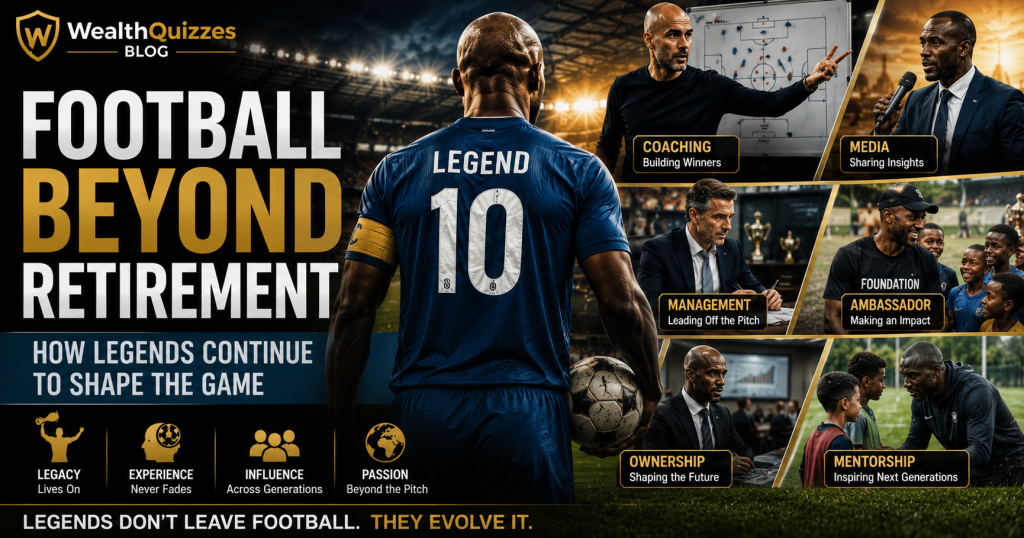
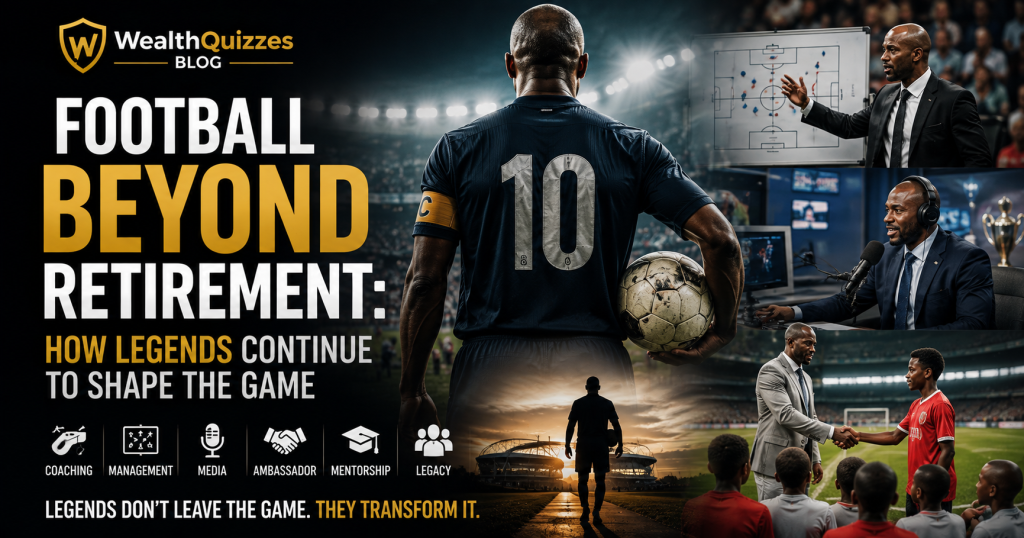
Some former players become managers and transform clubs. Others become technical directors, scouts, administrators, broadcasters, entrepreneurs, educators or owners. Some become ambassadors for the sport, while others use the visibility football gave them to influence social and political causes.
The modern football legend, therefore, does not necessarily retire from football. Instead, he or she changes position within it.
Retirement Is a Transition, Not an Ending
The first mistake is to think about football retirement in the same way as conventional retirement.
A 65-year-old accountant may retire from employment and leave the workforce. A footballer may retire from playing at 32, 35 or 38 and potentially have several decades of productive professional life ahead.
That creates a peculiar psychological and professional challenge.
Sport psychologists have long studied what happens when athletes lose the occupational identity around which much of their lives have been organised. Brewer, Van Raalte and Linder’s influential work on athletic identity described the extent to which an individual identifies with the role of athlete. A very strong athletic identity can contribute to motivation and performance during a playing career, but can also make the transition away from competitive sport more difficult.
More recent longitudinal research reinforces this point. Schmid, Hlasová, Ronkainen, Conzelmann and colleagues followed 290 Swiss elite athletes over a 12-year period and found that athletic identity generally declined after athletes left elite sport, although the extent and speed of that change varied considerably between individuals. The researchers also noted that an overly exclusive athletic identity can make athletes more vulnerable to career-ending transitions. (Springer)
This is why retirement planning cannot simply mean deciding what to do with money.
It also means answering a more fundamental question:
Who am I when I am no longer a footballer?
The Psychological Battle Behind the Final Whistle
Footballers spend much of their lives in highly structured environments.
Training schedules dictate their mornings. Matches determine their weekends. Coaches determine tactical responsibilities. Teammates become close social networks. Supporters recognise them. Media organisations follow them. Their physical performance becomes a central measure of their professional worth.
Then suddenly, the structure disappears.
Research into athletic retirement has identified identity disruption, loss of routine, uncertainty, financial pressures and changes in social relationships as important aspects of the transition. (MDPI)
Natalia Stambulova, one of the leading authorities on athlete career transitions, has argued that sporting transitions involve athletes coping with new demands and balancing resources against barriers. Her work helps explain why two players with similar playing careers can experience retirement very differently. (ScienceDirect)
Planning matters enormously.
A recent 2026 study of 221 retired elite athletes found that financial and employment concerns were among the principal factors influencing retirement decisions, while emotional difficulties such as sadness and emptiness were also reported. The study emphasised the importance of pre-retirement planning and employment support. (Wiley Online Library)
Football’s institutions increasingly recognise this problem. FIFA’s Players Executive Programme was created partly to prepare players and coaches for leadership positions away from the pitch and to facilitate smoother transitions into post-playing careers. FIFA specifically acknowledges that football careers are short, vulnerable to injury and that many players are insufficiently prepared for what comes afterwards. (Inside FIFA)
When the Player Becomes the Coach
Perhaps the most obvious post-playing pathway is coaching.
And football history is filled with extraordinary examples.
Johan Cruyff is arguably the classic case.
Cruyff was already one of football’s greatest players, winning three consecutive European Cups with Ajax between 1971 and 1973. But his influence became even more profound when he moved into coaching.
At Barcelona, he helped establish the footballing philosophy that would eventually influence generations of players and coaches. He led Barcelona to its first European Cup in 1992 and developed a footballing culture built around possession, positional intelligence, technical excellence and attacking initiative. UEFA has described him as a catalyst for Total Football and emphasised the lasting influence of his coaching legacy. (UEFA.com)
His greatest legacy may have been the coaches he produced.
Cruyff himself identified Pep Guardiola as perhaps the clearest example of a player he coached who subsequently became a highly successful manager. (UEFA.com)
That is an important principle of football’s post-retirement ecosystem:
A great footballer can influence the game through the players he produces; a great coach can influence it through the coaches he produces.
Guardiola: From Midfielder to Tactical Architect
Pep Guardiola demonstrates how playing knowledge can evolve into managerial philosophy.
As a Barcelona midfielder, Guardiola was part of Cruyff’s 1992 European Cup-winning team. Years later, he returned to the club as a coach and won the Champions League in 2009 and 2011 before subsequently managing Bayern Munich and Manchester City. (UEFA.com)
His journey illustrates why playing experience can be valuable without being sufficient.
A former player understands the physical and psychological realities of the dressing room. He understands what it feels like to make mistakes in front of thousands of people, to receive tactical instructions under pressure and to lose confidence after a poor performance.
But coaching requires additional competencies: leadership, communication, tactical analysis, delegation, squad management, psychology and decision-making.
UEFA’s research into European football supports this distinction. Approximately two-thirds of top-tier club head coaches have previously played professional football, but UEFA also stresses that playing experience is not a prerequisite for becoming a successful head coach. (UEFA.com)
Playing football can provide a foundation.
It does not automatically provide a coaching qualification.
Zidane, Ancelotti and the Player-Coach Double
Zinédine Zidane provides another remarkable example.
As a player, Zidane won the Champions League with Real Madrid in 2002. As a coach, he subsequently led the same club to three consecutive Champions League titles from 2016 to 2018. UEFA records him among the select group of individuals who have won the competition as both player and coach. (UEFA.com)
Carlo Ancelotti offers another version of the same transition.
Ancelotti was a decorated midfielder with AC Milan before becoming one of the most successful managers in European football. UEFA records him among the select group of people to have won the European Cup/Champions League both as player and coach. (UEFA.com)
The significance goes beyond trophies.
These examples demonstrate that football knowledge can accumulate rather than disappear when a player retires.
The playing career becomes an educational foundation for the next career.
From Dressing Room to Boardroom
Not every former player wants to become a manager.
Some move into football administration.
The modern football club is a complex organisation requiring expertise in recruitment, finance, commercial strategy, communications, governance, player development and sporting operations.
This has created opportunities for former players to become technical directors, sporting directors and executives.
Ivan Rakitić provides a contemporary example. After ending an almost two-decade playing career, the Croatia international moved into a technical-director role at HNK Hajduk Split while also pursuing UEFA Academy studies and serving on the board of the UEFA Foundation for Children. (UEFA.com)
The lesson is important: retirement can mean moving from performing football to managing football.
The former midfielder who once interpreted space on the pitch can eventually be interpreting recruitment strategy from the boardroom.
From Player to Owner
Another increasingly important pathway is ownership.
Lukas Podolski’s 2026 retirement illustrates this evolution. After an illustrious playing career that included Germany’s 2014 World Cup triumph, Podolski retired at 40 and moved into an ownership role with Górnik Zabrze, the Polish club where he concluded his playing career. (FIFA)
This represents another transformation in the relationship between footballers and clubs.
The player is no longer simply an employee of the football organisation.
He becomes a stakeholder in its future.
For wealthy former players, ownership can provide an opportunity to influence recruitment, youth development, commercial direction and institutional identity.
Legends as Teachers and Mentors
Another form of post-retirement influence is less glamorous but potentially more important: education.
Former players possess something that cannot easily be purchased—a lifetime of practical football knowledge.
They have experienced dressing rooms, tactical changes, major tournaments, injuries, pressure, failure and success.
That knowledge can be transferred to younger generations.
UEFA’s Academy has specifically developed education programmes for elite footballers leading towards careers in management, administration, scouting and media. UEFA has noted that many football legends pursue education as they prepare for life beyond playing. (UEFA.com)
Consider Cha Bum-kun.
The Korea Republic legend became a coach and subsequently established the Cha Bum-kun Football School, helping create structures through which his knowledge and experience could reach younger generations. FIFA continues to highlight his role in developing future footballers. (FIFA)
This is legacy in its purest form.
A footballer does not merely leave behind goals and trophies.
He leaves behind people.
The Media: When Legends Become the Voice of Football
Television, radio, podcasts and digital media have created another enormous post-playing career.
Former players can become analysts because they understand the game from inside the dressing room.
They can explain why a defensive line failed, why a midfielder failed to track a runner or why a striker made a particular movement.
But expertise alone is not enough.
A successful football analyst must translate technical knowledge into language that audiences understand.
Arne Friedrich provides a useful example. After his international career, the former Germany defender became a pundit and established a foundation and podcast through which he continued to engage with football and social causes. (FIFA)
The former player thus becomes something different:
not the subject of the football story, but one of its interpreters.
Football Legends as Ambassadors
Some former players move beyond football altogether while remaining deeply connected to the sport.
Their fame gives them access to governments, corporations, charities, international organisations and global audiences.
Didier Drogba, for example, became prominent not only as a football legend but also through humanitarian and peace-related initiatives in Côte d’Ivoire.
This illustrates the extraordinary social capital that elite football can create.
A former player may possess little formal political power but enormous symbolic influence.
That influence can be used for charitable causes, youth development, education, peacebuilding and social campaigns.
Football therefore becomes a platform from which the former player can address issues larger than football itself.
Nigeria and the Challenge of the Second Career
The issue is particularly important in countries where football careers are often viewed as the primary route to social mobility.
Research specifically examining amateur and semi-professional football in Nigeria has found that many young players eventually have to abandon their football ambitions and transition into alternative adulthood pathways. Ikechukwu Ejekwumadu’s research shows that this transition can be nonlinear, influenced by age, the likelihood of securing professional opportunities and family responsibilities. (Sage Journals)
That observation carries a powerful message.
The concept of a “second career” should not be reserved for established international stars.
It should begin much earlier.
Young footballers should be encouraged to develop education, entrepreneurship, vocational skills and professional networks alongside their football development.
A football career may last fifteen years.
A human career may last fifty.
The New Definition of a Football Legacy
The greatest post-retirement question is therefore not:
“What did you win?”
It is:
“What did you leave behind?”
Cruyff left a football philosophy.
Guardiola transformed tactical thinking across generations.
Zidane demonstrated that extraordinary playing intelligence can be translated into elite management.
Ancelotti turned experience as a midfielder into one of football’s most successful coaching careers.
Rakitić moved into technical administration.
Podolski moved towards ownership.
Cha Bum-kun invested in developing younger generations.
Others have chosen media, business, philanthropy, education or public service.
Their paths are different, but the underlying principle is the same.
Retirement from playing does not necessarily mean retirement from influence.
Preparing Players for Life Beyond the Boots
Football institutions therefore have a responsibility to prepare players before retirement arrives.
FIFA’s The Next 90 programme was explicitly designed to help former players transfer achievements developed during their football careers into second careers, with education identified as a key mechanism for that transition. (Inside FIFA)
The research is equally clear: dual careers and preparation can matter. A longitudinal study of professional football players found that having entrepreneurial experience increased the likelihood of pursuing entrepreneurship after retirement, while having a dual career and working during an athletic career increased the likelihood of continuing in employment afterwards. (ScienceDirect)
The smartest footballer, therefore, is not necessarily the one who waits until the final season to ask what comes next.
It is the one who starts preparing while still playing.
Conclusion: The Game Goes On
Football has always been obsessed with the next generation.
The academy replaces the veteran.
The young striker inherits the shirt number.
The next captain takes the armband.
But football’s greatest traditions are rarely transmitted simply by statistics. They are transmitted through people.
That is why retirement does not have to be a disappearance.
It can be a transformation.
The former striker can become a coach. The midfielder can become a sporting director. The defender can become an analyst. The captain can become an executive. The superstar can become an owner. The legend can become a mentor, educator, ambassador or philanthropist.
The footballer leaves the pitch—but the football does not leave the footballer.
Indeed, for some of the game’s greatest figures, the most important chapter of their football story begins after the final whistle.
And perhaps that is the real meaning of a football legacy:
You have truly left the game only when there is no longer anything of your knowledge, character, experience or vision living on through others.