
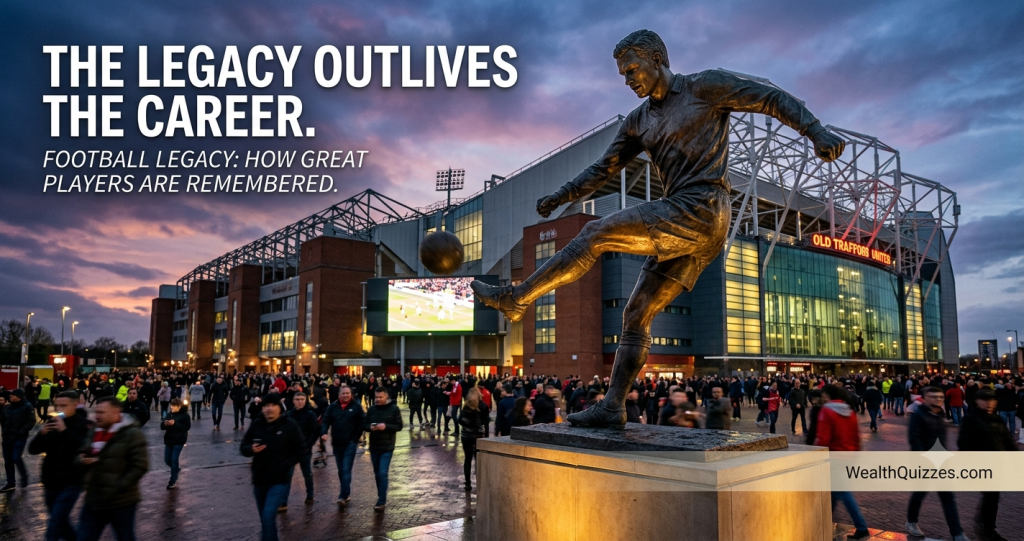
Football Legacy: How Great Players Are Remembered: Legacy Outlives Careers: Impact Beyond Retirement
What Makes a Footballer Unforgettable?
Football is a game measured by goals, trophies, records and statistics. Yet when the final whistle blows on a player’s career, history rarely remembers numbers alone. Instead, it remembers moments that inspired millions, leadership that united nations, values that transcended the sport and contributions that continued long after retirement. The greatest footballers become more than athletes—they become institutions, symbols of excellence and ambassadors whose influence extends across generations.
The conclusion of the FIFA World Cup 2026, hosted jointly by the United States, Canada and Mexico, provided a fitting reminder of this enduring truth. As football celebrated the emergence of a new generation of stars while bidding farewell to several iconic veterans, the tournament reinforced one of the game’s most important lessons: great careers eventually end, but true legacies never do.
The World Cup has always served as football’s grandest stage, producing unforgettable champions while immortalizing extraordinary individuals. However, the distinction between a great player and a legendary one often becomes clearer after retirement than during an active career. A footballer’s legacy is ultimately defined not merely by what he accomplished on the pitch, but by what he leaves behind for the sport and for society.
As the late Eduardo Galeano, one of football’s most celebrated writers, observed in his acclaimed book Soccer in Sun and Shadow:
“In football, as in life, style survives victory.”
His words capture a profound truth. Success may earn applause, but character, influence and inspiration create immortality.
Legacy Is More Than Goals and Trophies
Modern football is increasingly driven by analytics. Goals scored, assists recorded, distance covered, expected goals (xG), passing accuracy and defensive actions are meticulously documented. These statistics are invaluable for evaluating performance, but they cannot fully explain why certain footballers remain unforgettable decades after retirement.
For instance, Brazilian legend Pelé scored well over a thousand goals in his professional career and remains the only player to have won three FIFA World Cups (1958, 1962 and 1970). Yet Pelé’s enduring legacy rests not only on these remarkable achievements but also on his role in transforming football into a truly global phenomenon. His charisma, humility and commitment to promoting the sport made him one of the world’s first truly international sporting icons.
Similarly, Diego Maradona is remembered not simply because he captained Argentina to World Cup glory in 1986, but because he represented resilience, creativity and an extraordinary ability to inspire a nation during difficult times.
Football history demonstrates that while statistics record accomplishments, legacy measures influence.
Lionel Messi: Completing Football’s Greatest Story
Few players better illustrate the relationship between achievement and legacy than Lionel Messi.
For many years, despite an unparalleled club career with Barcelona and later Paris Saint-Germain and Inter Miami, critics argued that Messi required a FIFA World Cup title to complete his footballing résumé. His triumph with Argentina at the 2022 FIFA World Cup silenced that debate, while his final World Cup appearance in 2026 further cemented his place among football’s immortals.
Messi’s legacy, however, extends far beyond silverware.
His remarkable consistency over two decades, extraordinary humility despite global fame, unwavering loyalty to Argentina through periods of disappointment and unmatched technical brilliance have inspired millions of young footballers around the world.
Former Barcelona manager Pep Guardiola, widely regarded as one of football’s greatest coaches, famously remarked:
“Messi is the best player I have ever seen, and probably the best I will ever see.”
Such praise reflects not merely extraordinary ability but the lasting influence of a player whose style redefined modern football.
Cristiano Ronaldo: A Legacy Built on Relentless Excellence
Equally compelling is the legacy of Cristiano Ronaldo.
If Messi represents natural genius, Ronaldo embodies discipline, ambition and relentless self-improvement.
Throughout his extraordinary career, Ronaldo continually challenged conventional expectations regarding longevity and physical performance. His success across England, Spain, Italy and international football demonstrated remarkable adaptability and professionalism.
Five Ballon d’Or awards, UEFA Champions League triumphs, a UEFA European Championship and countless scoring records form part of his remarkable résumé.
Yet perhaps Ronaldo’s greatest legacy lies in demonstrating that sustained excellence results from discipline rather than talent alone.
Former Manchester United manager Sir Alex Ferguson repeatedly praised Ronaldo’s work ethic, describing him as one of the most dedicated professionals he had ever coached.
Generations of aspiring footballers continue to emulate not merely Ronaldo’s skills but also his commitment to preparation, fitness and professionalism.
Johan Cruyff: The Man Who Changed Football Thinking
Some footballers become legendary because they revolutionize how the game itself is played.
Dutch icon Johan Cruyff belongs firmly within this category.
Although Cruyff won numerous domestic and European honours, his greatest contribution was philosophical rather than statistical.
As both player and coach, Cruyff championed Total Football, emphasizing positional intelligence, technical excellence, fluid movement and attacking creativity. His ideas profoundly influenced clubs such as Ajax and Barcelona and continue shaping modern football through coaches including Pep Guardiola, Xavi Hernández and Mikel Arteta.
The influence of Cruyff illustrates that footballing legacy often extends beyond medals.
Ideas can outlive careers.
Leadership Defines Greatness
One of the defining characteristics shared by football’s greatest figures is exceptional leadership.
Leadership cannot always be measured statistically.
It reveals itself during adversity.
Franz Beckenbauer transformed defensive football through elegance and tactical intelligence while leading West Germany to World Cup success as both captain and coach.
Paolo Maldini became synonymous with loyalty, professionalism and consistency during an extraordinary career with AC Milan.
Didier Drogba transcended football by helping promote peace in Côte d’Ivoire during periods of political conflict.
Former FIFA President Sepp Blatter frequently emphasized football’s capacity to unite people across cultural and political divides.
Players who use their influence to promote unity leave behind legacies that extend far beyond sporting achievement.
Character Often Outlives Talent
Supporters remember how footballers conduct themselves as much as how they perform.
Talent attracts admiration.
Character earns respect.
Former Spain midfielder Andrés Iniesta, scorer of the winning goal in the 2010 FIFA World Cup Final, remains universally admired not only because of that historic moment but because of his humility, professionalism and respect for opponents throughout his career.
Similarly, N’Golo Kanté has earned worldwide admiration for combining elite performances with remarkable modesty and sportsmanship.
These examples remind us that greatness is measured as much by integrity as by ability.
Inspiring Future Generations
Perhaps the clearest measure of a footballer’s legacy is the extent to which future generations seek to emulate them.
Many of today’s brightest stars openly acknowledge the players who inspired their journeys.
Young talents such as Lamine Yamal have cited Lionel Messi as a major influence.
Kylian Mbappé famously admired Cristiano Ronaldo throughout his childhood.
Across Africa, countless footballers identify George Weah, the only African winner of the Ballon d’Or, as their greatest inspiration.
George Weah’s remarkable journey from Monrovia to becoming one of football’s greatest players—and later President of Liberia—illustrates how football can transform not only individual lives but entire societies.
Legacy creates aspiration.
Aspiration creates future greatness.
Retirement Does Not End Influence
Today’s football legends rarely disappear after retirement.
Many continue contributing to the sport as coaches, administrators, club owners, ambassadors and philanthropists.
Didier Deschamps captained France to the FIFA World Cup in 1998 before leading the nation to another World Cup triumph as head coach in 2018.
Zinedine Zidane became one of football’s most successful managers.
David Beckham has significantly influenced football’s global development through club ownership, charitable initiatives and ambassadorial roles.
Their continued contributions demonstrate that retirement often marks the beginning of a different kind of legacy.
World Cup 2026 and the Next Generation
The FIFA World Cup 2026 showcased several young footballers whose careers appear destined for greatness.
Spain’s Lamine Yamal, Nico Williams, Pedri and Pau Cubarsí represented the fearless new generation that propelled La Roja to world glory.
England’s Jude Bellingham continued establishing himself among football’s elite.
Argentina demonstrated that the transition from Lionel Messi’s era to the next generation was already underway.
Whether these players ultimately become football legends will depend upon much more than technical ability.
History will judge them according to leadership, consistency, professionalism, humility and contributions beyond the pitch.
Legacy Beyond Football
Modern footballers increasingly recognize their broader social responsibilities.
Many establish charitable foundations, invest in education, healthcare and youth development, or advocate for important social causes.
Marcus Rashford successfully campaigned against child food poverty in the United Kingdom.
Sadio Mané has financed hospitals, schools and public infrastructure in Senegal.
Juan Mata co-founded the Common Goal initiative, encouraging footballers to donate a percentage of their earnings to social development projects worldwide.
These contributions demonstrate that footballers can influence society long after their final matches.
Lessons for Every Profession
Football legacy offers valuable lessons beyond sport.
Whether one is a lawyer, entrepreneur, teacher, doctor, engineer or public servant, the same fundamental question eventually arises:
What will people remember after your career ends?
Leadership expert John C. Maxwell argues that leadership is ultimately measured by influence rather than position.
Similarly, author Simon Sinek has consistently emphasized that enduring success comes from inspiring others rather than pursuing personal achievement alone.
Football’s greatest legends embody these principles.
Their influence continues because they invested not merely in winning matches but in uplifting people.
Conclusion
Every football career eventually reaches its conclusion.
The stadiums grow quieter.
The celebrations become memories.
The trophies gather dust.
Yet true greatness refuses to fade.
From Pelé, Johan Cruyff and Franz Beckenbauer to Diego Maradona, Cristiano Ronaldo, Lionel Messi and countless other icons, football’s greatest figures remain relevant because their contributions extended far beyond ninety minutes on the pitch. They inspired generations, transformed tactical thinking, united communities, championed worthy causes and elevated the global game itself.
The FIFA World Cup 2026 once again reminded the world that while new stars will always emerge, genuine legacy belongs to those who leave football better than they found it.
Ultimately, what makes a footballer unforgettable is not simply the number of goals scored, trophies won or records broken. It is the values they embody, the lives they influence and the inspiration they provide long after retirement.
In football, careers are measured in seasons.
Legacies are measured in generations.
And that is why the greatest players are never truly gone—they continue to live wherever the beautiful game is played, celebrated and dreamed about.