
Football Stadiums That Changed History
Which stadiums have witnessed football’s greatest moments?
Football history is often told through the names of players, managers and champions. Pelé, Maradona, Messi, Cristiano Ronaldo, Cruyff, Beckenbauer, Zidane and countless others have become permanent figures in the story of the beautiful game. Yet behind almost every legendary performance stands another protagonist: the stadium.
A football stadium is more than concrete, steel, seats and grass. At its most powerful, it becomes a theatre of national identity, a witness to political change, a symbol of a city and a repository of collective memory. Some stadiums do not merely host history; they become part of it.
From Wembley in London to the Maracanã in Rio de Janeiro, from the San Siro in Milan to Mexico City’s legendary Azteca, certain grounds have witnessed moments so significant that the stadium itself has become inseparable from the event.
The question, therefore, is not simply which stadiums are the most beautiful or largest. The more interesting question is: which stadiums have changed the way football is remembered?
Wembley: Where Football Became a National Theatre
Few stadiums possess the symbolic importance of Wembley.
The original Wembley Stadium, then known as the Empire Stadium, opened in 1923 as part of the British Empire Exhibition. Its first major football event was the FA Cup Final between Bolton Wanderers and West Ham United. The official attendance was 126,047, although contemporary estimates suggested the crowd may have been substantially larger. The extraordinary scenes became known as the “White Horse Final” because mounted police were required to help clear supporters from the pitch. (Inside FIFA)
But Wembley ultimately acquired a significance far greater than the FA Cup.
In 1953, it hosted the famous England-Hungary encounter remembered as the “Match of the Century”, when the revolutionary Hungarian side defeated England 6-3. Fourteen years later, Wembley witnessed the greatest moment in English football history: England defeated West Germany 4-2 after extra time in the 1966 FIFA World Cup Final, with Geoff Hurst scoring a hat-trick. UEFA identifies the 1966 final as England’s finest hour at the stadium. (UEFA.com)
Wembley has subsequently hosted major European finals, EURO 1996 and numerous other landmark occasions. The modern stadium opened in 2007 on the site of the original ground, preserving the location’s extraordinary connection with English football.
That is why the stadium’s own history describes Wembley as the place where “the magic happens”, while Pelé famously called it the “cathedral of football.” (www.wembleystadium.com)
Wembley demonstrates an important truth: a stadium can become part of a nation’s emotional identity.
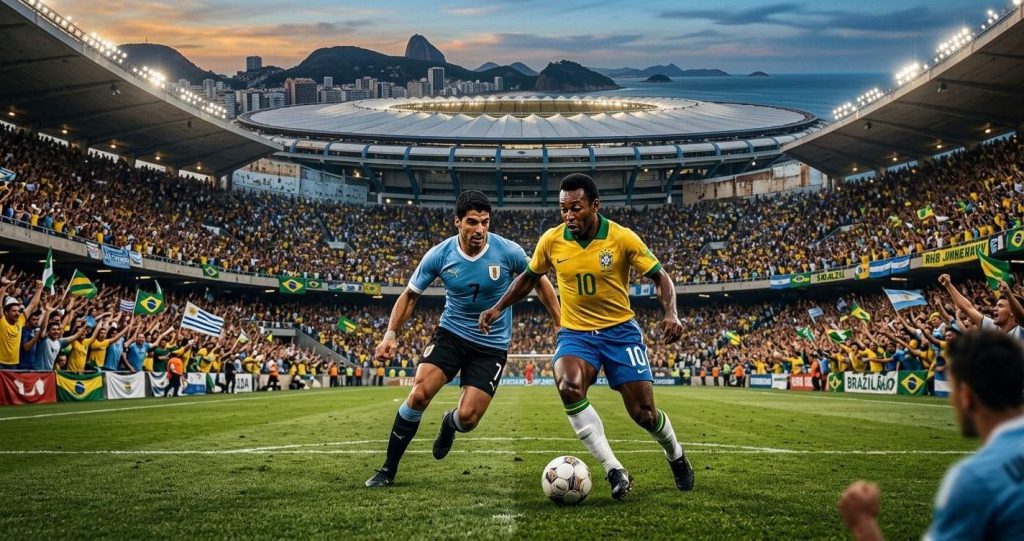
The Maracanã: Where Triumph and Tragedy Became Immortal
If Wembley represents English football’s national mythology, the Maracanã represents football’s extraordinary capacity for both ecstasy and devastation.
Opened in 1950 for the FIFA World Cup in Brazil, the Estádio do Maracanã immediately became one of the world’s great sporting arenas. Its most famous early chapter was also one of the most painful.
Brazil needed only a draw against Uruguay in the decisive match of the 1950 World Cup to win the title. Instead, Uruguay came from behind to win 2-1, with Alcides Ghiggia scoring the decisive goal. FIFA records the official attendance as 173,850, still the largest crowd ever recorded for a World Cup match, while estimates have placed the actual crowd above 200,000. (FIFA)
The event became known as the Maracanazo.
It was more than a football defeat. It became a national sporting trauma. The Maracanã had been constructed as a monument to Brazilian football ambition, yet it became the setting for one of Brazil’s most painful sporting memories.
Decades later, the same stadium offered Brazil and the world a different story.
The Maracanã hosted the 2014 FIFA World Cup Final, where Germany defeated Argentina 1-0 after extra time through Mario Götze’s goal. FIFA describes the venue as having hosted two men’s World Cup finals. (FIFA)
The significance is remarkable: the same stadium witnessed one of football’s greatest upsets and, 64 years later, another World Cup final.
The Maracanã therefore illustrates how stadiums accumulate memory. The grass changes, generations disappear and teams evolve, but the building retains the stories.
Estadio Azteca: The Stadium Where Legends Became Immortal
If one stadium has a credible claim to being football’s ultimate historical theatre, it is Mexico City’s Estadio Azteca, now known as Mexico City Stadium.
FIFA has described it as one of the world’s most revered football stadiums. It hosted the 1970 and 1986 World Cup finals and became the first stadium to host matches at three editions of the men’s FIFA World Cup when it hosted the 2026 tournament. (FIFA)
Its historical significance is extraordinary.
In 1970, Pelé led Brazil to a 4-1 victory over Italy in the World Cup Final, winning his third World Cup title. Carlos Alberto’s famous fourth goal became one of the most celebrated goals in World Cup history.
Sixteen years later, Diego Maradona transformed the same stadium into the setting for one of football’s most famous individual performances.
Against England in the 1986 quarter-final, Maradona scored both the infamous “Hand of God” goal and what FIFA recognises as the “Goal of the Century”. Argentina won 2-1 and eventually went on to win the tournament. (FIFA)
The stadium subsequently hosted the 1986 World Cup Final, where Maradona’s Argentina defeated West Germany 3-2.
The Azteca’s achievement is therefore almost impossible to replicate: Pelé and Maradona both lifted the World Cup there.
And its story continued in 2026. FIFA reported that the renovated Mexico City Stadium became the first stadium to host FIFA World Cup matches across three editions, while its five 2026 matches produced the tournament’s five largest attendances, each reaching 100 percent occupancy. (Inside FIFA)
That is not merely stadium history. It is football history concentrated in one location.
San Siro: The Cathedral of European Club Football
In Milan stands another stadium whose architecture and atmosphere have become inseparable from football itself: the San Siro.
Opened in 1926, the stadium became the shared home of AC Milan and Inter. UEFA records that Inter moved into the venue in 1947 and that subsequent expansions transformed it into one of Europe’s largest football grounds. It was also extensively remodelled for the 1990 FIFA World Cup. (UEFA.com)
Its importance, however, lies not merely in its size.
San Siro has hosted European Cup and UEFA Champions League finals in 1965, 1970, 2001 and 2016. The stadium has therefore repeatedly served as the stage on which European club supremacy was decided. (UEFA.com)
It is also one of the rare stadiums where two historically powerful clubs share the same footballing home.
The result is a unique atmosphere. On derby days, the stadium becomes the centre of Milanese football culture. The Derby della Madonnina is not simply a fixture between two teams; it is a contest between two identities occupying the same historic ground.
San Siro demonstrates another dimension of stadium history: a venue can become an institution within the institution of football itself.

Camp Nou: More Than a Football Stadium
Barcelona’s Camp Nou has also transcended the conventional definition of a sporting venue.
The stadium has been associated with some of the most important chapters in FC Barcelona’s history and has repeatedly hosted major European fixtures.
In 1982, Camp Nou hosted the UEFA Cup Winners’ Cup Final between Barcelona and Standard Liège. UEFA records that approximately 110,000 spectators attended as Barcelona defeated Standard 2-1. (UEFA.com)
But the stadium’s importance is not confined to trophy ceremonies.
Camp Nou became closely associated with Barcelona’s footballing philosophy and the club’s wider cultural identity. Generations of supporters watched the development of teams built around distinctive technical football, culminating in the extraordinary Barcelona sides of the modern era.
It is therefore a useful example of how a stadium can function simultaneously as sporting venue, cultural landmark and institutional symbol.
Santiago Bernabéu: The Theatre of European Ambition
Few venues have been as closely associated with sustained European success as Real Madrid’s Santiago Bernabéu.
The stadium has hosted major European finals, including European Cup/UEFA Champions League finals in 1957, 1969, 1980 and 2010, as well as the 1964 European Nations’ Cup Final and the 1982 FIFA World Cup Final. (Wikipedia)
The stadium’s significance is closely connected to Real Madrid’s extraordinary European identity.
For generations, opponents have entered the Bernabéu carrying not merely the challenge of defeating eleven footballers, but the psychological burden of playing in one of the most intimidating environments in European football.
The stadium’s evolution also reflects football’s transformation into a global entertainment industry. Its major modernisation has incorporated technologies and facilities designed to make the venue a year-round commercial and sporting destination. Recent reporting notes the installation of a retractable roof, a 360-degree scoreboard and advanced pitch technology. (The Sun)
The Bernabéu therefore represents the intersection of football tradition and the modern sports-business economy.
Stadiums Do More Than Host Matches
The history of these stadiums reveals a broader truth about football.
A stadium does not simply provide a place for a match to take place. It provides the physical setting in which collective memory is created.
Think about the difference between saying:
“Argentina defeated England in the 1986 World Cup.”
and saying:
“Maradona scored the Hand of God and the Goal of the Century at the Azteca.”
The second statement immediately produces an image.
The same is true of England’s 1966 triumph at Wembley, Brazil’s heartbreak at the Maracanã in 1950, Germany’s 2014 World Cup triumph at the Maracanã, or European finals decided at Wembley, San Siro and the Bernabéu.
The venue becomes part of the sentence.
This is why FIFA and UEFA continually preserve stadium histories in their official archives. These buildings are not merely infrastructure; they are repositories of the game’s collective memory. FIFA’s own historical material repeatedly presents venues such as Wembley, the Maracanã and the Azteca through the legendary matches and personalities associated with them. (UEFA.com)
When Architecture Becomes Memory
There is another reason these stadiums matter.
Football is unusually dependent on atmosphere. The pitch may be identical in dimensions, the ball may be the same and the rules may be universal, but the experience can change dramatically depending on where the match is played.
The proximity of supporters, the architecture of the stands, the acoustics, the history of the venue and the psychological expectations surrounding it all contribute to the identity of a stadium.
That is why players often speak about particular grounds with a mixture of respect and emotion.
A stadium can intimidate.
It can inspire.
It can unite.
And, sometimes, it can haunt.
The Maracanã demonstrates this perfectly. The same venue can represent national heartbreak in one generation and national celebration in another.
The Azteca demonstrates something even more extraordinary: the same physical ground can become associated with two of the greatest players in football history and two different World Cup triumphs.
Wembley demonstrates how a stadium can become woven into the identity of an entire nation.
San Siro demonstrates how architecture can embody club rivalry.
The Bernabéu demonstrates how a stadium can become part of a club’s competitive psychology.
The Stadiums That Will Outlive the Players
Footballers retire. Managers leave. Teams are rebuilt. Records are broken.
Stadiums, however, can remain.
They preserve the echoes of previous generations.
A child entering Wembley today can stand in a place where England once lifted the World Cup. A visitor to the Maracanã can occupy the same broader arena associated with the Maracanazo and the 2014 World Cup Final. At Mexico City’s historic stadium, visitors can contemplate the extraordinary fact that Pelé and Maradona both became world champions on the same ground.
That is the special power of football stadiums.
They turn moments into monuments.
They convert ninety minutes into history.
And they transform sporting contests into cultural memories capable of surviving generations.
Conclusion: Football’s Greatest Stadiums Are Living Museums
The greatest football stadiums are not necessarily the newest, largest or most technologically advanced.
Their true value lies in what they have witnessed.
Wembley witnessed England’s greatest footballing triumph. The Maracanã witnessed Brazil’s deepest World Cup heartbreak and later another World Cup final. San Siro became a European football institution. Camp Nou became synonymous with Barcelona’s footballing identity. The Bernabéu became a monument to Real Madrid’s European ambition. And the Azteca became the stage upon which Pelé and Maradona created World Cup mythology.
These stadiums remind us that football is ultimately about more than scores and trophies.
It is about memory.
Generations may forget the exact line-up of a particular match, the minute when a substitution was made or even the name of the referee. But they remember where history happened.
That is why the greatest stadiums in football are not merely venues.
They are witnesses. They are symbols. They are theatres of dreams, despair and triumph. And once a stadium has witnessed a truly historic football moment, that moment becomes part of the stadium forever.
The question, then, is not simply which stadium has witnessed football’s greatest moments?
Perhaps the better question is:
Which football stadium will witness the next moment that the world never forgets?