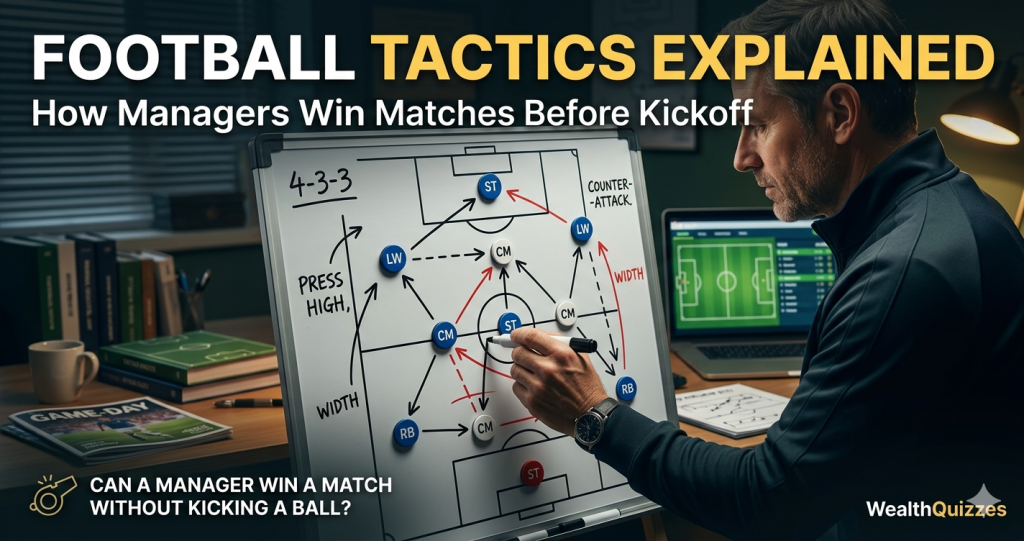
Football Tactics Explained: How Managers Win Matches Before Kickoff
Can a Manager Win a Match Without Kicking a Ball?
When football fans discuss victory, attention usually focuses on players. The striker who scores the winning goal, the goalkeeper who makes a crucial save, or the midfielder who dominates possession often receives the headlines. Yet long before the referee blows the opening whistle, another battle has already taken place—a battle of ideas, strategy, preparation, and tactical planning.
Football is often described as “the beautiful game,” but it is equally accurate to call it a game of chess played at high speed. Every movement, formation, pressing trigger, defensive shape, and attacking pattern reflects a strategic decision made by a manager and coaching staff.
The greatest managers in football history have repeatedly demonstrated that matches can often be influenced—and sometimes virtually won—before kickoff through superior tactical preparation.
This raises a fascinating question: Can a manager win a football match without ever touching the ball?
The answer is yes—at least partially. While players ultimately execute the plan, managers create the framework that determines how those players perform.
Football Is More Than Physical Ability
Football is often viewed through the lens of athleticism and technical skill. Speed, strength, dribbling ability, passing accuracy, and finishing are undeniably important.
However, elite football increasingly depends on tactical intelligence.
Former Dutch football visionary Johan Cruyff famously observed:
“Quality without results is pointless. Results without quality are boring.”
His philosophy highlighted the importance of organizing talent into a coherent system capable of producing consistent results.
Two teams may possess players of similar ability. Yet one team can dominate because its tactical structure is superior.
This is where managers become crucial.
The Birth of Modern Football Tactics
Football tactics have evolved dramatically over the decades.
Early football often resembled organized chaos, with teams deploying numerous attackers and placing limited emphasis on defensive organization.
As the sport matured, managers began recognizing that structure could create competitive advantages.
Legendary figures such as Herbert Chapman revolutionized football by introducing tactical innovations that transformed how teams approached matches.
Over time, formations evolved from the old 2-3-5 system into increasingly sophisticated structures such as:
- 4-4-2
- 4-3-3
- 3-5-2
- 4-2-3-1
- 3-4-3
Each formation reflects strategic priorities regarding attack, defense, pressing, and possession.
Today, tactical planning is among the most important responsibilities of a football manager.
Why Formations Matter
A formation is more than a collection of numbers.
It defines how a team occupies space.
Football analyst Jonathan Wilson, author of Inverting the Pyramid, argues that football history can largely be understood through the evolution of tactical systems.
Every formation creates strengths and weaknesses.
For example:
4-3-3
The 4-3-3 formation often provides:
- Width in attack.
- Midfield control.
- High pressing opportunities.
- Flexible defensive coverage.
This system has been successfully used by some of football’s most dominant teams.
4-2-3-1
The 4-2-3-1 offers:
- Defensive stability.
- Midfield balance.
- Creative freedom for attacking midfielders.
- Strong transitional play.
Many modern clubs favor this formation because of its tactical flexibility.
3-5-2
The 3-5-2 formation allows:
- Numerical superiority in midfield.
- Wing-back involvement.
- Defensive compactness.
However, it demands exceptional discipline from wide players.
Managers choose formations not because one system is universally superior but because different opponents require different solutions.
The Battle for Space
One of football’s most important tactical concepts is space.
Former Barcelona manager Pep Guardiola frequently emphasizes that football is fundamentally about controlling space.
The objective is simple:
- Create space when attacking.
- Deny space when defending.
Elite managers design tactical systems specifically to achieve these goals.
For example, attacking teams may stretch opponents horizontally by using wide wingers.
Defensive teams may remain compact to reduce passing lanes and limit opportunities.
The team that controls space often controls the game.
Pressing: Winning the Ball Before the Opponent Can Play
One of the most influential tactical developments in modern football is pressing.
Pressing refers to coordinated efforts to regain possession quickly after losing the ball.
Former Liverpool manager Jürgen Klopp popularized the concept of “counter-pressing” or “Gegenpressing.”
Klopp famously described counter-pressing as:
“The best playmaker in the world.”
The logic is straightforward.
Winning possession high up the pitch often creates immediate scoring opportunities before opponents can reorganize defensively.
Effective pressing requires:
- Coordination.
- Physical fitness.
- Tactical discipline.
- Communication.
Without preparation, pressing systems collapse.
This is why managers spend countless hours training players to recognize pressing triggers and positional responsibilities.
Possession Versus Direct Football
Football has long debated the value of possession.
Some managers believe controlling possession increases the likelihood of victory.
Others prioritize direct attacks and rapid transitions.
Pep Guardiola’s teams are known for possession-based football.
His philosophy seeks to dominate matches through ball control, positional superiority, and patient buildup play.
Conversely, some successful managers have preferred more direct approaches that emphasize speed, vertical passing, and quick counterattacks.
Sports scientist Professor Chris Anderson, co-author of The Numbers Game, notes that football success can be achieved through multiple tactical pathways.
There is no single winning formula.
Success depends on selecting the right strategy for available players and specific opponents.
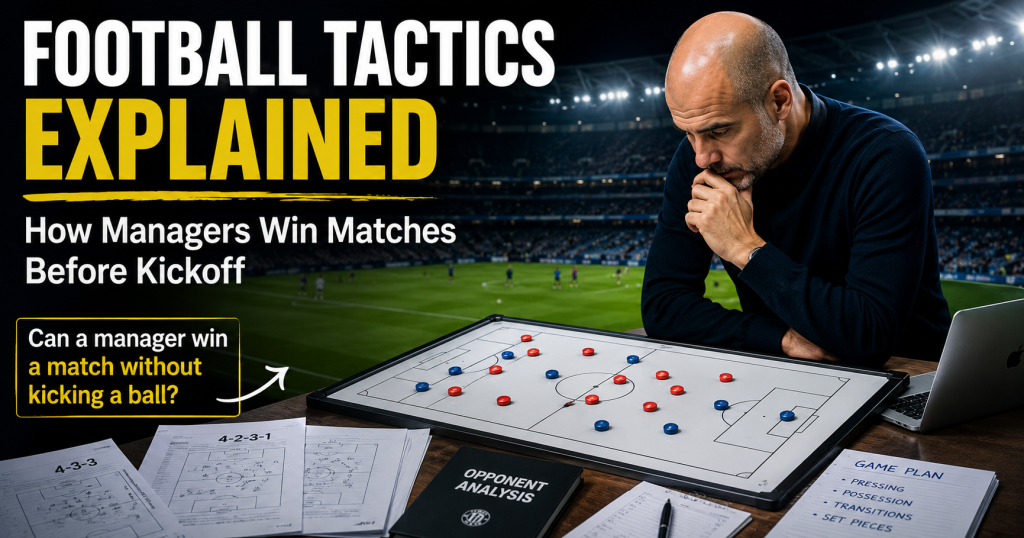
Tactical Flexibility Wins Modern Matches
One hallmark of elite managers is adaptability.
Football matches rarely unfold exactly as planned.
Opponents adjust.
Injuries occur.
Red cards happen.
Weather conditions change.
The best managers anticipate these possibilities.
Former Real Madrid manager Carlo Ancelotti has frequently been praised for his tactical flexibility. Rather than rigidly adhering to one system, he adapts to circumstances and player strengths.
Modern football increasingly rewards managers who can modify tactics during matches.
This adaptability often determines outcomes at the highest level.
The Importance of Data and Analytics
Football tactics are no longer based solely on observation.
Data analytics now plays a major role.
Teams employ analysts who examine:
- Passing patterns.
- Pressing efficiency.
- Defensive structures.
- Set-piece effectiveness.
- Opponent tendencies.
Performance analyst Michael Cox has documented how tactical analysis and data have become essential tools for modern managers.
Analytics help coaches identify weaknesses and opportunities that may otherwise go unnoticed.
Preparation today involves extensive research, simulation, and statistical analysis.
Managers effectively enter matches with detailed intelligence about opponents’ strengths and vulnerabilities.
Set Pieces: Football’s Hidden Weapon
Many matches are decided by set pieces.
Corners.
Free kicks.
Throw-ins.
Penalties.
These situations provide structured opportunities to create scoring chances.
Former Brentford set-piece coach Gianni Vio became renowned for designing highly sophisticated routines capable of producing goals from seemingly routine situations.
Research has consistently shown that set pieces contribute significantly to goal scoring, particularly in tightly contested matches.
Elite managers therefore devote substantial training time to these scenarios.
A well-designed corner routine can sometimes decide a championship.
The Psychological Side of Tactics
Tactics are not merely physical systems.
They also influence psychology.
A manager’s game plan can:
- Build player confidence.
- Reduce uncertainty.
- Create belief.
- Improve decision-making.
Sports psychologist Dr. Bob Rotella emphasizes that confidence often grows from preparation.
When players understand their tactical roles clearly, they perform with greater certainty and composure.
Managers therefore act as both strategists and psychologists.
The best tactical plans are those players fully understand and trust.
Famous Examples of Tactical Masterclasses
Football history contains numerous examples of managers outthinking opponents.
Sir Alex Ferguson frequently adjusted tactics to exploit specific weaknesses.
José Mourinho built a reputation for neutralizing stronger opponents through meticulous planning.
Pep Guardiola transformed positional play into an art form.
Jürgen Klopp revolutionized pressing systems.
Carlo Ancelotti consistently demonstrates tactical adaptability across different leagues and generations.
These managers achieved success not merely because they possessed talented players but because they maximized those players through superior strategic planning.
Their influence often became visible long before kickoff.
Why Great Managers Matter
A common criticism suggests that football is ultimately decided by players rather than coaches.
While players remain essential, evidence increasingly demonstrates that managerial influence is substantial.
Managers determine:
- Formations.
- Tactical systems.
- Pressing structures.
- Set-piece routines.
- Training methods.
- Opponent-specific strategies.
In many cases, identical players can produce dramatically different results under different managers.
This highlights the enormous value of tactical leadership.
Conclusion: Winning the Invisible Battle
Can a manager win a football match without kicking a ball?
Not entirely.
Players must still execute the plan.
However, managers can create conditions that dramatically increase the likelihood of success.
Through tactical systems, strategic preparation, opponent analysis, psychological conditioning, and in-game adjustments, managers influence virtually every aspect of modern football.
The most successful coaches understand that football is not merely a contest of athletic ability.
It is a contest of ideas.
Before the players enter the pitch, an invisible battle has already been fought in training grounds, video rooms, tactical meetings, and strategic planning sessions.
Often, the team that wins that battle gains a decisive advantage.
That is why football remains far more than a game of skill and fitness.
It is a game of strategy.
And sometimes, the manager’s most important contribution occurs before the first ball is kicked.