
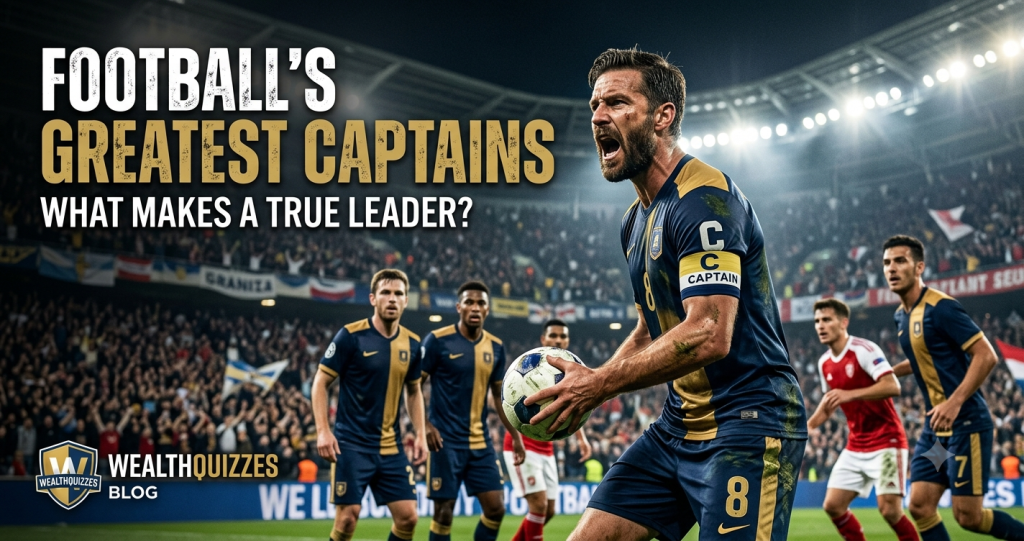
Football’s Greatest Captains: What Makes a True Leader?
Leadership Wins Championships: Why Do Some Captains Inspire Greatness While Others Simply Wear the Armband?
Every football team has a captain, but only a select few become legends. The captain’s armband is one of the most respected symbols in sport, yet its significance extends far beyond a strip of fabric worn around the upper arm. It represents responsibility, trust, sacrifice, resilience and the ability to inspire others when victory seems distant.
History has repeatedly shown that football’s greatest teams are often defined not only by extraordinary talent but also by extraordinary leadership. From lifting trophies on the world’s biggest stages to motivating teammates during moments of adversity, captains frequently become the emotional heartbeat of their teams.
The recently concluded FIFA World Cup 2026, hosted jointly by the United States, Canada and Mexico, once again highlighted the immense value of leadership. Throughout the tournament, experienced captains steadied nervous teammates, communicated tactical adjustments, managed emotions under pressure and demonstrated composure during the most demanding moments. While goals won matches, leadership shaped champions.
This raises an enduring question:
Why do some captains inspire greatness while others simply wear the armband?
The answer lies not in authority, but in influence. A captain’s greatest strength is rarely the power to command; it is the ability to inspire belief, earn trust and unite individuals behind a common purpose.
As legendary Liverpool manager Bill Shankly famously remarked:
“The trouble with referees is that they know the rules, but they do not know the game.”
The same principle applies to leadership. Anyone may understand football tactics, but true captains understand people.
Leadership Is Earned, Not Appointed
In football, the captain is often viewed as the team’s representative before referees and officials. However, the role extends far beyond ceremonial duties.
A true captain:
- Leads through personal example.
- Maintains discipline.
- Encourages teammates during adversity.
- Represents the team’s values.
- Communicates effectively with coaches and officials.
- Protects team unity.
- Accepts responsibility after defeat.
Leadership expert John C. Maxwell, author of The 21 Irrefutable Laws of Leadership, argues that leadership is fundamentally about influence rather than position.
Football consistently proves this principle.
Some players wear the captain’s armband.
Others become leaders without ever wearing it.
The greatest captains do both.
The Qualities of an Exceptional Captain
Football history reveals remarkable consistency regarding the characteristics shared by great captains.
They possess:
- Emotional intelligence.
- Courage.
- Consistency.
- Accountability.
- Humility.
- Tactical understanding.
- Calmness under pressure.
- Exceptional communication skills.
Former Manchester United manager Sir Alex Ferguson frequently emphasized that leadership begins with personal standards.
Captains cannot demand discipline they fail to demonstrate themselves.
Their actions establish expectations.
Franz Beckenbauer: The Elegant Leader
Few football captains influenced the sport more profoundly than Franz Beckenbauer.
Known as “Der Kaiser,” Beckenbauer transformed the role of the modern defender while captaining West Germany to victory at the 1974 FIFA World Cup.
His leadership style differed from traditional approaches.
Rather than relying upon emotion or confrontation, Beckenbauer inspired through intelligence, composure and tactical brilliance.
He later achieved another remarkable distinction by coaching Germany to World Cup success in 1990.
Very few individuals have shaped football leadership so comprehensively.
Diego Maradona: Inspiration Through Genius
Leadership takes different forms.
While Franz Beckenbauer embodied calm authority, Diego Maradona inspired through passion, courage and extraordinary ability.
As captain of Argentina during the 1986 FIFA World Cup, Maradona produced one of football’s greatest individual tournaments.
His performances elevated teammates who believed that with Maradona leading them, anything was possible.
Former Argentina coach Carlos Bilardo consistently praised Maradona’s capacity to inspire belief under immense pressure.
Leadership sometimes begins with extraordinary example.
Paolo Maldini: Leadership Through Loyalty
Modern football rarely witnesses careers as remarkable as Paolo Maldini’s.
The legendary AC Milan defender spent his entire professional career with one club.
Throughout more than two decades, Maldini demonstrated professionalism, humility and consistency.
He captained AC Milan during one of the club’s most successful eras while earning worldwide respect from teammates and opponents alike.
His leadership reflected quiet excellence rather than dramatic speeches.
Italian football icon Arrigo Sacchi repeatedly praised Maldini’s intelligence and professionalism as qualities that elevated entire teams.
Roy Keane: Relentless Standards
Some captains lead through uncompromising determination.
Former Manchester United captain Roy Keane became renowned for demanding absolute commitment from everyone around him.
His intensity sometimes generated controversy, but it also established extraordinarily high performance standards.
Former teammates frequently recalled that Keane’s competitive mentality inspired Manchester United to maintain excellence throughout the club’s most successful period under Sir Alex Ferguson.
Leadership occasionally requires difficult conversations.
Great captains understand this.
Carles Puyol: Humility and Unity
Barcelona and Spain legend Carles Puyol demonstrated another leadership model.
Never the most technically gifted player in his team, Puyol compensated through determination, sacrifice and unwavering commitment.
He captained both Barcelona and Spain during historic periods that included the 2010 FIFA World Cup and the UEFA European Championships.
Former Barcelona manager Pep Guardiola frequently described Puyol as the moral leader of the dressing room.
His humility strengthened team unity.
Lionel Messi: Leadership Through Growth
For many years, critics questioned Lionel Messi’s leadership because his personality differed dramatically from outspoken captains of previous generations.
Messi rarely delivered emotional public speeches.
Instead, he gradually developed into a quieter but equally effective leader.
His leadership during Argentina’s triumphs in the 2021 Copa América, the 2022 FIFA World Cup, and his influential presence leading into the 2026 FIFA World Cup reflected maturity, resilience and unwavering commitment.
Former Argentina manager Lionel Scaloni repeatedly praised Messi’s example, noting that younger players followed him because of his professionalism rather than his words.
Leadership evolves.
Messi demonstrated that authenticity can be more powerful than imitation.

The Captain During Crisis
Champions are rarely defined by comfortable victories.
Leadership becomes most valuable during adversity.
When a team concedes an early goal…
When a key player suffers injury…
When penalties decide elimination…
When supporters become anxious…
The captain must restore belief.
Sports psychologist Professor Richard H. Cox, author of Sport Psychology: Concepts and Applications, argues that emotional regulation under pressure distinguishes elite performers from equally talented competitors.
Captains become emotional stabilizers.
Their composure influences everyone around them.
FIFA World Cup 2026 and Leadership
The FIFA World Cup 2026 provided numerous examples of outstanding captaincy.
Throughout the tournament, captains managed increasingly complex responsibilities.
They:
- Encouraged younger teammates.
- Maintained tactical discipline.
- Communicated with referees.
- Controlled emotions.
- Protected team unity.
- Represented their nations with dignity.
Spain’s victorious campaign reflected collective leadership throughout the squad.
Experienced players guided emerging stars such as Lamine Yamal, Pedri, Nico Williams and Pau Cubarsí, creating a balanced environment where youth and experience complemented one another.
According to FIFA’s Technical Study Group, successful tournament teams consistently demonstrate strong internal leadership structures extending beyond individual captains.
Championships require multiple leaders.
Leadership Beyond the Pitch
Modern football captains increasingly influence society beyond football.
Examples include:
- Marcus Rashford’s campaign against child food poverty.
- Didier Drogba’s contribution to peace efforts in Côte d’Ivoire.
- Juan Mata’s co-founding of the Common Goal initiative.
- Sadio Mané’s investment in schools, hospitals and infrastructure in Senegal.
These leaders understand that influence carries responsibility.
Former South African President Nelson Mandela famously observed:
“Sport has the power to change the world.”
Football captains frequently become ambassadors for that ideal.
Communication Is Leadership
The best captains communicate constantly.
They encourage.
Correct.
Motivate.
Listen.
Resolve disagreements.
Build confidence.
Communication expert Dale Carnegie, author of How to Win Friends and Influence People, argued that genuine leadership depends upon understanding and inspiring others rather than commanding them.
Football dressing rooms provide daily evidence supporting this philosophy.
Captains Shape Team Culture
Every successful football team possesses a distinct culture.
Culture influences:
- Discipline.
- Work ethic.
- Accountability.
- Mutual respect.
- Collective ambition.
Captains help establish and protect these values.
Former Arsenal manager and current FIFA Chief of Global Football Development Arsène Wenger has repeatedly emphasized that sustainable success depends upon creating environments where players consistently pursue excellence together.
Culture wins championships.
Captains protect culture.
Lessons Beyond Football
Football captaincy offers valuable lessons for business, government, education and professional life.
Great leaders:
- Lead by example.
- Accept responsibility.
- Inspire confidence.
- Develop others.
- Remain calm under pressure.
- Prioritise the team above personal recognition.
Leadership scholar Simon Sinek, author of Leaders Eat Last, argues that exceptional leaders create environments where people feel safe, valued and motivated.
Football’s greatest captains embody precisely these qualities.
The Legacy of Great Captains
Supporters rarely remember captains solely because they lifted trophies.
They remember how those captains made others feel.
They remember courage.
Integrity.
Sacrifice.
Loyalty.
Character.
Years after retirement, football legends such as Franz Beckenbauer, Paolo Maldini, Carles Puyol, Roy Keane, Diego Maradona and Lionel Messi continue influencing new generations because their leadership transcended statistics.
Their example became their greatest achievement.
Conclusion
The history of football repeatedly demonstrates that championships are rarely won through talent alone. While extraordinary players score goals and produce unforgettable moments, exceptional captains provide the leadership that transforms talented individuals into united champions.
From Franz Beckenbauer’s elegance and Paolo Maldini’s professionalism to Diego Maradona’s inspiration, Carles Puyol’s humility and Lionel Messi’s quiet resilience, football’s greatest captains have shown that leadership takes many forms. Some lead with powerful speeches, others through relentless standards or calm composure, but all share one defining quality: they elevate those around them.
The FIFA World Cup 2026 reaffirmed this timeless truth. The teams that progressed furthest were not only technically gifted—they were emotionally united, tactically disciplined and guided by leaders who remained composed when pressure reached its highest point.
As legendary basketball coach John Wooden wisely stated:
“The most powerful leadership tool you have is your own personal example.”
Football’s greatest captains understood this better than anyone.
Ultimately, what separates a true captain from someone who merely wears the armband is not authority, reputation or seniority. It is the ability to inspire belief, unite diverse personalities and bring out the very best in others.
Because in football, as in life, leaders do not simply win matches.
They shape history.