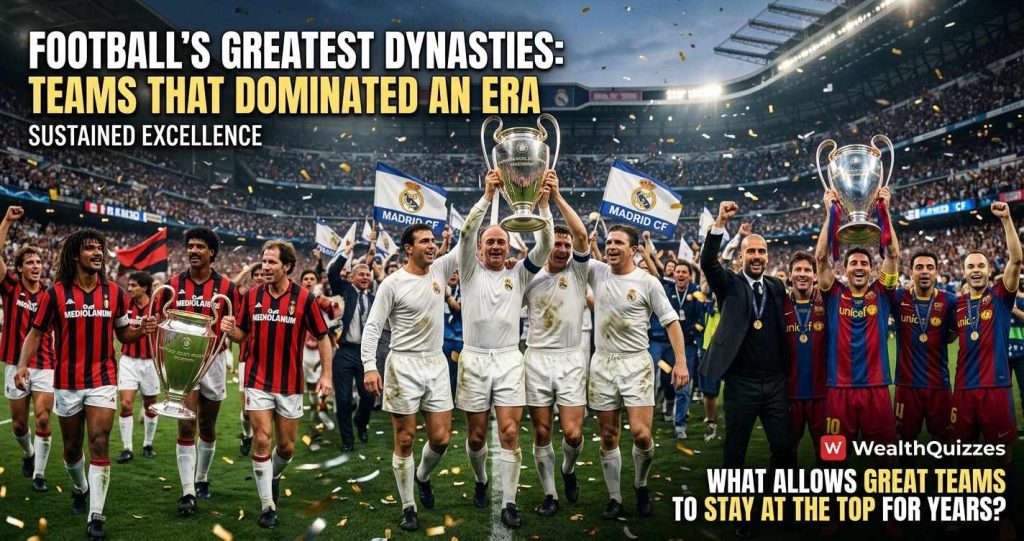
Football’s Greatest Dynasties: Teams That Dominated an Era: Sustained Excellence
What allows great teams to stay at the top for years?
Winning once can be explained by brilliance, timing, exceptional players or even a little luck. Winning repeatedly is something else entirely.
A great football team may capture a league title and disappear. Another may win a major European trophy before declining within a season or two. But every generation produces a handful of extraordinary sides that seem to resist the natural cycle of sporting decline. They win, rebuild, adapt, win again and eventually become more than successful teams: they become dynasties.
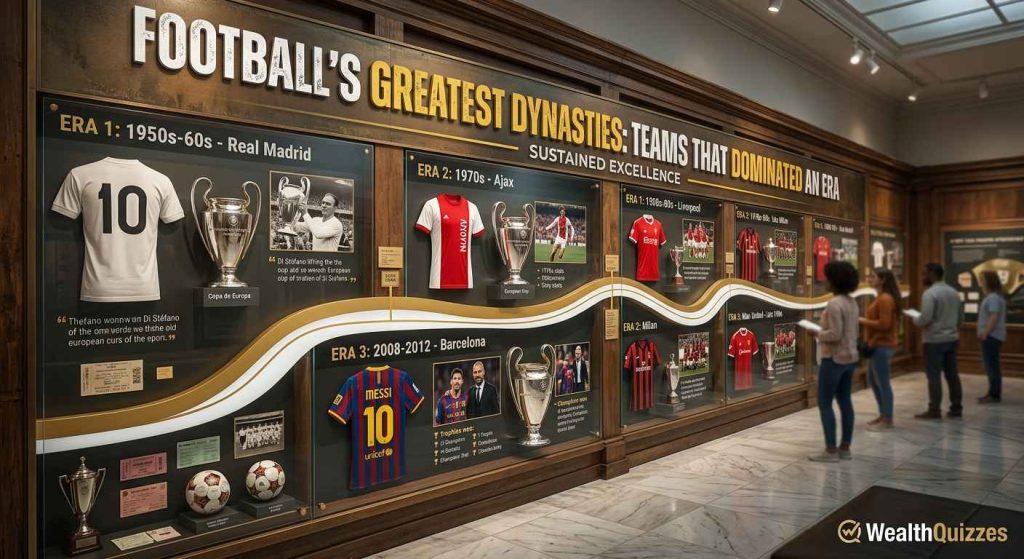
Real Madrid of the late 1950s. Ajax of the early 1970s. Bayern Munich of the mid-1970s. AC Milan under Arrigo Sacchi. Manchester United under Sir Alex Ferguson. Barcelona under Pep Guardiola. Real Madrid’s European champions of 2016–2018.
These teams were separated by geography, footballing philosophy, generations and technology. Yet they shared something remarkably similar: they developed systems capable of converting exceptional talent into sustained competitive advantage.
The history of football suggests that dynasties are not created merely by assembling the best players. They emerge when talent, leadership, recruitment, tactical innovation, institutional culture, financial strength, player development and the capacity to adapt become aligned.
As football historian Jonathan Wilson has repeatedly demonstrated through his examination of tactical evolution, great teams often become historically significant not merely because they win but because they change the way football is understood and played.
The greatest dynasties therefore do two things simultaneously.
They dominate their era—and redefine it.
What Is a Football Dynasty?
A dynasty is more than a successful team.
A team that wins one championship is a champion. A team that repeatedly competes for and wins major honours over a sustained period becomes something more significant.
There is no universally accepted mathematical definition of a football dynasty. However, the concept generally involves sustained excellence over multiple seasons, repeated major trophies, continuity of sporting identity and an ability to regenerate after losing important players.
That final characteristic is particularly important.
A great team can be destroyed by one transfer, one retirement or one managerial departure.
A dynasty finds a way to continue.
UEFA’s historical records illustrate just how rare sustained European dominance actually is. Real Madrid won the first five editions of the European Cup from 1956 through 1960, a record for consecutive victories that remains unmatched. Ajax then won three successive European Cups from 1971 to 1973, followed immediately by Bayern Munich’s three consecutive triumphs from 1974 to 1976.
In the modern Champions League era, Real Madrid again achieved three consecutive victories between 2016 and 2018. UEFA records that Madrid remain the only club to have won three successive Champions League finals in the post-1992 era.
That rarity tells us something important.
Dominance is difficult. Sustained dominance is exceptional.
Real Madrid: The Original European Superpower
Any discussion of football dynasties must begin with Real Madrid.
The club’s first great European dynasty emerged in the 1950s, when Alfredo Di Stéfano, Francisco Gento, Ferenc Puskás and their extraordinary supporting cast transformed the European Cup into a stage for Madrid’s supremacy.
Real Madrid won the first five European Cups between 1955/56 and 1959/60. UEFA describes that achievement as the competition’s benchmark for consecutive European victories.
But the significance of that side goes beyond five trophies.
Madrid established an enduring institutional expectation: European success was not an extraordinary event; it was part of the club’s identity.
That mentality would become important decades later.
Real Madrid’s modern European dynasty from 2016 to 2018 demonstrated that the club’s capacity for sustained excellence had survived radically different eras of football.
Under Zinedine Zidane, Madrid won the Champions League three times consecutively, defeating Atlético Madrid in 2016, Juventus in 2017 and Liverpool in 2018. UEFA records that the achievement made Madrid the first club to win three successive European Cup/Champions League finals on more than one occasion.
The lesson is profound.
A dynasty does not necessarily require the same players or manager forever.
It requires an institution capable of reproducing excellence.
Ajax: When a Team Changes Football Itself
Ajax’s early-1970s dynasty represents another dimension of greatness.
The Amsterdam side did not merely win three European Cups from 1971 to 1973. It helped redefine football through the principles associated with Total Football.
Johan Cruyff became the most recognisable figure of the movement, but the philosophy was larger than one player.
Players exchanged positions.
Defenders participated in possession.
Attackers defended.
Space became something to manipulate rather than merely occupy.
Rinus Michels provided the foundational coaching influence, while Stefan Kovács continued the work after Michels’ departure.
UEFA’s historical account notes that Ajax won the 1971 final against Panathinaikos, defeated Inter Milan in 1972 and completed the three-peat against Juventus in 1973.
Yet Ajax’s most enduring contribution may have been intellectual rather than statistical.
Its football influenced generations of coaches.
Cruyff later carried many of those principles to Barcelona, helping establish the philosophical foundations upon which another dynasty would eventually be built.
This is one of the clearest characteristics of football’s greatest dynasties:
Their influence survives their trophies.
Bayern Munich: Institutional Continuity
Bayern’s first great European dynasty followed Ajax almost immediately.
Franz Beckenbauer, Gerd Müller, Uli Hoeneß and their teammates formed the backbone of a team that won three consecutive European Cups between 1974 and 1976.
Bayern’s significance lies partly in the club’s remarkable capacity to preserve competitiveness across generations.
The Bavarian giant did not remain permanently dependent on the same generation. It repeatedly rebuilt.
That capacity for regeneration has become one of Bayern’s defining characteristics.
The club’s European record illustrates the broader pattern. UEFA’s current historical records list Bayern among the most successful clubs in European competition, with six European Cup/Champions League titles through 2026.
Bayern demonstrates an essential principle of dynasty-building:
The institution must eventually become more important than the individual generation.
AC Milan and the Revolution of Arrigo Sacchi
If Ajax transformed football through positional interchange and collective movement, Arrigo Sacchi’s AC Milan revolutionised the game through collective pressing, defensive organisation and tactical compactness.
The late-1980s Milan side featuring Franco Baresi, Paolo Maldini, Alessandro Costacurta, Mauro Tassotti, Frank Rijkaard, Ruud Gullit and Marco van Basten became one of football’s defining teams.
Its success was not simply the result of expensive talent.
Sacchi developed a highly coordinated collective system.
Players moved together.
The defensive line compressed space.
Pressing became collective rather than individual.
The team attempted to control not only the ball but the space in which the opponent could operate.
Milan won consecutive European Cups in 1989 and 1990, and UEFA records that the club was part of the small group of teams capable of reaching three successive European Cup finals in the early 1990s.
Sacchi’s greatest contribution was perhaps conceptual.
He helped demonstrate that a football team could achieve extraordinary defensive control without relying on purely reactive football.
The team could defend by actively controlling space.
Manchester United: The Dynasty of Adaptation
Manchester United under Sir Alex Ferguson presents perhaps the clearest example of sustained domestic dominance through continuous rebuilding.
Ferguson’s reign lasted from 1986 to 2013, during which Manchester United developed several different championship-winning generations.
The 1990s side was different from the team that dominated the early 2000s, which was itself different from the group that won the Champions League in 2008.
Players came and went.
Tactical approaches evolved.
The academy produced important players.
The club recruited internationally.
And Ferguson repeatedly rebuilt rather than simply preserving the past.
This is one reason his achievement is so difficult to reproduce.
A manager can build one exceptional team.
Building several successful teams over more than two decades requires organisational renewal.
The lesson extends beyond football.
Successful organisations eventually face the problem of their own success. Players age. Competitors learn. Tactical advantages disappear.
The organisation must change before decline forces it to change.
Barcelona: The Guardiola Revolution
Barcelona’s 2008–2012 period represents one of the most influential modern football dynasties.
Pep Guardiola inherited an extraordinary footballing culture but transformed it into an exceptionally sophisticated positional system.
Xavi Hernández, Andrés Iniesta, Sergio Busquets and Lionel Messi became central figures in a side that combined technical excellence with positional discipline.
Barcelona won the 2008/09 Champions League, La Liga and Copa del Rey, completing a historic treble. In 2011, Guardiola’s Barcelona defeated Manchester United 3–1 in the Champions League final at Wembley.
But again, the trophies tell only part of the story.
The team’s deeper achievement was demonstrating the extraordinary possibilities of possession as a mechanism of control.
The ball became both an attacking weapon and a defensive instrument.
If Barcelona had possession, the opponent could not attack.
The team’s positional structure created passing options while forcing opponents to make difficult defensive decisions.
Guardiola’s influence subsequently spread far beyond Barcelona, affecting coaches and football cultures across Europe and the world.
This is why dynasties matter.
They create followers.
Real Madrid, 2016–2018: Winning Through Resilience
The modern Real Madrid dynasty presents an interesting contrast to Guardiola’s Barcelona.
Madrid did not dominate every match through possession.
Instead, they developed extraordinary flexibility.
Cristiano Ronaldo provided elite scoring.
Luka Modrić controlled midfield.
Toni Kroos provided passing precision.
Casemiro supplied defensive balance.
Sergio Ramos became an influential leader.
And players such as Karim Benzema, Marcelo, Dani Carvajal and others contributed to a remarkably resilient collective.
The team could dominate possession when necessary, counterattack when space appeared and survive difficult periods.
Its greatest achievement was not simply winning three Champions League titles.
It was winning three in succession in an era when European competition had become extraordinarily deep.
UEFA’s records show how unusual that achievement was: in the Champions League era, only Real Madrid had managed three consecutive final victories before Paris Saint-Germain’s later back-to-back successes created another historical milestone.
Why Do Dynasties Eventually Collapse?
Every dynasty ends.
That is one of sport’s most reliable laws.
Players age.
Rivals improve.
Financial circumstances change.
Managers depart.
Tactical innovations spread.
The hunger generated by the first championship can diminish after repeated success.
Most importantly, opponents study winners.
The very success that created a dynasty can eventually become its vulnerability.
Once everyone understands how a successful team operates, its competitive advantage begins to disappear.
This is why adaptation is perhaps the most important ingredient of sustained excellence.
A team that repeats yesterday’s formula forever eventually becomes predictable.
The best dynasties therefore contain mechanisms for reinvention.
The Role of Culture
One of the most important findings from sports-performance research is that sustained excellence is not simply about tactics.
Researchers Andrew Cruickshank, Dave Collins and Sue Minten examined how high-performing professional sports organisations create and sustain culture. Their work in Psychology of Sport and Exercise concluded that high-performance culture is not something an organisation achieves permanently; it is continuously constructed and maintained through complex organisational processes.
This helps explain why some clubs repeatedly return to the top while others experience isolated golden generations.
A dynasty requires culture.
Players must understand what the club expects.
Young players must learn standards from senior professionals.
Recruitment must reflect the sporting philosophy.
Coaches must be given enough authority to implement ideas while remaining accountable.
Leadership must survive player turnover.
In other words:
A dynasty is an ecosystem.
The Importance of Recruitment and Succession
No team can remain dominant with the same eleven players forever.
That makes succession planning essential.
A club must identify replacements before decline becomes obvious.
The best dynasties therefore operate with two timelines.
The first is today: selecting the strongest possible team.
The second is tomorrow: developing or acquiring the players who will eventually replace today’s stars.
This is particularly visible in clubs with sophisticated academies.
Barcelona’s La Masia, Ajax’s youth system and Manchester United’s academy demonstrate how player development can contribute to institutional continuity.
Recruitment also matters.
The club must identify not only talented footballers but players capable of fitting its tactical and cultural requirements.
Talent without compatibility can destroy cohesion.
Money Helps—But Money Alone Does Not Create a Dynasty
Financial resources unquestionably matter in modern football.
The ability to recruit elite players, retain stars, employ world-class coaches and maintain sophisticated performance infrastructure provides enormous advantages.
But money does not guarantee sustained success.
Football history is full of wealthy teams that failed to build lasting dynasties.
The decisive factor is often what the organisation does with its resources.
A financially powerful club can buy talent.
A well-run club converts talent into competitive systems.
That distinction is critical.
The Five Pillars of Football Dynasties
Looking across the greatest eras, five common characteristics emerge.
1. Exceptional talent
Every dynasty requires players capable of performing at an extraordinary level.
2. A distinctive footballing idea
Ajax had Total Football. Sacchi had coordinated pressing and compactness. Guardiola’s Barcelona had positional play. Great teams know what they want their football to look like.
3. Leadership
Great players need leaders capable of maintaining standards and managing adversity.
4. Institutional culture
The club must make excellence reproducible rather than dependent upon one extraordinary generation.
5. Adaptation
Perhaps most importantly, successful teams must evolve before their competitors force them to.
Without adaptation, dominance becomes temporary.
The Real Secret: Excellence Must Become Reproducible
The most fascinating feature of a football dynasty is not that it finds greatness.
It is that it learns how to reproduce greatness.
Real Madrid did it across multiple generations.
Bayern did it across decades.
Manchester United did it through successive teams under Ferguson.
Barcelona did it by combining academy development with an identifiable football philosophy.
The strongest clubs understand that players eventually retire, managers eventually leave and tactics eventually become obsolete.
What survives is the institution.
That is why the greatest dynasties are not simply teams.
They are systems for producing teams.
Conclusion: Greatness Is Winning Once; Dynasty Is Staying There
Football history remembers champions.
But it reveres dynasties.
The difference is sustained excellence.
A great team can emerge suddenly and capture a trophy. A dynasty must overcome something much harder: time.
Time exposes weaknesses.
Time ages players.
Time allows competitors to study tactics.
Time changes managers.
Time alters football itself.
Yet the greatest football institutions repeatedly find ways to remain relevant.
The statistics are extraordinary. Real Madrid’s five consecutive European Cups from 1956 to 1960 remain unmatched. Ajax and Bayern each produced three consecutive European Cup triumphs in the 1970s. Real Madrid’s 2016–2018 Champions League sequence remains the defining modern three-peat. UEFA’s records also show just how rare European dynasties have become, with only a small number of clubs ever managing successive titles.
But trophies alone do not explain these achievements.
Behind every dynasty is a philosophy.
Behind the philosophy is a culture.
Behind the culture is leadership.
Behind the leadership is an institution capable of learning.
And behind all of it is an understanding that yesterday’s success cannot be allowed to become tomorrow’s complacency.
That may be the greatest lesson football’s dynasties offer.
Champions know how to win. Dynasties know how to remain hungry after winning.
And when a club can continually transform talent into performance, performance into trophies and trophies into a culture of expectation, it stops being merely a successful football team.
It becomes an era.