
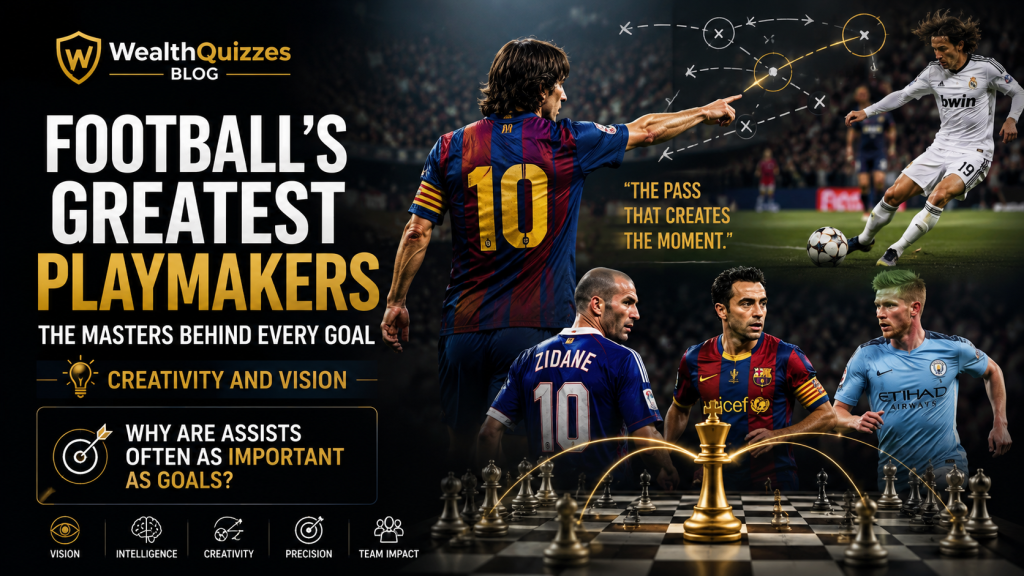
Football’s Greatest Playmakers: The Masters Behind Every Goal: Creativity and vision
Why are assists often as important as goals?
Football is usually remembered through its goals. The scoreline records who found the net, the headlines celebrate the goalscorer, and individual awards often gravitate toward players who produce spectacular finishing numbers. Yet behind many of football’s most memorable goals stands another kind of genius: the playmaker.
The playmaker is the footballer who sees the possibility before everyone else does. He notices the run that has not yet begun, identifies the space that defenders have not yet recognised and delivers the pass that turns an ordinary possession into a goalscoring opportunity. Sometimes he provides the final assist. Sometimes he supplies the pass before the assist. Sometimes his contribution is even less visible: drawing defenders away, controlling the tempo, changing the point of attack or creating the space from which somebody else eventually scores.
That is why the greatest playmakers are not simply measured by assists. They are measured by how profoundly they change the way a team attacks and, ultimately, how they make football look easier than it really is.
What Exactly Is a Playmaker?
The traditional image of a playmaker is the classic No. 10: a technically gifted midfielder positioned behind the striker, receiving the ball between the lines and looking for the decisive pass.
Players such as Diego Maradona, Michel Platini, Zinedine Zidane, Juan Román Riquelme and Kaká embodied versions of this role.
But modern football has expanded the definition.
A playmaker may now operate from deep midfield, as Andrea Pirlo did; from the right or left flank, as many modern creative wingers do; from a full-back position, as Trent Alexander-Arnold has done; or from almost anywhere on the pitch, as Lionel Messi has demonstrated throughout his career.
FIFA’s technical analysis of the 2018 World Cup described the playmaker as someone capable of dictating games through technique and tactical awareness. Former Brazil coach Carlos Alberto Parreira captured the role particularly well, observing that playmakers can “impose themselves on games, speed up or slow down the tempo, switch play, create and make things happen.” (Inside FIFA)
That description goes beyond the simple concept of an assist.
A playmaker is essentially a problem-solver.
Vision: Seeing the Pass Before It Exists
The first characteristic of an elite playmaker is vision.
Vision is not simply the ability to see the pitch. Every professional footballer sees the pitch. The distinction is that exceptional playmakers process what they see faster and anticipate what is about to happen.
Consider a midfielder receiving the ball with his back to goal. A conventional player might control the ball, turn and then search for an available teammate. A world-class playmaker has often scanned the field before receiving possession. He already knows where the defenders are, where his teammates are moving and which passing lane is about to open.
That fraction of a second can determine everything.
Xavi Hernández was perhaps one of the clearest examples. His football was built around positioning, scanning, passing angles and tempo control rather than spectacular physicality.
UEFA described him as the “brains” and “pulse” of Barcelona’s extraordinary 2008–12 side, while Guardiola emphasised how difficult Xavi would be to replace because of what he contributed on the pitch and the respect he commanded within the dressing room. (UEFA.com)
The genius was often in what Xavi did before he passed.
He would move into a pocket of space, receive the ball, attract pressure and release it just before opponents could close him down. The pass itself might travel only 10 metres. Yet its timing could destabilise an entire defensive structure.
That is playmaking.
The Assist: Football’s Underappreciated Contribution
An assist is football’s formal recognition of creativity.
But it is also an imperfect measurement.
Suppose a midfielder plays a brilliant through-ball that sends a striker into an open goal, but the striker misses. The midfielder receives no assist.
Now imagine another player delivers a routine five-yard pass to a teammate who scores an extraordinary 30-yard shot. The passer receives an assist.
The statistics therefore do not always tell the entire story.
Opta Analyst’s explanation of expected assists (xA) addresses precisely this problem. xA estimates how likely a completed pass is to become an assist, taking into account factors such as the type of pass, where it is made, where it is received and the pattern of play. (Opta Analyst)
This is important because it separates creative quality from creative outcome.
A playmaker’s teammate may fail to finish the opportunity. That does not necessarily mean the pass was poor.
Modern football analytics therefore increasingly attempts to recognise the value hidden behind conventional assist totals. FIFA has similarly noted how modern data systems are increasingly capable of describing and analysing events throughout a football match. (Inside FIFA)
The implication is significant: football is learning to appreciate the architect as well as the builder.
Xavi and Iniesta: When Creativity Becomes a System
Few midfield partnerships illustrate the power of playmaking better than Xavi Hernández and Andrés Iniesta.
Their importance to Barcelona and Spain was not simply that they could produce assists. Together, they changed the rhythm and structure of matches.
Xavi was the metronome: controlling possession, manipulating tempo and finding passing angles.
Iniesta was the improviser: carrying the ball through pressure, manipulating space and creating openings where none appeared to exist.
UEFA’s technical team recognised Iniesta’s contribution at UEFA EURO 2012 by naming him Player of the Tournament, despite the fact that he finished the competition with one assist and no goals. Andy Roxburgh explained that Iniesta symbolised the tournament through his creativity, incisiveness and movement both with and without the ball. (UEFA.com)
That decision is revealing.
If goals and assists were the only measures of value, Iniesta would not have been the obvious choice.
But football is more sophisticated than a spreadsheet.
A playmaker can dominate a match without scoring or assisting because his movements and decisions determine where the game is played.
Andrea Pirlo: The Deep-Lying Architect
Andrea Pirlo demonstrated another form of playmaking.
Unlike the traditional No. 10 who operates close to the penalty area, Pirlo often controlled matches from deep midfield.
His greatest weapon was not acceleration. It was time.
He could receive possession in front of his defence and immediately change the geography of the match with a long diagonal pass. His ability to switch play forced opponents to defend much larger spaces.
Former teammate Danilo described Pirlo as a player who was not particularly quick but possessed extraordinary intelligence, technique and vision. (Inside FIFA)
Pirlo’s career demonstrated an important principle: great playmaking is not necessarily about playing closer to goal; it is about controlling the conditions under which opportunities are created.
A 50-yard pass that eliminates an entire defensive line can be every bit as influential as a final pass inside the penalty area.
Luka Modrić: The Complete Modern Playmaker
Luka Modrić represents another evolution of the position.
His playmaking is not confined to the final third. He can dictate from deep, carry the ball forward, escape pressure, recover possession, switch play and arrive around the penalty area.
FIFA’s technical analysis of the 2018 World Cup identified Modrić as the outstanding playmaker of the tournament. Bora Milutinović praised his ability to “pull the strings”, while FIFA’s analysis noted his capacity to dictate the pace, defend, attack and score. (Inside FIFA)
That versatility explains why modern playmakers are increasingly difficult to classify.
The old distinction between midfielder, winger and attacking midfielder is becoming less useful. Elite creators operate across zones.
Kevin De Bruyne: The Playmaker as a Weapon
Kevin De Bruyne offers perhaps the clearest modern example of the playmaker as a direct attacking weapon.
His passing combines vision with velocity.
He can play a disguised through-ball, deliver an early cross, strike a diagonal pass behind a defensive line or attack space himself.
Former Belgium manager Roberto Martínez described De Bruyne as capable of producing a goalscoring opportunity “out of nothing” and argued that what made him unique was his ability to increase the tempo of the game while operating with extraordinary quality in the final third. (FIFA)
That combination is crucial.
A creative player does not merely create chances. A great playmaker forces defenders to make decisions.
Should the defender close De Bruyne? If so, another player may become free.
Should the defender track the striker? De Bruyne may pass into the space behind him.
Should the defensive line drop? De Bruyne may shoot or deliver a cross.
The best playmakers therefore create uncertainty.
Neymar, Messi and the Creative Forward
The playmaker does not have to be a midfielder.
Lionel Messi and Neymar demonstrated how forwards can become primary creators.
Neymar, for example, combined dribbling, ball carrying and passing to create opportunities. Opta’s analysis found that during his period at Paris Saint-Germain, only Lionel Messi and Thomas Müller had averaged a higher expected-assist figure per 90 minutes among players meeting the relevant playing-time threshold across Europe’s top five leagues. (Opta Analyst)
Messi took the concept even further.
He could begin an attack in midfield, eliminate opponents through dribbling, attract multiple defenders and then either finish the move himself or release a teammate.
This creates an important distinction between assisting a goal and creating the conditions for a goal.
Sometimes the creator is responsible for both.
The Modern Playmaker Is Everywhere
Football’s tactical evolution has made playmaking more distributed.
Full-backs now create from wide areas. Centre-backs initiate attacks from deep. Goalkeepers participate in build-up play. Defensive midfielders dictate possession. Wingers move inside to create numerical superiority.
Trent Alexander-Arnold is a particularly interesting example. Opta’s xA analysis of Liverpool’s full-backs showed how conventional chance-creation statistics could conceal the quality of their passing. Alexander-Arnold and Andy Robertson both created 41 open-play chances in the analysed Premier League season, but their underlying xA profiles differed significantly. (Opta Analyst)
This demonstrates how the modern game has transformed the meaning of creativity.
The playmaker is no longer necessarily the player wearing No. 10.
The playmaker is the player who creates advantage.
Why Assists Can Matter as Much as Goals
Goals determine results.
But assists often determine how goals happen.
A striker may finish 30 chances, but somebody must create many of those opportunities.
The relationship between creator and scorer is therefore symbiotic.
The goalscorer receives the final statistical reward, but the playmaker often begins the chain of events that produces it.
And this is why football history is filled with partnerships that became legendary precisely because one player created what another finished.
Xavi and Messi.
Iniesta and Messi.
Pirlo and his forwards.
De Bruyne and Manchester City’s attackers.
Neymar and his teammates.
The creator is often the bridge between possession and penetration.
Creativity Cannot Be Manufactured
There is, however, a reason truly great playmakers remain rare.
Technical skills can be trained. Passing patterns can be rehearsed. Tactical systems can be taught.
But imagination is harder to manufacture.
FIFA’s Andy Roxburgh famously titled its technical discussion of the role: “You cannot manufacture a maestro.” (Inside FIFA)
That statement captures the mystery surrounding elite playmakers.
A coach can teach a player where to stand.
He can teach him how to strike the ball.
He can teach him the team’s attacking patterns.
But the ability to look at a crowded penalty area and imagine a passing lane that exists for only half a second is something much harder to programme.
It requires perception, anticipation, technique, courage and imagination operating simultaneously.
The Future of Playmaking
Technology is now making it easier to recognise these contributions.
Expected assists, progressive passes, shot-creating actions, passes into the penalty area, carries into dangerous areas and other advanced metrics are increasingly being used to evaluate creativity.
But data should complement football intelligence rather than replace it.
A statistic can tell us that a player created 3.5 chances per match.
It cannot completely explain why those chances were created.
It cannot fully capture the psychological effect of a midfielder whose reputation causes opponents to retreat.
It cannot easily quantify the way a perfectly timed movement creates space for somebody else.
And it cannot reproduce the emotional response of watching a player see something that nobody else saw.
That is why the greatest playmakers remain artists as well as athletes.
Conclusion: The Architects Behind Football’s Greatest Moments
Football may belong to the goalscorers in the record books, but it also belongs to the architects who make those goals possible.
The greatest playmakers have always possessed a rare combination of vision, intelligence, technique and imagination. They understand that football is not merely about where the ball is; it is about where the ball will be next.
From Xavi’s orchestration to Iniesta’s improvisation, Pirlo’s deep distribution, Modrić’s complete midfield mastery, De Bruyne’s devastating final passes and Neymar’s creative brilliance, the history of football is also a history of its great creators.
UEFA’s technical analysis of Spain’s great teams described Xavi’s orchestration and Iniesta’s incisiveness as central to their success. (UEFA.com) FIFA’s technical studies likewise identify the importance of playmakers in imposing rhythm, changing tempo, switching play and creating opportunities. (Inside FIFA)
So, why are assists often as important as goals?
Because a goal is the conclusion of an attacking story.
The assist is often where the story truly begins.
And behind the assist stands the player who saw the possibility before anyone else—the master who transformed space into opportunity, opportunity into a chance, and a chance into history.
That is the playmaker: football’s creative architect, its midfield strategist and, very often, the unseen master behind the goal.