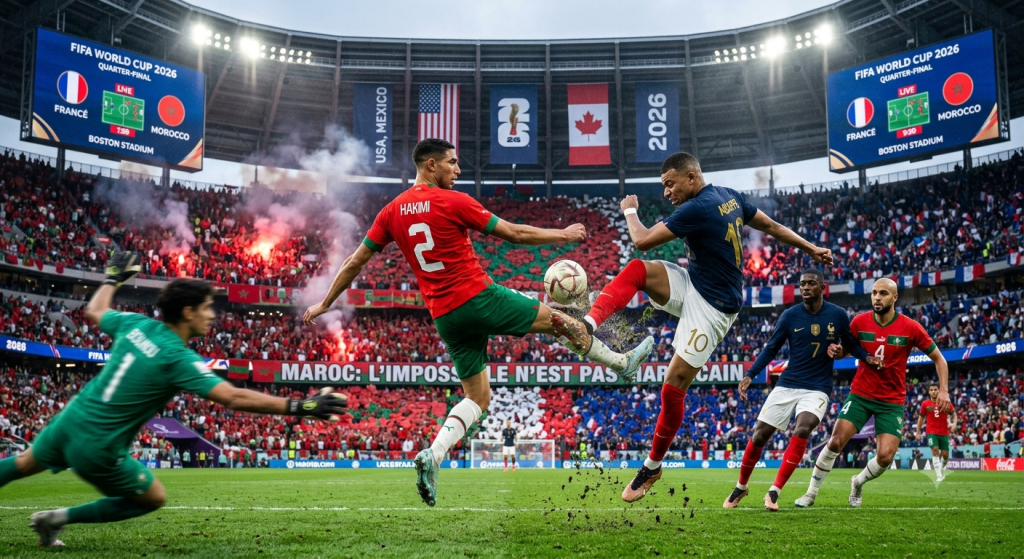
France 2–0 Morocco: Mbappé’s Ruthless Edge Ends Africa’s Boldest Dream at World Cup 2026
How France Broke Morocco’s Resistance, Reached the Semi-Finals, and Reminded the World Why Tournament Football Punishes Even the Brave
There are World Cup matches that feel like ordinary quarter-finals, and then there are matches that carry history, memory, symbolism and emotional weight long before the first whistle. France versus Morocco at FIFA World Cup 2026 belonged firmly in the second category. It was not merely a battle for a semi-final place in Foxborough, Massachusetts. It was a rematch of the 2022 World Cup semi-final, a confrontation between one of Europe’s most powerful football nations and Africa’s most consistent tournament side of the last four years, and a match shaped by deep cultural, linguistic and footballing connections between both countries. By full time, France had won 2–0, with goals from Kylian Mbappé and Ousmane Dembélé, but the scoreline alone does not capture the significance of the night. This was a match about elite finishing, tactical maturity, Morocco’s historic ambition, and the hard truth that World Cups often reward the side with the sharper edge rather than the nobler story.
France’s victory sends Didier Deschamps’ side into another World Cup semi-final and keeps alive their pursuit of a third world title. It also reinforces the sense that, whatever the tactical fashions or emerging challengers of the moment, tournament football still bends toward teams that combine structure, depth, defensive authority and a superstar capable of deciding the biggest games. Morocco, by contrast, leave the quarter-finals with pain but not with shame. The Atlas Lions were once again carrying not only national expectation but the hopes of a continent, and although they could not overcome France, they have still deepened their claim to be one of the most important African teams of the modern World Cup era.
According to Reuters, France secured a “comfortable 2–0 win” over Morocco in the quarter-final, with captain Kylian Mbappé scoring his eighth goal of the tournament before Ousmane Dembélé added a second to seal the result. Reuters’ report also framed the win as another demonstration of France’s tournament efficiency and of Mbappé’s relentless influence on the biggest stage.
The Stakes Were Bigger Than a Quarter-Final
The emotional significance of France versus Morocco was obvious before kick-off. Morocco had already made history at the 2022 World Cup in Qatar by becoming the first African nation to reach a World Cup semi-final. Their run in 2026 has shown that Qatar was not a one-off miracle but the product of a durable football project. CAF’s report on Morocco’s 3–0 Round of 16 win over Canada described them as the first African nation to reach the World Cup quarter-finals more than once, underlining how their current generation has shifted from surprise package to serious tournament force.
France, meanwhile, entered the match with a very different kind of pressure. For Les Bleus, quarter-finals are not the horizon; they are the checkpoint before the real business begins. Didier Deschamps has turned France into one of the defining tournament machines of modern football, a side that no longer treats the World Cup as a stage for chaos but as a competition to be managed with authority. Their route into the last eight had not been flawless—Paraguay made them work hard in the Round of 16—but it had again shown a team capable of staying emotionally stable under stress. The French Football Federation’s review of the Paraguay match described the 1–0 win as an exercise in patience, with Mbappé’s penalty eventually breaking a stubborn opponent after a difficult, heat-affected contest.
So the quarter-final presented a fascinating collision of narratives. Morocco came in with momentum, belief and the tactical confidence of a side that had already outlasted elite opposition on this stage. France arrived with pedigree, superior depth, and a captain in Mbappé who was already shaping the Golden Boot race. Al Jazeera’s pre-match analysis noted that France had scored freely through the tournament and entered the tie as favourites, while Morocco were once again carrying Africa’s hopes and the possibility of another upset.
Morocco’s Story Was One of Courage, But France’s Was One of Precision
Matches like this often expose the difference between a team that is emotionally compelling and a team that is structurally ruthless. Morocco were never short of courage. They were never short of effort. They were not intimidated by France’s reputation or by the moment. But France were the more clinical side, and in tournament football that difference can be decisive.
Morocco had arrived in the quarter-finals by playing with exactly the qualities that made them such a compelling force in Qatar in 2022: defensive organisation, midfield discipline, transition threat, and a collective spirit that often allows them to outperform the raw individual market value of their squad. Their 3–0 victory over Canada in the Round of 16 was another demonstration of that identity. CAF highlighted the goals of Azzedine Ounahi and Soufiane Rahimi in a performance that showed Morocco’s ability to absorb pressure, improve during the game, and finish strongly.
But against France, the margin for imperfection was smaller. Reports before the game suggested Morocco were also dealing with a significant selection issue around Ismael Saibari, one of their most influential attacking players of the tournament, and that mattered because matches of this level often turn on whether a side has enough firepower to punish its opponent’s mistakes.
France, by contrast, looked like a side with multiple ways to hurt Morocco. Mbappé was the obvious focal point, but he was surrounded by pace, invention and technical quality in Michael Olise, Ousmane Dembélé and a supporting cast capable of turning transitions into goals within seconds. That difference in attacking depth became one of the defining truths of the match.
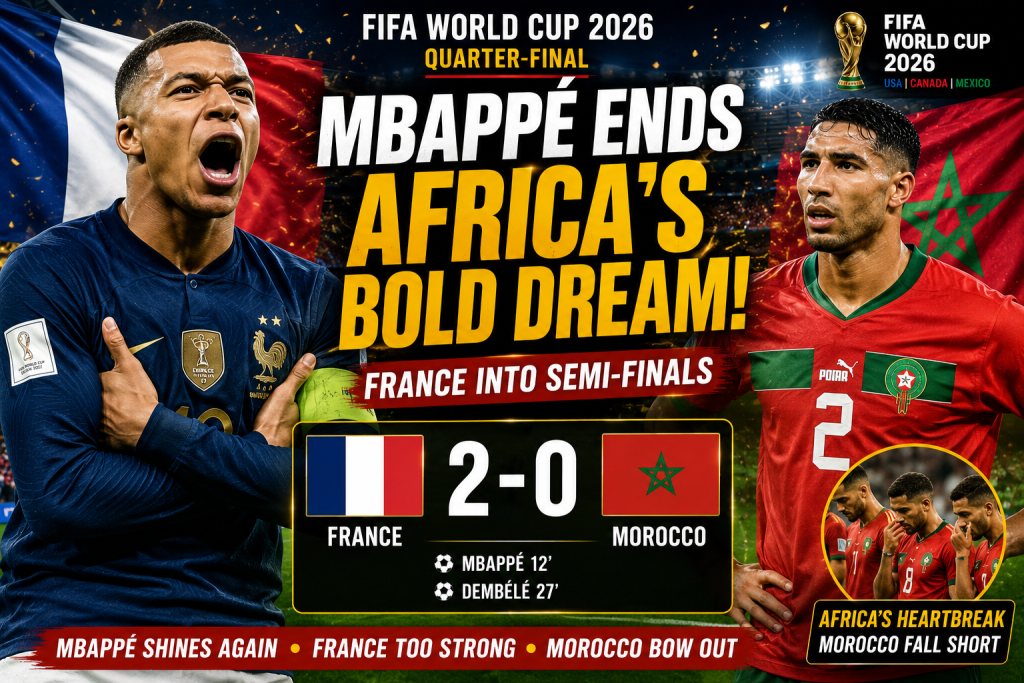
Mbappé Once Again Took the Big Moment
At some point, repeated tournament excellence stops being form and becomes identity. That is where Kylian Mbappé now lives. The French captain entered the quarter-final already among the leading scorers of the competition, and by the end of the night he had added another goal to his World Cup story. Reuters reported that his strike was his eighth of the tournament, a remarkable number at this stage of the competition and another reminder that France possess the most decisive attacking figure left in the bracket.
Mbappé’s significance in this match was not just that he scored. It was that his presence altered Morocco’s defensive geometry from the opening stages. A defence that has built its reputation on compactness and discipline was forced to keep one eye on the space behind, one eye on the dribble threat in isolation, and one eye on the possibility that Mbappé could arrive between lines rather than simply running in behind. That is the burden elite forwards place on opponents: they make defenders split their concentration, and split concentration is where mistakes begin.
The goal itself mattered because it arrived at the point where Morocco still had hope of dragging the game deeper into tension. Knockout football often becomes most dangerous for underdogs when they survive the first hour without damage. France denied Morocco that possibility by striking through Mbappé and taking control of the emotional rhythm of the match. Once France led, the burden on Morocco changed completely. They were no longer the disciplined challenger trying to stay inside the game. They were the trailing side, forced to open up, forced to take risks, and therefore forced to play a match more favourable to France’s attacking weapons.
Dembélé’s Goal Killed the Contest — and Showed France’s Depth
If Mbappé’s goal shifted the quarter-final, Ousmane Dembélé’s goal effectively closed it. Reuters and live match threads from the game indicate that Dembélé scored France’s second within minutes of the opener, a sequence that turned a live quarter-final into a mountain Morocco could not realistically climb.
Dembélé’s role matters because it speaks to one of the central reasons France remain so dangerous in tournament football: they do not depend on one attacking route. Even when Mbappé is the central story, France have too many secondary threats for opponents to survive by focusing on him alone. Michael Olise, Désiré Doué, Bradley Barcola, Dembélé and others give France a range of attacking profiles that few national teams can match. Some can beat you in transition. Some can isolate defenders one-versus-one. Some can arrive late in the box. Some can manipulate tight spaces between midfield and defence. That diversity of threat means France rarely need to play the same game twice.
Against Morocco, it meant that once the Atlas Lions were forced to chase, France could punish the spaces that inevitably opened. Dembélé’s goal was not just a second goal. It was evidence that France’s attack is layered enough to turn one moment of scoreboard pressure into a complete tactical takeover.
Morocco Were Beaten, But They Were Not Reduced
It would be easy, after a 2–0 quarter-final defeat, to tell the Morocco story purely as a failure to take the final step. That would be too shallow a reading. Morocco’s World Cup 2026 has to be understood in the longer context of African football and of Morocco’s own evolution.
This is now a side that has reached the latter stages of consecutive World Cups. That is not a fluke. It is not an accident of one golden month. It is a sign of a federation, a talent pipeline and a coaching structure that have built something sustainable. In 2022 Morocco became the first African semi-finalist in World Cup history. In 2026 they became the first African nation to reach the quarter-finals twice. Those are not just Moroccan milestones; they are continental milestones.
There is also a broader symbolic value to Morocco’s run. African football has long had the talent to unsettle elite nations, but it has not always had the institutional continuity, tactical cohesion or tournament calm to do so repeatedly. Morocco now look like an exception to that old pattern. They are no longer merely Africa’s brave representative. They are one of the few non-traditional powers in the world game who can now enter a World Cup with realistic ambitions of making the final four.
That is why this defeat should be read carefully. Morocco lost to France because France were better on the day and sharper in both boxes. They did not lose because they were out of place in the quarter-finals. There is a profound difference between those two things.
Why France Look Like Genuine Champions Again
If Morocco’s exit is part of a larger story of progress, France’s win is part of a larger story of menace. This was not a flashy quarter-final performance in the sense of total domination from first whistle to last. But it was the kind of performance that wins World Cups: measured, controlled, opportunistic and emotionally stable.
France have now shown across this tournament that they can win in different ways. They can overwhelm weaker opponents with pace and volume. They can survive awkward, physical or heat-affected knockout matches, as they did against Paraguay. And now they have shown they can end the run of a deeply organised, emotionally charged Morocco side without losing control of themselves. That versatility is the mark of a serious champion.
There is also the Deschamps factor. Whatever debates persist around style, his France sides understand tournament football. They rarely look panicked. They rarely seem surprised by the emotional pressure of knockout games. They know how to live inside the tension of a World Cup and still produce the one or two moments needed to settle it. That is a difficult quality to measure statistically, but it shows up repeatedly in results.
The Match Also Told a Story About the Global Balance of Football
One of the most fascinating aspects of World Cup 2026 has been the way it has mixed familiar power with shifting geography. Europe and South America still supply the biggest favourites, but the competition has repeatedly shown that the old certainties are eroding. Morocco’s run, Norway’s elimination of Brazil, Egypt pushing Argentina to the edge, and the stubborn competitiveness of multiple non-traditional powers all point to a game that is becoming more globally balanced.
France’s victory over Morocco therefore matters in two ways at once. On one level, it reasserts the authority of an established giant. On another, it only became necessary because Morocco are now strong enough to make such quarter-finals feel plausible rather than romantic. That may be one of the biggest truths of this World Cup: the giants still matter, but they no longer own inevitability.
What Comes Next
For France, the path now leads to the semi-finals and the possibility of another major final. With Mbappé in this form, with a defence anchored by players such as Dayot Upamecano and William Saliba, and with multiple attacking options around the captain, France have every reason to believe they can go all the way. Reuters’ framing of the result as “comfortable” may sound simple, but comfort at this stage of a World Cup is a sign of enormous strength.
For Morocco, the immediate feeling will be pain. Quarter-finals are cruel because they leave teams just one step short of the medal zone, just one result short of genuine immortality. But when the emotion cools, Morocco will still be able to look at this tournament as further proof that they are no longer visitors to the World Cup’s serious endgame. They belong there now.
Conclusion: France Ended the Dream, But Morocco Changed Nothing About Their Importance
France’s 2–0 win over Morocco was one of those World Cup matches where the scoreboard tells the truth, but not the whole truth. The truth is that France were more clinical, more composed and more richly equipped in attack. Mbappé delivered again. Dembélé punished the opening. Deschamps’ side handled the occasion like a team that knows exactly what quarter-finals are supposed to feel like. They deserve their place in the semi-finals.
But the whole truth is larger. Morocco were not merely defeated opponents; they were the carriers of one of the tournament’s most significant stories. Their presence in the quarter-finals was another declaration that African football’s ceiling is rising, and that Morocco in particular have become one of the most reliable tournament sides outside the traditional elite. France ended the dream on the night. They did not end the argument that Morocco belong among the world’s most serious international teams.
In the end, that may be the real meaning of France 2–0 Morocco. France moved one step closer to the trophy. Morocco moved one step deeper into history.