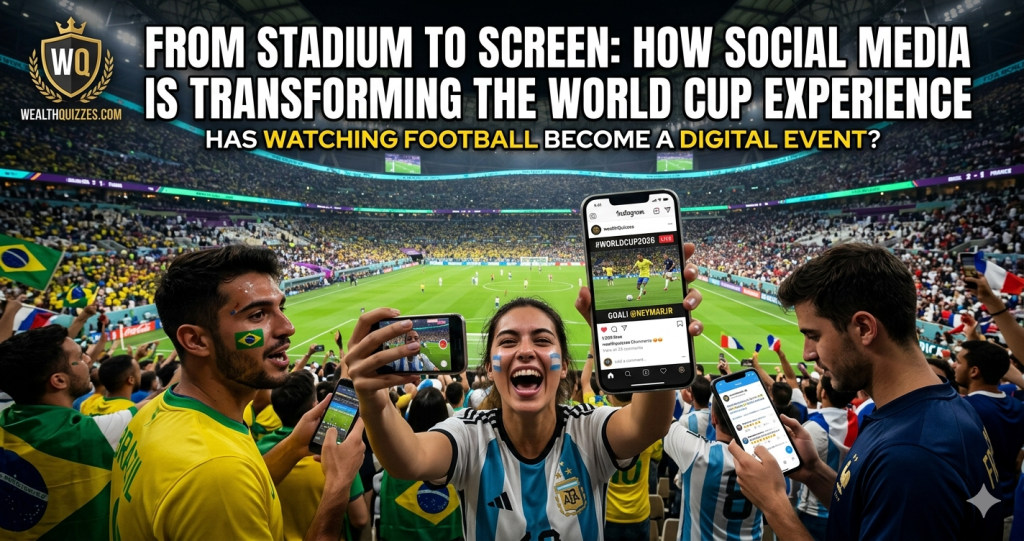
From the Stadium to the Screen: How Social Media Is Transforming the World Cup Experience
Has Watching Football Become as Much a Digital Event as a Sporting One?
There was a time when experiencing the FIFA World Cup meant gathering around a television or listening to live radio commentary while eagerly awaiting the next day’s newspapers for match reports and analysis. Today, that experience has been transformed. Fans no longer wait for highlights or expert opinions. Every goal, controversial decision, tactical adjustment, and emotional celebration is instantly shared, debated, analyzed, and immortalized across social media platforms within seconds.
The FIFA World Cup 2026, hosted across the United States, Canada, and Mexico, is not only the largest World Cup ever played but also the most digitally connected. Billions of supporters are following the tournament simultaneously through smartphones, tablets, smart televisions, and social networking platforms. The World Cup is no longer confined to the ninety minutes played inside the stadium. It has become a continuous global conversation that unfolds before kickoff, throughout the match, and long after the final whistle.
From viral goal celebrations on TikTok to tactical breakdowns on YouTube, live reactions on X, behind-the-scenes stories on Instagram, and fan communities on Facebook, social media has fundamentally reshaped how football is consumed.
This evolution raises an important question: Has watching football become just as much a digital event as a sporting one?
The evidence strongly suggests that it has.
The Digital Revolution in Football
Football has always been the world’s most popular sport, but digital technology has expanded its reach beyond anything previously imaginable.
According to the FIFA, the 2022 FIFA World Cup attracted billions of viewers across television and digital platforms, while social media engagement reached record-breaking levels. With the expansion to a 48-team tournament in 2026, digital participation has grown even further.
Supporters no longer experience matches alone.
They experience them together online.
A fan in Lagos, another in Buenos Aires, one in Tokyo, and another in London can celebrate the same goal simultaneously while interacting in real time through comments, videos, memes, and live discussions.
Media scholar Henry Jenkins has described this phenomenon as participatory culture, where audiences are no longer passive consumers but active contributors who help shape the narrative surrounding major events.
The FIFA World Cup perfectly illustrates this transformation.
Every Fan Has Become a Broadcaster
One of social media’s greatest impacts is that every supporter now possesses the ability to create content.
Previously, football analysis belonged almost exclusively to television commentators, newspapers, and professional journalists.
Today, millions of fans produce:
- Match reactions.
- Tactical analysis.
- Player ratings.
- Comedy skits.
- Podcasts.
- Highlight compilations.
- Statistical breakdowns.
Many independent football creators now command audiences comparable to traditional media organizations.
Football journalist Jonathan Wilson has observed that football discussion has become significantly more democratic because supporters can directly influence conversations rather than merely consume them.
This democratization has diversified football coverage while introducing new perspectives into public discourse.
Real-Time Engagement Has Changed Everything
Perhaps the greatest transformation lies in speed.
Social media has eliminated the delay between football action and public reaction.
When a spectacular goal is scored, millions of reactions appear online within moments.
When referees make controversial decisions, debates begin immediately.
Supporters no longer wait for post-match analysis.
Analysis begins during the match itself.
Former England striker and broadcaster Gary Lineker has frequently remarked that football now unfolds simultaneously on the pitch and across digital platforms.
The second screen has become almost as important as the first.
Many supporters watch matches while simultaneously engaging with online communities.
The Rise of Short-Form Football Content
Platforms emphasizing short-form video have transformed football storytelling.
Goals, assists, celebrations, skill moves, tactical animations, fan reactions, and humorous moments are condensed into highly shareable clips reaching millions of viewers.
Sports marketing experts note that younger audiences increasingly consume football through brief digital highlights rather than traditional long-form broadcasts.
This trend has expanded football’s accessibility while changing viewing habits.
Supporters now experience countless moments beyond the live broadcast itself.
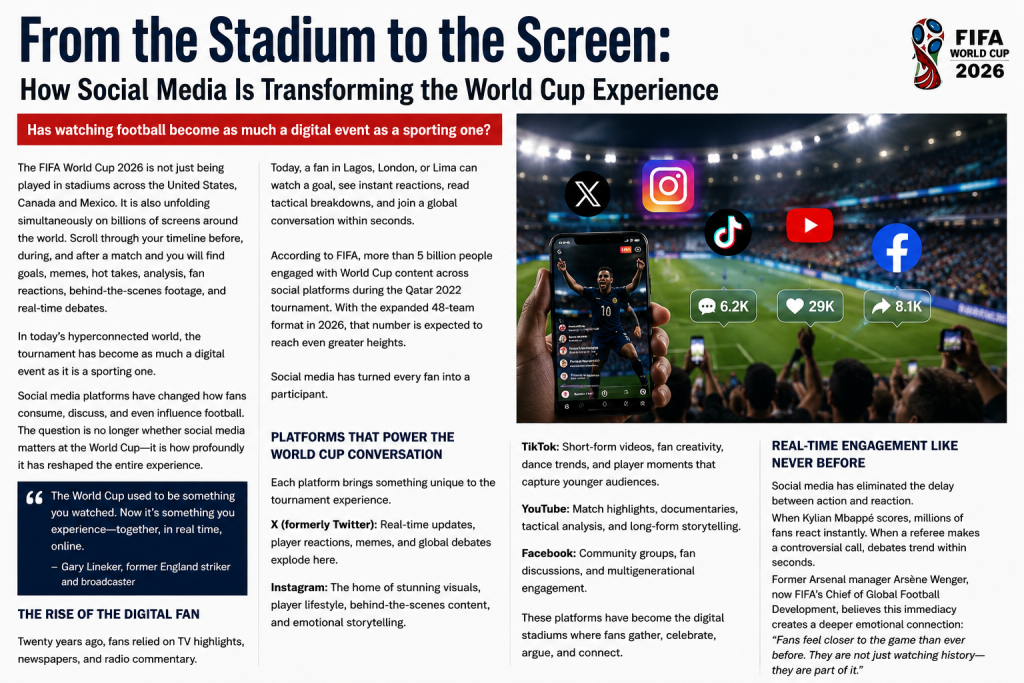
Athletes Speak Directly to Supporters
Social media has also transformed relationships between players and fans.
Footballers no longer rely exclusively on journalists to communicate with the public.
Instead, they share:
- Training sessions.
- Recovery routines.
- Family moments.
- Matchday preparations.
- Personal reflections.
- Charitable initiatives.
Global stars such as Kylian Mbappé, Lionel Messi, and Cristiano Ronaldo reach hundreds of millions of followers through their personal social media accounts.
This direct communication strengthens emotional connections between players and supporters while allowing athletes greater control over their public image.
Tactical Education Has Become Mainstream
Social media has not merely entertained supporters.
It has educated them.
Complex tactical concepts once discussed only among professional coaches now reach ordinary fans through animated graphics, statistical visualizations, and expert breakdowns.
Former Arsenal manager and FIFA Chief of Global Football Development Arsène Wenger has repeatedly emphasized that football supporters are becoming increasingly knowledgeable because of widespread access to tactical analysis.
Fans now regularly discuss:
- High pressing.
- Expected goals (xG).
- Build-up structures.
- Defensive blocks.
- Positional play.
- Transition football.
Football conversation has become considerably more sophisticated.
Social Media Drives Football Business
The World Cup is not only a sporting spectacle.
It is also a commercial powerhouse.
Digital engagement significantly influences:
- Sponsorship value.
- Merchandise sales.
- Brand partnerships.
- Advertising campaigns.
- Broadcasting revenue.
Sports economist Stefan Szymanski argues that digital visibility has become one of football’s most valuable commercial assets.
Sponsors increasingly evaluate teams and players based not only on performances but also on their online influence.
A viral moment can generate millions of impressions within hours.
That visibility translates directly into commercial value.
The Double-Edged Sword of Instant Reaction
Despite its many benefits, social media also presents challenges.
Football has become an environment of constant scrutiny.
Every missed penalty, defensive error, or controversial decision is dissected instantly before a global audience.
Players frequently experience intense criticism immediately after matches.
Sports psychologist Bob Rotella has argued that elite athletes must increasingly develop psychological resilience because digital criticism arrives faster and spreads further than ever before.
Managing online attention has become an essential component of modern professional football.
Artificial Intelligence Is Changing Fan Engagement
Artificial intelligence is beginning to reshape digital football experiences.
Supporters now receive:
- Personalized match highlights.
- AI-generated statistics.
- Automated tactical insights.
- Interactive match predictions.
- Customized news feeds.
These technologies allow fans to consume football in ways tailored specifically to their interests.
The FIFA World Cup 2026 demonstrates how technology continues expanding the relationship between supporters and the game.
Building Global Communities
Perhaps social media’s greatest achievement has been its ability to unite supporters across cultures.
Football has always connected people.
Digital platforms have amplified that connection.
Fans from different continents celebrate together, debate respectfully, exchange cultural perspectives, and build friendships based upon shared passion for the sport.
Media scholar Henry Jenkins argues that digital communities create stronger emotional engagement because audiences participate rather than merely observe.
The World Cup has become the ultimate example of this global participation.
The Future of the Digital World Cup
Looking ahead, football’s digital evolution appears certain to continue.
Emerging technologies such as augmented reality, virtual reality, artificial intelligence, and immersive streaming promise to transform fan experiences even further.
Supporters may soon:
- Experience matches through virtual stadium seats.
- Interact with AI commentators.
- Access personalized tactical simulations.
- Participate in immersive fan communities.
While the stadium will always remain the emotional heart of football, digital experiences will continue expanding the ways supporters engage with the game.
Conclusion: Football Has Entered a New Era
Has watching football become as much a digital event as a sporting one?
Without question.
The FIFA World Cup 2026 demonstrates that football now exists simultaneously in physical stadiums and digital spaces. Every match generates not only goals and results but also billions of online conversations, videos, reactions, analyses, and shared experiences.
Social media has transformed supporters from spectators into participants, commentators, analysts, and storytellers. It has strengthened football’s global reach, deepened fan engagement, accelerated tactical education, and reshaped the business of the sport.
As Henry Jenkins observed, audiences today help create the stories they consume.
Nowhere is that more evident than during the FIFA World Cup.
The beautiful game no longer ends when the referee blows the final whistle.
In the digital age, the conversation continues long after the match is over, connecting billions of supporters around the world and making the FIFA World Cup not only football’s greatest tournament but also one of the world’s largest shared digital experiences.