

Goalkeepers of Glory: The Unsung Heroes of FIFA World Cup 2026
Why Goalkeepers Often Determine Who Lifts the Trophy
Football has long celebrated its great goalscorers. The names of prolific strikers, creative playmakers, and dazzling wingers often dominate headlines, highlight reels, and award ceremonies. Their spectacular goals become iconic moments that define generations. Yet hidden behind every championship-winning campaign is another figure whose contribution is often less glamorous but equally decisive—the goalkeeper.
In every FIFA World Cup, history repeatedly demonstrates that while goals win matches, great goalkeeping wins tournaments. The finest goalkeepers produce moments of brilliance that rarely receive the same level of public admiration as spectacular goals, yet their saves often prove even more valuable. A penalty saved in the closing moments, a crucial one-on-one stop, a commanding aerial interception, or a perfectly timed distribution can alter the destiny of an entire nation.
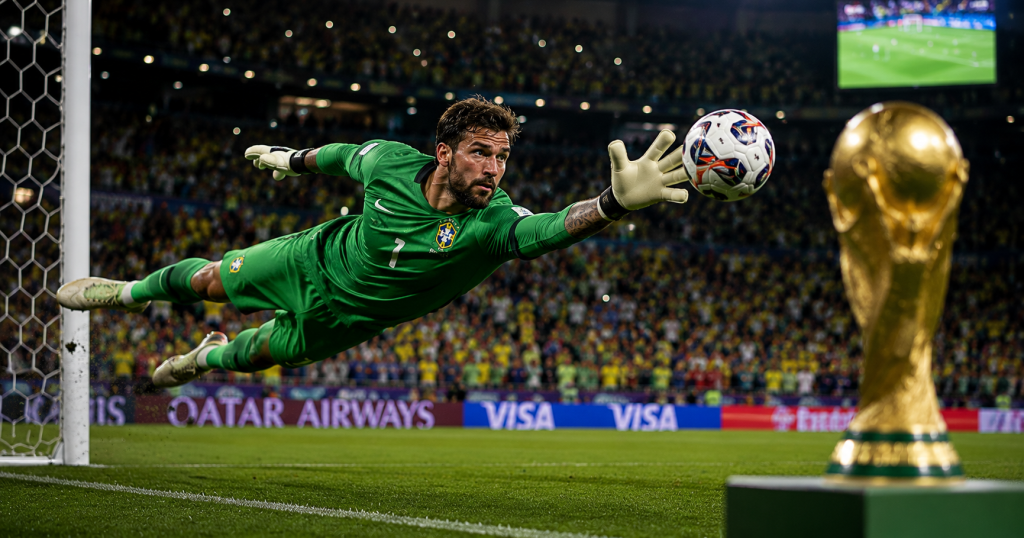
The FIFA World Cup 2026 has once again reinforced this enduring truth. Throughout the tournament, goalkeepers have emerged as silent architects of success, rescuing their teams during moments of intense pressure and providing the confidence upon which championship ambitions are built. Their influence extends far beyond stopping shots; they organize defenses, initiate attacks, maintain composure under immense pressure, and frequently become the emotional leaders of their teams.
This raises a compelling question: Why do goalkeepers so often determine who ultimately lifts football’s greatest trophy?
The answer lies in the unique combination of psychology, leadership, athletic excellence, tactical intelligence, and decision-making that defines football’s most specialized position.
The Most Demanding Position in Football
Among all positions on the football pitch, none carries greater responsibility than the goalkeeper.
Unlike outfield players, mistakes made by goalkeepers frequently lead directly to goals. A striker may miss several opportunities before eventually scoring, but a goalkeeper often receives only one chance to make the correct decision.
Legendary goalkeeper Lev Yashin, the only goalkeeper ever to win the Ballon d’Or, famously remarked that goalkeeping is a profession of patience, concentration, and courage. His observation remains just as relevant today.
For ninety minutes, a goalkeeper must remain mentally engaged, even during long periods without meaningful action. When called upon, reactions must be immediate and flawless.
The Last Line of Defense
Modern football has become increasingly tactical and physically demanding, but one principle remains unchanged.
Every successful team depends upon an exceptional final line of defense.
Football historian David Goldblatt argues that while football tactics have evolved dramatically over the past century, the goalkeeper has consistently remained the team’s ultimate insurance policy.
Defenders may reduce opportunities.
Midfielders may control possession.
Attackers may score goals.
But when every other layer fails, the goalkeeper alone stands between victory and defeat.
The Psychology of Elite Goalkeeping
Goalkeeping demands extraordinary mental resilience.
Sports psychologist Bob Rotella has consistently argued that elite performers distinguish themselves not by avoiding mistakes but by recovering from them immediately.
This principle applies especially to goalkeepers.
A goalkeeper may concede an unfortunate goal early in a match.
Yet they must instantly regain emotional control because additional decisive moments inevitably follow.
Unlike many other positions, goalkeepers cannot afford lingering self-doubt.
Their confidence influences the confidence of the entire team.
Leadership Begins at the Back
Many successful national teams appoint experienced goalkeepers as vocal leaders.
Standing behind the defensive line provides an ideal perspective from which to organize teammates.
Goalkeepers constantly communicate by:
- Directing defensive positioning.
- Coordinating pressing structures.
- Warning teammates about danger.
- Managing defensive transitions.
- Organizing set-piece marking.
Former Manchester United manager Sir Alex Ferguson repeatedly emphasized that communication and leadership often separate world-class goalkeepers from merely talented ones.
The best goalkeepers command their penalty areas with both authority and composure.
Reflexes Meet Preparation
Spectacular saves often appear spontaneous.
In reality, they result from years of deliberate preparation.
Sports scientist Tim Gabbett has demonstrated that elite athletic performance depends upon repeated exposure to realistic training environments.
Goalkeepers routinely practice:
- Reaction speed.
- Diving technique.
- Positioning.
- Ball handling.
- Footwork.
- Decision-making.
Thousands of repetitions enable split-second responses during competition.
Preparation transforms instinct into reliable performance.
Modern Goalkeepers Are Complete Footballers
The role of the goalkeeper has expanded dramatically.
Today’s elite goalkeepers contribute far beyond shot-stopping.
Former Barcelona manager Pep Guardiola has repeatedly described goalkeepers as the first attackers in modern football.
Their responsibilities now include:
- Building attacks from the back.
- Accurate long passing.
- Short passing under pressure.
- Sweeping behind defensive lines.
- Initiating counterattacks.
Goalkeepers increasingly function as additional outfield players during possession.
This evolution has fundamentally reshaped football tactics.
Penalty Shootouts: Football’s Ultimate Psychological Battle
Few moments influence World Cup history more dramatically than penalty shootouts.
Goalkeepers frequently become national heroes by saving decisive penalties.
Sports psychologist Geir Jordet has conducted extensive research into penalty shootouts.
His studies indicate that successful goalkeepers combine:
- Detailed preparation.
- Opponent analysis.
- Emotional control.
- Confident body language.
- Tactical anticipation.
Penalty success depends as much upon psychology as athletic ability.
The goalkeeper’s ability to introduce uncertainty into the penalty taker’s mind often determines the outcome.
Sports Science Has Elevated Goalkeeping
Advances in sports science have transformed goalkeeper preparation.
Training now incorporates:
- High-speed video analysis.
- Biomechanical assessment.
- Reaction technology.
- Virtual reality simulations.
- Data analytics.
- Artificial intelligence.
Sports performance specialists use these tools to improve movement efficiency while reducing injury risk.
The FIFA World Cup 2026 showcases perhaps the most scientifically prepared generation of goalkeepers in football history.
Reading the Game Before It Happens
Elite goalkeepers rarely rely solely on reflexes.
Instead, they anticipate events before they occur.
Former Italian goalkeeper Gianluigi Buffon has often explained that positioning enables goalkeepers to make difficult saves appear routine.
Anticipation requires:
- Tactical awareness.
- Opponent recognition.
- Pattern identification.
- Constant concentration.
The greatest saves frequently begin several seconds before the shot itself.
World Cup Legends Between the Posts
The FIFA World Cup has produced numerous legendary goalkeeping performances.
Among the tournament’s most celebrated goalkeepers are:
- Lev Yashin.
- Gordon Banks.
- Dino Zoff.
- Oliver Kahn.
- Iker Casillas.
- Emiliano Martínez.
Each produced performances that extended beyond individual brilliance.
They inspired confidence throughout their entire teams.
Their influence reached every area of the pitch.
Goalkeepers Shape Team Identity
Football journalist Jonathan Wilson notes that teams frequently adopt tactical identities based upon goalkeeper characteristics.
A goalkeeper comfortable with distribution encourages possession-based football.
An exceptional shot-stopper allows defenders to press more aggressively.
An outstanding sweeper enables higher defensive lines.
Thus, goalkeepers influence tactics even when they rarely touch the ball.
The Economics of Elite Goalkeepers
Goalkeepers have also become increasingly valuable assets.
Sports economist Stefan Szymanski argues that modern football increasingly recognizes the economic value of preventing goals alongside scoring them.
Elite goalkeepers now command substantial transfer fees because their performances directly influence:
- Tournament success.
- Commercial value.
- Club revenue.
- Sponsorship opportunities.
Investment in elite goalkeeping has become a strategic priority.
Lessons Beyond Football
Goalkeeping offers valuable lessons applicable beyond sport.
Successful goalkeepers demonstrate:
- Responsibility.
- Composure.
- Leadership.
- Preparation.
- Resilience.
- Accountability.
These qualities remain equally valuable in business, law, medicine, education, and public service.
Leadership often involves preventing problems before others even recognize them.
Goalkeepers embody precisely that principle.
The Legacy of World Cup 2026
The FIFA World Cup 2026 has once again demonstrated that football championships depend not only upon attacking brilliance but also upon defensive excellence.
Every tournament eventually reaches moments where margins become extraordinarily small.
One save.
One interception.
One command shouted to defenders.
One courageous dive.
Such moments often separate champions from runners-up.
Goalkeepers create many of those moments.
Conclusion: The Silent Architects of Champions
Why do goalkeepers so often determine who lifts the FIFA World Cup trophy?
Because football’s greatest tournaments are frequently decided not by the number of spectacular goals scored but by the number of seemingly impossible goals prevented.
The FIFA World Cup 2026 has reinforced the enduring importance of the men between the posts. Through exceptional leadership, tactical intelligence, psychological resilience, athletic excellence, and scientific preparation, modern goalkeepers have become complete footballers capable of influencing every phase of the game.
As Lev Yashin demonstrated decades ago, greatness in goalkeeping is measured not merely by spectacular saves but by the confidence inspired throughout an entire team.
The world’s greatest strikers may capture headlines.
The world’s greatest midfielders may dictate the rhythm of matches.
But when football’s biggest prize is finally lifted into the air, history repeatedly reminds us that somewhere along the journey, a goalkeeper made the save that changed everything.
They are the guardians of glory, the silent architects of championship success, and the unsung heroes whose contributions often determine football’s greatest triumphs.