How Football Changed the Global Sports Economy: Football as an Economic Force
How did football become the world’s richest and most influential sport?
Football began as a game played for competition, community and pride. Today, it is a global economic ecosystem involving broadcasting corporations, technology companies, airlines, banks, betting and gaming businesses, sportswear manufacturers, sovereign investors, private-equity funds, tourism authorities, media platforms, advertisers, stadium developers and millions of consumers.
Few sports have achieved anything comparable in geographic reach or commercial depth.
The modern football economy stretches from the neighbourhood academy to billion-dollar clubs, from children’s jerseys sold in Lagos to television rights negotiated across continents, and from a ticket purchased at a local stadium to sponsorship agreements worth hundreds of millions of dollars.
But describing football simply as the “world’s richest sport” requires some qualification. American football’s NFL, for example, generates enormous revenues, while other major sports have extraordinarily valuable competitions and franchises. What makes football exceptional is the combination of scale, global participation, commercial reach, cultural influence and a deeply interconnected club-and-national-team ecosystem.
And the numbers are becoming extraordinary.
According to Deloitte’s 2026 Annual Review of Football Finance, the European football market generated a record €40.2 billion in the 2024/25 season, becoming the first time the market had crossed €40 billion. The five largest European leagues alone generated €21.6 billion. Premier League clubs accounted for £6.8 billion of revenue. (Deloitte)
Football is no longer merely part of the sports economy.
Football is one of the engines of the global sports economy.
From Local Game to Global Industry
The transformation did not happen overnight.
Football’s early development was largely local and community-based. Clubs were associated with factories, schools, towns, religious institutions and neighbourhoods. Spectators paid relatively modest sums to watch matches, while players were generally far less commercially valuable than today’s stars.
The economic structure changed dramatically as football became professionalised and organised into national competitions.
But the greatest revolution came when football became a broadcast product.
A stadium can accommodate tens of thousands of spectators.
Television can reach tens of millions.
The internet can reach hundreds of millions.
That distinction fundamentally changed football’s economics.
A match was no longer valuable merely because people could attend it. It became valuable because billions of people could potentially watch, discuss, share, analyse and consume commercial products around it.
This is the foundation of modern sports economics.
Television Changed Everything
Among the most important developments in football’s commercial history was the explosion of broadcasting rights.
Television transformed football clubs and leagues from organisations selling tickets into organisations selling audience access.
Broadcasters compete for the right to show football because live sport possesses a characteristic that recorded entertainment often lacks: immediacy.
A match cannot be meaningfully spoiled in advance for the viewer who wants to experience it live.
This makes elite football extraordinarily attractive to broadcasters and advertisers.
FIFA’s financial figures demonstrate the scale of this model. In 2025 alone, FIFA generated approximately US$1.04 billion from television broadcasting rights, making broadcasting its largest revenue category that year. Marketing rights generated a further US$965 million. (FIFA Football Technology)
The economic principle is straightforward:
The more people who want to watch, the more valuable access to those people becomes.
This helped turn football rights into some of the most expensive assets in the entertainment industry.
The Premier League Revolution
Perhaps no competition illustrates the commercial transformation of football better than the English Premier League.
When the Premier League was established in 1992, it was not simply a new football competition. It represented a new commercial architecture.
The league developed a sophisticated broadcasting model, internationalised its brand and progressively turned its clubs into global entertainment businesses.
The result has been extraordinary.
Deloitte reports that Premier League clubs generated £6.8 billion in aggregate revenue during 2024/25, up 8% year-on-year. (Deloitte)
The league’s commercial power has also spread beyond broadcasting.
Premier League clubs increasingly monetise:
- shirt sponsorship;
- stadium naming and hospitality;
- merchandise;
- digital content;
- international tours;
- licensing;
- membership programmes;
- social media;
- corporate partnerships;
- data and technology;
- premium matchday experiences.
In 2023/24, Premier League commercial revenue exceeded £2 billion for the first time, according to Deloitte. (Deloitte)
That is an important development because it demonstrates that football’s economic model is becoming increasingly diversified.
Football’s Three Traditional Economic Pillars
The football business historically rests on three major revenue pillars.
1. Broadcasting
Television and increasingly streaming platforms pay leagues and competitions for media rights.
2. Commercial Revenue
Sponsors pay for association with clubs, players and competitions. Manufacturers pay for kit rights. Companies purchase advertising inventory and partnership packages.
3. Matchday Revenue
Fans purchase tickets, hospitality packages, food, drinks and merchandise.
Modern football has expanded all three.
And the stadium itself has become an economic asset.
A stadium is no longer necessarily a building used for 25 or 30 football matches each year.
It can host concerts, conferences, restaurants, museums, retail operations, corporate events and tourism experiences.
Deloitte notes that stadium redevelopment and commercial activity have become increasingly important drivers of football revenue. In Europe’s big five leagues, aggregate matchday revenue reached €3.4 billion in 2024/25. (Deloitte)
The Rise of the Football Brand
Perhaps football’s most powerful economic innovation is the transformation of clubs into brands.
Real Madrid is not merely a football team.
Manchester United is not merely a football team.
Barcelona, Bayern Munich, Liverpool and Paris Saint-Germain are not merely football teams.
They are global consumer brands.
Their logos appear on shirts, footwear, video games, television programmes, social media feeds, advertising campaigns and commercial products.
The economic value lies partly in emotional attachment.
A football supporter does not merely consume a product.
He or she develops an identity around it.
This distinction is crucial.
A consumer might change smartphone brands.
A football supporter rarely changes the club they support.
That creates an extraordinarily durable commercial relationship.
The Economics of the Footballer
Footballers themselves have also become economic assets.
A world-class player does not simply produce goals, assists or defensive actions.
He can generate:
- ticket demand;
- shirt sales;
- social-media engagement;
- sponsorship opportunities;
- broadcast interest;
- international audiences;
- commercial partnerships;
- transfer income.
This explains why elite footballers can command extraordinary transfer fees.
The transfer market has effectively created a global labour market in which clubs compete for scarce elite talent.
Sports economists such as Stefan Szymanski and Simon Kuper, in Soccernomics, have emphasised the relationship between sporting success and financial performance: clubs that consistently compete at the highest level tend to gain greater revenues, while greater revenues can enable them to acquire and retain better players.
This creates a powerful feedback loop:
Money can buy talent; talent can generate success; success can generate more money.
That mechanism is one reason financial inequality can become self-reinforcing in elite football.
The Globalisation of Football
Football’s economic revolution is also a story about globalisation.
The English Premier League is watched far beyond England.
La Liga has followers throughout Latin America, Asia and Africa.
The Champions League has become a global entertainment property.
The FIFA World Cup can transform an entire country’s tourism, infrastructure and international visibility.
Players themselves have become global ambassadors.
A Nigerian supporter can follow a Premier League club every weekend, purchase its shirt online, watch its players on social media and discuss its matches with supporters thousands of kilometres away.
Geography no longer limits football’s commercial reach.
The internet has accelerated this transformation.
Social media has converted football clubs into 24-hour media organisations.
A club no longer communicates with supporters only on match day.
It can publish training videos in the morning, player interviews at noon, tactical analysis in the afternoon and match highlights at night.
Every piece of content represents another opportunity to generate attention.
And attention has become an economic asset.
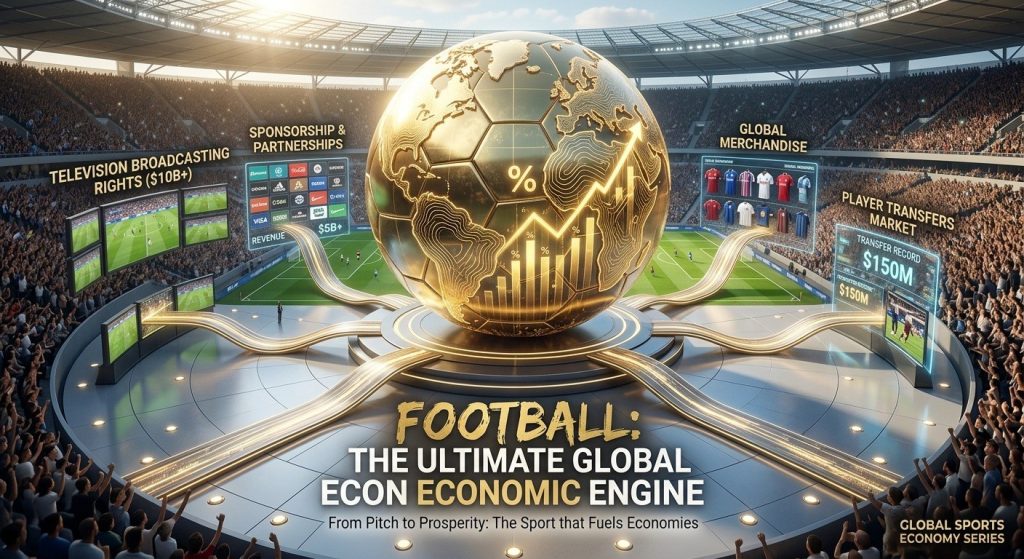
FIFA: Football as a Global Commercial Machine
At the top of the pyramid sits FIFA.
The organisation’s financial structure illustrates just how valuable global football has become.
FIFA reported US$2.661 billion in revenue and other income in 2025, with broadcasting rights contributing about US$1.044 billion and marketing rights approximately US$965 million. Licensing generated about US$97 million, while hospitality rights and ticket sales contributed roughly US$410 million. (FIFA Football Technology)
The figures also demonstrate something important about modern football.
The money does not come from one source.
It comes from an ecosystem.
Television companies pay for audiences.
Sponsors pay for association.
Fans pay for experiences.
Manufacturers pay for licensing.
Hospitality companies monetise premium consumers.
Cities benefit from tourism.
Airlines benefit from international travel.
Hotels benefit from visitors.
Restaurants benefit from match-related activity.
Technology companies benefit from digital consumption.
In other words, football creates economic activity far beyond the football pitch.
The Club World Cup and Football’s Expanding Economic Geography
The 2025 FIFA Club World Cup provided a striking example of football’s continuing commercial expansion.
FIFA reported that the tournament generated strong financial results, with 2.49 million spectators attending 63 matches across 12 stadiums. Ticketing generated approximately US$261 million, while hospitality generated another US$150 million. (FIFA Football Technology)
The tournament also demonstrated how football’s economic geography is changing.
The traditional centre of football’s commercial power has been Europe.
But investment, audiences, tournaments and ownership are increasingly global.
UEFA’s latest financial analysis records continued investor interest in European football, including growing involvement from US investors and increasing interest in minority stakes. UEFA identified 111 football investment deals in Europe in 2025, including 29 controlling-stake acquisitions involving top-division clubs. (ECFIL 2025)
Football is therefore becoming increasingly international not only in terms of supporters but also in terms of capital.
The Financialisation of Football
This leads to another major transformation.
Football clubs have increasingly become investment assets.
Private investors, institutional capital, wealthy individuals, sovereign-linked funds and multinational corporations have all recognised that football clubs possess something difficult to reproduce: a global emotional customer base.
A football club can own intellectual property, stadium assets, media rights, sponsorship relationships and a worldwide community of supporters.
That makes football attractive to investors.
But there is a danger.
Football revenue can rise dramatically without corresponding profitability.
UEFA’s latest financial analysis highlights precisely this tension: European top-division club revenue is projected to exceed €30 billion, yet rising costs mean record revenues do not automatically translate into profits. (UEFA.com)
Deloitte’s 2026 figures tell a similar story. Despite record revenues, Premier League clubs’ aggregate pre-tax losses increased dramatically to £948 million in 2024/25. (Deloitte)
This is an important economic lesson.
Revenue is not profit.
Football may be richer than ever while individual clubs remain financially vulnerable.
Football’s Impact Beyond Clubs
The economic influence of football extends into entire cities and countries.
Major tournaments create demand for:
- hotels;
- airlines;
- restaurants;
- transport;
- security;
- construction;
- telecommunications;
- retail;
- tourism;
- advertising;
- event management;
- digital services.
The FIFA World Cup is particularly powerful because it temporarily concentrates global attention on a host country.
Stadiums may be the visible infrastructure, but the economic footprint extends much further.
The tournament becomes an international marketing platform for the host nation.
This explains why governments are often willing to invest heavily in football infrastructure.
The expected return is not always direct ticket revenue.
It may include tourism, international exposure, infrastructure development, diplomatic influence and long-term destination branding.
The Women’s Game: A New Economic Frontier
Football’s economic expansion is also increasingly visible in women’s football.
Deloitte reported that Women’s Super League clubs generated £90 million in aggregate revenue in 2024/25, representing a 39% increase over the previous season. (Deloitte)
The growth demonstrates that football’s commercial model still has substantial room for expansion.
Women’s football is attracting larger audiences, sponsorship agreements, broadcast investment and professional infrastructure.
That matters because football’s economic future will not be confined to men’s competitions.
The next major phase of growth may come from markets and demographics that have historically been under-monetised.
Is Football Really the World’s Richest Sport?
This question requires intellectual honesty.
Football cannot simply be declared the richest sport by every financial measure.
The NFL, for example, generates enormous revenues per team. Major American sports franchises can also command extraordinary valuations.
But football’s unique strength lies elsewhere.
It has perhaps the world’s most extensive combination of:
global participation + international competitions + club football + national teams + broadcasting + sponsorship + merchandising + player trading + tourism + digital media + cultural influence.
That is why football’s economic influence is so difficult to replicate.
The game has built an economic ecosystem that operates at almost every level of society.
The Future: From Football Economy to Football Ecosystem
The next stage of football’s economic evolution is already emerging.
Streaming will continue to challenge traditional television.
Artificial intelligence will transform scouting, analytics and fan engagement.
Virtual and augmented reality could create new forms of matchday consumption.
Digital memberships can connect clubs directly to international supporters.
Data will become increasingly valuable.
Stadiums will become entertainment and commercial destinations rather than simply football venues.
And investors will continue to search for undervalued football markets.
The economic question will therefore no longer be simply:
How much money can football generate?
It will become:
How efficiently can football convert global attention into sustainable economic value?
Conclusion: Football Became an Economy Because It Became an Identity
Football’s greatest economic achievement was not the invention of television rights or sponsorship.
It was something deeper.
Football transformed emotional loyalty into economic value.
A supporter watches a match because they care.
That attention attracts broadcasters.
Broadcasters attract advertisers.
Advertisers attract sponsors.
Sponsors finance clubs and competitions.
Clubs invest in players.
Players create sporting drama.
Drama attracts more supporters.
And the cycle continues.
That is football’s economic engine.
The latest figures reveal just how powerful it has become. European football surpassed €40 billion in annual revenue in 2024/25, while FIFA generated more than US$2.6 billion in 2025 alone. (Deloitte)
But the most remarkable statistic is not financial.
It is the number of people who care.
Football’s greatest asset is not the stadium, the television contract, the shirt or even the player.
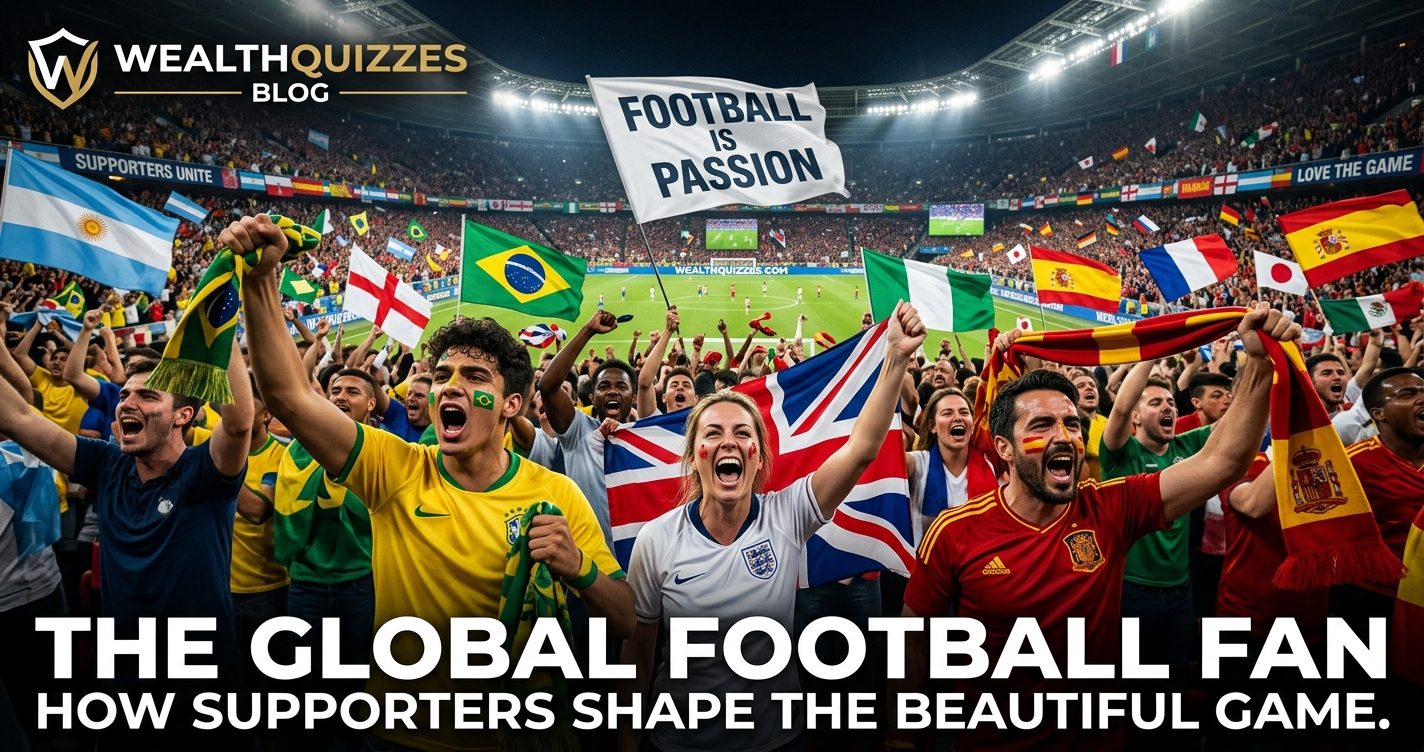
It is the global supporter.
That is why football has changed the sports economy.
It took a simple game—22 players, one ball and two goals—and built around it one of the most sophisticated commercial ecosystems in modern entertainment.
The transformation from local pastime to global economic force is therefore not merely a story about money.
It is a story about attention, identity, culture, technology, capital and human emotion.
And as long as billions of people continue to care about what happens when the ball crosses the line, football’s economic influence is unlikely to disappear.
The beautiful game did not merely enter the global economy. It helped redefine what the modern sports economy could become.