Kanem-Bornu: The Ancient Empire That Survived for Centuries
Long before the emergence of the modern states of Nigeria, Chad, Niger and Cameroon, the Lake Chad region was home to one of Africa’s most enduring political traditions: Kanem-Bornu. For centuries, successive rulers known as the Mai presided over a state whose political influence, commercial networks and intellectual traditions extended across large parts of the Central Sudan and into the Sahara.
What makes Kanem-Bornu particularly remarkable is not simply its antiquity. It is the empire’s extraordinary ability to adapt without losing its political identity. Dynasties changed, capitals moved, territories were lost and recovered, and military technologies evolved. Yet the institution of the Mai and the political traditions associated with Kanem-Bornu survived for many centuries.
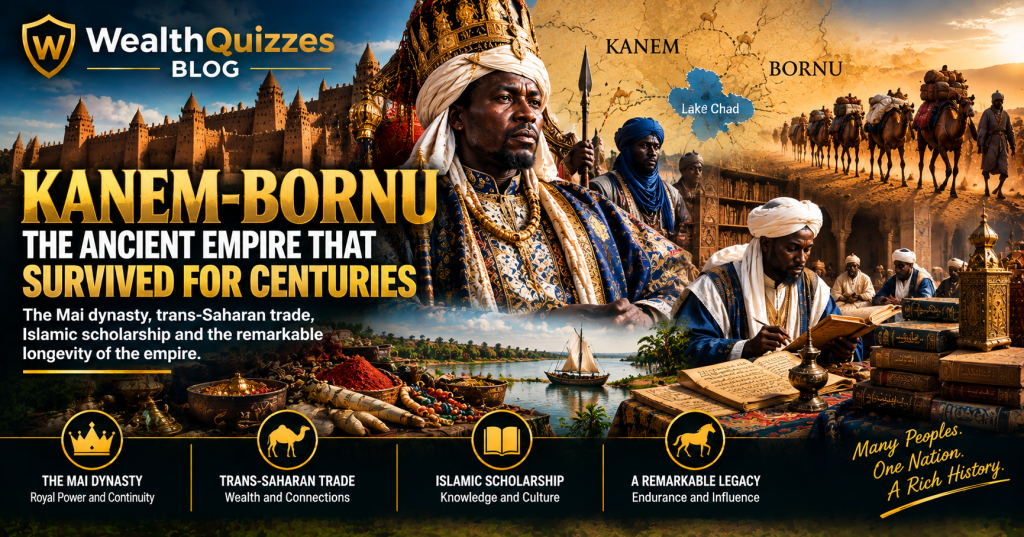
The story of Kanem-Bornu is therefore not merely the story of an ancient empire. It is a story of political resilience, trans-Saharan commerce, Islamic transformation, military adaptation and institutional continuity.
The Origins of Kanem
The precise origins of Kanem remain a subject of scholarly debate. Archaeological evidence, oral traditions and Arabic written sources do not always provide an identical chronology. Nevertheless, historians generally place the emergence of Kanem as a substantial political formation around the first millennium CE.
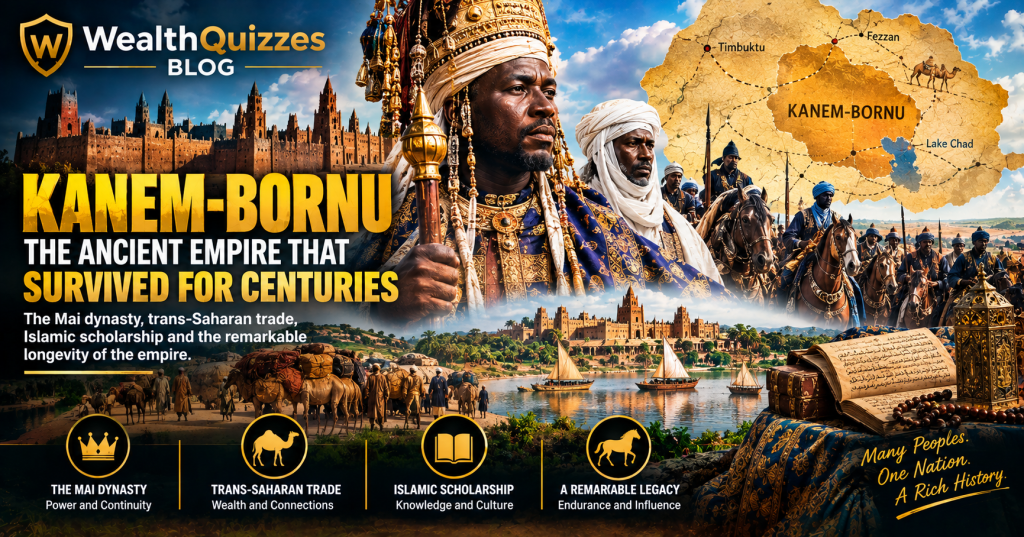
The Metropolitan Museum of Art identifies the Kanem kingdom as emerging by about the tenth century, describing its formation as involving pastoralist clans brought together under a ruling dynasty. The empire developed around the eastern and northeastern shores of Lake Chad, an environment that connected the Sahel, the Sahara and the savanna regions farther south.
The strategic position of the Lake Chad basin was fundamental to Kanem’s development. The region was neither an isolated desert frontier nor simply an agricultural zone. It was a meeting point between different ecological and commercial worlds.
To the north lay the Sahara and the North African trading centres. To the west were the Hausa states and other Sudanic societies. To the east lay the territories toward the Nile and the wider Central African interior, while the south connected Kanem to the lands around the Chari and Logone systems.
This geographical position gave Kanem something enormously valuable: connectivity.
The Mai Dynasty and the Making of a Durable State
At the centre of Kanem-Bornu’s political system stood the Mai, the royal ruler whose authority combined political, military and religious dimensions.
The history of the monarchy is complicated by differences among king lists, oral traditions and later written chronicles. Nevertheless, the continuity of the royal institution is striking. Scholars distinguish between earlier ruling traditions and the later Sēfuwa/Sayfawa dynasty, which became the dominant royal house of Kanem and subsequently Bornu.
Historian Dierk Lange, one of the leading modern scholars of Kanem-Bornu, has demonstrated the importance of the Sēfuwa dynasty in the empire’s transformation. According to Lange, the Sēfuwa established themselves in Kanem around the eleventh century and subsequently expanded their authority into Bornu. By the thirteenth century, Bornu had become increasingly important to the dynasty.
The importance of the dynasty was not merely genealogical. It provided an institutional framework through which political authority could survive periods of war, migration and territorial disruption.
That was one of Kanem-Bornu’s greatest strengths.
The empire could lose a territory without necessarily losing the state.
Islam and the Transformation of Kanem
One of the most important developments in Kanem’s history was the adoption and gradual institutionalisation of Islam among the ruling elite.
Islam did not simply arrive as a replacement for existing traditions. It became intertwined with political authority, diplomacy, literacy and scholarship.
The relationship between Islam and Kanem was complex. Historian E. Lavers, together with scholars such as Humphrey Fisher and Dierk Lange, has examined the political consequences of Islamisation in Kanem. Cambridge scholarship notes that the adoption of Islam by the ruling establishment involved tensions between Islamic political ideals and older traditions.
This is important because Kanem-Bornu illustrates a broader pattern in African history: Islamisation could strengthen political institutions while simultaneously creating new debates about royal authority, law and religious legitimacy.
The Mai increasingly became connected to the wider Muslim world. Pilgrimage to Mecca, correspondence with Muslim rulers, the employment of scholars and the development of Arabic literacy all helped connect the Chad basin to a much larger intellectual and political system.
Kanem and the Trans-Saharan Trade
Kanem-Bornu’s longevity cannot be understood without examining the trans-Saharan trade.
The Sahara was not an impenetrable barrier. It was a vast commercial corridor crossed by caravans carrying commodities, people, ideas and political influence.
Historian B. G. Martin, in his important study Kanem, Bornu, and the Fazzān: Notes on the Political History of a Trade Route, demonstrated the significance of the route linking Kanem and Bornu with North Africa through the Fezzan and the Libyan coast. He described this route as a major connection maintained across centuries between the Central Sudan and North Africa.
The commercial system involved multiple commodities. From the southern regions came products such as slaves, ivory and other valuable goods, while northern markets supplied manufactured products, textiles, metal goods, horses and other commodities.
The Metropolitan Museum of Art describes the Sahara as a major “superhighway” of exchange, with camel caravans transporting goods across the desert between North Africa and the Sahel.
For Kanem-Bornu, control over routes and commercial centres provided revenue, diplomatic leverage and access to foreign technologies.
Trade therefore helped sustain the political structure.
But the relationship worked in both directions: the empire protected and controlled trade, while trade helped finance the empire.
The Move from Kanem to Bornu
One of the greatest tests of Kanem-Bornu came in the fourteenth century.
The empire faced serious political and military pressure in Kanem, particularly from the Bulala. Eventually, the Sēfuwa ruling establishment was forced to retreat from its traditional centre.
Yet this did not mark the end of the empire.
Instead, the political centre shifted westward into Bornu.
This episode is perhaps the clearest illustration of Kanem-Bornu’s remarkable resilience.
Dierk Lange’s research shows that the loss of Kanem did not destroy the Sēfuwa political system. The dynasty compensated for its territorial losses in the east through its growing influence farther west, while Bornu increasingly became the centre of imperial power.
In other words, Kanem-Bornu survived by relocating rather than collapsing.
The empire changed its geographical centre while preserving its political identity.
Bornu and the Revival of Imperial Power
After the migration into Bornu, the state gradually rebuilt its strength.
A new political centre emerged around Ngazargamu, which became one of the most important capitals in the history of Bornu. The Mai once again exercised authority over a substantial territory and re-established connections with commercial and intellectual networks.
The fifteenth and sixteenth centuries were particularly important in the reconstruction of Bornu power.
Mai Ali Gaji is traditionally associated with the consolidation of Bornu and the establishment of Ngazargamu as a major capital. His reign and those of his successors helped stabilise the political system after generations of conflict.
By this stage, the empire was no longer simply an ancient Kanem kingdom that had moved westward. It had become a sophisticated Bornu-centred imperial state with its own political, military and intellectual traditions.
Islamic Scholarship and the Rise of a Learned Court
One of Kanem-Bornu’s most important legacies was its contribution to Islamic scholarship in the Central Sudan.
The emergence of Arabic literacy transformed the intellectual life of the region.
The court attracted Muslim scholars, jurists, teachers and chroniclers. Arabic became an important language of scholarship and diplomacy, while local intellectual traditions developed around Islamic education.
A particularly important figure was Ahmad ibn Fartuwa, a sixteenth-century scholar and chief imam associated with Bornu. His writings provide valuable historical information about the reign and military campaigns of Mai Idris Alooma.
Scholarship on the Arabic literary tradition of Nigeria identifies Bornu as one of the earliest major centres of Arabic-Islamic learning in the region, with Ngazargamu attracting scholars from across the wider Muslim world. The tradition eventually became locally rooted, producing scholars and historical writings of its own.
This intellectual tradition was part of a much larger network.
Bornu was connected to places such as Cairo, the Fezzan, Tripoli, Katsina, Timbuktu and other centres of Islamic learning.
The empire was therefore not intellectually isolated. It participated in a trans-Saharan world of scholarship in which books, teachers, religious ideas and political concepts circulated alongside commercial goods.
Mai Idris Alooma: Military and Political Transformation
Perhaps the most celebrated ruler in the later history of Bornu was Mai Idris Alooma, who ruled in the late sixteenth century.
His reign is particularly well documented because of the writings of Ahmad ibn Fartuwa, who recorded the first twelve years of Alooma’s reign.
Alooma represented the combination of political authority, military innovation and Islamic leadership that characterised the mature Bornu state.
Under him, Bornu strengthened its military organisation, expanded its diplomatic relationships and improved its ability to project power.
One of the most remarkable developments was the introduction of firearms.
Cambridge historians Humphrey Fisher and Virginia Rowland note that the earliest known reference to firearms in the Central Sudan is associated with the reign of Idris Alooma. Their research identifies the presence of Turkish-linked musketeers and specialised firearm expertise in Alooma’s forces.
This was not simply a technological curiosity.
It demonstrated a fundamental characteristic of Bornu’s political system: adaptation.
The empire was willing to incorporate useful foreign technology into an established African military system.
Diplomacy Beyond the Sahara
Bornu’s international connections extended beyond commerce.
The empire maintained diplomatic contacts with North African and Middle Eastern powers.
B. G. Martin’s research shows that Bornu came into contact with the Ottoman Empire during the sixteenth century. Correspondence and diplomatic exchanges reveal that Mai Idris sought access to Ottoman military resources, including firearms and possibly military assistance.
These contacts demonstrate that Bornu was not a peripheral political community merely receiving influences from elsewhere.
It was an active participant in international diplomacy.
The Mai could negotiate, request military assistance, exchange envoys and engage rulers far beyond the Lake Chad basin.
Why Did Kanem-Bornu Survive for So Long?
The extraordinary longevity of Kanem-Bornu cannot be attributed to a single factor.
Several elements reinforced one another.
First was dynastic continuity. The Mai institution provided a durable centre of political legitimacy.
Second was geographical adaptability. When Kanem became difficult to defend, the political centre moved to Bornu.
Third was commercial integration. Control of trans-Saharan trade generated wealth and connected the empire to powerful external markets.
Fourth was Islamic connectivity. Islam provided access to literacy, scholarship, diplomacy and a wider political community stretching across North Africa and the Middle East.
Fifth was military adaptation. From cavalry and fortified settlements to firearms and imported military expertise, Bornu repeatedly adjusted to changing strategic circumstances.
Sixth was institutional memory. The empire preserved historical traditions, royal genealogies, religious learning and administrative practices that allowed successive rulers to inherit a recognisable political system.
These factors help explain why Kanem-Bornu survived while many other medieval African states disappeared or were absorbed by competing powers.
The Empire and the Wider Nigerian Historical Landscape
Although Kanem-Bornu was centred around the Lake Chad basin rather than the southern regions of present-day Nigeria, its history is deeply relevant to Nigerian history.
Its influence extended into parts of what is now northeastern Nigeria, while its commercial and intellectual networks connected it with the Hausa states and other political communities.
Indeed, the Central Sudan cannot be understood through modern national boundaries.
The political geography of medieval and early modern Africa was different from today’s map. Kanem-Bornu’s history unfolded across territories that today belong to several sovereign states.
This is precisely why its story is so important: African political history predates the modern borders of Africa.
A Legacy of Extraordinary Resilience
Kanem-Bornu eventually faced new challenges from the nineteenth century, including the upheavals associated with the Fulani jihad and the rise of rival political forces.
Yet even then, the political traditions of Bornu did not simply disappear.
The dynasty and its institutions continued to exert influence, and the region remained politically significant into the modern era.
The empire’s greatest legacy may therefore be its demonstration of what political resilience looked like in precolonial Africa.
Kanem-Bornu was not continuously powerful for more than a thousand years. It experienced wars, internal conflicts, territorial losses, dynastic struggles and periods of decline.
Its achievement was more sophisticated than uninterrupted dominance.
It repeatedly reorganised itself in response to crisis.
When its political centre was threatened, it moved.
When commercial conditions changed, it adapted.
When Islam expanded, it incorporated Islamic scholarship into its political and intellectual culture.
When military technology changed, it acquired firearms.
When diplomatic opportunities emerged, it negotiated with powers as distant as the Ottoman Empire.
That capacity for adaptation is what makes Kanem-Bornu one of the most remarkable political traditions in African history.
Conclusion
The history of Kanem-Bornu challenges the outdated idea that Africa’s great precolonial states were short-lived or politically unsophisticated.
For centuries, the Mai dynasty presided over a state connected to the Sahara, North Africa and the wider Muslim world. Its merchants crossed desert routes; its scholars produced Arabic writings; its rulers undertook pilgrimage and diplomacy; its armies adopted new military technologies; and its political institutions survived dramatic territorial transformations.
From Kanem to Bornu, from Njimi to Ngazargamu, the empire repeatedly demonstrated that political survival depends not merely on military strength but on institutional continuity, economic connectivity and the ability to adapt.
Kanem-Bornu therefore deserves a prominent place in the history of Africa—not simply as an ancient empire that lasted for centuries, but as one of the continent’s clearest examples of political endurance and historical resilience.
WealthQuizzes Blog Takeaway
Kanem-Bornu survived because it adapted. Its Mai dynasty provided continuity; trans-Saharan trade supplied wealth and international connections; Islam opened doors to scholarship and diplomacy; and military innovation enabled the empire to respond to changing threats. Its history is a powerful reminder that some of Africa’s most enduring civilisations were built not only through conquest, but through the ability to transform themselves without losing their identity.
Renowned Authorities and Scholarly Works
The historical interpretation above draws particularly on the work of:
- Dierk Lange, whose research on the Sēfuwa dynasty and the political transformation from Kanem to Bornu is central to modern scholarship.
- B. G. Martin, whose research examines Kanem-Bornu’s relationship with the Fezzan and the trans-Saharan trade route.
- Humphrey J. Fisher, a major authority on the history of Islam and the Central Sudan.
- Virginia Rowland, whose research with Fisher examined the introduction of firearms into the Central Sudan.
- E. Lavers, whose scholarship addresses the relationship between Islam and political change in Kanem.
- Ahmad ibn Fartuwa, the sixteenth-century Bornu scholar and chief imam whose historical writings provide an important near-contemporary account of the reign of Mai Idris Alooma.
- Robert O. Collins and James M. Burns, whose A History of Sub-Saharan Africa places Kanem-Bornu within the broader history of African state formation.
- The Metropolitan Museum of Art, whose scholarship and educational resources illuminate the Central Sudan, trans-Saharan commerce and the relationship between trade and Islamic culture.