
Lessons from FIFA World Cup 2026: What Business Leaders Can Learn from Football
Leadership, Teamwork, Strategy, and Resilience on the World’s Biggest Stage
The FIFA World Cup has always been more than a football tournament. Every four years, it becomes a living laboratory of leadership, strategy, innovation, risk management, crisis response, teamwork and decision-making under immense pressure. While billions of fans watch for the goals and trophies, business executives, entrepreneurs and organizational leaders can observe something equally valuable—the principles that separate successful teams from those that fall short.
The recently concluded FIFA World Cup 2026, jointly hosted by the United States, Canada and Mexico, offered perhaps the richest collection of business lessons in the tournament’s history. As the first World Cup featuring 48 nations and 104 matches, it challenged FIFA, participating teams and host nations with unprecedented logistical, operational and strategic complexities.
Ultimately, Spain emerged as world champions, defeating Argentina in the final after producing one of the tournament’s most disciplined and tactically sophisticated campaigns. However, every participating nation—from champions to those eliminated in the group stage—left behind lessons applicable far beyond football.
Management thinker Peter Drucker, widely regarded as the father of modern management, famously observed:
“Management is doing things right; leadership is doing the right things.”
That distinction was visible throughout FIFA World Cup 2026.
Similarly, Harvard Business School professor Michael Porter has consistently argued that sustainable success results not merely from operational effectiveness but from strategic positioning.
Football’s biggest tournament demonstrated precisely why these principles remain timeless.
Leadership Begins with Vision
Every successful World Cup team begins with a clear vision.
Spain’s manager Luis de la Fuente inherited a talented but relatively inexperienced squad. Rather than attempting to replicate Spain’s famous tiki-taka era exactly, he modernised the team’s identity while preserving its core strengths—technical excellence, positional discipline and intelligent ball movement.
Business leaders face similar responsibilities.
Successful organizations do not merely imitate competitors.
They build upon their own strengths while adapting to changing realities.
Former Apple CEO Steve Jobs once remarked:
“Innovation distinguishes between a leader and a follower.”
Spain’s victory illustrated this principle perfectly.
They respected tradition without becoming prisoners of it.
Teamwork Always Outperforms Individual Brilliance
One of football’s greatest myths is that tournaments are won by superstar players.
History repeatedly proves otherwise.
Although Spain possessed exceptional talents such as Rodri, Lamine Yamal and Nico Williams, their greatest strength was collective unity.
Every player understood his role.
Every player sacrificed for the team.
Every player trusted the system.
Business organizations operate in exactly the same way.
Research by Patrick Lencioni, author of The Five Dysfunctions of a Team, consistently demonstrates that trust and collaboration outperform individual brilliance within high-performing organizations.
Many companies recruit exceptional individuals.
Far fewer build exceptional teams.
World Cup 2026 reinforced that distinction.
Strategy Matters More Than Resources
Several nations entered the tournament with squads valued far above many of their competitors.
Yet football repeatedly reminded the world that financial strength alone does not guarantee success.
Well-organized teams frequently challenged or defeated nations possessing greater individual talent.
This reflects one of Michael Porter’s most influential management principles:
Competitive advantage comes from choosing a distinctive strategy—not merely possessing greater resources.
Businesses often make the mistake of believing that larger budgets automatically create superior outcomes.
World Cup football demonstrates otherwise.
Strategy consistently amplifies resources.
Poor strategy wastes them.
Adaptability Determines Survival
No World Cup unfolds exactly as expected.
Injuries occur.
Weather changes.
Opponents surprise.
Refereeing decisions alter momentum.
Championship teams adapt.
Spain displayed remarkable tactical flexibility throughout the tournament.
Against possession-oriented opponents, they pressed intelligently.
Against counter-attacking sides, they maintained defensive discipline.
Against physically aggressive teams, they controlled tempo rather than engaging in unnecessary battles.
Business environments evolve similarly.
Markets shift.
Consumer preferences change.
Technological disruption accelerates.
Organizations incapable of adapting rarely remain successful for long.
Management scholar John Kotter, renowned for his work on organizational change, argues that adaptability has become one of the defining characteristics of successful enterprises.
World Cup 2026 provided compelling evidence.
Resilience Defines Champions
Every successful organization experiences setbacks.
So does every World Cup champion.
Spain endured difficult moments.
Argentina overcame challenging knockout fixtures.
England recovered emotionally after painful defeats.
France responded courageously despite disappointment.
Resilience—not perfection—separated successful teams from unsuccessful ones.
Former NBA coach Pat Riley famously stated:
“Champions keep playing until they get it right.”
The principle extends naturally into business.
Great organizations rarely avoid adversity.
They simply recover faster.
Culture Eats Strategy for Breakfast
Management expert Peter Drucker is widely credited with one of business’s most quoted observations:
“Culture eats strategy for breakfast.”
World Cup 2026 repeatedly confirmed this truth.
Every successful national team possessed a strong internal culture.
Players accepted responsibility.
Experienced leaders mentored younger teammates.
Coaches communicated clearly.
Egos remained subordinate to collective objectives.
Spain’s dressing room became widely admired for its professionalism, unity and humility.
Corporate organizations seeking sustained excellence should pay close attention.
Healthy organizational culture remains one of the strongest competitive advantages available.
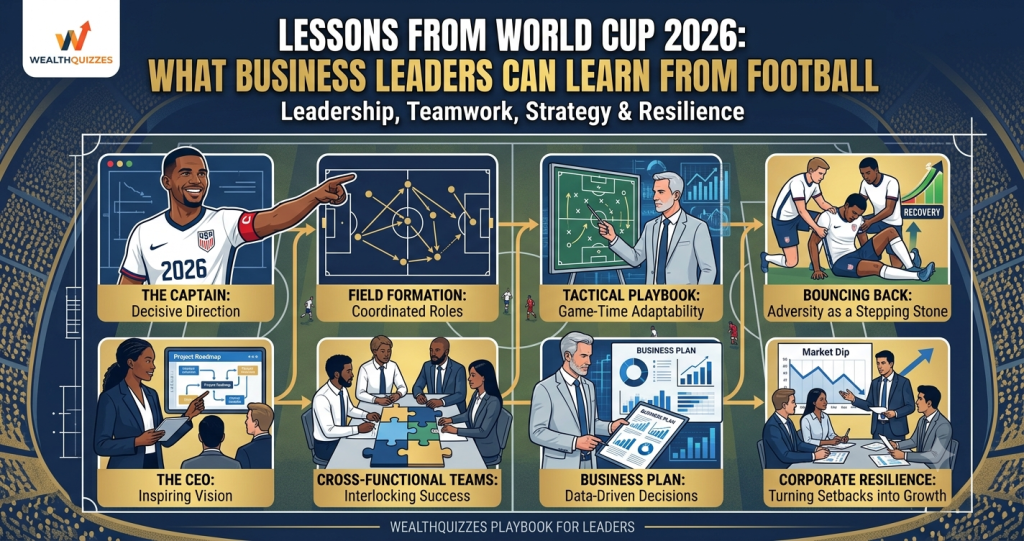
Data Supports Decisions—But Never Replaces Judgment
Modern football increasingly relies upon analytics.
Teams employ performance analysts, GPS tracking systems, artificial intelligence-assisted scouting and sophisticated statistical modelling.
Yet no successful coach allows data to replace experience.
Former Arsenal manager Arsène Wenger, now FIFA’s Chief of Global Football Development, has consistently advocated integrating technology into football while preserving human creativity and decision-making.
Businesses face identical challenges.
Artificial intelligence, predictive analytics and automation provide extraordinary capabilities.
However, leadership still requires judgment, ethics and emotional intelligence.
Technology enhances decisions.
It does not eliminate leadership.
Youth Development Is a Long-Term Investment
One of the defining stories of World Cup 2026 was the emergence of exceptionally talented young players.
Spain’s Lamine Yamal and Pau Cubarsí demonstrated remarkable maturity.
England’s Jude Bellingham continued establishing himself among football’s elite.
Argentina’s younger generation complemented experienced veterans seamlessly.
These successes did not occur by accident.
They reflected years of systematic investment in youth development.
Business organizations often focus excessively upon immediate profitability while neglecting future leadership.
Leadership expert Jim Collins, author of Good to Great, argues that enduring organizations consistently invest in developing future leaders long before they become indispensable.
Football provides the same lesson.
Champions prepare successors before they require them.
Communication Under Pressure Matters
World Cup football operates under extraordinary public scrutiny.
Managers conduct press conferences after every match.
Captains address teammates before decisive moments.
Coaching staffs communicate tactical adjustments within seconds.
Miscommunication frequently produces costly consequences.
Business environments increasingly resemble this reality.
Crisis communication.
Investor relations.
Customer engagement.
Internal leadership.
Every aspect of organizational performance depends upon clear, credible communication.
Leadership is impossible without effective communication.
Innovation Never Stops
Spain’s World Cup success reflected continual tactical innovation.
Traditional positional football evolved into more dynamic movement.
Goalkeepers participated actively in possession.
Midfielders assumed increasingly flexible responsibilities.
Football continues changing because successful teams refuse complacency.
The same applies to business.
Former Amazon CEO Jeff Bezos repeatedly emphasized the importance of maintaining what he called “Day One thinking“—remaining innovative regardless of organizational success.
Champions continue evolving even after becoming champions.
Emotional Intelligence Wins Loyalty
Technical expertise alone rarely inspires people.
Great leaders understand emotions.
Throughout World Cup 2026, managers successfully balanced discipline with empathy.
They supported disappointed players.
Celebrated collective achievements.
Protected younger footballers from excessive pressure.
Psychologist Daniel Goleman, whose research popularized emotional intelligence, argues that self-awareness, empathy and relationship management distinguish outstanding leaders from merely competent managers.
Football consistently reinforces this conclusion.
Excellence Requires Continuous Preparation
The public watches ninety minutes.
Coaches oversee years of preparation.
Every successful World Cup campaign reflects thousands of hours spent planning training sessions, analysing opponents, refining tactics and developing players.
Business success follows the same pattern.
Visible achievements often conceal years of disciplined preparation.
As legendary basketball coach John Wooden famously stated:
“When opportunity comes, it’s too late to prepare.”
Preparation remains one of leadership’s greatest competitive advantages.
The Legacy of Spain’s Triumph
Spain’s World Cup victory represented far more than another football championship.
It demonstrated the enduring value of disciplined leadership, strategic clarity, organizational culture and collective commitment.
The team’s success was built not merely upon technical superiority but upon shared purpose.
That lesson extends naturally into boardrooms.
The world’s strongest organizations rarely succeed because they possess the smartest individuals.
They succeed because they align talented people behind a common vision.
What Every Business Leader Should Take Away
The FIFA World Cup 2026 offers several enduring lessons for executives, entrepreneurs and organizational leaders:
- Vision creates direction.
- Culture sustains performance.
- Teamwork outperforms individual brilliance.
- Strategy maximizes limited resources.
- Adaptability ensures survival.
- Innovation prevents stagnation.
- Emotional intelligence strengthens leadership.
- Preparation reduces uncertainty.
- Resilience transforms setbacks into future success.
- Long-term investment in people always produces sustainable competitive advantage.
These principles apply equally to multinational corporations, government institutions, startups and nonprofit organizations.
Conclusion
The FIFA World Cup may be contested on football pitches, but its lessons extend far beyond sport.
The tournament reminded the world that sustainable success is rarely accidental.
Champions emerge through disciplined preparation, courageous leadership, intelligent strategy, resilient cultures and unwavering teamwork.
Spain did not become world champions solely because they possessed exceptional footballers.
They became champions because they consistently demonstrated the qualities that define every great organization.
For business leaders, the message is unmistakable.
Winning in today’s competitive marketplace requires many of the same attributes required to win football’s greatest prize.
Leadership must inspire.
Teams must collaborate.
Strategies must evolve.
Innovation must continue.
Resilience must endure.
Because whether in football or business, trophies are rarely won by talent alone.
They are earned by organizations that consistently transform vision into performance, pressure into opportunity and teamwork into lasting excellence.