Nigeria After the Civil War: Reconstruction, Reconciliation and the “No Victor, No Vanquished” Policy
How Nigeria Attempted to Rebuild the Country After 1970—and the Challenges That Followed
When the Nigerian Civil War ended in January 1970, Nigeria faced a task arguably as difficult as winning the war itself: how to rebuild a country that had been physically devastated, economically disrupted and psychologically divided by three years of conflict.
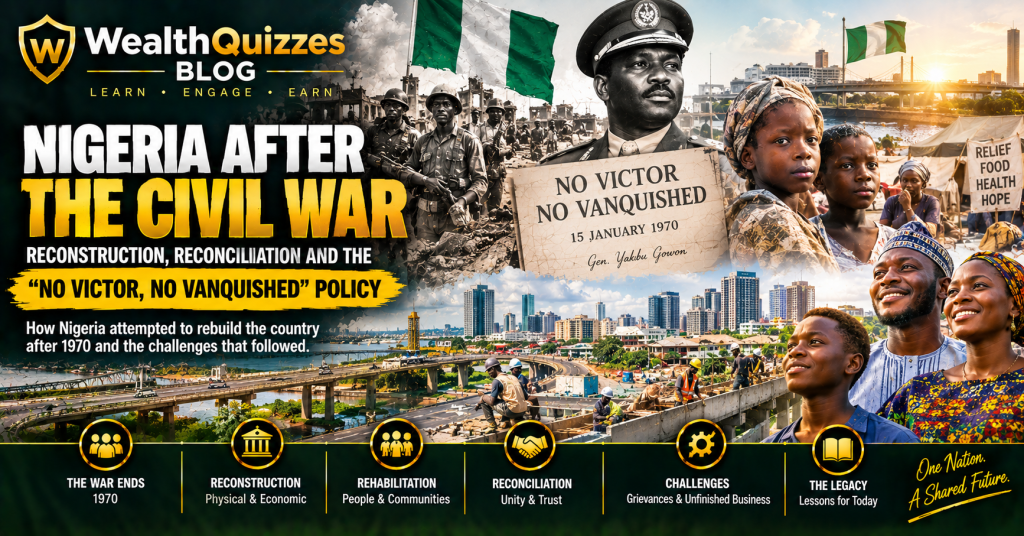
On 15 January 1970, General Yakubu Gowon, then Head of the Federal Military Government, declared that the country had entered the “dawn of national reconciliation” and famously adopted the principle of “No Victor, No Vanquished.” The Federal Government subsequently pursued what became known as the Three Rs—Reconstruction, Rehabilitation and Reconciliation—as the principal framework for post-war recovery. (Blackgeeks.com.ng)
The policy was ambitious. Nigeria had to repair roads, bridges, schools, hospitals and industries; resettle displaced populations; revive agriculture and commerce; reintegrate former Biafran officials and soldiers; restore confidence in a common Nigerian identity; and prevent the bitterness of the war from producing another conflict.
Yet the post-war experience was complicated. There were genuine efforts at reconciliation and considerable reconstruction, but there were also policies concerning currency, public employment, property and political integration that generated enduring grievances, particularly among many people in the former Eastern Region.
The story of post-war Nigeria is therefore neither simply one of successful reconciliation nor one of complete marginalisation. It is a more complicated story of reconstruction alongside unresolved grievances.
The Meaning of “No Victor, No Vanquished”
The phrase “No Victor, No Vanquished” was politically significant because the Federal Government had technically defeated Biafra militarily.
Rather than treating the defeated population as an enemy population, Gowon’s government presented the war as a national tragedy from which all Nigerians had suffered.
In his 1970 post-war address, Gowon declared that the conflict was over and called for reconciliation and the rebuilding of the country. He also announced guarantees concerning the security of citizens and their political rights. (Blackgeeks.com.ng)
The principle had an important practical implication: there would be no general programme of reprisals, mass executions or post-war tribunals against ordinary Biafrans.
John de St. Jorre, whose influential history of the war described the conflict as “The Brothers’ War,” emphasised the absence of the kind of widespread post-conflict retribution that might have been expected after such a bitter conflict. (University of Benin Repository)
This was an important foundation for rebuilding Nigeria as a single political community.
But the slogan was also more than a humanitarian statement. It was a political declaration that Biafra as a sovereign entity had disappeared, while the people who had lived there remained Nigerians.
Historian Roy Doron has noted that Gowon’s formulation became a powerful framework for post-war discourse, but it also had a consequence: serious discussion of the causes and experiences of the war was restricted for many years. (OUP Academic)
The Three Rs: Reconstruction, Rehabilitation and Reconciliation
The post-war programme is often summarised as the 3Rs.
Reconstruction
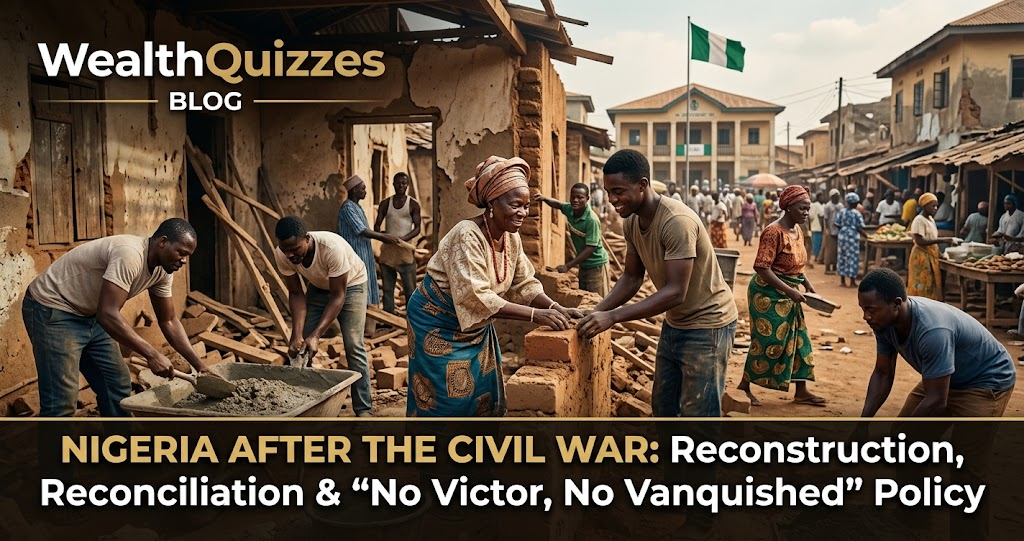
Reconstruction concerned the physical and economic restoration of areas affected by the war.
The former Eastern Region had suffered extensive destruction. Roads, bridges, schools, hospitals, markets, industries and government facilities had been damaged or abandoned.
Adenrele Awotona’s influential study of African post-war reconstruction identifies the scale of Nigeria’s challenge: the economic and social life of the principal theatres of war had been severely disrupted, while physical assets and economic infrastructure had sustained considerable damage. (ScienceDirect)
The Federal Government therefore incorporated reconstruction into the Second National Development Plan, 1970–1974.
The official plan was explicitly designed both to reconstruct war-damaged areas and to develop the rest of Nigeria. Its programme included economic policy, agriculture, industry, education, employment, public works, infrastructure, housing and community development. (CBN Library)
The plan was particularly important because reconstruction was not treated solely as an Eastern Nigerian problem. It was incorporated into a broader national development programme.
The Federal Government sought to rebuild the national economy while simultaneously addressing the special needs of areas most severely affected by the war.
Rehabilitation and the Return to Normal Life
Rehabilitation focused more directly on people.
Millions of Nigerians had been displaced during the conflict. Families had been separated, businesses disrupted and livelihoods destroyed.
The former East-Central State faced particularly severe challenges. Its first post-war budget, presented by Administrator Ukpabi Asika in 1970, described widespread impoverishment and extensive damage to infrastructure and institutions. The programme prioritised education, health, infrastructure, public works and administrative reorganisation. (Nigeria Repository)
The speed with which some basic services were restored was notable.
Research on post-war reconstruction in Igboland records that schools began reopening within months of the end of hostilities. UNICEF and UNESCO assisted in repairing damaged educational facilities, while communities themselves contributed resources to rebuilding schools and hospitals. (ResearchGate)
This community participation is important. Reconstruction was not accomplished by Abuja alone.
Local communities, voluntary organisations, religious bodies and international humanitarian organisations also played significant roles in restoring social services.
The experience demonstrated an important principle of post-conflict reconstruction: physical rebuilding often depends upon the willingness of affected communities to participate in rebuilding their own institutions.
Reintegration of Former Biafrans
Reconciliation also required reintegrating people who had served the Biafran administration or armed forces.
The Federal Government adopted a general amnesty approach rather than mass prosecution. Former civil servants were, in principle, permitted to return to public service, while citizens were guaranteed the right to reside and work in different parts of Nigeria. (University of Benin Repository)
There were also symbolic appointments designed to demonstrate reintegration.
Ukpabi Asika, a prominent figure from the former Eastern Region, was incorporated into the Federal political structure, while J.O.J. Okezie was appointed to the Federal Executive Council. Such measures were intended to demonstrate that the former Biafran population had not been permanently excluded from the Nigerian state. (Nigeria Repository)
The Federal Government also moved to restore former Biafran institutions and reconnect the region to the national economy.
In this respect, “No Victor, No Vanquished” was not merely rhetoric. There were tangible efforts to bring former opponents back into the political and administrative system.
The Difficult Question of Money
One of the most controversial aspects of rehabilitation involved the Biafran currency and banking system.
During the war, Biafra had introduced its own currency. After the conflict, the Federal Government required former Biafran currency holdings to be exchanged for Nigerian currency.
Critics argue that the arrangements placed severe financial limitations on many returning Easterners, particularly because deposits were not simply restored on a pound-for-pound basis. The issue became part of the wider debate over whether the post-war settlement was genuinely equal for all Nigerians. (Cambridge University Press)
This illustrates an important distinction between legal reintegration and economic reintegration.
A citizen could formally regain Nigerian citizenship and the right to live and work anywhere in the federation while simultaneously facing substantial economic obstacles.
The Abandoned Property Controversy
Perhaps no post-war issue illustrates the difficulties of reconciliation more clearly than abandoned property.
During the war, many Nigerians—particularly Easterners who had fled other parts of the country—left houses, shops, businesses and other assets behind.
Various abandoned-properties committees were established during and after the war. The handling, management and eventual restoration of those properties became a major source of dispute. (ResearchGate)
Supporters of the Federal Government’s approach point to arrangements through which rents from some properties were collected and later remitted to owners. (ResearchGate)
Critics, however, contend that property policies and subsequent legislation left many former owners dissatisfied and created long-lasting perceptions of injustice.
Recent scholarship continues to identify abandoned property as one of the unresolved issues in the post-war settlement. (University of Benin Repository)
The controversy demonstrates why reconciliation cannot be achieved through political declarations alone.
Property rights, economic restitution and institutional fairness matter.
The Challenge of Reconciliation
The most difficult of the Three Rs was probably reconciliation.
Reconstruction can be measured through kilometres of roads, schools reopened and bridges rebuilt.
Rehabilitation can be measured through people returning to their homes, jobs being restored and services resuming.
Reconciliation is much harder to measure.
It involves questions such as:
- Did former enemies trust one another again?
- Did Igbo citizens feel fully accepted within Nigeria?
- Did other Nigerians believe their security was guaranteed?
- Could people discuss the causes and consequences of the war openly?
- Were grievances adequately acknowledged?
Tom Lodge’s study of post-war conflict resolution argues that Nigeria’s reconciliation challenge extended considerably beyond immediate amnesties and reconstruction measures. He also notes the later emergence of renewed neo-Biafran sentiment as evidence that questions surrounding reintegration were not completely resolved. (Taylor & Francis Online)
This is a significant observation.
The absence of another civil war does not necessarily mean that every underlying grievance disappeared.
The Problem of Silence
One of the most consequential features of the post-war settlement was the relative reluctance to engage publicly with the deeper causes and experiences of the war.
Doron argues that serious public discourse about the Civil War was heavily restricted for decades and only became substantially more open following Nigeria’s return to civilian rule in 1999. (OUP Academic)
This created a paradox.
The government sought national unity partly by encouraging Nigerians to look forward rather than continually revisit the conflict. That approach may have helped stabilise the country in the immediate post-war period.
But silence can also preserve competing memories.
A society can suppress a historical argument without resolving it.
As the decades passed, different communities developed different memories of the war—memories of survival, military sacrifice, starvation, displacement, political exclusion and national reunification.
Reconstruction in the Context of the Oil Boom
The post-war period also coincided with the rapid expansion of Nigeria’s petroleum industry.
Oil revenues increasingly became central to federal finances, giving the government resources for large-scale infrastructure and development projects.
The combination of political centralisation, petroleum revenue and post-war reconstruction contributed to a major transformation of the Nigerian state.
Yet it also created new questions about resource distribution.
The oil-producing areas of the Niger Delta—many of which had been within or adjacent to the former Eastern theatre—became increasingly important to the Nigerian economy. This produced a new political problem: how should the benefits and environmental costs of petroleum extraction be distributed?
Thus, the post-war settlement did not eliminate regional economic tensions. In some respects, it created new arenas in which questions of federalism, resource control and citizenship would be contested.
Was “No Victor, No Vanquished” Successful?
The answer depends on what is being measured.
If the objective was to prevent widespread post-war reprisals and keep Nigeria territorially united, the policy achieved important results.
Nigeria remained one country.
Former Biafran territory was reintegrated.
Basic infrastructure and public services were progressively restored.
The Federal Government adopted a reconciliation-oriented public posture rather than treating millions of Easterners as permanent enemies.
Elaigwu’s study of Gowon’s administration highlights the absence of summary executions and the government’s efforts to reintegrate former opponents, including political appointments and reconstruction programmes. (Nigeria Repository)
But if the objective was complete social and economic reconciliation, the record is much more contested.
Studies of post-war policy point to continuing disputes over abandoned property, currency, public employment and political representation. (Nigerian Journals Online)
The most defensible historical conclusion is therefore that the settlement was partly successful, partly incomplete.
The Long-Term Legacy
The post-war reconstruction programme helped lay the foundations for Nigeria’s subsequent economic and administrative development.
The Second National Development Plan was broader than emergency reconstruction. It envisioned national economic expansion, infrastructure, agriculture, manufacturing, education, transport, electricity and other sectors. The IMF’s contemporary analysis records an ambitious projected average annual real GDP growth rate of 6.6 percent for the 1970–74 plan period. (IMF eLibrary)
But reconstruction did not resolve the fundamental political questions surrounding Nigerian federalism.
The Civil War had strengthened the Federal Government and contributed to the continued dominance of military rule. It also encouraged a more centralised Nigerian state.
At the same time, the war’s memory remained politically significant.
Later debates about restructuring, federalism, resource control and southeastern political identity have repeatedly returned, directly or indirectly, to questions that the Civil War and its aftermath left unresolved.
Historical Lessons
Nigeria’s post-war experience offers several important lessons.
1. Winning a war is easier than rebuilding a nation
Military victory ends combat. It does not automatically restore livelihoods, trust or dignity.
2. Reconstruction must include people, not only buildings
Roads and bridges matter, but so do employment, education, property rights, financial recovery and social inclusion.
3. Reconciliation requires more than slogans
“No Victor, No Vanquished” was a powerful national message, but reconciliation ultimately depends on institutions and policies that people perceive as fair.
4. Historical memory cannot be permanently suppressed
Doron and other scholars demonstrate that the long restriction of Civil War discourse did not eliminate competing memories. (OUP Academic)
5. Economic justice is part of peacebuilding
Disputes over currency, property and access to economic opportunity can preserve resentment long after political violence has ended.
Conclusion
Nigeria’s post-Civil War experience was one of the most ambitious nation-building exercises in postcolonial Africa.
The Federal Government inherited a country physically damaged by war and psychologically divided by trauma. Its response—Reconstruction, Rehabilitation and Reconciliation—sought simultaneously to rebuild infrastructure, restore livelihoods and reintegrate former adversaries.
There were genuine achievements. Schools reopened, infrastructure was repaired, displaced populations returned, the economy was placed on a new development path, and former Biafrans were formally reincorporated into the Nigerian state.
But the story was not without contradictions.
The handling of abandoned property, currency, public employment and historical memory created grievances that outlived the immediate reconstruction period. Scholars continue to debate how far the 3Rs actually fulfilled the promise contained in “No Victor, No Vanquished.” (Nigerian Journals Online)
Perhaps the most important lesson is that peace is not the same thing as reconciliation.
The end of fighting in 1970 prevented the immediate disintegration of Nigeria. Reconstruction helped restore the physical foundations of national life. But genuine reconciliation required—and continues to require—something deeper: a political system in which citizens across regions and communities believe that their rights, security, property and dignity are protected equally.
The Nigerian Civil War ended in 1970.
The work of building the peace it was supposed to create has continued ever since.