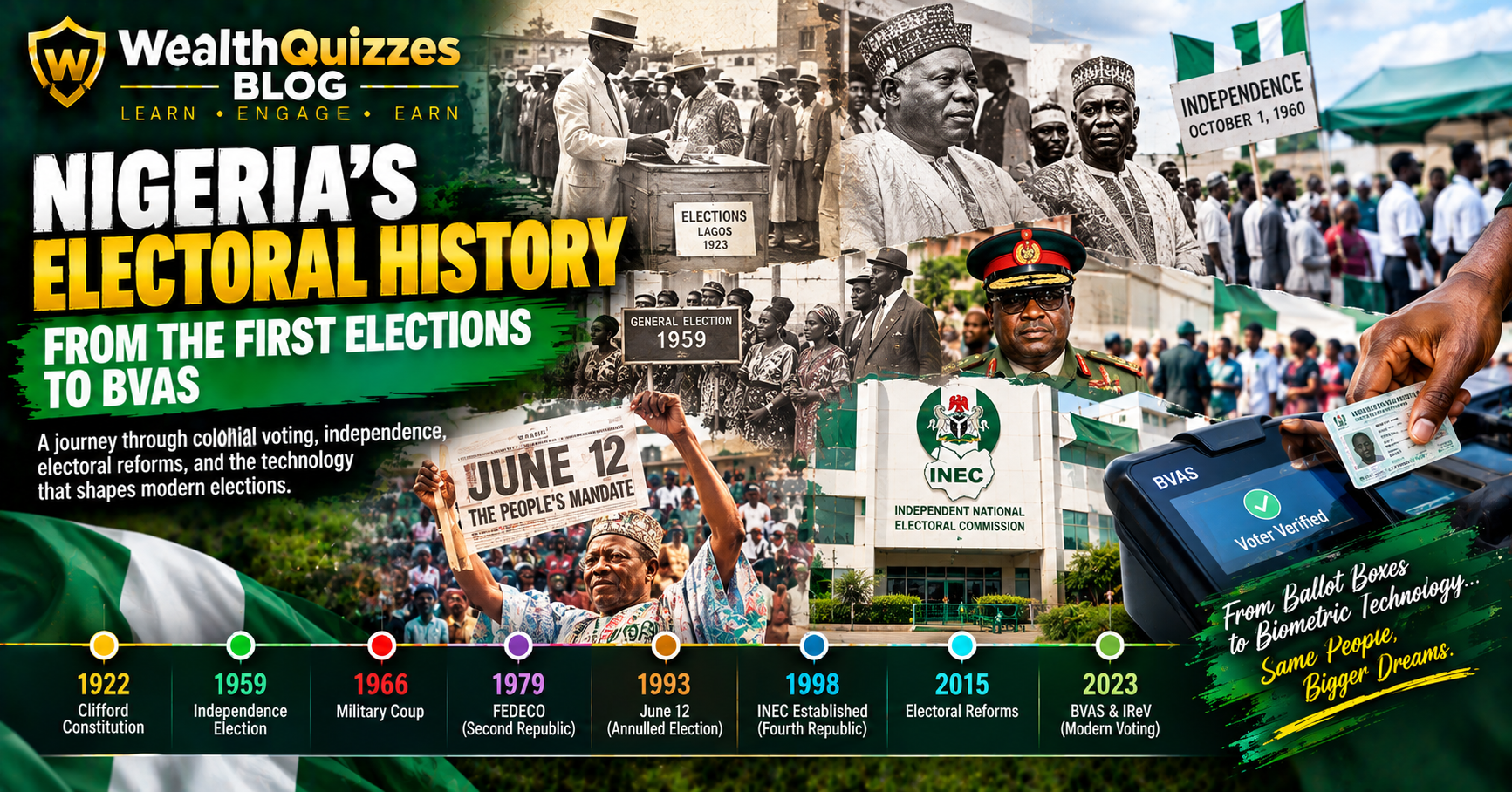
Nigeria’s Electoral History: From the First Elections to BVAS
A Chronological Journey Through Colonial Voting, Independence, Electoral Reform and Modern Voting Technology
Nigeria’s electoral history is a story of political awakening, constitutional change, contested power and the continuing struggle to make the people’s votes count. From the restricted elections of the colonial period to the deployment of the Bimodal Voter Accreditation System (BVAS), the country’s electoral system has undergone profound transformation. Yet, despite improvements in voter registration, accreditation, election administration and technology, the central question remains: how can Nigeria guarantee elections that citizens trust?
Understanding this history requires more than a list of elections. It demands an examination of the institutions, laws, political conflicts and technological reforms that have shaped the relationship between Nigerian citizens and representative government.
1. The Colonial Foundations: The Clifford Constitution of 1922
The introduction of formal electoral politics in colonial Nigeria is commonly associated with the Clifford Constitution of 1922, introduced under Governor Sir Hugh Clifford. It established a limited elective principle by allowing four representatives to be elected to the Legislative Council: three for Lagos and one for Calabar.
The franchise was highly restrictive. Eligibility depended on conditions including a minimum annual income of £100 and a qualifying period of residence. Voting was confined to a small section of the male population in the designated areas, while the Northern Provinces remained outside this electoral arrangement.
As Nigerian political scientist Jide Akanji explains in his work on Nigeria’s electoral process, the early elections of 1923, 1928, 1933 and 1938 helped stimulate political organisation and nationalist activity, despite their narrow reach. The Nigerian National Democratic Party (NNDP), founded by Herbert Macaulay in 1923, became an important force in Lagos politics. The Nigerian Youth Movement subsequently emerged as another significant political organisation.
These elections were not democratic in the modern sense. They excluded most Nigerians from political participation and offered only limited representation. Nevertheless, they introduced a constitutional mechanism through which political competition, party organisation and demands for broader representation could develop.
2. The Richards and Macpherson Constitutions: Expanding Political Participation
The Richards Constitution of 1946 reorganised the country into Northern, Western and Eastern regions. It also sought to encourage greater participation in regional affairs, although it did not establish a fully representative national democracy. Its introduction without broad Nigerian consultation generated opposition among emerging nationalist leaders.
The Macpherson Constitution of 1951 followed a more consultative process. Discussions took place through local, divisional, provincial, regional and central forums. The resulting arrangement expanded political participation and strengthened regional legislatures.
Scholarly accounts of Nigerian constitutional development emphasise that the Macpherson process was important because it involved a wider range of Nigerians in discussions about the country’s political future. It also revealed significant disagreements over regional autonomy, national unity and the distribution of political power.
These constitutional changes helped transform electoral politics from a narrow colonial experiment into a more consequential struggle over self-government. Political parties increasingly competed for influence in regional institutions and prepared for the transfer of power from Britain to Nigerian leaders.
3. The 1959 General Election and Independence
The 1959 federal election was a decisive milestone. It was conducted by the Electoral Commission of Nigeria (ECN), established to administer the pre-independence federal elections. The contest helped determine the political leadership of the country as Nigeria approached independence.
The principal parties were the Northern People’s Congress (NPC), the National Council of Nigeria and the Cameroons (NCNC), and the Action Group (AG). Their support reflected regional political structures, ideological differences, leadership rivalries and competing visions of Nigeria’s future.
The NPC emerged as the largest party in the federal legislature, and a coalition arrangement enabled the formation of the government led by Abubakar Tafawa Balewa. Nigeria became independent on 1 October 1960, retaining a parliamentary system and the British monarch as its formal head of state. The country became a republic in 1963.
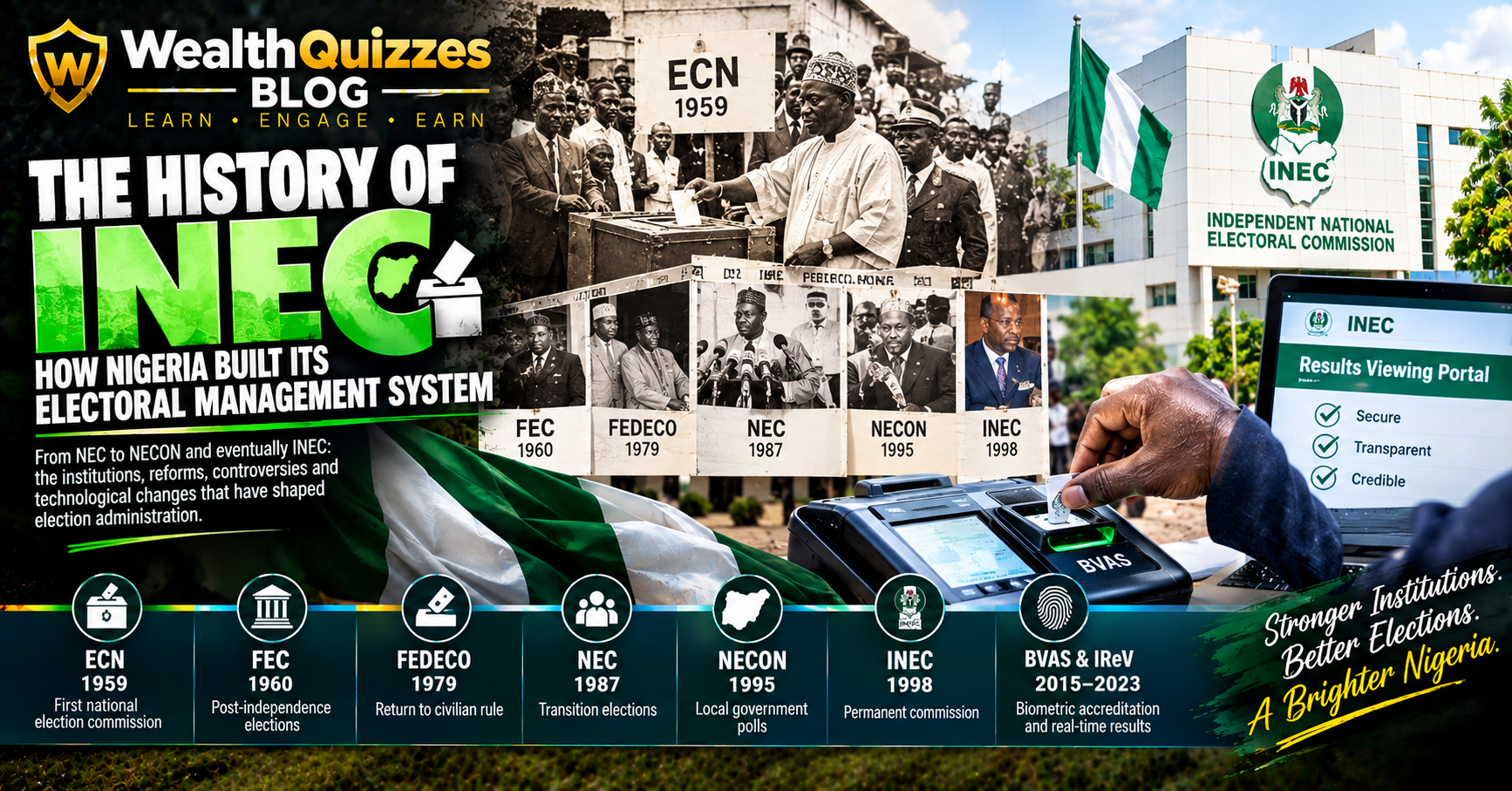
The establishment of the ECN was also significant institutionally. It demonstrated that the administration of elections required a dedicated body rather than being treated simply as an incidental responsibility of government. According to the Independent National Electoral Commission (INEC), the ECN’s role in the 1959 election formed the beginning of the succession of electoral commissions that would later include FEC, FEDECO, NEC, NECON and INEC.
4. The First Republic: Elections, Political Crisis and the 1966 Coup
After independence, the Federal Electoral Commission (FEC) conducted the 1964 federal election and the 1965 regional elections. These contests took place amid intense rivalry among political parties, disagreements over regional power and growing public concern about electoral manipulation.
The First Republic’s political system combined parliamentary government with a federation of three large regions. Rotimi T. Suberu, writing in The Oxford Handbook of Nigerian History, explains that although the system provided regional self-government and parliamentary coalitions, its structural imbalance and intense inter-regional competition contributed to serious instability.
The 1964 federal election was deeply contested, while the 1965 Western Region election produced severe violence and political disorder. These crises undermined confidence in representative institutions. On 15 January 1966, military officers overthrew the civilian government, ending the First Republic.
The episode illustrated a fundamental weakness in Nigeria’s electoral development: elections alone could not guarantee democratic stability where political competition became violent, institutions lacked sufficient credibility, and political actors were unwilling to accept the rules of the contest.
5. Military Rule and the Return to Civilian Government in 1979
Following the civil war, successive military governments controlled the country for more than a decade. Although elections were suspended at the national level during much of this period, the question of returning to civilian government remained central to political planning.
The Federal Electoral Commission (FEDECO) was established during the transition programme leading to the Second Republic. It administered the 1979 general elections, which introduced a presidential system of government and brought Shehu Shagari to office. FEDECO also conducted the 1983 elections.
The 1979 election marked an important constitutional change. Nigeria moved away from the Westminster parliamentary system towards a presidential model with a clearer separation between executive and legislative institutions. However, the 1983 election was accompanied by widespread allegations of malpractice and political violence. The resulting loss of confidence in civilian governance contributed to the military coup of 31 December 1983.
This period reinforced the importance of independent election administration, transparent procedures, effective dispute resolution and the willingness of political parties to respect credible results.
6. The 1993 Election: June 12 and the Crisis of Electoral Legitimacy
Nigeria’s 12 June 1993 presidential election remains one of the most consequential events in its electoral history. Conducted under the National Electoral Commission (NEC), chaired by Humphrey Nwosu, the election featured Moshood Kashimawo Olawale Abiola of the Social Democratic Party (SDP) and Bashir Tofa of the National Republican Convention (NRC).
The election was widely acclaimed as credible by many observers and commentators. Results reported from the exercise indicated that Abiola had a substantial lead. However, the military government of General Ibrahim Babangida annulled the election before the electoral process was formally completed through an official final presidential declaration.
The annulment triggered protests, political resistance and a prolonged national crisis. Babangida eventually stepped aside, but the military government led by General Sani Abacha took power in November 1993.
The June 12 experience remains a powerful reminder that the credibility of an election depends not only on the conduct of voting but also on whether the authorities respect the process and allow its legally required conclusion. It also became a lasting symbol of the demand for democratic accountability.
7. From NECON to INEC: The Fourth Republic Begins
The military government of Abacha established the National Electoral Commission of Nigeria (NECON) in 1995. Following Abacha’s death in 1998, General Abdulsalami Abubakar initiated a transition programme and established INEC after NECON was dissolved.
INEC’s inauguration marked a new phase in the country’s electoral administration. The 1999 general elections brought Nigeria back to civilian rule, with Olusegun Obasanjo inaugurated as president on 29 May 1999. Since then, Nigeria has conducted successive general elections in 2003, 2007, 2011, 2015, 2019 and 2023.
The Fourth Republic has provided the longest uninterrupted period of civilian constitutional government in Nigeria’s post-independence history. Nevertheless, the quality of elections has varied. The 2003 and 2007 elections attracted substantial criticism over malpractice, while later electoral reforms sought to improve voter registration, accreditation, results management and public confidence.
The 2015 presidential election was another historic moment: the incumbent president, Goodluck Jonathan, conceded defeat to Muhammadu Buhari, whose All Progressives Congress (APC) won the election. The peaceful transfer of power demonstrated the importance of political restraint and acceptance of electoral outcomes.
8. Electoral Reforms: From Paper Registers to Biometric Accreditation
Nigeria’s electoral reforms have sought to address recurring problems, including multiple registration, impersonation, ballot stuffing, inaccurate voter registers and disputed results.
A major technological step came in 2015, when INEC deployed the Smart Card Reader to verify Permanent Voter Cards and check fingerprints during voter accreditation. Although the system represented progress, INEC later documented challenges involving card reading, fingerprint verification and attempts to bypass accreditation procedures.
The Electoral Act 2022 strengthened the legal framework for election administration and provided a more explicit basis for technological procedures. The Act and related reforms also sought to improve transparency, clarify responsibilities and address longstanding weaknesses in the electoral process. INEC’s review of the 2023 general election records the significance of these reforms and the Commission’s subsequent recommendations for further improvements.
9. BVAS and IReV: The Digital Turn in Nigerian Elections
The Bimodal Voter Accreditation System (BVAS) represents a major stage in Nigeria’s use of electoral technology. Unlike the earlier Smart Card Reader, BVAS uses biometric verification methods to authenticate voters. It also supports the upload of polling-unit result information to INEC’s Result Viewing Portal (IReV).
According to INEC’s official 2023 General Election Report, the Commission adapted its voter-enrolment technology to develop BVAS for election-day accreditation and the upload of polling-unit results. The report describes BVAS and IReV as important components of the technology deployed for the 2023 general election.
The technologies serve related but distinct purposes. BVAS is primarily an accreditation device, helping to verify that a person presenting to vote is the registered voter they claim to be. IReV is a public results-viewing platform, intended to make polling-unit result sheets accessible online. IReV should not be confused with the formal legal process through which authorised electoral officers collate and declare results.
These systems can reduce certain opportunities for impersonation and improve public access to result information. However, they cannot independently prevent every form of electoral malpractice. Network limitations, device failures, delayed uploads, operational mistakes, insecurity and deliberate misconduct can still affect the process.
INEC’s post-election review specifically recommended improvements to BVAS’s online and offline functionality, network mapping, connectivity options and testing of results-management systems before elections. These recommendations demonstrate that digital election administration requires continuous technical improvement, not merely the acquisition of devices.
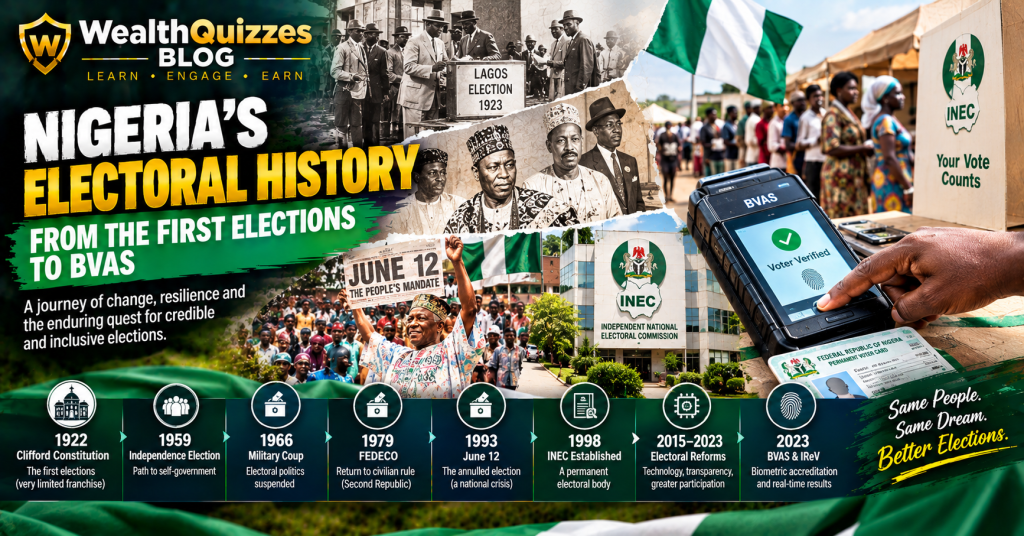
10. The 2023 Election: Progress and Unfinished Questions
The 2023 general election represented the seventh successive general election since the return to civilian rule in 1999. BVAS and IReV attracted considerable public attention because citizens expected technology to strengthen transparency and reduce disputes.
The deployment represented a substantial advance in election administration, but the experience also exposed practical challenges. Delays in uploading some results, technical difficulties and disagreements about compliance with electoral procedures fuelled public controversy and litigation.
The lesson is not that technology has failed, nor that technology alone can guarantee credible elections. Rather, technology is one part of a broader system that also depends on electoral law, trained personnel, reliable infrastructure, security, transparent procedures, independent oversight and effective judicial remedies.
Credibility must be assessed through evidence: whether voters were properly accredited, whether votes were counted accurately, whether result sheets were handled in accordance with the law, and whether complaints were resolved through legitimate procedures.
Conclusion: The Future of Elections in Nigeria
From the restricted franchise of the Clifford Constitution to the nationwide elections of the Fourth Republic, Nigeria’s electoral journey reflects a gradual expansion of political participation and a continuing search for institutional credibility.
The establishment of successive electoral commissions, the return to civilian rule in 1979 and 1999, the enduring significance of June 12, the introduction of biometric accreditation and the deployment of BVAS and IReV all represent important milestones. Yet no technology can substitute for political integrity, impartial administration, reliable infrastructure and public accountability.
The future of Nigerian elections will depend on whether reforms produce more than technical innovation. They must help ensure that every eligible voter can participate safely, that every lawful vote is counted accurately, that results are handled transparently, and that electoral disputes are resolved fairly.
Nigeria has travelled a long way from the four restricted seats of the colonial era. Its next challenge is to make credible elections a consistent reality—so that public office is determined by the lawful choice of voters rather than by manipulation, intimidation or institutional failure.
Selected Authorities and Further Reading
- Independent National Electoral Commission (INEC) — About INEC: History and Constitutional Functions. Official account of the succession of electoral commissions and INEC’s mandate.
- Independent National Electoral Commission (INEC) — Report of the 2023 General Election. Official report on election preparation, BVAS, IReV and electoral operations.
- Independent National Electoral Commission (INEC) — Review of the 2023 General Election. Recommendations on election technology, accreditation and results management.
- Jide Akanji — INEC conference paper on Nigeria’s electoral process, including the restrictive franchise and elections under the Clifford Constitution.
- Rotimi T. Suberu — “Federalism and the First Republic of Nigeria, 1960–1966,” in The Oxford Handbook of Nigerian History. Analysis of the First Republic’s federal structure, regional rivalry and democratic instability.
- “Elections and Democratic Transition in Nigeria under the Fourth Republic” — African Affairs. Scholarly analysis of electoral transitions and democratic development.