The History of INEC: How Nigeria Built Its Electoral Management System
From ECN to NECON and INEC: The Institutions, Reforms, Controversies and Technology That Have Shaped Nigerian Elections
Nigeria’s electoral history is not merely the story of how citizens cast ballots. It is also the history of the institutions responsible for registering voters, organising elections, accrediting voters, counting votes, announcing results and resolving electoral disputes. Behind every general election lies a system of laws, administrative procedures, personnel, technology and political relationships that determines whether the process commands public confidence.
The Independent National Electoral Commission (INEC), established in the transition to the Fourth Republic, is the latest and most enduring institution in a succession of electoral management bodies. Its predecessors operated under different constitutional arrangements and political conditions, from colonial administration and the First Republic to military rule and successive attempts to restore civilian government.
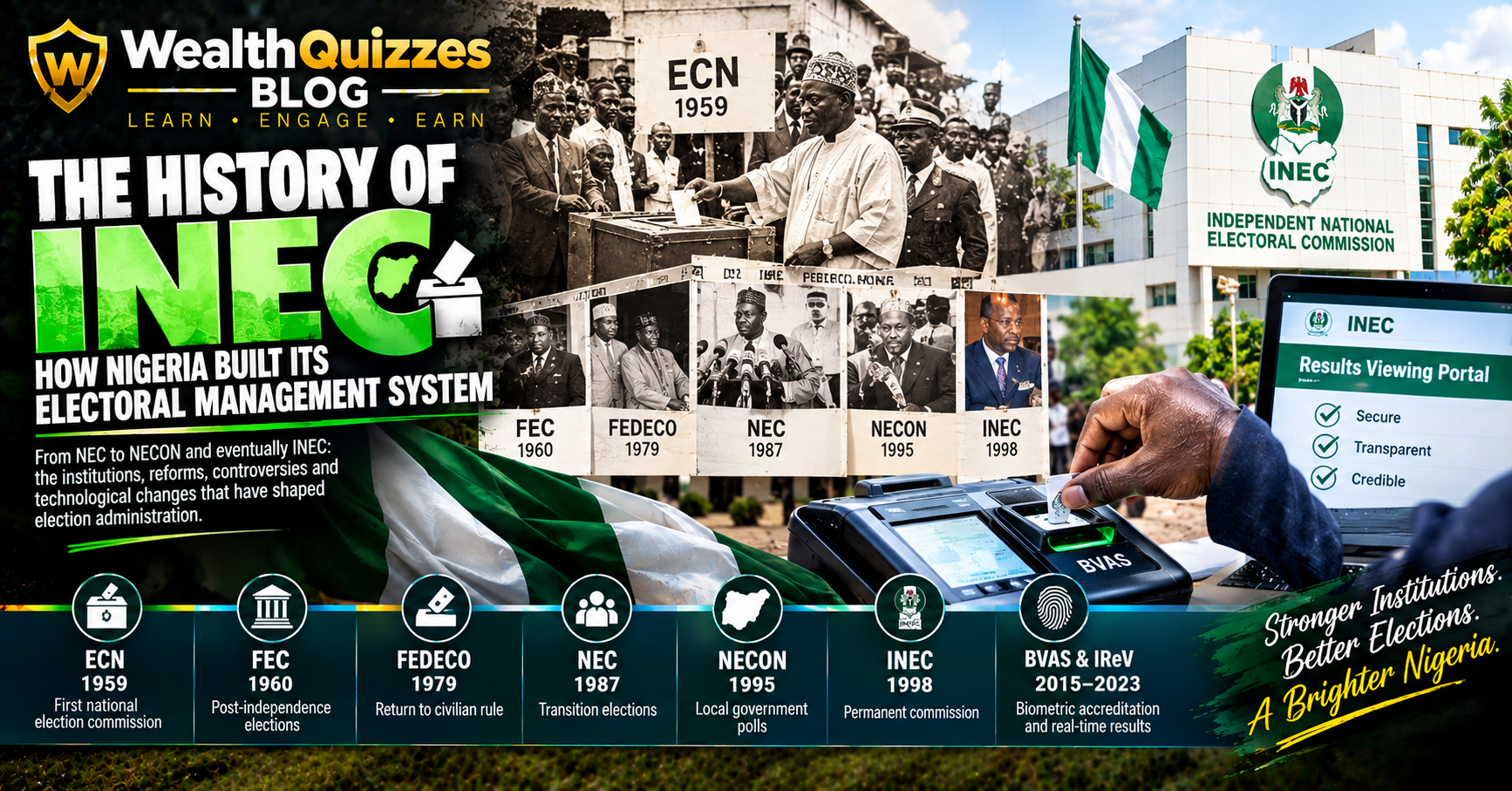
The evolution from the Electoral Commission of Nigeria (ECN) to the Federal Electoral Commission (FEC), the Federal Electoral Commission (FEDECO), the National Electoral Commission (NEC), the National Electoral Commission of Nigeria (NECON) and finally INEC reveals a persistent national challenge: how to build an electoral institution that is professionally capable, politically impartial and sufficiently independent to administer elections in a highly competitive political environment.
1. The Origins of Electoral Administration: ECN and the 1959 Election
Although Nigeria’s first formal elections date to the colonial period, the institutional history of modern national election administration is commonly traced to the establishment of the Electoral Commission of Nigeria (ECN), which conducted the 1959 federal election.
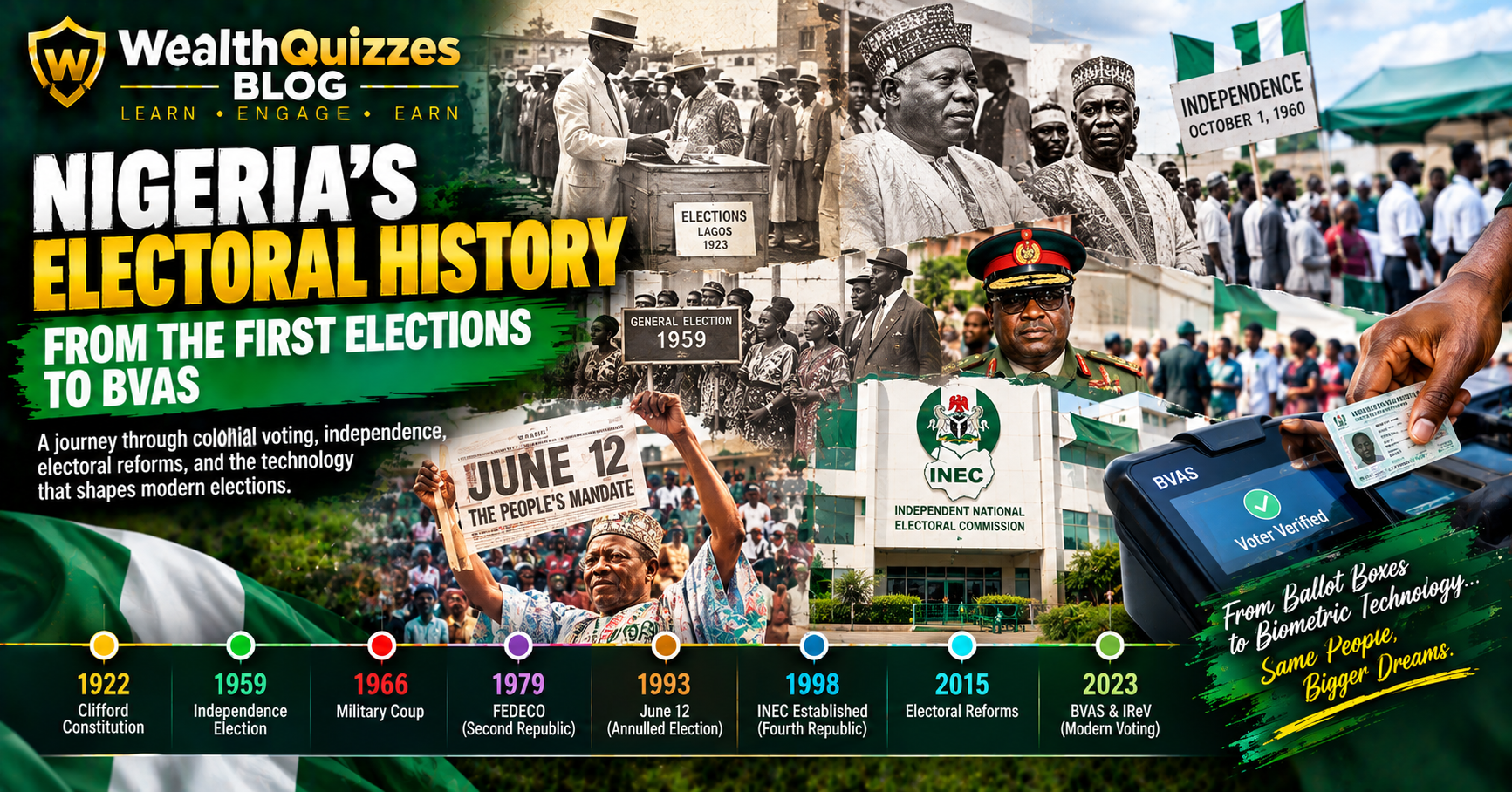
Earlier electoral arrangements had emerged under the Clifford Constitution of 1922. That constitution introduced the elective principle into the Legislative Council, providing four elected seats—three for Lagos and one for Calabar. The franchise was highly restricted, including an income qualification that excluded most Nigerians. These elections helped stimulate political organisation and nationalist activity, but they did not constitute universal democratic participation. The Senate Committee on Constitution Review identifies the Clifford Constitution as the beginning of Nigeria’s formal electoral system.
By the late 1950s, constitutional negotiations and the expansion of regional self-government had made the organisation of a national election essential. The ECN administered the 1959 federal election, which helped determine the leadership of independent Nigeria. The Northern People’s Congress (NPC), the National Council of Nigeria and the Cameroons (NCNC), and the Action Group (AG) were central competitors in the political landscape.
Nigeria became independent on 1 October 1960. The ECN’s significance extended beyond the election itself: it established the precedent that electoral administration required a dedicated commission with responsibility for conducting elections. INEC’s official institutional history identifies the ECN as the first body in the sequence of national electoral commissions that later included FEC, FEDECO, NEC, NECON and INEC.
2. FEC and the First Republic: Electoral Competition and Political Crisis
Following independence, the Federal Electoral Commission (FEC) administered the 1964 federal election and the 1965 regional elections. These contests took place amid intense party rivalry, regional competition and allegations of electoral malpractice.
The First Republic operated a parliamentary system within a federation of large regions. Electoral competition was closely connected to disputes over regional power, political representation and the control of government. The crises surrounding the 1964 federal election and the 1965 Western Region election severely damaged confidence in the political system.
In his scholarly analysis of Nigerian elections, political scientist Rotimi T. Suberu places the difficulties of electoral governance within the broader challenges of federalism, political rivalry and institutional weakness. His work on Nigeria’s search for credible electoral administration also demonstrates that electoral problems cannot be understood solely as technical failures: the political incentives and institutional arrangements surrounding election management matter as well.
The First Republic collapsed following the military coup of 15 January 1966. The electoral commission ceased to function within the political order that had created it. This episode exposed a recurring weakness in Nigeria’s electoral development: a commission could administer elections, but it could not by itself guarantee that political actors would respect democratic institutions or accept the results of political competition.
3. FEDECO and the Return to Civilian Rule in 1979
After years of military government and the Nigerian Civil War, the restoration of civilian government became a major national objective. The military administration prepared a transition programme and established the Federal Electoral Commission, commonly known as FEDECO, to organise elections for the Second Republic.
FEDECO administered the 1979 general election, which brought Shehu Shagari to the presidency, and the 1983 general election. The 1979 election was especially significant because it was conducted under a new presidential constitution, replacing the parliamentary system used during the First Republic.
However, the 1983 election was accompanied by serious allegations of irregularities, violence and manipulation. The military coup of 31 December 1983 ended the Second Republic.
The FEDECO experience reinforced the importance of impartial electoral administration, but it also illustrated the limitations of administrative reform when political competition is marked by intense pressure and weak compliance with electoral rules. INEC’s official history records FEDECO’s responsibility for the 1979 and 1983 elections.
4. NEC and the Babangida Transition Programme
The National Electoral Commission (NEC) was established under the military administration of General Ibrahim Babangida as part of a transition programme intended to return Nigeria to civilian government.
NEC administered a series of local government, state and national elections during the transition period. It also supervised the process that culminated in the presidential election of 12 June 1993, widely remembered as one of the most consequential elections in Nigerian history.
The election featured Moshood Kashimawo Olawale Abiola of the Social Democratic Party (SDP) and Bashir Tofa of the National Republican Convention (NRC). The results reported from the election indicated a substantial lead for Abiola. However, the military government annulled the election before the presidential result was formally completed through an official final declaration.
The annulment triggered widespread protests and a profound political crisis. Babangida eventually stepped aside in August 1993, but the military administration of General Sani Abacha took power in November that year.
The June 12 episode demonstrated that the credibility of an election depends not only on the mechanics of voting and counting, but also on whether political authorities allow the legally required process to reach its conclusion. It also revealed the vulnerability of an electoral commission operating within a transition programme ultimately controlled by the military government.
In their study of Nigeria’s democratic transition under the Fourth Republic, scholars published in African Affairs trace the repeated renaming and reconstitution of electoral management bodies, noting that institutional autonomy and capacity have remained central concerns throughout Nigeria’s electoral history.
5. NECON: Electoral Administration under Abacha
In December 1995, General Sani Abacha’s government established the National Electoral Commission of Nigeria (NECON), replacing NEC. NECON conducted transitional elections into local government councils as part of the military government’s political programme.
The commission operated in a period when the future of civilian government remained uncertain and the political environment was heavily controlled by the military. Its activities therefore need to be understood within the broader context of the Abacha transition programme, rather than as evidence of a completed return to democratic rule.
The distinction between holding elections and establishing credible democratic government is important. Elections can take place without providing a meaningful opportunity for citizens to choose their leaders freely. A credible electoral system requires not only administrative arrangements but also genuine political competition, respect for constitutional rules and safeguards against arbitrary interference.
INEC’s official institutional history records that NECON was dissolved following Abacha’s death in June 1998 and the subsequent transition under General Abdulsalami Abubakar.
6. The Establishment of INEC and the Fourth Republic
Following Abacha’s death, General Abdulsalami Abubakar initiated a transition programme leading to the restoration of civilian government. NECON was dissolved, and the Independent National Electoral Commission (INEC) was established in 1998.
The inauguration of INEC marked a new stage in Nigeria’s electoral management system. The commission administered the elections that preceded the return to civilian rule on 29 May 1999, when Olusegun Obasanjo was inaugurated as president.
INEC’s constitutional position gave it responsibility for organising elections to the offices of president, governors, the National Assembly and state Houses of Assembly. Its functions also include voter registration, political party registration and monitoring, campaign oversight, civic education and the conduct of referendums where required by law.
The Fourth Republic has provided Nigeria with its longest uninterrupted period of civilian constitutional government since independence. INEC has administered general elections in 1999, 2003, 2007, 2011, 2015, 2019 and 2023, alongside numerous off-cycle governorship elections, bye-elections and local electoral processes where applicable.
Nevertheless, the commission’s history during the Fourth Republic has not been free of controversy. The 2007 general election attracted extensive criticism from domestic and international observers. In his Oxford Academic chapter, Suberu explains that criticism of the 2007 elections prompted major constitutional, statutory and administrative reform proposals. He also notes that the 2011 and 2015 elections were widely regarded by many observers as comparatively better administered, although serious vulnerabilities persisted.
This pattern illustrates that electoral credibility is not a permanent achievement. It must be built and defended through every electoral cycle.
7. Reforming INEC: Independence, Professional Capacity and Public Confidence
A central issue in the history of INEC is its independence. A commission may be formally established by the Constitution, yet still face challenges arising from appointments, funding, logistics, political pressure and the enforcement of electoral rules.
Suberu’s analysis identifies the composition of the commission and the influence of political authorities over appointments as important questions in assessing electoral independence. His discussion of reform proposals also highlights the significance of constitutional and statutory safeguards, administrative competence and public accountability.
Reform efforts have addressed several areas: voter registration, election personnel training, the handling and collation of results, political party regulation, voter education, election security and the resolution of disputes.
The Electoral Act 2022 introduced changes intended to address longstanding operational and legal problems. INEC’s 2023 General Election Report describes the Act as an enhanced legal framework containing numerous new provisions relevant to election administration. The report also outlines the commission’s strategic objectives for improving electoral operations, voter and civic education, political party management, stakeholder engagement and institutional capacity.
The broader lesson is that electoral reform must combine sound law with consistent implementation. A strong legal framework is ineffective if election officials lack adequate training, technology is poorly tested, results procedures are unclear or political actors disregard the rules.
8. BVAS and IReV: The Technological Transformation of Election Administration
One of the most important recent developments in Nigeria’s electoral system has been the adoption of digital technology for voter accreditation and polling-unit result transparency.
The Bimodal Voter Accreditation System (BVAS) was developed from INEC’s voter-enrolment technology and adapted for use during elections. It uses biometric verification to help establish that a person presenting to vote is the registered voter they claim to be. It also supports the upload of polling-unit result information to the INEC Results Viewing Portal (IReV).
INEC’s official 2023 General Election Report states that BVAS was deployed for voter accreditation and the upload of polling-unit results to IReV. The report also explains that the system captured GPS coordinates for polling units and that the commission conducted a mock accreditation exercise before election day to test functionality.
BVAS and IReV serve related but distinct purposes. BVAS is principally an accreditation system, while IReV is a public results-viewing portal. IReV allows the public to view polling-unit result sheets uploaded to the platform, but it should not be confused with the formal legal process of collation and declaration by authorised electoral officers.
These technologies can reduce opportunities for impersonation and improve access to polling-unit result information. However, they cannot independently prevent every form of malpractice. Network limitations, device failures, delayed uploads, logistical difficulties, insecurity and human error can still affect election administration.
INEC’s post-election review of the 2023 general election identified recommendations across a wide range of areas, including election technology, results management, logistics, security, voter education and the legal framework. In December 2024, the commission’s chairman reported that the review had produced 142 recommendations, including proposals requiring administrative action and others requiring action by external stakeholders or the legislature.
The experience of BVAS and IReV therefore points to the need for rigorous testing, dependable infrastructure, clear legal rules, transparent contingency procedures and effective public communication. Technology can strengthen an electoral process, but it cannot replace institutional integrity.
9. The Future of Nigeria’s Electoral Management System
The history of Nigeria’s electoral commissions reveals a continuous search for a system capable of administering elections fairly in a complex political environment. The transition from ECN to FEC, FEDECO, NEC, NECON and INEC reflects changes in constitutional arrangements, political regimes and the country’s expectations of electoral administration.
INEC’s next phase must build on the progress already made while addressing persistent concerns about independence, operational reliability, transparency and public trust. This requires stable and adequate funding, merit-based professional development, stronger voter education, effective security arrangements, transparent results procedures and clear legal guidance on the use of technology.
It also requires political parties and candidates to respect electoral rules, citizens to participate peacefully, and courts to resolve disputes impartially and efficiently.
Conclusion: Building an Electoral Institution That Nigerians Can Trust
Nigeria’s electoral management system has travelled a long and difficult path—from a restricted colonial franchise to nationwide elections administered by a constitutionally established commission. The creation of successive electoral bodies, the return to civilian government, the controversies surrounding June 12, and the adoption of BVAS and IReV all represent important stages in that journey.
Yet, the history of these institutions also shows that changing a commission’s name or introducing new technology is not enough. Electoral credibility depends on independence, professional competence, transparent procedures, political restraint and the consistent application of the law.
INEC is more than the latest name in a succession of electoral commissions. It is a central institution in Nigeria’s democratic system, entrusted with translating the constitutional right to vote into a credible process for choosing public officials.
Its ultimate measure of success will not be the number of elections conducted or devices deployed, but whether Nigerians can reasonably trust that their votes are protected, counted accurately and reflected in the lawful outcome of elections.
Selected Authorities and Further Reading
- Independent National Electoral Commission (INEC) — About INEC: History, Functions and Electoral Commissions. Official history of ECN, FEC, FEDECO, NEC, NECON and INEC.
- Rotimi T. Suberu — “Nigeria in Search of a Credible Electoral Administration: Recent Reforms and Persistent Challenges,” in Democracy, Elections, and Constitutionalism in Africa, Oxford University Press, 2021.
- “Elections and Democratic Transition in Nigeria under the Fourth Republic,” African Affairs. Scholarly discussion of electoral commissions, institutional autonomy and electoral credibility.
- Independent National Electoral Commission (INEC) — Report of the 2023 General Election. Official report on electoral operations, BVAS, IReV and the legal framework.
- Independent National Electoral Commission (INEC) — Review of the 2023 General Election. Post-election findings and recommendations for future reforms.
- Senate Committee on Constitution Review — Constitution History. Background on the Clifford Constitution and the evolution of Nigeria’s constitutional system.