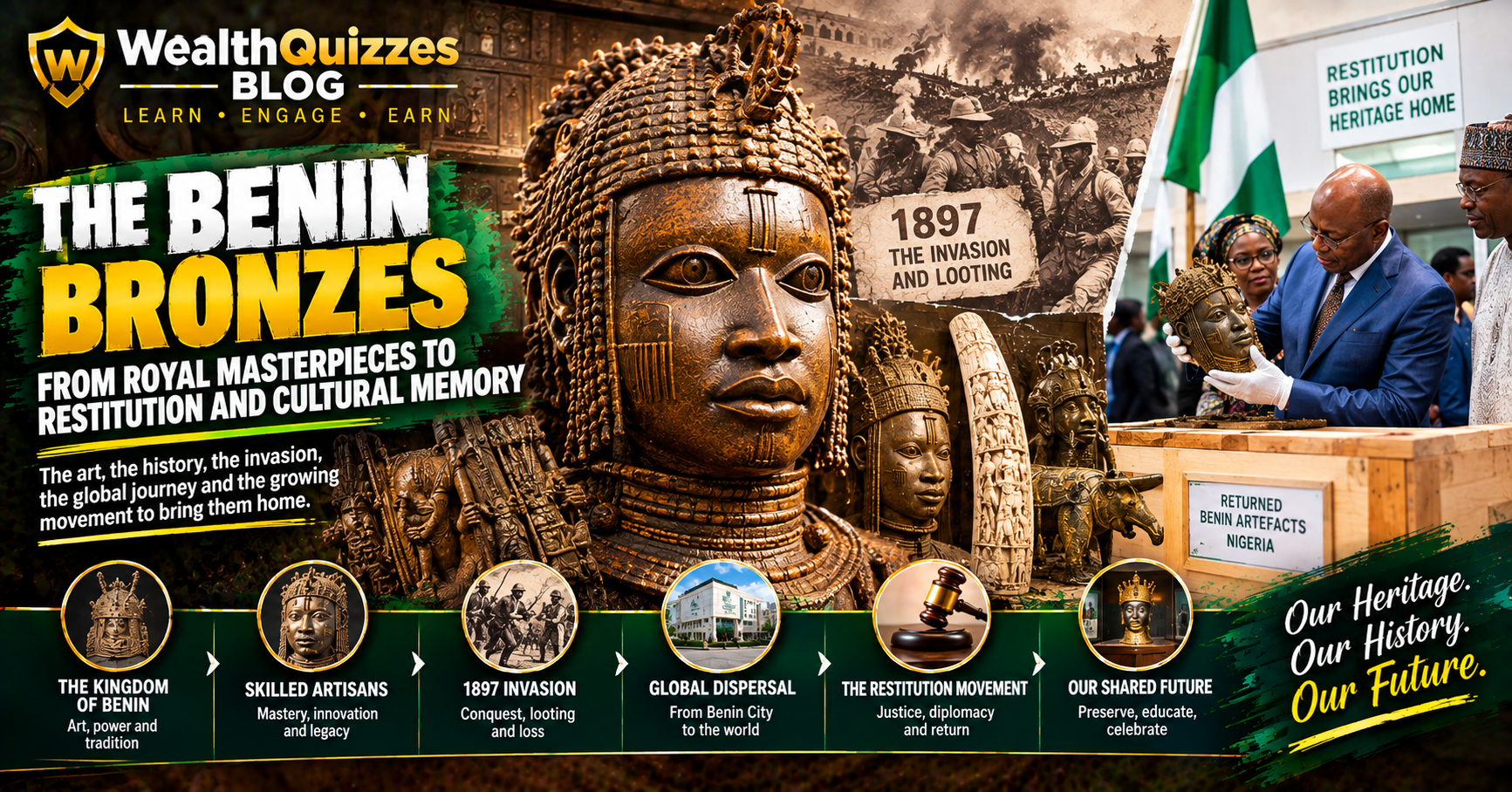
The Benin Bronzes: From Royal Masterpieces to Restitution and Cultural Memory
How One of Africa’s Greatest Artistic Traditions Survived Conquest—and Why the Fight to Bring Its Treasures Home Still Matters
Long before colonial rule reshaped the political map of Nigeria, the Kingdom of Benin had developed an extraordinary artistic tradition that combined technical sophistication, royal patronage, religious symbolism and historical record-keeping. Its celebrated brass and bronze sculptures, intricately carved ivory tusks, commemorative heads and palace plaques represented much more than artistic decoration. They expressed the authority of the Oba, honoured ancestors, preserved historical memory and communicated the kingdom’s relationships with other societies.
Today, many of these works are displayed in museums outside Nigeria. Their dispersal is closely connected to the British invasion of Benin City in 1897, when British forces looted thousands of objects from the royal palace and other sacred spaces. The resulting international debate over their ownership has become one of the most important cases in the global movement to recover cultural property removed during colonial conquest.
The history of the Benin Bronzes is therefore not simply a story about beautiful objects. It is a story about African civilisation, artistic innovation, colonial violence, historical memory, cultural identity and the meaning of restitution.
1. The Kingdom Behind the Masterpieces
The Benin Bronzes originated in the Kingdom of Benin, a pre-colonial state whose historic capital was Benin City, in present-day Edo State, Nigeria. The kingdom developed over many centuries, establishing political institutions, specialised craft guilds, diplomatic relationships and commercial networks.
The ruler, known as the Oba, occupied a central position in the kingdom’s political and religious life. Royal authority was expressed through ceremonies, courtly regalia, ancestral rituals and the production of objects that commemorated rulers and significant events.
The British Museum’s account of the Benin Bronzes explains that specialist guilds produced brass and bronze works for the royal court from at least the sixteenth century. Other court-sponsored crafts included ivory carving, woodwork, textiles, leatherwork and the production of ornaments using coral and other materials. Many objects were commissioned for ancestral altars or used in rituals associated with the installation of a new Oba.
These works were products of an organised artistic system rather than isolated acts of individual creativity. Skilled artisans worked within established traditions, with knowledge passed between generations. Royal patronage supported the development of specialist techniques and helped maintain standards of workmanship.
The kingdom’s political and artistic institutions were interconnected. Art communicated royal authority, preserved dynastic memory and helped sustain the religious practices through which political legitimacy was understood.
2. What Are the Benin Bronzes?
The term Benin Bronzes is widely used for a collection of historical artworks associated with the Kingdom of Benin. Despite the name, the objects are not all made of bronze. Many are cast brass, while others include ivory, wood and other materials.
The collection includes commemorative heads, relief plaques, human and animal figures, royal ornaments, ritual objects and intricately carved ivory tusks. Some of the best-known plaques once decorated pillars in the royal palace. Their images depict rulers, court officials, attendants, warriors, ceremonial activities and relationships with foreign visitors.
The British Museum notes that these objects provide valuable evidence of Benin’s dynastic and social history, including its diplomatic and commercial connections with neighbouring societies and European visitors.
The plaques are particularly important because they preserve visual records of court life. Clothing, regalia, weapons, ceremonial objects and the arrangement of figures offer clues about status, political hierarchy and cultural practices. Such evidence complements written accounts and oral traditions.
Their historical value is inseparable from their cultural and spiritual significance. Some objects were associated with ancestral shrines and royal ceremonies. For communities connected to the kingdom, they are not merely museum specimens; they are part of an inherited cultural world.
3. The Technology and Skill of Benin Artisans
The artistic achievements represented by the Benin Bronzes challenge outdated assumptions that sophisticated technologies and complex artistic traditions originated exclusively outside Africa.
Benin’s brass-casting tradition required considerable technical knowledge. Artisans employed the lost-wax casting process, in which a model is created in wax, encased in a mould, and heated so that the wax melts away. Molten metal is then poured into the space left by the wax. After cooling, the mould is removed and the resulting object is finished by skilled hands.
The process requires precision in modelling, mould-making, temperature control, metal handling and finishing. It also depends on accumulated experience and the transmission of specialist knowledge.
The British Museum places Benin’s artistic tradition within a wider West African history of metalworking that includes the celebrated cast-brass traditions of Ife and the remarkable archaeological discoveries at Igbo-Ukwu. These traditions demonstrate the diversity and depth of metalworking expertise in the region.
Benin’s artists were not simply copying foreign styles. They developed distinctive visual conventions suited to their own political, religious and cultural environment. Their works combined technical ability with historical storytelling and symbolic meaning.
The significance of the Benin Bronzes consequently extends beyond their monetary value. They are material evidence of African intellectual achievement, specialised labour and the capacity of pre-colonial societies to sustain sophisticated artistic institutions.
4. Benin’s Early Contact with Europe
Contacts between Benin and Portugal developed from the late fifteenth century. These encounters formed part of a wider network of trade and diplomacy connecting West African societies with European commercial interests.
The British Museum records exchanges between the courts of Benin and Portugal, including diplomatic visits and commercial relationships. It also notes that Portuguese mercenaries later fought alongside Edo forces in military campaigns, a relationship commemorated in some Benin sculptures.
These contacts should not be confused with the later establishment of British colonial domination. Early commercial and diplomatic relations involved African rulers negotiating with foreign visitors from positions shaped by their own political and economic interests.
Over time, however, the balance of power changed. European imperial expansion, industrialised military technology and increasingly aggressive commercial ambitions altered relations between West African kingdoms and European powers.
By the nineteenth century, Britain had become a dominant force along much of the West African coast. Commercial disputes and imperial ambitions increasingly threatened the independence of states that had previously maintained their own systems of government.
The Kingdom of Benin would eventually experience the destructive consequences of this transformation.
5. The British Invasion of 1897
The defining rupture in the history of the Benin Bronzes occurred in February 1897, when British forces invaded Benin City.
The expedition followed an earlier episode in which a British-led party travelling towards Benin was attacked in January 1897. The circumstances, political tensions and commercial interests surrounding the confrontation must be understood within the broader context of expanding British imperial power in the region.
British forces subsequently entered Benin City, occupied the capital and looted the royal palace and associated compounds. Buildings were burned or damaged, sacred and ceremonial spaces were ransacked, and thousands of objects were removed. The Oba, Ovonramwen Nogbaisi, was eventually captured and sent into exile.
The British Museum acknowledges that objects in its Benin collection were taken during the 1897 expedition and that the occupation involved widespread destruction and pillage. It records that the removed objects were distributed among members of the expedition, treated as spoils of war or sold into the international art market.
The invasion was not simply an archaeological event. It was an act of military conquest that ended Benin’s independence and brought the kingdom under British imperial control.
It is important, however, to distinguish what the historical evidence establishes from claims that remain disputed. Historians continue to debate aspects of the expedition’s scale of violence, casualties and interpretation. Cresa Pugh’s 2025 article in The Journal of African History, for example, examines how restitution debates intersect with the histories of slavery, colonialism, diaspora communities and disputes over custodianship. A separate 2024 article in the International Journal of Cultural Property questions some specific casualty and violence claims made in the restitution literature. Such debates reinforce the need to ground historical interpretation in documentary evidence rather than exaggeration.
The documented looting and removal of Benin objects in 1897 remain central to the restitution debate, even as scholars continue to scrutinise particular interpretations of the invasion.
6. How the Objects Spread Across the World
After the invasion, Benin artefacts entered museums, private collections and commercial markets in Europe and elsewhere. Some were sold to finance the expedition’s costs; others were acquired by officers, dealers and institutions.
The British Museum received hundreds of Benin plaques soon after the invasion. Its historical account records that 304 plaques were displayed in 1897 on loan from the British government’s Foreign Office, after which the museum successfully sought and received 203 of them as a donation. Other objects were acquired through later purchases, gifts and private collections.
This dispersal transformed the international understanding of Benin art. Museum displays brought the works to the attention of scholars and wider audiences, and their quality challenged European racial stereotypes that had denied African societies a history of sophisticated artistic achievement.
Yet this recognition came at a profound cost. Many objects were removed without the consent of the communities whose histories and rituals they represented. Their dispersal separated cultural works from the places, institutions and traditions that had given them meaning.
The resulting question is not whether museums have contributed to the study and preservation of the objects. They have. The central issue is whether the circumstances of their acquisition justify continued possession, and how historical wrongs should be addressed.
7. The Restitution Movement: Bringing the Bronzes Home
Calls for the return of Benin artefacts have grown over decades, supported by Nigerian governments, the Benin Royal Palace, cultural organisations, scholars and international advocates for restitution.
Restitution involves more than the physical transfer of objects. It raises questions about legal ownership, cultural responsibility, conservation, public access, historical interpretation and the authority to determine how returned heritage should be managed.
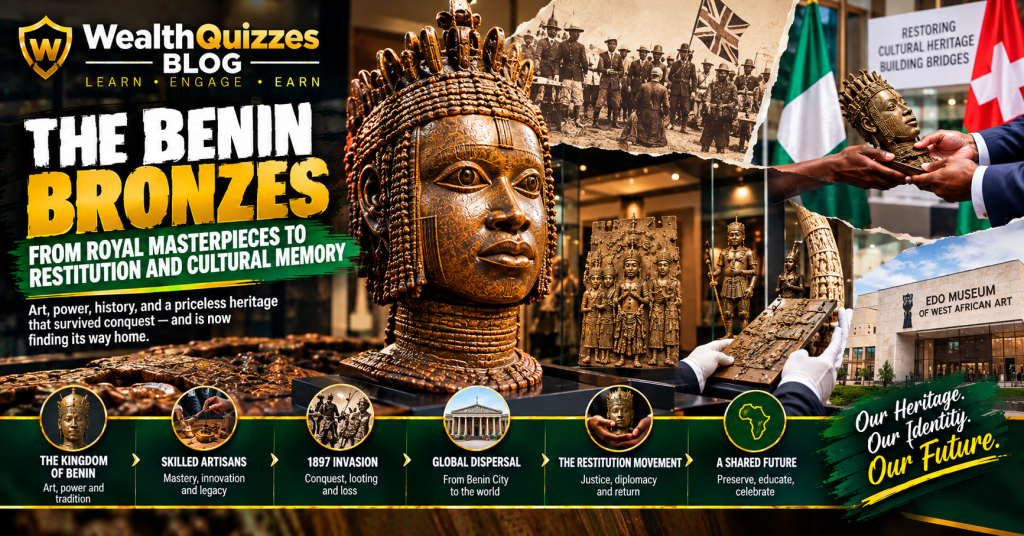
The Netherlands returned 119 Benin artefacts to Nigeria in June 2025, marking a major restitution milestone. The returned objects included plaques, royal regalia, figures and a bell that had been looted during the 1897 British invasion. The return was undertaken at Nigeria’s request through its National Commission for Museums and Monuments.
In June 2026, three Swiss museums returned 18 artefacts from the Kingdom of Benin to Nigeria. The joint announcement by the Swiss Confederation, the Federal Republic of Nigeria, the Musée d’ethnographie de Genève, the Rietberg Museum and the Ethnographic Museum at the University of Zurich described the objects as part of the Benin Bronzes looted in the late nineteenth century. The agreement also addressed cooperation to combat illicit trade in cultural property and protect cultural heritage.
These returns demonstrate that restitution is no longer simply a theoretical debate. It has become a practical process involving provenance research, diplomatic negotiations, legal claims and agreements between governments and cultural institutions.
Nevertheless, the work remains unfinished. Large collections of Benin objects are still held abroad, and each institution must address the history and legal status of the items in its care.
8. Who Should Custody the Returned Artefacts?
Restitution also raises a question within Nigeria: who should hold and manage the objects when they return?
The federal government, Edo State, the National Commission for Museums and Monuments and the Benin Royal Palace all have interests in the preservation and interpretation of Benin heritage. Their respective roles have sometimes generated disagreements over ownership, authority and management.
Desmond O. Oriakhogba’s 2022 article in the Journal of Intellectual Property Law & Practice examines the legal and copyright questions surrounding the repatriation of Benin Bronzes, including issues arising from digitisation and the potential commercial use of images of the objects. The article highlights the importance of clarifying rights and responsibilities as artefacts are returned.
A durable restitution framework should therefore provide clear arrangements for custody, conservation, research, public display and community access. It should also respect the cultural and spiritual significance of objects associated with the royal court and ancestral practices.
Returning an object is an important step, but it should be followed by responsible stewardship. The objective is not simply to change the location of an artefact; it is to restore meaningful relationships between cultural heritage and the people whose history it embodies.
9. Why the Benin Bronzes Matter to Nigeria Today
The Benin Bronzes matter for at least three reasons.
First, they preserve history. They provide visual evidence of royal ceremonies, political relationships, artistic traditions and social organisation. Their study helps reconstruct aspects of the past that cannot be understood through written documents alone.
Second, they affirm cultural identity. For the Edo people and the wider Nigerian public, the objects demonstrate the sophistication of African artistic traditions and challenge simplistic narratives that portray pre-colonial Africa as lacking complex institutions or technological knowledge.
Third, they raise questions of justice and responsibility. The 1897 invasion and the subsequent dispersal of artefacts connect contemporary debates about ownership to the history of colonial conquest. Restitution requires institutions to confront how objects entered their collections and to decide what ethical and legal obligations follow.
The case also offers a broader lesson for Nigeria’s cultural policy. Repatriated objects need secure conservation facilities, trained specialists, accessible public interpretation and meaningful involvement by the communities connected to them. Digital catalogues and responsible educational programmes can widen access, but they should complement rather than replace the physical and cultural relationships through which heritage is understood.
Conclusion: More Than Bronze, More Than History
The Benin Bronzes are masterpieces of African art, but their significance cannot be separated from the history of the kingdom that produced them or the events that removed them from their original settings.
They testify to the artistic expertise, political institutions and cultural traditions of the Kingdom of Benin. Their dispersal in 1897 reflects the violence of colonial conquest, while the growing movement for restitution demonstrates the continuing effort to address the consequences of that history.
The returns from the Netherlands in 2025 and Switzerland in 2026 show that international cooperation can produce concrete results. They also raise expectations that more institutions will investigate their collections and resolve outstanding claims through transparent and responsible processes.
Ultimately, the restoration of Benin heritage is not merely about recovering objects. It is about historical recognition, cultural continuity and the right of communities to participate meaningfully in the care and interpretation of their own heritage.
For Nigeria, the challenge is to ensure that these treasures, whether newly returned or still held abroad, are understood not as relics of a vanished past but as living evidence of a civilisation whose achievements continue to shape the country’s cultural identity.
Selected Authorities and Further Reading
- British Museum — Benin Bronzes. Institutional history of the objects, their artistic functions, the 1897 expedition and the development of the museum collection.
- Cresa Pugh — “Echoes of History: Legacies of the Benin Bronzes and Restitution Within the Black Atlantic,” The Journal of African History, Cambridge University Press, 2025. Examines restitution, diaspora claims and competing questions of custodianship.
- International Journal of Cultural Property — “Distorting History in the Restitution Debate,” 2024. A scholarly examination of evidence and disputed historical interpretations surrounding the 1897 conquest.
- Desmond O. Oriakhogba — “Repatriation of Ancient Benin Bronzes to Nigeria: Reflection on Copyright and Related Issues,” Journal of Intellectual Property Law & Practice, 2022. Discusses legal questions surrounding repatriation and digitisation.
- Associated Press — “Netherlands Returns 119 Looted Artifacts Known as Benin Bronzes to Nigeria,” June 2025. Reports on a major restitution ceremony and the continuing international recovery effort.
- Ethnographic Museum at the University of Zurich and partner institutions — Joint media release on the return of 18 Benin artefacts to Nigeria, 29 June 2026. Documents the Swiss restitution agreement and its cultural-property protection objectives.