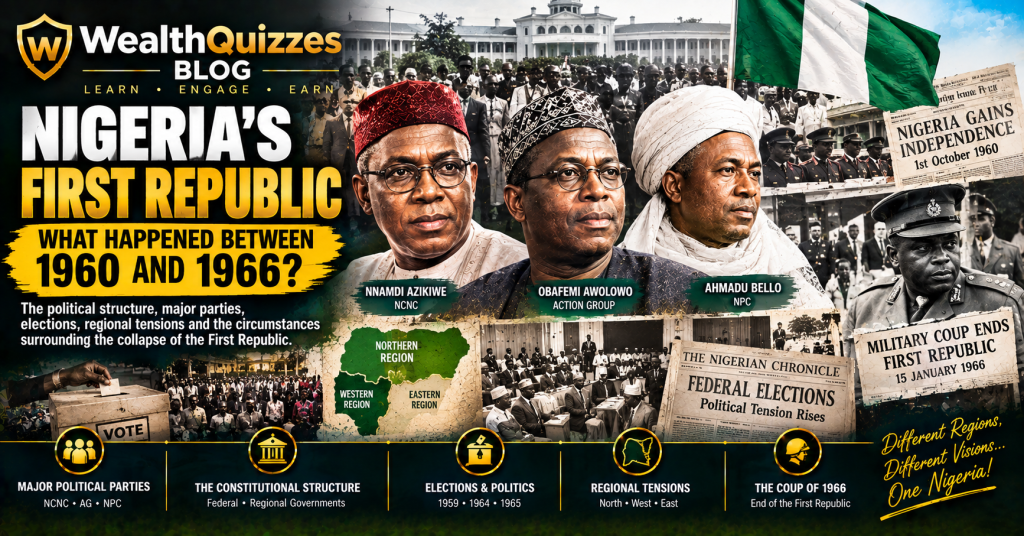
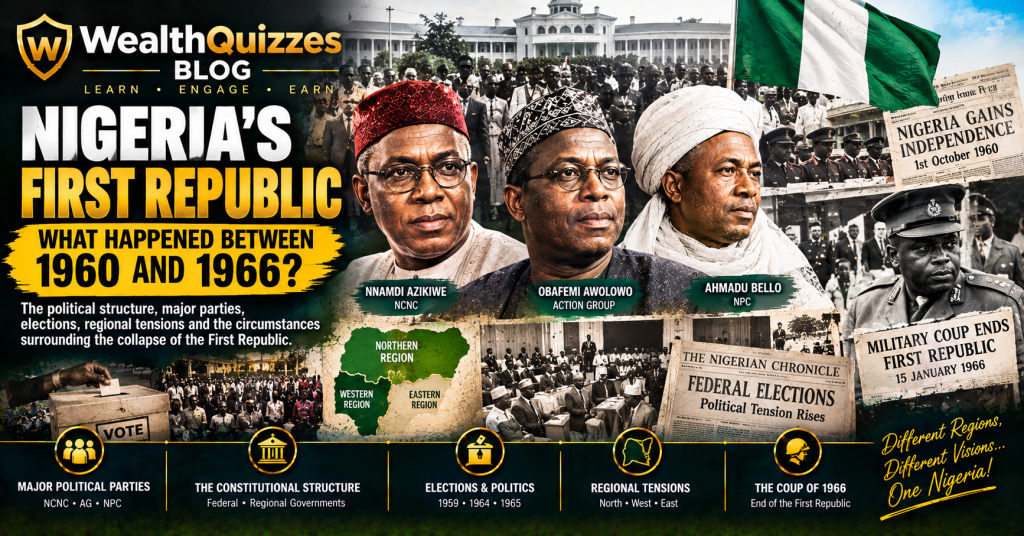
NIGERIA’S FIRST REPUBLIC: WHAT HAPPENED BETWEEN 1960 AND 1966?
The Political Structure, Major Parties, Elections, Regional Tensions and the Circumstances Surrounding the Collapse of Nigeria’s First Republic
When Nigeria became independent on 1 October 1960, there was considerable optimism that the country would develop into one of Africa’s leading parliamentary democracies. The new state inherited a Westminster-style constitutional system, an elected parliament, regional governments and a political class that had successfully negotiated independence from Britain.
Yet barely five years later, that democratic experiment had collapsed.
On 15 January 1966, a group of military officers overthrew the civilian government. Prime Minister Sir Abubakar Tafawa Balewa, Northern Premier Sir Ahmadu Bello, Western Premier Chief Samuel Ladoke Akintola and several other senior politicians and military officers were killed. The First Republic was effectively brought to an end, and Nigeria entered a prolonged period of military rule. (OUP Academic)
The collapse was not caused by one event alone. It resulted from a combination of constitutional weaknesses, regional competition, party rivalry, disputed elections, census controversies, the Western Region crisis, allegations of corruption, institutional distrust and escalating political violence.
Historian Rotimi T. Suberu, writing in The Oxford Handbook of Nigerian History, cautions against romanticising the First Republic as simply a period of benign decentralised federalism. He argues that the federal system combined substantial regional self-government with serious structural contradictions, particularly because the Northern Region was larger than the other regions combined. (OUP Academic)
The Political Structure at Independence
Nigeria became independent under the 1960 Independence Constitution.
The country adopted a federal parliamentary system modelled substantially on the Westminster system. The Queen of the United Kingdom remained the formal head of state, represented in Nigeria by a Governor-General. The Prime Minister was head of government and exercised executive authority through a cabinet drawn from Parliament. (SCCR)
The Federal Parliament was bicameral, consisting of a Senate and House of Representatives.
The country was divided into three principal regions:
- Northern Region
- Western Region
- Eastern Region
The regions possessed considerable autonomy and had their own governments, legislatures and premiers. The Federal Government was responsible for matters such as defence, external affairs, currency, customs and other national responsibilities. (Nigeria Repository)
This arrangement was intended to accommodate Nigeria’s diversity. In practice, however, the regional structure became one of the major sources of political competition.
The problem was particularly acute because the Northern Region was larger in population and territory than the Eastern and Western Regions combined. This gave northern political parties substantial numerical strength at the federal level. Suberu identifies this structural imbalance as one of the fundamental weaknesses of the First Republic. (OUP Academic)
The Three Major Political Parties
Nigeria’s First Republic was dominated by three major political organisations.
The Northern People’s Congress (NPC) was the dominant political force in the North. It was associated with Ahmadu Bello, who remained Premier of the Northern Region, and Abubakar Tafawa Balewa, who became Prime Minister.
The National Council of Nigeria and the Cameroons (NCNC), later renamed the National Convention of Nigerian Citizens, was associated with Nnamdi Azikiwe and was strongest in the Eastern Region.
The Action Group (AG), led by Obafemi Awolowo, was strongest in the Western Region.
Cambridge historians Gerardo Serra and Morten Jerven describe the political landscape at independence as one in which each of these three parties drew much of its support from the ethnic group dominant in its respective region: the NPC from the Hausa-Fulani-dominated North, the NCNC from the Igbo-dominated East and the AG from the Yoruba-dominated West. (Cambridge University Press)
This does not mean that the parties had no support outside their principal regions. They did. But the regional foundation of their political power was unmistakable.
The NPC-NCNC Coalition
The 1959 federal election had produced a fragmented Parliament.
The NPC emerged as the largest party, but it did not possess an outright majority sufficient to govern alone. It therefore formed a coalition with the NCNC.
This arrangement continued into independence.
Tafawa Balewa became Prime Minister, while Nnamdi Azikiwe eventually became Governor-General. Awolowo, whose Action Group remained outside the governing coalition, became Leader of the Opposition. (Chatham House)
The coalition was an important attempt to make Nigeria’s parliamentary system work despite the absence of a single national majority party.
But it also produced an enduring political problem: the Federal Government depended heavily on a partnership between two regionally based parties, while the principal opposition was another regionally based party.
The competition for federal power therefore remained closely connected to regional interests.
From Monarchy to Republic, 1963
Nigeria’s constitutional status changed in October 1963.
The country became the Federal Republic of Nigeria, ending the constitutional position of the British monarch as head of state.
The new Republican Constitution replaced the Governor-General with a President. Dr Nnamdi Azikiwe became Nigeria’s first President, while Tafawa Balewa remained Prime Minister and head of government. The parliamentary system itself was retained. (Nigeria Repository)
Thus, the President was largely ceremonial, while executive political power remained concentrated in the Prime Minister and Cabinet.
The change was symbolically important: Nigeria was no longer constitutionally tied to the British Crown.
But changing the head of state did not resolve the deeper political tensions within the federation.
The Action Group Crisis of 1962
The first major political crisis of the First Republic occurred within the Action Group.
Awolowo had moved to the federal level as Leader of the Opposition after the 1959 elections. His former deputy, Samuel Ladoke Akintola, remained Premier of the Western Region.
The relationship between the two men deteriorated sharply.
The dispute involved personal and political leadership, party strategy, relations with the Federal Government and competing approaches to the future of the Action Group.
Eventually, the disagreement became a constitutional crisis in the Western Region.
The regional legislature descended into disorder, and the Federal Government declared a state of emergency in the Western Region in 1962. Moses Majekodunmi was appointed administrator. (Cambridge University Press)
The crisis demonstrated how quickly a party dispute could become a federal constitutional crisis.
It also destroyed much of the political cohesion of the Action Group.
The Coker Commission and Awolowo’s Trial
The Western crisis was followed by the Coker Commission of Inquiry, which investigated the affairs of certain statutory corporations in the Western Region.
The Commission’s report raised serious questions about the relationship between public corporations, government finances and the Action Group. The original 1962 government report remains an important primary source for understanding the controversy. (Google Books)
The political consequences were enormous.
Awolowo and several associates were subsequently prosecuted for treasonable felony and convicted.
The case remains historically controversial because questions have been raised about the political context in which the prosecution occurred. What is beyond dispute is that the imprisonment of the leader of the principal federal opposition further damaged the credibility of the young republic.
The World Bank’s historical account of Nigeria’s development similarly identifies the Western emergency, Awolowo’s treason trial and the Coker Commission as interconnected developments in the political deterioration of the period. (World Bank)
The Census Controversy
Perhaps no issue better demonstrated the connection between demography and political power than the 1962–63 census controversy.
Population figures mattered because parliamentary representation and the allocation of federal resources were connected to population.
The initial 1962 count produced figures that threatened the North’s established demographic majority. The controversy became so intense that the results were effectively abandoned and another census was conducted in 1963.
The second census gave the North approximately 29.8 million people, restoring its position as having an absolute majority of Nigeria’s population. Eastern political leaders rejected the figures, and the Eastern Region eventually challenged them in court. (Cambridge University Press)
The controversy was therefore not simply a disagreement over statistics.
Population had become political power.
As Serra and Jerven demonstrate, the census became intertwined with parliamentary representation, resource distribution, electoral registration and the rivalry between the regions. (Cambridge University Press)
The Creation of the Mid-Western Region
Another important development was the creation of the Mid-Western Region in 1963.
The new region was carved out of the Western Region following a referendum.
Its creation altered the balance of power within the federation and weakened the geographical dominance of the old Western Region. It also created a new political centre whose leaders could play an important role in federal coalition politics.
By this point, Nigeria’s political map had changed from three regions to four:
Northern, Eastern, Western and Mid-Western Regions.
Yet the fundamental regional competition remained.
The 1964 Federal Election
The 1964 federal election was supposed to provide a democratic mechanism for determining the next Federal Government.
Instead, it became one of the most controversial episodes of the First Republic.
Political alliances had changed dramatically.
The NPC and Akintola’s Nigerian National Democratic Party (NNDP) became associated with the Nigerian National Alliance (NNA).
The opposition forces, including the NCNC and Action Group elements, formed the United Progressive Grand Alliance (UPGA).
The election was preceded by disputes over electoral administration, nominations and political intimidation.
The conflict became so severe that UPGA called for a boycott in several areas. Contemporary and later accounts describe widespread disputes over candidate nominations, unopposed returns and the conduct of the poll. (OUP Academic)
The election therefore failed to generate the broad legitimacy that a young democracy required.
Political scientist Richard L. Sklar had already identified a central contradiction in the First Republic: Nigeria’s machinery of government was heavily regionalised, while political parties simultaneously attempted to operate across regional boundaries. The result was an unstable competition between regional power blocs. (Cambridge University Press)
The Western Region Election Crisis of 1965
If the 1964 federal election damaged confidence in the electoral system, the 1965 Western Region election pushed the crisis much further.
Akintola’s NNDP, allied with the NPC, contested the election against opposition forces.
The result was bitterly disputed.
Violence spread through parts of the Western Region. Political opponents were attacked, properties were destroyed and retaliatory violence escalated.
The period became associated with the expression “Operation Wetie”, referring to the use of petrol in political attacks and arson. The violence became a symbol of the collapse of political restraint in the region. (Historical Nigeria)
The importance of the Western crisis cannot be overstated.
A democratic election had become associated with violence rather than peaceful alternation of power.
Oxford scholarship on Nigerian electoral administration identifies the 1964 federal and 1965 Western elections as the final major electoral crises in a succession of political breakdowns that paved the way for the January 1966 military coup. It identifies manipulation of electoral registers, intimidation, obstruction of polling and counting agents and falsification of results among the serious problems associated with these elections. (OUP Academic)
Why Did the First Republic Collapse?
It is tempting to identify one explanation for the collapse.
Some accounts emphasise ethnic politics.
Others highlight electoral malpractice and corruption.
Others stress the structural imbalance of the federal system.
Still others emphasise the inability of the political class to develop effective national institutions.
The evidence suggests that these explanations should not be treated as mutually exclusive.
The First Republic inherited a federation in which the Northern Region was substantially larger than the other regions. This created a persistent imbalance in federal parliamentary power. (OUP Academic)
The major parties were strongly connected to regional constituencies. Political competition consequently became entangled with fears about which region would control the federation. (Cambridge University Press)
The Action Group crisis demonstrated the fragility of parliamentary conventions.
The census controversies transformed population statistics into instruments of political competition.
The 1964 election undermined public confidence in electoral legitimacy.
The 1965 Western election and subsequent violence demonstrated the inability of civilian institutions to contain political conflict.
And the imprisonment of major opposition figures further weakened confidence in the political system.
Lynn Schler’s study of the First Republic similarly describes the period as one in which regional, ethnic and class conflicts complicated the process of nation-building even before independence and continued to shape statecraft after 1960. (JSTOR)
The Coup of 15 January 1966
Against this background came the military intervention of 15 January 1966.
The coup involved young military officers who attacked political and military targets in Lagos, Ibadan and Kaduna.
Among those killed were:
- Prime Minister Tafawa Balewa;
- Northern Premier Ahmadu Bello;
- Western Premier Ladoke Akintola;
- Federal Finance Minister Festus Okotie-Eboh; and
- several senior military officers.
Richard Sklar described the coup as the overthrow of a “crisis-bound” Nigerian government. (Cambridge University Press)
Major-General Johnson Thomas Umunnakwe Aguiyi-Ironsi, the most senior surviving military officer, assumed power.
The civilian constitutional order had effectively ended.
The precise motivations and character of the coup remain subjects of historical debate. It is misleading to reduce the event simply to a single ethnic conspiracy, although the disproportionate deaths of northern political leaders and the predominantly Igbo background of several of the principal coup plotters contributed enormously to the interpretation of the coup as an assault on the northern political order. Subsequent scholarship has also examined the structural, ideological and military dimensions of the intervention. (Cambridge University Press)
From First Republic to Military Rule
The January coup did not immediately resolve Nigeria’s political crisis.
Ironsi’s government increasingly centralised authority and moved toward a more unitary administrative structure. His policies generated substantial opposition, particularly in the North, where many politicians and officers regarded the changes as a threat to federalism and northern political autonomy. (Cambridge University Press)
On 29 July 1966, a counter-coup brought Lieutenant-Colonel Yakubu Gowon to power.
The cycle of political and military crisis continued.
The violence surrounding the coups, together with attacks on Igbo communities and the resulting displacement, eventually contributed to the crisis that culminated in the Nigerian Civil War of 1967–1970. The Oxford Handbook of Nigerian History identifies the January 1966 coup as a critical turning point leading eventually to the Eastern Region’s attempt to secede as Biafra. (OUP Academic)
Conclusion: A Republic That Collapsed Under the Weight of Its Contradictions
Nigeria’s First Republic lasted only from 1960 to 1966, but its political legacy remains enormous.
It was an ambitious experiment in parliamentary federalism.
Its leaders inherited a country of extraordinary ethnic, religious, linguistic and regional diversity and attempted to govern it through institutions inherited largely from British colonial constitutionalism.
There were genuine achievements.
Nigeria operated a parliamentary democracy. Regional governments possessed substantial autonomy. Political parties competed openly. Parliament debated national issues. Constitutional change occurred through legislative and political processes rather than revolution.
But the system also contained serious weaknesses.
The federal structure was uneven.
Political parties were strongly regionalised.
Population became a weapon in political competition.
Constitutional conventions were repeatedly tested.
Opposition politics became increasingly hostile.
The 1964 federal election damaged electoral legitimacy.
The 1965 Western election crisis pushed political violence to unprecedented levels.
And by January 1966, confidence in civilian political institutions had deteriorated severely.
The collapse of the First Republic was therefore not a sudden event on 15 January 1966.
The coup was the culmination of a political crisis that had been developing for years.
As Rotimi Suberu’s Oxford analysis makes clear, the First Republic’s federal system simultaneously encouraged regional self-government and intensified the structural competition among the regions. (OUP Academic)
The most important historical lesson may therefore be this:
Nigeria’s First Republic did not fail simply because Nigerians were incapable of democracy. It failed because a young democracy was operating within a political structure in which regional power, ethnic identity, electoral competition and control of the federal centre had become dangerously intertwined.
The story of 1960–1966 is consequently not merely the story of a republic that collapsed.
It is the story of Nigeria’s first attempt to answer one of its most enduring political questions:
How can a deeply diverse country distribute political power fairly enough for all its constituent peoples to trust the same national state?
That question was unresolved when the First Republic fell in 1966—and it would continue to shape Nigeria’s political history for decades to come.