Nigeria’s Military Era: From the First Coup to the Return of Democracy
A Chronological Examination of Military Governments, Major Transitions, Constitutional Changes and the Eventual Return to Civilian Rule
Nigeria’s post-independence political history cannot be understood without examining the extraordinary influence of the military. Between the first military coup on 15 January 1966 and the restoration of elected civilian government on 29 May 1999, military governments dominated Nigeria for roughly three decades, interrupted only by the Second Republic between 1979 and 1983. According to historian and political scientist Eghosa E. Osaghae, Nigeria’s military era was rooted partly in the fragility of the postcolonial state, but its consequences extended much further, fundamentally transforming Nigeria’s political institutions, federal structure and constitutional order. (OUP Academic)
Indeed, the military was in power for 29 of the 33 years between 1966 and 1999, making it arguably the most influential institution in Nigeria’s post-independence political development. (OUP Academic)
The military’s involvement began as an intervention supposedly intended to correct political instability. Over time, however, military rule itself became a source of authoritarianism, centralisation, constitutional experimentation and political conflict. Its eventual withdrawal in 1999 was therefore not simply the end of a dictatorship. It was the culmination of decades of failed and partially successful attempts to construct a stable democratic order.
The First Coup and the End of the First Republic
Nigeria’s First Republic ended violently on 15 January 1966, when a group of military officers overthrew the civilian government.
Prime Minister Abubakar Tafawa Balewa, Northern Region Premier Ahmadu Bello, Western Region Premier Samuel Ladoke Akintola and other senior political and military figures were killed. Major-General Johnson Thomas Umunnakwe Aguiyi-Ironsi, the most senior surviving officer, subsequently assumed national leadership. (OUP Academic)
The coup was followed by intense political controversy. Its ethnic interpretation became particularly consequential because many of the political casualties were northern leaders, while several of the principal coup plotters were Igbo officers.
Ironsi’s government suspended the 1960/63 constitutional order and ruled through military decrees. His administration also attempted to reorganise Nigeria’s political structure.
The most controversial measure was Decree No. 34 of May 1966, popularly known as the Unification Decree, which sought to replace the federal-regional arrangement with a more centralised system.
Instead of resolving Nigeria’s political crisis, the policy deepened suspicion, particularly in the North.
The July 1966 Counter-Coup
On 29 July 1966, northern and other military officers staged a counter-coup. Ironsi was killed alongside Lieutenant-Colonel Adekunle Fajuyi, and Lieutenant-Colonel Yakubu Gowon eventually emerged as Head of State. Nigeria’s State House records Gowon’s tenure as running from August 1966 to July 1975. (State House)
The counter-coup was followed by widespread violence against Igbos and other Easterners, particularly in Northern Nigeria. The resulting displacement and insecurity contributed directly to the political crisis that preceded the Nigerian Civil War.
The war itself began in 1967 after Colonel Chukwuemeka Odumegwu Ojukwu declared the independence of Biafra. The conflict lasted until 1970. The Oxford Handbook of Nigerian History notes that the Civil War and the preceding violence fundamentally altered the relationship between the Nigerian state and movements challenging its authority. (OUP Academic)
Gowon and the Consolidation of Military Rule, 1966–1975
General Gowon governed Nigeria throughout the Civil War and its immediate aftermath.
His government confronted two enormous tasks: preserving Nigeria’s territorial integrity and rebuilding the country after the war.
The post-war policy of “Reconstruction, Rehabilitation and Reconciliation”, popularly expressed through the principle of “No Victor, No Vanquished,” attempted to reintegrate former Biafrans into Nigeria.
Gowon’s government also continued the process of restructuring Nigeria into smaller states. The creation of 12 states in 1967 was partly intended to weaken the dominance of the old regions and address fears of regional hegemony.
Yet military rule also became increasingly centralised. Osaghae identifies the hyper-centralist character of successive military regimes as one of the defining features of the era. (OUP Academic)
Gowon initially promised a return to civilian rule. But by 1974 he postponed the proposed transition, arguing that Nigerians had not yet demonstrated sufficient moderation in pursuing sectional interests. (Cambridge University Press)
His government was subsequently overthrown.
Murtala Muhammed: Reform and a New Transition, 1975–1976
On 29 July 1975, Brigadier Murtala Ramat Muhammed led the coup that removed Gowon.
Murtala’s government introduced a more assertive reform agenda. It sought to reorganise the public service, combat perceived administrative corruption and accelerate the return to civilian government.
One of the most important constitutional developments was the continued expansion of the state structure. Murtala argued that creating more states could reduce fears of domination by one region over another. His government subsequently created seven additional states, bringing the total to 19 after his assassination and the continuation of his programme by his successor. (Cambridge University Press)
Murtala also initiated the process that produced the 1979 Constitution.
But his administration was short-lived.
On 13 February 1976, Murtala was assassinated during an attempted coup led by Lieutenant-Colonel Buka Suka Dimka.
His deputy, General Olusegun Obasanjo, assumed power.
Obasanjo and the Birth of the Second Republic
Obasanjo continued Murtala’s transition programme.
A 49-member Constitution Drafting Committee was established in 1975, followed by a Constituent Assembly. One of its most significant recommendations was the replacement of Nigeria’s inherited Westminster parliamentary model with an executive presidential system. (Cambridge University Press)
The 1979 Constitution therefore represented a fundamental constitutional departure.
It established:
- an executive President who served as both Head of State and Head of Government;
- elected state governors;
- a bicameral National Assembly consisting of the Senate and House of Representatives;
- an independent judiciary with constitutional review powers; and
- a federal structure based on states rather than the old regions. (SCCR)
The presidential model was partly intended to avoid the coalition and regional instability associated with the First Republic.
On 1 October 1979, Obasanjo handed power to an elected civilian government led by Shehu Shagari.
This marked Nigeria’s first successful transition from military to civilian government.
The Second Republic and the Return of the Military, 1979–1983
The Second Republic lasted only four years.
President Shehu Shagari’s government faced economic difficulties, political disputes and accusations surrounding electoral malpractice and corruption.
On 31 December 1983, the military intervened again.
Major-General Muhammadu Buhari became Head of State.
The coup demonstrated one of the central problems of Nigeria’s military era: civilian governments repeatedly failed to establish a political order sufficiently trusted by the military establishment, while military governments themselves increasingly claimed that only military intervention could restore order.
Buhari’s “War Against Indiscipline”
The Buhari regime introduced a highly authoritarian style of government.
It launched the War Against Indiscipline, targeting lateness, disorder, corruption and other forms of perceived social indiscipline.
The government also introduced tribunals and harsh measures against corruption and political misconduct.
But political freedoms were severely restricted.
The regime was itself overthrown on 27 August 1985, when Major-General Ibrahim Babangida assumed power. (State House)
Babangida and the Longest Transition Programme
Babangida’s eight-year rule became one of the most consequential periods of Nigeria’s military era.
His government attempted to combine military control with an elaborate programme of political transition.
Babangida’s regime introduced structural economic reforms, including the Structural Adjustment Programme (SAP) from 1986. Cambridge historians Falola and Heaton describe the period as one in which Nigeria experienced further economic deterioration, with SAP contributing to significant social and economic hardship. (Cambridge University Press)
The government also reorganised Nigeria’s political system.
The 1989 Constitution was designed as the foundation for the proposed Third Republic. It broadly retained the presidential system introduced in 1979 while incorporating new arrangements for the political transition. (Cambridge University Press)
Babangida’s government eventually created two officially recognised political parties:
- the Social Democratic Party (SDP); and
- the National Republican Convention (NRC).
The regime attempted to control the transition by regulating party formation and political competition. (Cambridge University Press)
But the transition ultimately collapsed over the 12 June 1993 presidential election.
The June 12 Crisis and the Abacha Era
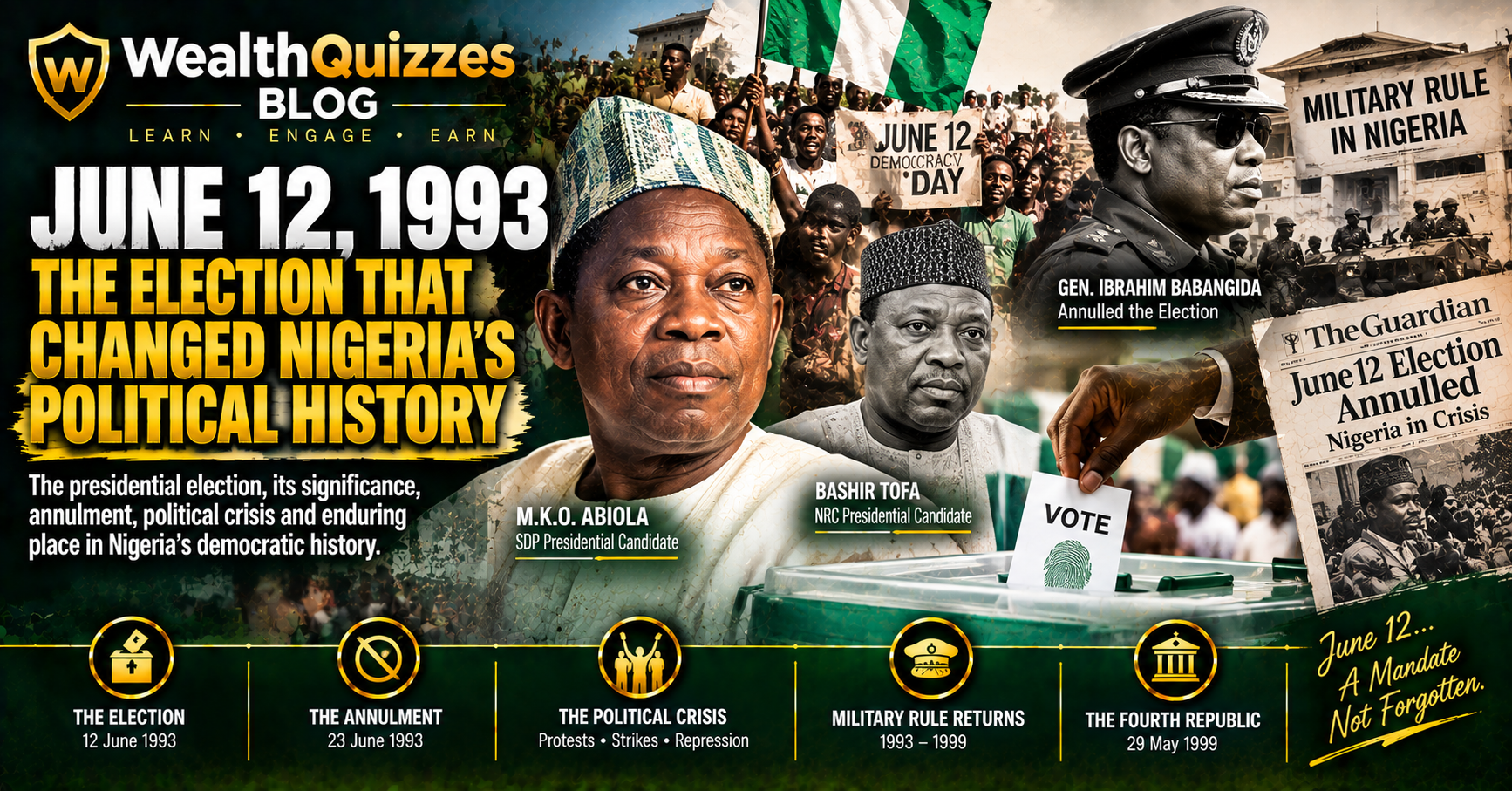
The 12 June 1993 presidential election is widely regarded by scholars as a critical turning point.
Unofficial results indicated that Moshood Kashimawo Olawale Abiola of the SDP had won the election, but Babangida annulled the process. The annulment triggered widespread protests, strikes and political crisis. (Cambridge University Press)
Babangida eventually “stepped aside” in August 1993 and transferred power to an Interim National Government headed by Ernest Shonekan.
The arrangement lasted only about three months.
On 17 November 1993, General Sani Abacha seized power.
Abacha’s government abandoned the previous transition framework and established a highly authoritarian military regime. The State House records his tenure as running from November 1993 until June 1998. (State House)
Political parties were dissolved, democratic activists were arrested, and opposition movements faced severe repression.
The execution of Ken Saro-Wiwa and eight other Ogoni activists in 1995 became an international symbol of the regime’s repression.
Abacha also initiated another transition programme, but growing evidence suggested that the process could potentially culminate in his own civilian presidency.
As Pita Agbese argues, the failure of Babangida’s and Abacha’s transition programmes demonstrated the difficulty of expecting military regimes to engineer a genuinely autonomous democratic order. (Cambridge University Press)
Abdulsalami Abubakar and the Final Transition
Abacha died suddenly on 8 June 1998.
General Abdulsalami Abubakar succeeded him.
Unlike the previous prolonged transition programmes, Abubakar moved rapidly toward civilian rule.
He released political prisoners, dissolved the existing military-created political structures and established a new electoral process. He also promised a new constitution and set a timetable for elections.
Cambridge scholar Ebenezer Obadare notes that the Abubakar programme differed significantly from Abacha’s in its methodology and objectives and culminated in the election of Olusegun Obasanjo as president-elect. (Cambridge University Press)
The death of M.K.O. Abiola in July 1998 complicated the June 12 question, but the military ultimately proceeded with the transition.
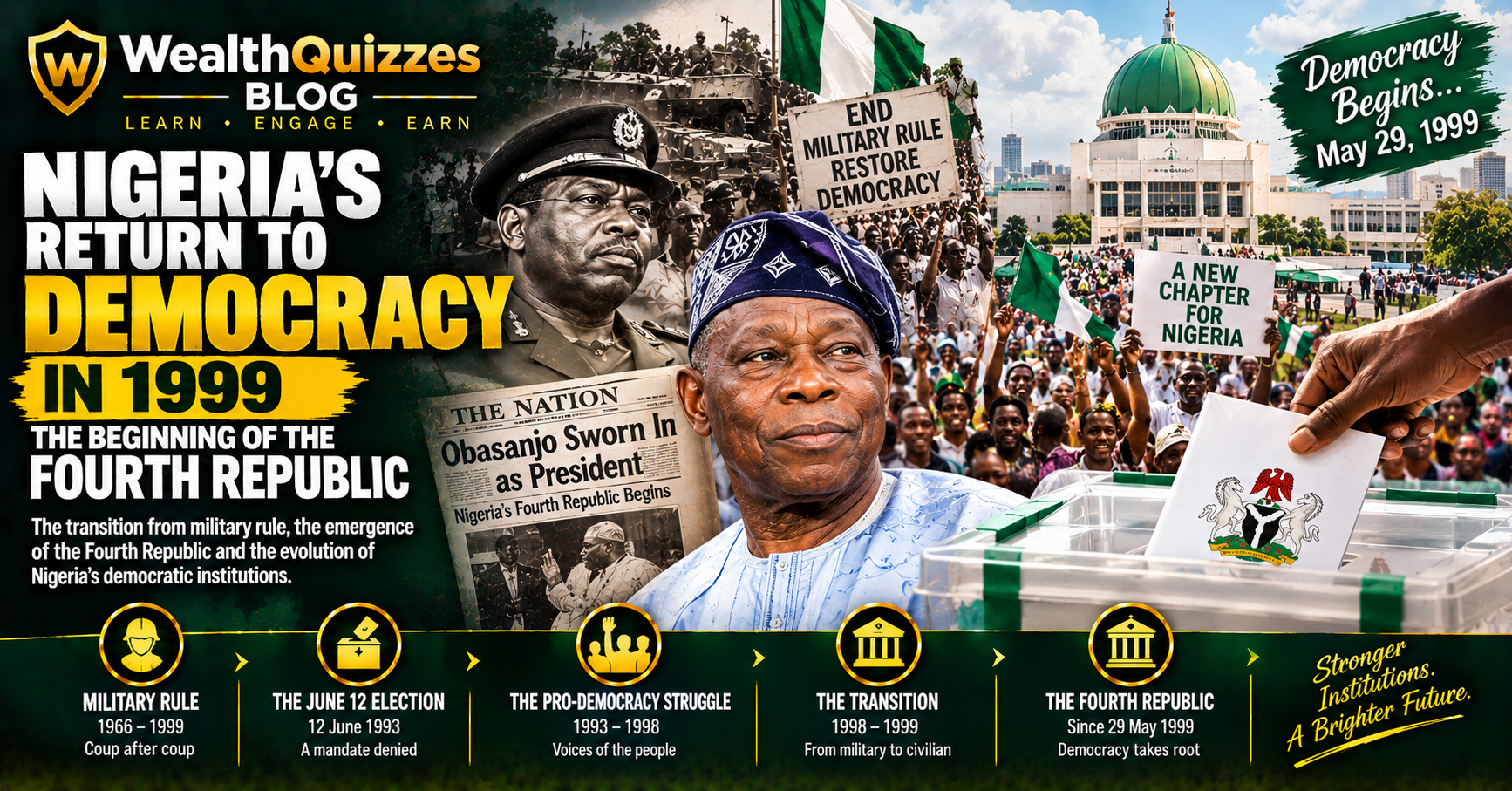
On 29 May 1999, General Olusegun Obasanjo was sworn in as President of the Federal Republic of Nigeria.
The Fourth Republic had begun.
The Constitutional Legacy of Military Rule
One of the most important legacies of the military era was constitutional.
Nigeria entered independence with a relatively decentralised parliamentary federation based on regions.
By 1999, it had become a 36-state presidential federation with a much stronger central government.
Constitutional scholar Rotimi Suberu describes this as a dramatic transformation—from a parliamentary federation of four regions to a centrist presidential federalism with 36 states. Much of this transformation occurred under military governments. (OUP Academic)
The military therefore did not merely occupy political office. It fundamentally reshaped the Nigerian state.
State creation, centralisation of fiscal resources, the presidential system and federal administrative institutions all formed part of this transformation. (Forum of Federations)
Why Did Military Rule Eventually End?
Military rule did not end because the military suddenly ceased to have political interests.
Rather, several forces converged.
First was the resilience of civil society.
Professional associations, labour unions, journalists, students, lawyers, religious organisations and pro-democracy groups repeatedly challenged military authoritarianism.
Second was declining military legitimacy.
Osaghae argues that the military’s claim to superior moral and political competence progressively weakened as successive regimes failed to deliver stable democratic government. (OUP Academic)
Third was economic decline.
The economic difficulties associated with the 1980s and 1990s reduced public confidence in military government.
Fourth was the international environment. The end of the Cold War and the global democratic wave increased international pressure on authoritarian governments.
Finally, the death of Abacha created an opening for a much faster and more credible transition under Abubakar. (OUP Academic)
Historical Lessons of the Military Era
Nigeria’s military experience provides several important lessons.
First, military intervention rarely eliminates the political problems that produce coups. The military repeatedly entered government promising correction, but each intervention generated new constitutional and legitimacy problems.
Second, constitutions cannot by themselves resolve political conflict. Nigeria experimented with parliamentary and presidential systems, regional and state structures, and multiple constitutional arrangements. Institutional design mattered, but political behaviour and legitimacy mattered just as much.
Third, excessive centralisation has consequences. The military created a stronger federal centre and numerous states, but the resulting structure generated continuing debates over federalism, resource control and state autonomy. Suberu describes this as part of Nigeria’s continuing constitutional transition. (OUP Academic)
Fourth, civil society matters. Nigeria’s eventual return to democracy was not simply a gift from the military. It was also the product of sustained pressure from citizens and organisations that resisted authoritarian rule. (OUP Academic)
Conclusion
Nigeria’s military era was one of the most transformative periods in the country’s modern history.
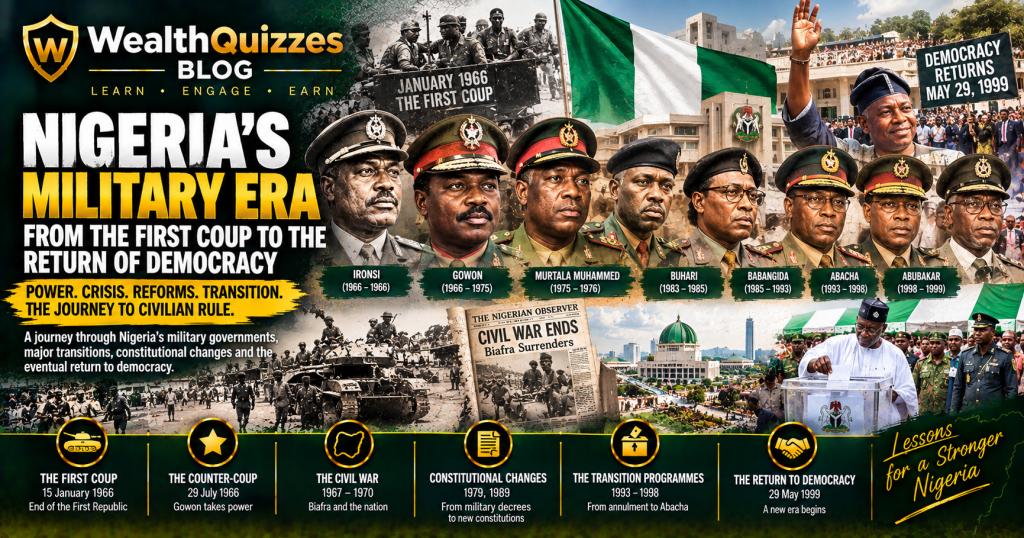
Beginning with the January 1966 coup, military intervention became a recurring feature of Nigerian politics. The regimes of Aguiyi-Ironsi, Yakubu Gowon, Murtala Muhammed, Olusegun Obasanjo, Muhammadu Buhari, Ibrahim Babangida, Sani Abacha and Abdulsalami Abubakar governed Nigeria at different moments, with the Second Republic of Shehu Shagari from 1979 to 1983 providing the principal civilian interruption. (State House)
The military era produced profound changes: the Civil War, the creation of states, greater federal centralisation, the presidential system, structural economic reforms, repeated transition programmes and eventually the constitutional framework of the Fourth Republic.
But perhaps its most enduring legacy is the lesson that political stability cannot be permanently achieved through military force.
The Nigerian military repeatedly intervened because civilian politics appeared incapable of resolving the country’s problems. Yet decades of military government ultimately demonstrated that authoritarian intervention could not substitute for legitimate institutions, accountable leadership, constitutionalism and democratic participation.
The return to civilian rule on 29 May 1999 therefore represented more than another change of government. It marked the culmination of a long struggle over the fundamental question of Nigerian statehood:
Who should govern Nigeria—and by what constitutional authority?
Nigeria’s answer since 1999 has been civilian constitutional democracy. The durability of that answer remains one of the most important legacies of the country’s long military era.