Norway 2–1 Brazil: Haaland, Nusa and the Night the World Cup Shifted
How Norway Knocked Out Brazil and Rewrote the Story of FIFA World Cup 2026
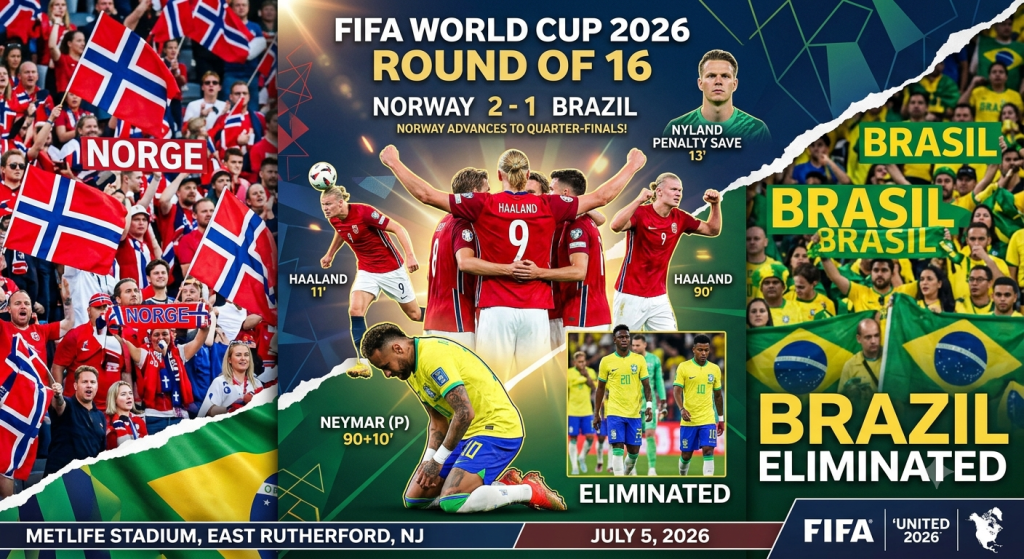
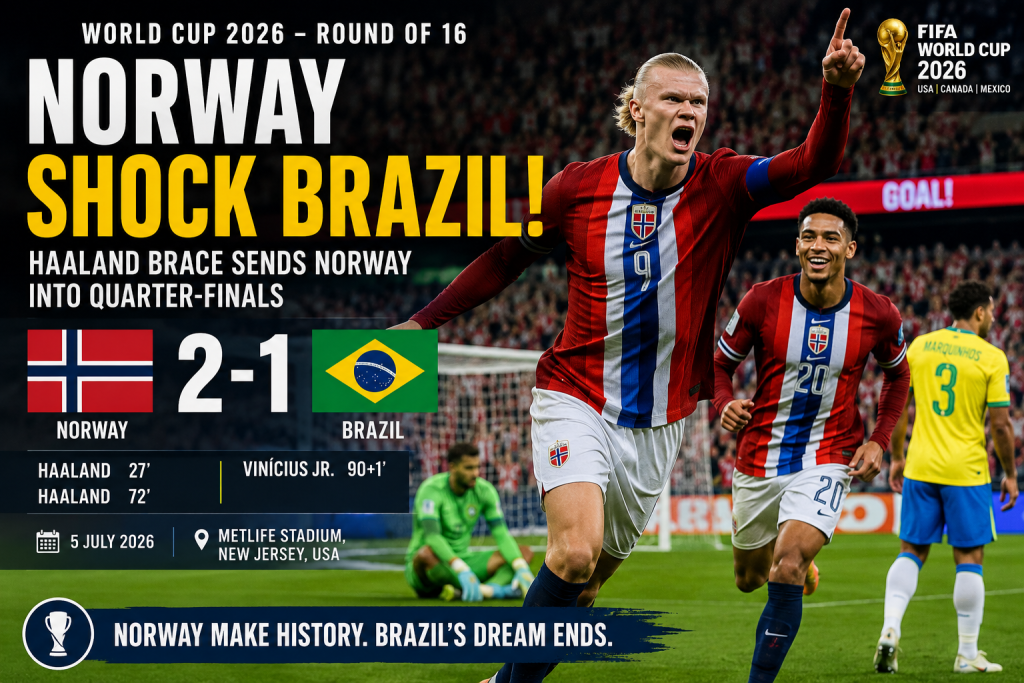
If the FIFA World Cup exists to remind the world that football does not respect reputation, then Norway’s 2–1 victory over Brazil on 5 July 2026 was one of the tournament’s clearest statements yet. On paper, Brazil entered the Round of 16 as one of the competition’s glamour contenders: five-time world champions, stacked with elite talent, coached by Carlo Ancelotti, and widely expected to navigate the knockout rounds. Norway arrived with less history, fewer global expectations, and a squad still often discussed through the narrow lens of one extraordinary centre-forward, Erling Haaland. By full-time in East Rutherford, that frame no longer held. Norway were quarter-finalists, Brazil were going home, and the World Cup had produced another result that will sit for years in the archive of tournament shocks.
The scoreline alone was dramatic enough: Norway 2, Brazil 1. But the deeper significance of the match lies in how it was won, what it revealed about both teams, and what it may yet mean for the shape of World Cup 2026. Haaland’s brace, the tactical intelligence of Ståle Solbakken’s side, Brazil’s inability to control key moments, and the emotional swing of a knockout night all combined to create one of the tournament’s defining stories so far. Reports from multiple outlets, including Al Jazeera’s match report and ESPN’s live coverage and reaction, confirm the central fact: Norway stunned Brazil 2–1, with Haaland scoring twice to send the Scandinavians into the quarter-finals.
A Result Bigger Than One Match
To understand why this game matters, it is necessary to begin with the scale of the upset. Brazil do not enter World Cups merely as participants. They enter as a football civilisation. Every tournament involving Brazil carries the weight of Pelé, Garrincha, Romário, Ronaldo, Rivaldo, Ronaldinho, Kaká, Neymar, and the broader mythology of jogo bonito. Even when Brazil are imperfect, they are still judged by the standard of winning the tournament, not merely competing in it.
Norway’s football history, by contrast, is far more modest at the World Cup level. The country has produced elite individuals, and this generation is unquestionably the strongest Norway has fielded in decades, but there remained a psychological and historical gulf between the sides before kick-off. That is why this result resonates beyond the bracket. Norway did not merely beat a strong team. They eliminated one of the sport’s most symbolically powerful nations in the first knockout round of the biggest World Cup ever staged.
And they did it without looking overawed.
Haaland as the Decisive Force
The obvious place to begin the football analysis is with Haaland, because this was the sort of knockout performance that changes a player’s tournament status. Great strikers do not simply score in easy group matches; they score in games where a nation’s World Cup hangs in the balance. Haaland did exactly that.
According to the match reporting, his two goals carried Norway past Brazil and pushed his tournament tally to seven, further strengthening his case as one of the defining figures of World Cup 2026. But the significance of his display goes beyond numbers. Haaland represented the clearest difference between the teams in the most important attacking zones: directness, conviction, and ruthless timing.
Brazil had more of the historic aura. Norway had the striker who turned the match.
This is not to reduce Norway’s performance to one player, because that would be unfair to the structure and discipline of the side around him. But elite tournament football often swings on whether a team possesses a forward who can convert low-volume opportunities into high-value outcomes. Haaland is built for that environment. He does not need 10 touches in the box. He does not require an endless flow of possession. He needs one transition, one gap between centre-backs, one half-second to set his body, one moment when the ball arrives in a zone he can attack with violence and clarity. Norway gave him those moments, and he punished Brazil.
Norway’s Tactical Maturity Was the Real Story Behind the Story
If Haaland supplied the headlines, Norway’s collective tactical performance supplied the platform. This was not a smash-and-grab victory built purely on luck or isolated finishing. Norway were organised, emotionally steady, and intelligent in the way they managed space against a Brazilian team with obvious attacking quality.
Pre-match analysis had already identified the likely battlegrounds: Norway’s compact shape, the relationship between Haaland and Martin Ødegaard, and Brazil’s need to control transitions. Several previews noted that Norway’s most credible route to victory would be to protect central spaces, stay alive defensively, and then release their front-line quickly when possession was regained. That script is effectively what unfolded.
Norway did not need to dominate the ball to dominate the key moments. Their plan was rooted in tournament realism rather than vanity. They were willing to defend compactly, to accept phases without possession, and to trust that when the match opened, they had the personnel to hurt Brazil. This is one of the central truths of knockout football: control is not measured only by possession share. Sometimes control means forcing the game to occur on your terms.
That is what Norway achieved.
Brazil’s Problem Was Not Only Conceding Goals — It Was Failing to Control the Emotional Flow of the Match
When a heavyweight exits the World Cup, the first instinct is often to ask what went wrong tactically. That question matters here, but it is incomplete. Brazil’s bigger problem was that they never fully controlled the emotional flow of the game. Knockout football is rarely just about systems; it is about sequence, nerve, and the ability to settle a match when momentum becomes unstable.
Brazil still had the kind of players capable of turning the match. Vinícius Júnior remained the most obvious individual danger, and Brazil’s attacking talent meant Norway were never likely to enjoy a comfortable evening. Yet Brazil increasingly looked like a team chasing clarity rather than dictating it. The game did not unfold with the calm authority one expects from a side intending to win the World Cup. It unfolded with uncertainty.
That is not merely a criticism of one player or one defensive mistake. It is a broader observation about knockout management. Brazil needed to impose rhythm, control second balls, reduce the space Norway wanted to attack, and emotionally flatten the match after difficult moments. Instead, Norway kept the game alive long enough for belief to grow.
Once that happens in the World Cup, reputations become fragile.
Why This Match Fits the Wider Story of World Cup 2026
One reason this result feels so important is that it fits a wider pattern already visible in the tournament. World Cup 2026 has repeatedly shown that the gap between traditional giants and well-drilled challengers is narrower than many expected. The expanded 48-team format has not simply created more matches; it has created more opportunities for nations outside the old hierarchy to build momentum, develop belief, and carry that confidence into the knockout phase.
Norway’s win over Brazil belongs in that broader narrative. It reinforces one of the defining themes of this World Cup: the age of passive underdogs is fading. Teams arrive now with elite coaching, sophisticated analysis, high-level sports science, and players who compete weekly in Europe’s top leagues. Norway are a perfect example of that modern football reality. Haaland is a global superstar. Ødegaard operates at the highest tactical level in club football. Around them is a team far more tactically literate and physically prepared than the old stereotype of a “smaller nation” would suggest.
So while the result is an upset in historical and symbolic terms, it is not an inexplicable one. It is the product of a changing football landscape in which good teams no longer wait for permission to challenge great names.
Haaland’s Brace Will Dominate the Memory, but Ødegaard and Norway’s Structure Deserve Equal Credit
Tournament narratives naturally gravitate to scorers, and Haaland earned every headline. But football matches of this kind are usually won by the interaction between a star and a structure. Norway’s ability to remain connected between midfield and attack, to support Haaland quickly, and to defend with enough discipline that Brazil could not simply overwhelm them was essential.
That is where players such as Martin Ødegaard matter enormously. Even when he is not the final scorer, a player of his profile changes the geometry of the game. He provides the pass before the chance, the turn that breaks a pressing line, the decision that releases a runner at the right moment. Norway’s knockout maturity came not from adrenaline alone but from technical control in the moments that mattered.
Against Brazil, that combination of structure and star power proved enough.
The Pressure Now Shifts Completely
One of the most fascinating consequences of this result is psychological rather than tactical. Before the Round of 16, Brazil carried the expectation and Norway carried the opportunity. After the match, those roles change. Brazil’s tournament is over, and the post-mortem will inevitably be severe. Questions will be asked about selection, balance, tactical decisions, defensive transitions, and whether this generation once again fell short of the standards associated with the shirt.
Norway, meanwhile, move forward with a different burden: no longer the plucky outsider, but a genuine quarter-final threat. A team that can eliminate Brazil cannot be treated as a novelty act. It must be treated as a contender capable of shaping the final weeks of the tournament.
That is perhaps the biggest shift created by this match. Norway are no longer a story. They are now a football problem for whoever faces them next.
What Brazil’s Exit Means
Brazil’s elimination is one of the most significant developments of World Cup 2026 so far. In purely football terms, it removes one of the tournament’s deepest talent pools and one of its most commercially magnetic teams. In emotional terms, it strips the knockout rounds of one of their most recognisable narratives: Brazil’s pursuit of another world title. In tactical terms, it is another warning to every heavyweight left in the competition that attacking talent alone is not enough in tournament football.
World Cups do not reward potential. They reward execution under pressure.
Brazil, for all their quality, did not execute well enough on the night.
What Norway’s Win Means
For Norway, the meaning is the opposite. This is not merely a quarter-final qualification. It is a statement that the nation’s golden generation has now produced a result worthy of the talent long associated with it. Haaland’s goals will be replayed, but the broader achievement is collective: Norway absorbed the pressure of the occasion, respected Brazil without fearing them, and delivered one of the most important victories in the country’s football history.
That matters not only for this tournament but for Norway’s identity as a football nation. International football is shaped by moments that reframe what a country believes is possible. This feels like one of those moments.
Conclusion: The Night Norway Turned Promise Into History
Norway 2–1 Brazil will be remembered first as the night Erling Haaland knocked one of football’s superpowers out of the World Cup. That is fair enough; decisive strikers deserve decisive headlines. But the match deserves to be remembered more fully than that. It was also the night Norway’s tactical maturity, emotional control, and tournament intelligence came together on the biggest stage. It was the night Brazil discovered that heritage does not defend transitions, and that status does not rescue a team once the knockout rounds begin to move against it. And it was the night World Cup 2026 produced another reminder that this tournament belongs not to the most famous team, but to the team that best handles the moment in front of it.
Haaland will take the photographs and the acclaim. He earned both. Yet the deeper lesson of the match is collective. Norway did not beat Brazil because football is random. Norway beat Brazil because they had a plan, believed in it, executed it, and possessed the elite striker required to turn pressure into history.
That is how World Cups are won. And on this night in East Rutherford, it is how Brazil were sent home.