
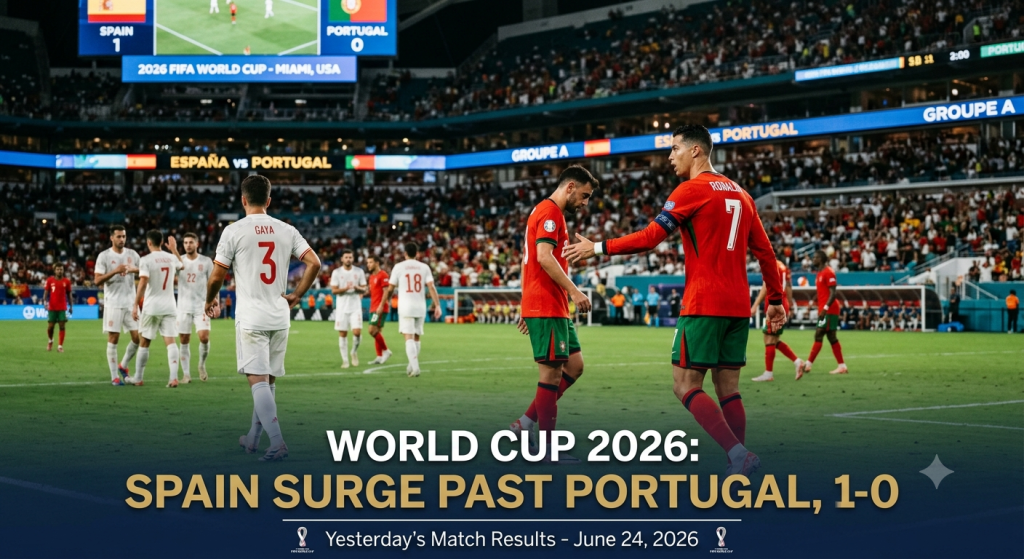
Spain 1–0 Portugal: Merino’s Late Strike, Ronaldo’s Last Dance and the Night Iberian Football Turned Into World Cup Theatre
How Spain Knocked Out Portugal and Ended Cristiano Ronaldo’s World Cup Story
Few World Cup fixtures arrive carrying as much emotional, tactical and symbolic weight as Spain versus Portugal. Even before a ball is kicked, an Iberian knockout clash comes loaded with history, identity, rivalry and star power. When the fixture also carries the possibility that it could be Cristiano Ronaldo’s final World Cup appearance, the occasion becomes larger than a normal Round of 16 tie. That was the backdrop to Spain’s 1–0 victory over Portugal in Arlington, Texas, on 6 July 2026—a result settled only in stoppage time by a decisive finish from Mikel Merino, but shaped by a deeper story of patience, control, frustration, and the unforgiving nature of knockout football.
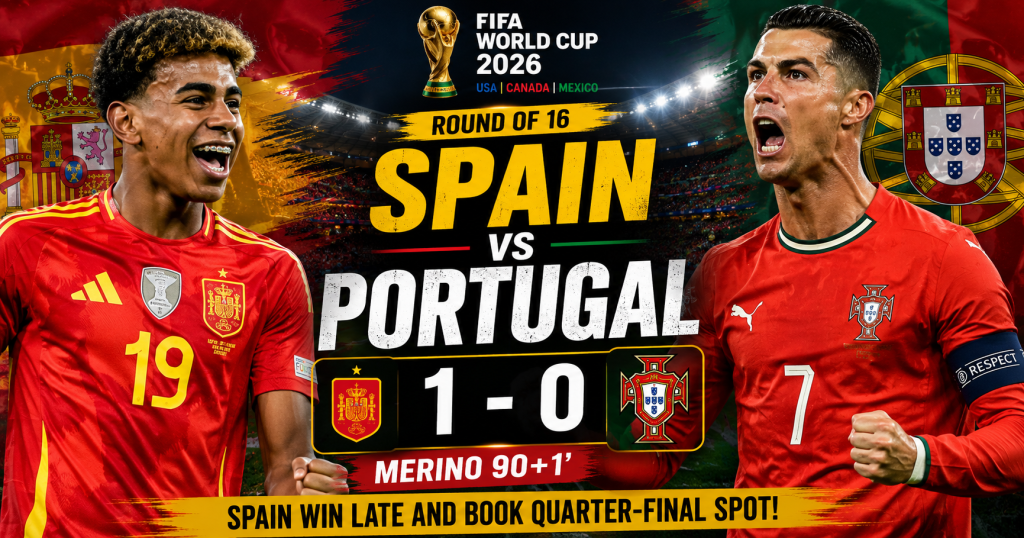
On paper, this was one of the glamour matches of the FIFA World Cup 2026 Round of 16. Spain arrived as reigning European champions, a side rich in technical control, midfield intelligence and youthful attacking talent. Portugal arrived with a squad full of elite names and with the emotional gravity of Ronaldo’s final World Cup campaign hanging over the entire occasion. Yet by the end of a tense, low-margin contest at Dallas Stadium, it was Spain who had found the one decisive moment. Merino’s goal in the first minute of stoppage time gave Spain a 1–0 win, sent them into the quarter-finals, and likely closed the final chapter of Ronaldo’s World Cup career. Reuters, Al Jazeera, Sky Sports and the Asian Football Confederation all reported the same essential sequence: a cagey contest, little true attacking fluency, and then a late Merino finish after a pass from Ferran Torres that eliminated Portugal and pushed Spain onward.
But as with the best World Cup knockout games, the significance of the match lies in more than the scoreline. Spain’s victory was not merely about a late goal. It was about the strategic discipline required to survive a tense derby-like contest, the difficulty of balancing possession with penetration, the challenge of carrying legacy players deep into tournament football, and the way World Cups often turn on one substitution, one lapse of concentration, or one calm finish after ninety minutes of tactical strain.
A Match That Promised Fireworks but Delivered Tension
The pre-match billing suggested spectacle. Spain and Portugal are not just neighbours; they are footballing mirrors and rivals, nations whose modern teams are comfortable on the ball, tactically sophisticated and populated by players from Europe’s elite clubs. There were obvious narrative attractions everywhere: Cristiano Ronaldo possibly taking the World Cup stage for the last time; Lamine Yamal representing Spain’s youthful future; Portugal trying to prove that their “golden generation after the golden generation” could finally turn talent into a truly historic World Cup run; Spain trying to show that they are more than a possession-heavy side and are now genuine tournament finishers under pressure.
What unfolded, however, was not a game of open attacking brilliance. It was a game of caution, structure and restraint. Sky Sports described it as an “underwhelming” encounter in which neither team consistently rose to the level of the occasion until the very end, while the AFC’s match report noted that extra time looked certain before Merino’s stoppage-time intervention settled the tie.
That contrast between expectation and reality is not unusual in World Cup knockout football. At club level, these players often operate inside well-drilled attacking structures, with repeated automatisms and extensive tactical familiarity. International tournament football is different. The margin for error is smaller, the emotional cost of risk is higher, and the fear of making the mistake that ends a nation’s campaign often narrows the game. Spain and Portugal did not play as if they were in a league fixture. They played as if one bad transition, one misplaced pass or one failed recovery run could end everything. That caution defined the match.
Spain Controlled More of the Ball, but Control Was Not the Same as Fluency
Spain’s identity remains rooted in ball control, positional discipline and technical circulation. That much was visible again here. Europa Press’s statistical summary of the match credited Spain with the majority of possession and more total shots, reinforcing the sense that they carried a greater share of territorial initiative. Yet possession in itself did not mean Spain were carving Portugal open. Their circulation was often cleaner than Portugal’s, but not consistently sharper. The game repeatedly drifted into sterile phases where Spain had the ball without transforming that control into a sustained sequence of high-quality chances.
That matters because it highlights both Spain’s strength and their current tension as a team. Their strength is obvious: they can slow the game, keep it within their tactical frame, and deny opponents easy access to chaotic transitions. Their tension is that tournament football eventually demands more than control; it demands incision. Against Portugal, Spain found the incision late rather than consistently.
Still, there is value in understanding what that control achieved. In a World Cup knockout match, domination is not always about entertaining. Sometimes it is about making the game small enough that one moment can decide it in your favour. Spain never allowed Portugal to turn the contest into a wide-open, emotionally chaotic match. That in itself was a kind of control.
Portugal’s Problem Was Not a Lack of Talent but a Lack of Rhythm
Portugal’s elimination will inevitably produce familiar questions: Why did a squad with so much technical quality create so little? Why did a side containing players such as Bruno Fernandes, Vitinha, João Félix and Ronaldo fail to impose itself more forcefully? Why did the attack feel disconnected rather than dangerous?
The answer is not that Portugal lacked quality. The answer is that they lacked rhythm. They never fully settled into a pattern of attacking that forced Spain’s structure to break. Reuters’ photographic coverage and Sky’s reporting both framed the match as one in which Portugal’s big names struggled to truly stamp themselves on the contest. There were moments of threat, and one of the most important came before half-time when Nuno Mendes struck the crossbar, a reminder that the match could easily have tilted the other way. But moments were too isolated. Portugal looked like a team waiting for one of its stars to create a decisive break rather than a side constructing sustained attacking pressure.
That distinction matters. World Cup knockout football punishes teams that rely too heavily on individual rescue. Spain were not flawless, but they looked more structurally coherent. Portugal looked more dependent on inspiration.
The Ronaldo Question Hung Over the Match — and Over Portugal’s Entire Tournament
It is impossible to write about Portugal’s defeat without addressing the figure at the centre of its emotional narrative: Cristiano Ronaldo. By his own admission before the match, this was set to be his final World Cup appearance, and that reality transformed the game into something larger than a standard last-16 exit. Ronaldo’s presence is never neutral. He brings goals, aura, leadership, scrutiny, expectation, and the weight of one of the greatest individual careers football has ever seen. But in late-career tournament football, legacy and tactical utility do not always align perfectly.
This is where the match becomes uncomfortable for Portugal. Ronaldo remains one of the greatest players in the history of the sport, but World Cups are not testimonial events. They are ruthless performance environments. Spain’s late goal did not merely end Portugal’s campaign; it sharpened the question of whether Portugal’s attack was too emotionally organised around Ronaldo’s final chapter rather than ruthlessly optimised for the present demands of the tournament.
That is not to say Portugal lost because Ronaldo played. Football is rarely that simplistic. But it is fair to say that the team’s attacking structure never found the fluidity, speed or unpredictability needed to truly stretch Spain. When a knockout game remains tight into stoppage time, a team’s margin for inefficiency disappears. Portugal discovered that in the hardest way possible.
Merino’s Winner Was a Lesson in Tournament Football
The decisive moment arrived in the 91st minute, and in many ways it was the perfect World Cup goal—not spectacular in distance or technique, but devastating in timing and consequence. Ferran Torres, himself a substitute, slipped a pass into Mikel Merino, who finished calmly to beat Diogo Costa and send Spain through.
The goal mattered not only because it won the match, but because of what it represented. It was a triumph of squad depth, timing and coaching intervention. Merino did not begin the match as the central story. He became it because tournament football often turns substitutes into history-makers. A coach’s bench choices, the energy of fresh legs, and the ability to read a slowing match can matter as much as the original starting XI.
Spain’s bench changed the game at the exact moment when the contest seemed destined for extra time. That is a hallmark of mature tournament teams: they may not dominate every minute, but they retain enough control and enough quality in reserve to punish the decisive opening when it appears.
Why Spain Won: Not Because They Were Brilliant, but Because They Were Better at the Match That Existed
There is a temptation after knockout victories to overpraise the winners and overcondemn the losers. This game resists that kind of simple reading. Spain were not dazzling. They were not relentlessly creative. They did not play one of the great World Cup matches. But they were better at playing the match that actually existed.
That is a different skill, and in tournament football it may be the most important one.
The match that existed was tight, emotionally heavy, tactically compressed and low-scoring. It demanded patience more than spectacle, concentration more than freedom, and the ability to stay emotionally balanced long enough for one chance to matter. Spain handled that environment better than Portugal. They made fewer costly emotional errors. They sustained more territorial control. They used their bench more decisively. And when the one big opening arrived, they took it.
That is not glamorous. It is just effective. World Cups are full of teams that can look more exciting than Spain for twenty-minute bursts. There are fewer teams that can navigate a cagey last-16 duel with this level of calm and survive to the next round.
What Portugal’s Exit Says About the Current Tournament
Portugal’s elimination also fits a broader pattern in World Cup 2026. This tournament has repeatedly shown that star names and squad depth do not guarantee fluency once the knockout rounds begin. The expanded format has produced more varied routes to the Round of 16, but once teams reach the last sixteen, the competition narrows into a series of psychological and tactical stress tests. Reputation matters less than execution. Legacy matters less than clarity.
Portugal were not blown away. They were edged out. That can be even more painful, because it suggests not a collapse but a failure to find one more decisive action, one more phase of control, one more attacking sequence with conviction. In elite tournament football, that is often the difference between a quarter-final and a post-mortem.
What Spain’s Victory Means Going Forward
For Spain, this win is significant precisely because it was not easy. Great tournament teams are not measured only by the matches they dominate. They are measured by the awkward nights they survive. Spain have now shown they can win an unattractive knockout game against a major opponent with huge emotional stakes attached. That is a useful credential.
It also reinforces the depth of Spain’s squad. The presence of players like Rodri, Pedri, Dani Olmo, Yamal, Ferran Torres and Merino gives them multiple routes through a tournament. They can control, they can counter, they can rotate profiles from the bench, and they can win late. Those are serious tournament assets.
Yet Spain will also know they must improve. A quarter-final will ask more of them than this performance delivered. If they remain this blunt in the final third for long stretches, they may not always get a stoppage-time rescue. The win was valuable. It was not a declaration of perfection.
Ronaldo’s World Cup Ending: A Great Career, an Unhappy Final Image
The emotional image that may endure from this match is not Merino’s finish but Ronaldo’s dejection at full time. Reuters’ photo coverage captured that visual immediately: Ronaldo looking devastated as Spain celebrated and Portugal’s World Cup campaign ended. If this was indeed his final World Cup appearance, it was a cruelly quiet ending for a player who has spent two decades making football history on the biggest stages.
Yet there is something almost fitting about the way tournament football treated him in the end. The World Cup has always been a place where greatness is not guaranteed a perfect script. It denied Johan Cruyff a title by circumstance, denied Lionel Messi for years before finally yielding in 2022, and now appears to have denied Ronaldo the kind of final World Cup exit that mythology might have preferred. Instead, it gave him what it gives everyone eventually: an opponent, a clock, a shrinking margin, and a result that does not care about reputation.
Conclusion: Spain Advanced, Portugal Departed, and the World Cup Delivered Another Lesson in Ruthless Timing
Spain’s 1–0 win over Portugal will not be remembered as the most beautiful match of World Cup 2026, but it may prove one of the most consequential. It was a game in which spectacle gave way to structure, in which the fear of defeat shaped the flow more than the desire for expression, and in which one late substitution and one calm finish altered the emotional map of the tournament. Mikel Merino’s 91st-minute goal sent Spain into the quarter-finals, ended Portugal’s campaign, and likely brought Cristiano Ronaldo’s World Cup story to its final page.
Spain deserve credit not because they were irresistible, but because they were resilient, patient and precise at the decisive instant. Portugal leave with regret not because they were humiliated, but because they never quite found the rhythm, bravery or attacking clarity needed to turn talent into control. And Ronaldo leaves, perhaps for the final time on this stage, with the brutal reminder that the World Cup is the one arena where football’s greatest reputations still have to submit to the smallest margins.
That is what made this match feel so heavy. It was not merely Spain versus Portugal. It was a clash between two footballing nations, two tactical identities, two generations, and one fading icon’s final attempt to bend history one last time. Spain won the tie. Merino won the moment. The World Cup, as it so often does, kept the bigger story for itself.