
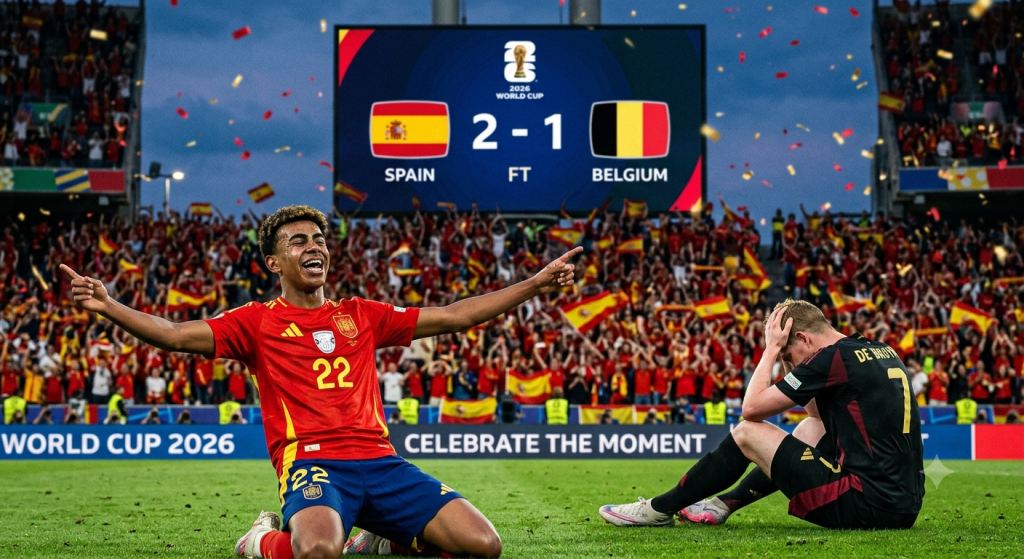
Spain 2–1 Belgium: La Roja’s New Generation Marches On as Belgium’s Golden Era Finally Fades
How Spain’s youthful brilliance, tactical discipline, and championship mentality overcame a resilient Belgium to book a place in the FIFA World Cup 2026 semi-finals
The FIFA World Cup has always been a tournament where generations collide. Legends bid farewell, rising stars announce themselves, and footballing empires are either renewed or brought to an end. Spain’s dramatic 2–1 victory over Belgium in the quarter-finals of the FIFA World Cup 2026 perfectly captured all three realities. Played before a packed stadium and watched by hundreds of millions around the globe, the encounter showcased everything that makes World Cup football the greatest spectacle in sport: tactical intelligence, technical excellence, emotional intensity, and moments of individual brilliance capable of changing history.
For Spain, the victory represents another significant step towards reclaiming the world title they last won in 2010. For Belgium, however, it may well represent the closing chapter of one of the most gifted generations ever assembled by the nation. While the Red Devils fought courageously until the final whistle, La Roja once again demonstrated why tournament football is won not merely through talent, but through collective organisation, composure under pressure, and clinical execution when opportunities arise.
As the tournament moves into its decisive stages, Spain have quietly established themselves as one of the strongest contenders for the FIFA World Cup 2026 trophy.
A Quarter-Final Worthy of the World Stage
Long before kickoff, this fixture promised to be one of the most technically gifted contests of the tournament.
Spain entered the match having steadily grown into the competition. After navigating the group stage with confidence and overcoming Portugal in a tightly contested Round of 16 encounter, Luis de la Fuente’s side appeared increasingly balanced. Their trademark possession football remained intact, but unlike previous Spanish teams, this version possessed greater verticality, more pace in transition and far greater willingness to attack directly when opportunities presented themselves.
Belgium, meanwhile, arrived determined to prove that experience still matters on football’s biggest stage.
Although many members of the country’s famous “Golden Generation” have retired, Belgium continue to possess world-class quality across every department. Their journey to the quarter-finals had been built on resilience, disciplined defending and efficient attacking play.
The match therefore presented an intriguing tactical battle between Spain’s youthful dynamism and Belgium’s experienced pragmatism.
Spain’s Midfield Once Again Controlled the Game
If football matches are often won in midfield, Spain deserved every bit of their victory.
From the opening whistle, Spain monopolised possession with remarkable composure. Their midfield triangle continuously rotated positions, creating passing angles that prevented Belgium from establishing sustained pressure.
This has become the defining characteristic of modern Spanish football.
Rather than merely enjoying possession for its own sake, Spain now use the ball as both an attacking weapon and a defensive shield. Every completed sequence gradually exhausted Belgium’s defensive structure while simultaneously limiting opportunities for counterattacks.
Former Arsenal manager Arsène Wenger has long argued that possession is valuable only when it creates positional superiority and destabilises opponents.
Spain illustrated that philosophy perfectly throughout the match.
Instead of circulating the ball harmlessly across the back line, they repeatedly manipulated Belgium’s defensive block before exploiting the spaces that inevitably appeared between midfield and defence.
The result was a performance built not on spectacular moments alone but on sustained tactical control.
Lamine Yamal Continues to Rewrite Football History
Every World Cup produces a player who captures global imagination.
At FIFA World Cup 2026, one of those names is undoubtedly Lamine Yamal.
Despite his extraordinary youth, the Barcelona winger continues to display maturity far beyond his years. His confidence on the ball, exceptional first touch and ability to eliminate defenders in one-on-one situations have transformed Spain’s attack into one of the tournament’s most entertaining.
Against Belgium, Yamal repeatedly stretched the defensive line, forcing full-backs to retreat and creating space for Spain’s midfield runners.
More importantly, he never appeared intimidated by the occasion.
Former Barcelona coach Pep Guardiola once described elite footballers as players capable of making difficult decisions appear simple.
Yamal continues to embody that description.
Rather than forcing impossible dribbles, he consistently chose the correct option—whether releasing overlapping teammates, switching play or attacking isolated defenders.
His performance served as another reminder that football’s next global superstar may already have arrived.
Belgium Refused to Surrender
Despite Spain’s territorial dominance, Belgium demonstrated precisely why they have remained one of Europe’s strongest football nations over the past decade.
After falling behind, they responded with courage rather than panic.
Their equalising goal injected fresh belief into the contest and briefly shifted momentum.
Belgium pressed higher, attacked with greater urgency and began forcing Spain into mistakes that had previously been absent.
For nearly twenty minutes, the momentum belonged entirely to the Red Devils.
This resilience has always characterised Belgian football.
Former Belgium manager Roberto Martínez frequently emphasised that tournament football rewards emotional stability above everything else.
Belgium displayed exactly that quality.
Even when Spain appeared superior technically, Belgium continued believing they could change the outcome.
Their refusal to surrender transformed an already excellent football match into genuine World Cup drama.
Spain’s Winning Goal Reflected Championship Quality
Great teams rarely require dozens of chances.
They simply recognise decisive moments when they arrive.
Spain’s winning goal perfectly illustrated this principle.
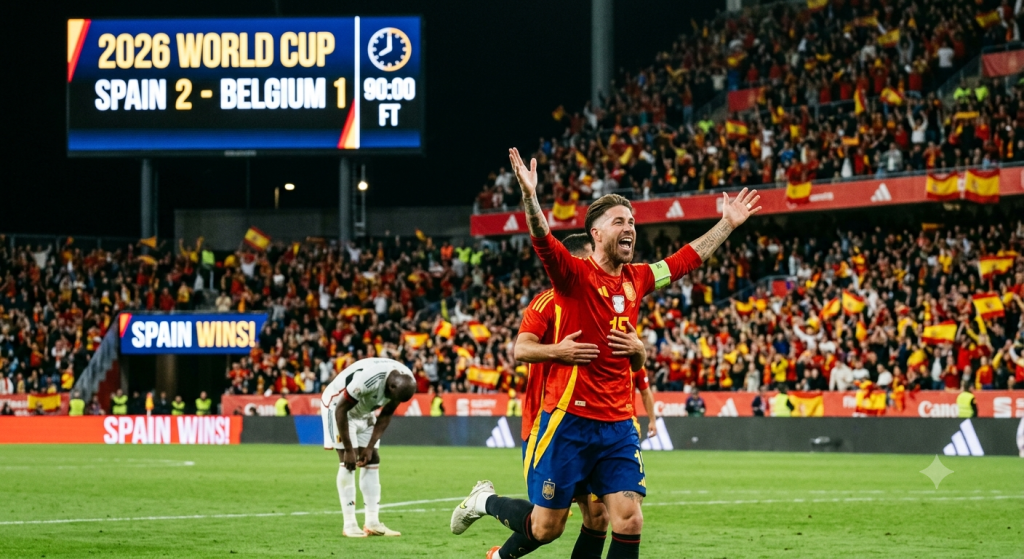
After patiently circulating possession, La Roja suddenly accelerated the tempo with a sequence of quick vertical passes that completely disrupted Belgium’s defensive organisation.
Within seconds, what had seemed like a harmless possession sequence became a match-winning attack.
The finish itself demonstrated composure rather than desperation.
Instead of blasting wildly towards goal, Spain calmly exploited the goalkeeper’s positioning before placing the ball beyond reach.
Championship-winning teams consistently possess this characteristic.
They understand when patience is required and when immediate aggression becomes necessary.
Spain’s second goal represented exactly that balance.
Tactical Discipline Remains Spain’s Greatest Weapon
Modern football often celebrates individual brilliance.
However, tournaments are usually won through collective organisation.
Spain once again demonstrated this fundamental truth.
Without the ball, every player immediately recovered into compact defensive positions.
Passing lanes disappeared.
Belgium found themselves forced into increasingly ambitious long passes rather than penetrating combinations.
Former Italian coach Arrigo Sacchi has repeatedly argued that football’s greatest teams defend as a single unit and attack as a single unit.
Spain currently exemplify that philosophy better than almost any remaining nation.
Their attacking players defend.
Their defenders initiate attacks.
Their midfield controls every transition.
This collective understanding transforms talented footballers into genuine championship contenders.
Belgium’s Golden Generation Deserves Respect
Although Belgium leave the tournament disappointed, history should remember this generation kindly.
Over the past fifteen years, Belgian football has experienced unprecedented success.
The nation consistently produced elite footballers competing for Europe’s biggest clubs.
They reached the latter stages of major tournaments and spent significant periods ranked among the world’s best national teams.
Yet international football can be cruel.
Unlike club competitions, opportunities arrive only every two years.
Even exceptional teams frequently leave without major silverware.
That reality should never diminish Belgium’s contribution to modern football.
Instead, their legacy should be measured by how profoundly they transformed the country’s football culture and inspired future generations.
Spain Are Emerging as Serious World Cup Favourites
Every tournament eventually identifies its genuine contenders.
Spain have unquestionably entered that conversation.
They possess balance across every department.
Their defence remains organised.
Their midfield controls matches.
Their attack combines creativity with ruthless efficiency.
Most importantly, they appear emotionally composed regardless of circumstance.
Championship-winning teams rarely panic.
Spain have repeatedly demonstrated exactly that quality throughout FIFA World Cup 2026.
Whether dominating possession, protecting leads or responding to setbacks, they consistently appear in control of their emotions.
That psychological stability may ultimately prove more valuable than any tactical system.
The Bigger Story: Football’s Changing Balance of Power
Spain’s victory also reflects a broader trend emerging throughout FIFA World Cup 2026.
The tournament has become a fascinating blend of established football powers and ambitious new challengers.
Traditional giants such as Spain, France and Argentina continue progressing deep into the competition.
At the same time, nations like Norway and Morocco have demonstrated that the gap separating football’s elite from emerging powers continues to narrow.
This competitive balance has made World Cup 2026 one of the most unpredictable tournaments in recent memory.
No victory comes easily.
Every knockout match demands complete concentration.
Spain’s hard-fought success over Belgium serves as another reminder that reputations alone no longer win football matches.
Preparation, adaptability and execution remain decisive.
What Lies Ahead
Spain now advance into the semi-finals carrying enormous momentum.
Their blend of youthful excitement and experienced leadership makes them one of the most complete teams remaining in the competition.
Lamine Yamal continues announcing himself as one of world football’s brightest young stars.
The midfield remains among the finest in international football.
The defence has consistently delivered under pressure.
If these qualities continue, Spain will believe another World Cup title is well within reach.
Belgium, meanwhile, depart with disappointment but also dignity.
Their campaign demonstrated resilience, professionalism and the enduring quality that has characterised Belgian football for over a decade.
Although this defeat hurts, it should also serve as the beginning of another rebuilding process capable of producing the nation’s next generation of stars.
Conclusion
Spain’s 2–1 victory over Belgium was far more than another quarter-final result.
It was a demonstration of why modern tournament football rewards intelligence as much as talent.
Spain combined tactical discipline, technical excellence and psychological composure to overcome one of Europe’s most respected football nations.
Belgium fought courageously until the very end, but football at the highest level often belongs to the team capable of recognising and exploiting the game’s defining moments.
La Roja did exactly that.
With every passing match, Spain look increasingly capable of lifting the FIFA World Cup 2026 trophy. Their exciting blend of fearless youth, experienced leadership and sophisticated tactical organisation has transformed them into one of the tournament’s most formidable teams.
If this performance against Belgium is any indication, the road to becoming world champions may very well pass through Spain.