The Aba Women’s War of 1929: When Women Challenged British Colonial Authority
What triggered the uprising, how it unfolded and why it remains one of Nigeria’s most important anti-colonial movements
The history of Nigeria’s struggle against British colonial rule is often told through the actions of male political leaders, traditional rulers, military commanders and nationalist politicians. Yet one of the most remarkable confrontations with British authority in colonial Nigeria was led overwhelmingly by women.
The Aba Women’s War of 1929, known in Igbo as Ogu Umunwanyi and in Ibibio as Ekong Iban, was a mass movement in southeastern Nigeria in which thousands of women challenged colonial taxation, warrant chiefs, native courts, economic policies and the erosion of indigenous political institutions. The uprising began at Oloko in the Bende Division and spread across large parts of the Eastern Provinces, involving predominantly Igbo and Ibibio women as well as women from communities including Ogoni and Andoni. Historian Adam Paddock dates the wider conflict from 23 November 1929 to 10 January 1930, although the immediate chain of events and local protests began earlier in November. (OUP Academic)
The episode was subsequently labelled the “Aba Women’s Riot” in British colonial records. Modern historians have increasingly rejected the implication that it was merely a spontaneous disturbance. Lorna Lueker Zukas describes it more accurately as a strategically organised anti-colonial revolt addressing social, political and economic grievances. (Wiley Online Library)
Colonial Rule and the Changing Political Order
To understand the Women’s War, it is necessary to understand the nature of British rule in southeastern Nigeria.
British colonial administrators sought to govern through indirect rule, using selected African authorities to administer local populations. In northern Nigeria, the system could build upon established emirate institutions. In many parts of southeastern Nigeria, however, political authority was more dispersed among village assemblies, lineage groups, elders, age organisations, title associations and women’s institutions.
Paddock’s Oxford Research Encyclopedia study observes that the British introduced an “almost completely alien political system” of warrant chiefs and native courts into societies where political authority had previously been distributed among several institutions and across genders. (OUP Academic)
This mattered enormously.
The warrant chiefs were colonial appointees or recognised authorities empowered to perform administrative functions on behalf of the British. In many communities, their authority was viewed as an artificial enlargement of chiefly power. Women who had previously exercised influence through customary institutions increasingly found themselves excluded from the new colonial political machinery.
Consequently, the Women’s War was not simply about taxation.
It was about who had the right to exercise authority in the community.
The Taxation Question
The immediate spark came from the colonial government’s taxation policies.
Direct taxation of men had been introduced in southeastern Nigeria shortly before the uprising. In 1928, the colonial government extended direct taxation more systematically into the region. The experience was already unpopular, particularly because household economic conditions were difficult.
Then came a new enumeration exercise.
In 1929, colonial officials sought more detailed information about households, including wives, children and livestock. The purpose was connected to colonial administrative and fiscal assessment, but the exercise generated intense suspicion among the population.
In Oloko, a warrant chief, Okugo, delegated the task of counting to a local mission-school teacher, Mark Emeruwa. When Emeruwa attempted to count women and property, a confrontation occurred with Nwanyeruwa, an Oloko woman.
The incident became the immediate spark.
The women interpreted the counting of wives and property as evidence that the colonial government intended to impose taxation on women. Importantly, historians distinguish between the rumoured extension of taxation to women, which triggered the revolt, and the actual taxation policy then being applied to men. The rumour was powerful because it was entirely consistent with the women’s experience of an expanding colonial fiscal system. (OUP Academic)
The fear was intensified by economic circumstances.
Historian Susan M. Martin, in her Cambridge University Press study Palm Oil and Protest, places the uprising within the economic difficulties of the Ngwa region, where women’s livelihoods were closely connected to produce markets. Falling produce prices and the pressure on women’s economic autonomy made the prospect of further taxation particularly threatening. (Cambridge University Press)
From One Village to a Mass Movement
The extraordinary feature of the uprising was the speed with which the protest spread.
Women possessed extensive networks through markets, kinship, community associations and women’s organisations. Markets were particularly important. They connected women from different villages and provided channels through which information could travel rapidly.
The women of Oloko organised themselves and demanded an explanation from Okugo.
They did not initially begin with an armed confrontation.
Instead, they employed established forms of collective protest.
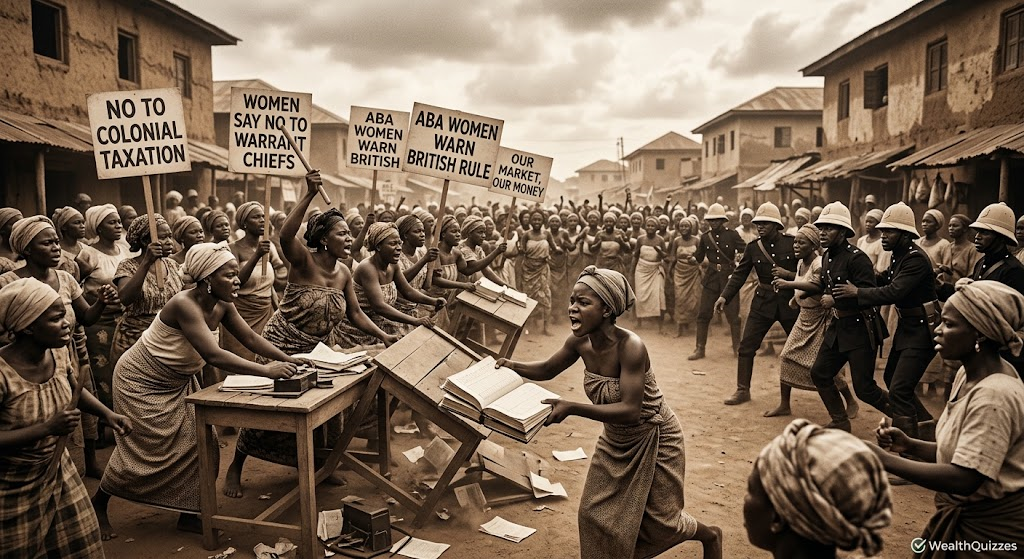
One such method was known in English as “sitting on” a man. Women gathered around the residence or office of an unpopular official or authority figure, singing, dancing, shouting grievances and refusing to leave until their demands were addressed. The practice transformed women’s collective social authority into a potent political weapon. Cambridge scholar Judith Lynne Hanna has examined the importance of dance and performance as mechanisms through which women could exercise political pressure, particularly where they were excluded from formal political institutions. (Cambridge University Press)
The movement soon became much larger.
Women from surrounding communities joined the protest, and the movement spread beyond Oloko into other parts of the Eastern Provinces. Contemporary and later accounts describe thousands of women participating.
The British authorities were confronted with something they had not anticipated: a mass political movement operating through indigenous women’s networks rather than through conventional political parties or male chiefs.
The Women Targeted Colonial Institutions
As the movement expanded, the women’s grievances broadened.
They targeted warrant chiefs, native courts, colonial administrative offices, commercial installations and other symbols of colonial power.
Paddock records a remarkable range of tactics: women removed the caps of office from warrant chiefs, looted factories, burned native court buildings, blocked railway lines, cut telegraph wires, released prisoners from colonial jails and destroyed or confiscated colonial property. (OUP Academic)
The symbolism was important.
The warrant chief’s cap represented colonial recognition and authority. By demanding or removing it, the women were effectively declaring that the authority conferred by the colonial state was illegitimate in their communities.
They were therefore attacking not merely individual officials but the institutional architecture of colonial government.
Aba Became a Symbol—but Oloko Was the Spark
Despite its popular name, the Aba Women’s War did not begin in Aba.
The immediate outbreak occurred at Oloko, and the movement subsequently spread to Aba and other centres.
Aba nevertheless became historically important because it was a major commercial and administrative centre containing European trading interests and colonial institutions. As the movement expanded, women confronted these institutions and demonstrated that colonial commercial power could also become a target of political resistance.
This is why historians increasingly prefer the broader term Women’s War of 1929 rather than treating the event as merely an “Aba riot.” The movement extended across a wide geographical area and involved several communities. Zukas identifies participants from six ethnic groups—Igbo, Ibibio, Andoni, Ogoni, Bonny and Opobo. (Wiley Online Library)
British Authorities Responded With Force
The British colonial government initially attempted to contain the movement through administrative measures and assurances.
Officials repeatedly assured women that they would not be taxed.
But the assurances did not immediately end the resistance.
The underlying grievances were much broader than the taxation rumour.
Women were challenging the warrant-chief system, native courts, colonial economic intervention and the weakening of their traditional political influence.
Eventually, the colonial administration resorted to armed force.
British colonial troops opened fire on women at Abak, Utu Etim Ekpo and Opobo. Paddock records that the most significant loss of life occurred at Opobo, after which the major phase of the Women’s War came to an end, although smaller instances of resistance continued. (OUP Academic)
The violence exposed a fundamental contradiction in British claims about indirect rule.
The colonial government presented its system as a means of governing African societies while supposedly minimising direct interference. Yet when indigenous women mobilised against the political and economic structures introduced by colonial rule, the state ultimately relied on coercive force to restore order.
The Political Consequences
The Women’s War produced significant administrative consequences.
One of the most important was the British decision to abandon or substantially modify the warrant-chief system in the affected areas and introduce village councils.
This was a major concession because the warrant-chief system had been one of the principal sources of women’s resentment. (OUP Academic)
Yet the victory was incomplete.
Women were generally excluded from the new formal political structures.
This illustrates one of the central paradoxes of the Women’s War: women successfully forced the colonial administration to reconsider aspects of its system while remaining marginalised within the formal structures that replaced it.
The movement nevertheless demonstrated the political power of women as a collective.
More Than a Tax Revolt
Modern scholarship strongly cautions against reducing the Women’s War to a simple tax dispute.
The American Historical Association discussion of the episode identifies direct taxation, new local courts and warrant chiefs as important triggers, while the historical evidence also points toward wider economic and social grievances. (AHA)
Zukas similarly identifies the movement as a response to interconnected social, political and economic grievances. She also places it within the economic turbulence of the late 1920s, including declining palm-oil prices, unemployment, rising prices and other pressures on southeastern communities. (Wiley Online Library)
The colonial economic system had made palm produce increasingly important to household livelihoods. When the economic position of producers deteriorated, taxation and colonial interference became even more difficult to tolerate.
Thus, the Women’s War was simultaneously about:
- taxation;
- economic survival;
- market autonomy;
- abuse by warrant chiefs;
- native courts;
- political exclusion;
- colonial interference;
- the defence of customary institutions; and
- women’s collective authority.
A Landmark in Nigerian Anticolonial History
The Women’s War occupies an important place in the development of Nigerian anticolonial resistance because it demonstrated that political mobilisation could transcend the boundaries imposed by colonial administration.
Paddock argues that the movement marked an important transition from predominantly localised, ethnic-based opposition to British imperialism toward resistance that crossed ethnic and class boundaries. (OUP Academic)
That development deserves emphasis.
The women were not operating as members of a modern nationalist political party. They were responding primarily to immediate community concerns. Yet their movement created a wider challenge to colonial authority.
This is precisely why Marc Matera, Misty L. Bastian and Susan Kingsley Kent’s The Women’s War of 1929: Gender and Violence in Colonial Nigeria is significant. Their scholarship deliberately challenges the traditional tendency of colonial history to focus on relationships between European men and African men while rendering African women invisible. (Cambridge University Press)
The women of 1929 were not passive victims of colonialism.
They were political actors.
The Legacy of the Aba Women’s War
The significance of the Women’s War extends far beyond 1929.
It established a powerful historical precedent for women’s political mobilisation in Nigeria.
It demonstrated that market networks could become political networks; that cultural practices such as collective singing, dancing and “sitting on” could become instruments of political resistance; and that women excluded from formal political institutions could nevertheless exercise enormous political influence.
Most importantly, it forced colonial officials to confront a reality they had underestimated:
women possessed organised political power outside the structures created by the colonial government.
The movement also occupies an important place in the longer history of Nigerian nationalism. Later generations of Nigerian women—including activists, market leaders, trade unionists and nationalist organisers—would continue to challenge political exclusion and colonial or postcolonial authority.
The Women’s War therefore belongs not merely to the history of southeastern Nigeria, nor solely to the history of women.
It belongs to the history of Nigeria’s struggle to define who has the right to govern, who has the right to participate, and whose voice must be heard in the making of society.
Conclusion: The Women Who Made Colonial Power Reconsider Itself
The Aba Women’s War of 1929 was one of the most remarkable popular uprisings in colonial Africa.
It began with a seemingly ordinary administrative exercise: the counting of people and property.
But beneath that exercise lay deeper tensions over taxation, economic hardship, political authority, colonial courts and the restructuring of indigenous society.
When women at Oloko refused to accept what they believed was an assault on their economic and political autonomy, their protest spread into a mass movement.
Thousands participated.
Colonial institutions were challenged.
Warrant chiefs were confronted.
Native courts and colonial property were attacked.
Railways and communication networks were disrupted.
And eventually, British troops used lethal force to suppress the uprising. (OUP Academic)
Yet the story did not end with suppression.
The British administration was compelled to change aspects of its system of local government, including abandoning the warrant-chief arrangement in the affected areas in favour of village councils.
The women had demonstrated the limits of colonial authority.
The Aba Women’s War was therefore not simply a “riot.” It was a major anticolonial movement rooted in women’s political organisation, economic power and collective action.
Its enduring lesson is perhaps the simplest:
Colonial Nigeria was never governed without resistance—and Nigerian women were among those who resisted it most courageously.
Renowned Authorities and Further Reading
- Adam Paddock, University of Wisconsin-Whitewater, The Women’s War of 1929, Oxford Research Encyclopedia of African History. Paddock provides one of the most useful scholarly syntheses of the causes, chronology, participants, tactics and consequences of the movement. (OUP Academic)
- Marc Matera, Misty L. Bastian & Susan Kingsley Kent, The Women’s War of 1929: Gender and Violence in Colonial Nigeria (Palgrave Macmillan, 2012). Their work is particularly important for placing gender at the centre of the history of colonialism and resistance. (Cambridge University Press)
- Susan M. Martin, Palm Oil and Protest: An Economic History of the Ngwa Region, South-Eastern Nigeria, 1800–1980 (Cambridge University Press). Martin’s work is particularly valuable for understanding the economic background of the revolt and the importance of palm produce and women’s economic autonomy. (Cambridge University Press)
- Lorna Lueker Zukas, Women’s War of 1929, Wiley’s major reference works. Zukas characterises the movement as a strategically executed anticolonial revolt rather than simply a colonial “riot.” (Wiley Online Library)
- Judith Lynne Hanna, Dance and the “Women’s War”, Cambridge University Press, which examines the political significance of women’s performance and dance as forms of collective power. (Cambridge University Press)
- A. Adu Boahen, African Perspectives on Colonialism, which situates the uprising within wider African resistance to colonial taxation and administrative restructuring. The American Historical Association reproduces the relevant historical discussion and terminology. (AHA)
- Toyin Falola, whose scholarship and review of Matera, Bastian and Kent’s work further situates the Women’s War within the historiography of Nigerian colonialism and mass political mobilisation. (Cambridge University Press)