The Amalgamation of 1914: Why Northern and Southern Nigeria Were Joined Together
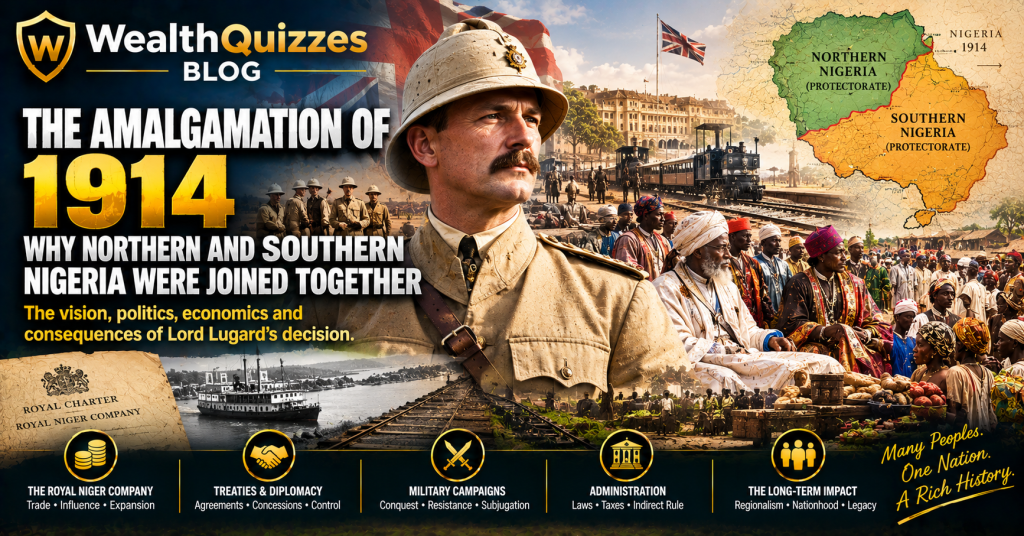
On 1 January 1914, a major constitutional and administrative change took place in British West Africa. The British Protectorates of Northern and Southern Nigeria were amalgamated under a single central administration, with Sir Frederick Lugard becoming the first Governor-General of the new Colony and Protectorate of Nigeria.
The event is commonly remembered as the “Amalgamation of Nigeria” and is often described as the moment Nigeria was created. That description is useful, but incomplete. The territory that became Nigeria had already been progressively assembled by British conquest, diplomacy and administrative consolidation during the preceding decades. Moreover, the amalgamation did not instantly erase the profound political, cultural, religious, economic and administrative differences between Northern and Southern Nigeria.
Rather, the 1914 amalgamation was primarily a British colonial administrative project. It was designed to reduce the cost and duplication of colonial administration, integrate complementary economic systems, centralise certain departments and revenues, improve communications and strengthen Britain’s control over its West African possession.
The long-term consequences, however, extended far beyond what British officials could have anticipated. By placing enormously diverse peoples and political traditions under one central colonial government, Britain created the territorial and institutional framework from which the modern Nigerian state eventually emerged.
Nigeria Before 1914
The Nigeria of 1914 was not a pre-existing unified nation waiting to be joined together.
British authority had developed in stages.
Lagos had been annexed in 1861. British influence subsequently expanded into the Niger Delta and the interior. The Royal Niger Company exercised commercial and political authority over large territories before the British government assumed direct control. Military campaigns during the late nineteenth and early twentieth centuries brought powerful states and communities under British sovereignty.
By 1900, Britain administered two principal protectorates: the Protectorate of Northern Nigeria and the Protectorate of Southern Nigeria. Lagos had already been merged administratively with Southern Nigeria in 1906.
The two protectorates, however, developed very differently.
Northern Nigeria contained the former emirates of the Sokoto Caliphate. Lugard had developed a system of indirect rule there, governing through emirs and other established authorities while placing them under British supervision.
Southern Nigeria presented a much more complicated political landscape. It contained centralised kingdoms and states such as Benin and numerous Yoruba political systems, but also extensive areas where authority was distributed among villages, lineages, councils, age grades and other associations.
Consequently, the administrative model that worked relatively effectively in the northern emirates could not simply be transplanted into every southern community.
Historian Olufemi Vaughan, writing in the Oxford Handbook of Nigerian History, emphasises that indirect rule had highly varied consequences across Nigeria and encountered significant difficulties in southern areas. The colonial state was therefore never as administratively uniform as the word “amalgamation” might suggest.
Why Did Britain Want Amalgamation?
The strongest motivations were administrative and economic.
Britain was operating two large colonial administrations that required separate officials, departments, budgets and bureaucratic structures.
Northern Nigeria was also financially disadvantaged by its geography. It was landlocked and therefore lacked the customs revenue generated by Southern Nigeria’s ports and international trade.
Colonial records and later historical studies show that Northern Nigeria had depended heavily on financial assistance from the British government before amalgamation. A Cambridge study of colonial legal administration notes that Northern Nigeria’s budget depended substantially on grants from the Imperial Government; between 1902 and 1912, these grants amounted to hundreds of thousands of pounds.
Southern Nigeria, by contrast, possessed valuable coastal ports, customs receipts and expanding commercial activity.
The economic logic was therefore straightforward: combine the finances of the two administrations and create a larger colonial treasury.
Lugard himself subsequently described the financial arrangements following amalgamation. The budgets of the former Northern and Southern administrations were merged into a single budget, while separate provincial estimates continued to be prepared.
Amalgamation therefore allowed Britain to redistribute resources within one colonial financial system.
The Southern Surplus and the Northern Deficit
This financial dimension is one of the most important—and most controversial—aspects of the amalgamation.
Northern Nigeria had enormous territory and population but comparatively limited access to customs revenue. Southern Nigeria possessed the ports through which much of the country’s international trade passed.
Lugard’s own 1914 report contrasted the two territories sharply. He described Northern Nigeria as having been heavily occupied with developing Native Administration and raising revenue through direct taxation, while Southern Nigeria had experienced substantial material development supported by trade and customs income.
The merger therefore had the potential to make the colonial administration financially more self-sustaining.
Modern scholars Matthew M. Heaton and Toyin Falola similarly identify economic considerations as a major element in understanding the amalgamation. The northern administration’s financial difficulties and the south’s stronger revenue base were central to the logic of bringing the two territories into one fiscal system.
This does not mean, however, that the South simply “paid for the North” in a simplistic modern sense. Colonial revenue consisted of multiple streams, and both regions contributed economically to the new colonial system. The important historical point is that Britain could now manage revenues and expenditures across a single colonial budget rather than maintaining two largely separate financial administrations.
Administrative Efficiency
Another major reason was administrative efficiency.
Britain had created numerous overlapping departments in Northern and Southern Nigeria.
Railways, customs, marine services, postal and telegraph systems and other functions increasingly required coordination across territorial boundaries.
Indeed, the process of administrative integration had begun even before 1914.
By 1912, the separate railway systems were being brought together, and in 1913 the Railway, Marine and Customs Departments were being reorganised in preparation for wider amalgamation. Modern historical research shows that Lugard saw transportation infrastructure as essential to connecting the northern interior with southern ports and markets.
The Niger River and the railway network were particularly important.
Northern agricultural and commercial products needed access to the coast, while imported manufactured goods moved inland.
Amalgamation therefore provided Britain with an administrative framework through which the northern interior and southern ports could function as parts of a more integrated colonial economy.
Lugard’s Role
Frederick Lugard was the principal architect and executor of the amalgamation.
He had previously served as High Commissioner of Northern Nigeria and had developed his system of indirect rule there. In 1912, he returned to Nigeria with the responsibility of implementing the amalgamation scheme.
His objective was not simply to place a new flag over the territory.
Lugard wanted to create a more coherent colonial administration.
His experience in Northern Nigeria strongly influenced his thinking. He regarded the emirate system as an effective mechanism through which British authority could operate indirectly. Existing rulers could collect taxes, administer local affairs and enforce certain laws, while British Residents supervised them.
After amalgamation, Lugard sought to extend aspects of this system beyond the North.
That ambition encountered serious difficulties.
The political institutions of southern Nigeria differed enormously from those of the Sokoto emirates. In many southeastern communities, for example, there were no equivalent paramount rulers whom the British could simply appoint or supervise.
The Oxford Handbook of Nigerian History notes that Lugard’s philosophy of indirect rule was initially developed in the former Sokoto emirates but proved much more difficult to implement uniformly throughout Nigeria.
What Exactly Was Amalgamated?
This is an important historical distinction.
The amalgamation did not mean that the North and South suddenly became administratively identical.
The new Nigerian administration retained significant regional structures.
The northern and southern provinces continued to have Lieutenant-Governors, while departments that could be centrally administered were placed under the Governor-General.
Separate provincial administration therefore survived within a broader central structure.
A contemporary analysis of Lugard’s scheme shows that the amalgamation was partly a centralisation of common services, rather than the immediate destruction of every regional administrative distinction.
This explains why describing 1914 as the creation of a completely unified Nigerian state can be misleading.
It was more accurately the creation of a single overarching colonial administration over two historically distinct administrative regions.
The Question of Nigerian Consent
Perhaps the most important distinction between the 1914 amalgamation and modern ideas of political union is the question of consent.
The amalgamation was a decision of the British colonial government.
It was not the outcome of a referendum, constitutional convention or negotiated agreement among the peoples of Northern and Southern Nigeria.
British officials were primarily concerned with imperial administration, financial efficiency, economic development and political control.
Indeed, colonial officials themselves recognised the difficulties involved in joining the two territories.
Historical research on British colonial policy records concerns within the Colonial Office about whether the proposed system was genuinely unitary, federal or merely a personal union under one Governor-General. Officials also questioned how allegiance could be created between societies with profoundly different political and religious traditions.
These questions would become extraordinarily important in the decades that followed.
The Amalgamation and Indirect Rule
The amalgamation strengthened the reach of indirect rule as a central philosophy of British governance.
In the North, British officials could work through emirs whose authority had deep historical roots.
In the South, however, colonial officers sometimes attempted to manufacture equivalents.
The infamous warrant-chief system in parts of southeastern Nigeria illustrates the problem.
Where colonial authorities could not find established central rulers, they sometimes appointed individuals as intermediaries and treated them as “traditional” authorities.
This contributed to resentment and conflict because colonial officials were sometimes imposing political structures that did not correspond to indigenous systems.
The British therefore created a paradox.
They claimed to govern through traditional institutions, but in some areas they altered, elevated or even invented forms of traditional authority to make indirect rule possible.
The Creation of a Nigerian Political Framework
The greatest long-term consequence of the amalgamation was territorial.
A single colonial state now existed over an enormous area populated by hundreds of communities and numerous linguistic, religious and cultural groups.
The British had not created all these identities. They had, however, placed them within a single political framework.
The Oxford Handbook of Nigerian History describes Nigeria as an agglomeration of cultures, languages, political institutions and economic relationships assembled through British territorial conquest and administrative consolidation. It stresses that these communities were connected in important ways but were by no means socially or historically homogeneous.
This is perhaps the most useful way to understand the significance of 1914.
Amalgamation created a political container before it created a shared national identity.
Regionalism and the Long-Term Consequences
The consequences became clearer during the constitutional development of the twentieth century.
Although Nigeria was formally one colonial territory, Britain continued to administer different regions in substantially different ways.
Northern Nigeria retained a distinctive political and educational trajectory. Missionary activity and Western-style education expanded more rapidly in the South, particularly in parts of the Yoruba and southeastern regions.
These differences contributed to the emergence of different political elites and political expectations.
By the time Nigeria moved toward independence, regional political organisations had become powerful.
Northern, Western and Eastern political blocs emerged, and the competition among them shaped constitutional negotiations, federal arrangements and electoral politics.
Historian David Olayinka Ajayi argues that the significance of the 1914 amalgamation cannot be separated from the British policies that followed it, particularly the ways colonial administration interacted with the challenge of national unity.
Similarly, Falola and Heaton conclude that British colonialism created Nigeria but did little to make it a stable, self-sustaining national entity. Their assessment is particularly significant because it moves beyond the simplistic argument that amalgamation alone caused every subsequent Nigerian crisis.
Was Amalgamation a “Mistake”?
The question is frequently asked, but historians must approach it carefully.
Calling the amalgamation a “mistake” imposes a modern judgment upon an imperial decision that was designed primarily to serve British interests.
From the British perspective, amalgamation offered practical advantages: reduced administrative duplication, fiscal integration, coordinated transportation, centralised services and stronger political control.
From the perspective of later Nigerian nation-building, however, the arrangement created enormous challenges.
The peoples incorporated into Nigeria did not enter the union as equal political partners negotiating a common constitution.
The new state was an imperial construction.
That does not mean that Nigerians could never develop a genuine Nigerian identity. They did.
Nigerian nationalism eventually transformed the colonial territory into a political community whose people demanded self-government and independence.
But the nation-building process had to work with a territorial framework inherited from colonial rule.
The Irony of 1914
There is a profound irony in the history of the amalgamation.
The British joined Northern and Southern Nigeria largely for administrative and economic reasons.
Yet the political entity they created eventually became the foundation of an independent African nation.
The colonial government sought efficiency; Nigerian nationalists eventually sought independence.
The British sought to govern Nigeria more effectively; Nigerians later used the institutions of that same territory to demand self-government.
The amalgamation was therefore simultaneously an instrument of imperial control and an important step in the territorial formation of modern Nigeria.
Conclusion
The 1914 amalgamation should not be understood simply as Lord Lugard deciding one morning to “join the North and South.”
It was the culmination of decades of British conquest, territorial consolidation and administrative experimentation.
Britain had already conquered or subordinated much of the territory that would become Nigeria. By 1914, the existence of two large protectorates had become increasingly inconvenient from the standpoint of colonial finance and administration.
Northern Nigeria had limited customs revenue and depended heavily on imperial financial support. Southern Nigeria possessed ports, customs income and a more commercially developed coastal economy. Railways and other infrastructure increasingly connected the northern interior with the southern coast. Britain therefore saw economic and administrative advantages in bringing the two systems under one central government.
Lugard became the principal architect of the scheme, and on 1 January 1914, Northern and Southern Nigeria were placed under the new Colony and Protectorate of Nigeria.
But amalgamation did not create immediate political or social unity.
Separate regional structures remained. Different legal, educational and political traditions persisted. Indirect rule operated very differently from one part of the country to another. The British colonial state had created a common administration, but not a common national consciousness.
That national consciousness had to be developed later—largely by Nigerians themselves.
The enduring legacy of 1914 is therefore best captured in a single observation: Britain created the territorial framework called Nigeria; the difficult task of turning that framework into a nation was left to subsequent generations.
WealthQuizzes Blog Takeaway
The 1914 amalgamation was fundamentally a colonial administrative and economic decision, not a negotiated act of national self-determination.
It joined two territories with markedly different histories and administrative systems under one British government. In doing so, it created the territorial framework of modern Nigeria—but it also inherited and institutionalised many of the regional differences that Nigerian nation-building would later have to confront.
Understanding 1914 is therefore essential to understanding both the creation of Nigeria and the continuing debate over what it means to be Nigerian.