

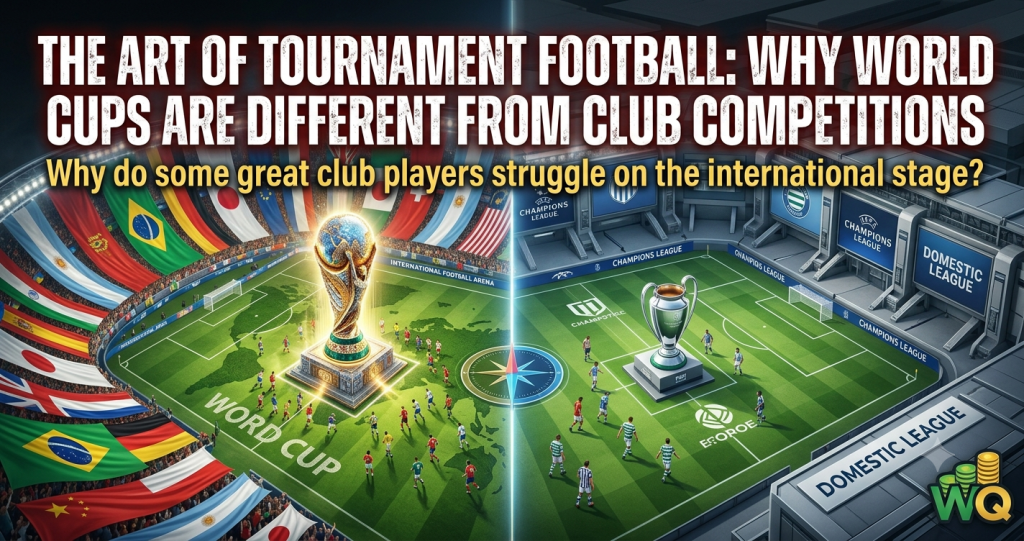
The Art of Tournament Football: Why World Cups Are Different from Club Competitions
Why Do Some Great Club Players Struggle on the International Stage?
Every FIFA World Cup revives one of football’s most intriguing questions: why do some players who look unstoppable in club football suddenly appear ordinary on the international stage? A forward who scores 30 goals in the Premier League or La Liga can go quiet for an entire tournament. A midfielder who controls games every week in the UEFA Champions League may struggle to impose himself against opponents he would normally dominate. At the same time, players who are less celebrated at club level can become giants in World Cup football, carrying their countries deep into the tournament.
The ongoing FIFA World Cup 2026 has once again put that contrast under a spotlight. The tournament has already delivered surprise eliminations, underdog runs, breakout performers, and heavyweight nations leaning on players who may not be the biggest stars in club football but who are proving decisive in tournament conditions. Reuters noted this week that the expanded 48-team World Cup has created more opportunities for shocks and has already seen major names such as Germany and the Netherlands punished by more efficient, tactically disciplined opponents, even if the broader structure still tends to favour the traditional powers over a longer run.
That is the essential point. World Cup football is not simply club football in different shirts. It is a different ecosystem with different rhythms, pressures, incentives, and tactical demands. The players who master it understand that tournament football is not only about quality; it is about timing, emotional control, adaptability, and the ability to solve problems in compressed, high-stakes situations.
Club Football and Tournament Football Are Built on Different Logics
Club football rewards continuity. Teams train together for months, often years. Managers can install complex tactical systems, rehearse automatisms, rotate squads, and recover from poor results over a 38-game league season or a multi-round continental campaign. Chemistry is built over time. Players understand each other’s movements almost instinctively.
International football offers no such luxury. National-team coaches work with their squads in short windows. Even at the World Cup, preparation time is limited. Tactical plans must be simplified, relationships accelerated, and roles clarified quickly. A player may spend ten months immersed in one club system and then be asked to operate in a different structure, with different teammates, against unfamiliar opponents, under the most intense scrutiny in sport.
Football historian David Goldblatt has repeatedly argued that international football compresses emotion and meaning in ways club football rarely can. The World Cup is not a marathon; it is a sequence of high-pressure examinations. One poor half, one missed chance, one tactical misread can change the destiny of an entire nation.
That difference matters because footballers are not merely technical machines. They are performers operating within systems, routines, and emotional contexts. Change the context, and performance can change with it.
Tournament Football Is a Game of Compression
The first reason World Cups feel different is simple: everything is compressed. There is less time to prepare, less time to recover, and far less room for error.
In club football, an elite player can survive a quiet month. In the World Cup, a quiet week can end the tournament. Group-stage games are not warm-up exercises; they are strategic battles where every point, every goal difference swing, and every booking can alter the bracket. The 2026 tournament’s expanded format has added another layer of complexity, with 12 groups and a Round of 32, increasing the number of strategic calculations teams must make about progression, rotation, and risk management. FIFA’s own technical reports from the group stage show how teams are increasingly tailoring their game plans not just to opponents but to tournament state—whether they need a draw, need to protect goal difference, or need to manage energy for a possible extra-time match days later.
Tournament football therefore rewards players who can produce clarity under uncertainty. It is not enough to be talented. You must be tournament-functional.
The Tactical Demands Are Different
Club football increasingly belongs to systems. Pressing triggers, build-up structures, rest-defence spacing, and coordinated possession patterns are drilled repeatedly over months. A player who thrives in club football often does so because the surrounding structure amplifies his strengths and protects his weaknesses.
International football is more fragmented. Coaches simply do not have enough time to build the same level of tactical sophistication. That means matches can become more transitional, more reactive, and more dependent on moments rather than mechanisms. Jonathan Wilson, one of football’s most respected tactical writers, has long argued that tournament football often rewards tactical pragmatism over aesthetic purity. In a World Cup, the objective is not to prove a football philosophy; it is to survive and advance.
That reality is visible in World Cup 2026. FIFA’s Technical Study Group has highlighted increased tactical flexibility, more in-game adjustments, and a rise in goals per match during the group stage, while also noting how many successful teams have mixed proactive attacking with disciplined compact defending. Some of the tournament’s best performers have not necessarily been the teams with the most polished club-like patterns, but those who have managed space, transitions, and emotional momentum most effectively.
This helps explain why certain club stars struggle. A winger who depends on the overlapping full-back and interior rotations of his club side may receive none of those supports with his national team. A midfielder accustomed to controlling tempo behind elite press-resistant teammates may find himself exposed in a more chaotic, vertical game. A striker fed by carefully rehearsed service patterns may suddenly be isolated.
Chemistry Cannot Be Assumed
One of the most underrated aspects of tournament football is relational familiarity. At club level, a forward knows exactly when his playmaker will look for the reverse pass. A centre-back knows when his goalkeeper will come off the line. A full-back understands when the winger wants the underlap versus the overlap. These details are not cosmetic; they are the infrastructure of elite performance.
At the World Cup, much of that must be built at speed. Some national teams manage it brilliantly because they have a settled core, a clear style, and a coaching staff that prioritises role clarity. Others do not. That gap can make great club players look strangely disconnected.
Former Arsenal manager and current FIFA executive Arsène Wenger has often stressed that modern players are tactically educated, but international football still depends heavily on how quickly those players can absorb a collective idea. The World Cup punishes teams that need too long to find their rhythm.
Pressure Is Not Generic; It Is National
Pressure exists in club football, but World Cup pressure is different. It is national, historical, and inescapably symbolic. At club level, a player represents an employer, a fan base, and a sporting project. At the World Cup, he is perceived as representing an entire people, a flag, and sometimes decades of national longing or trauma.
Sports psychologist Bob Rotella has consistently argued that pressure is shaped not just by the event itself but by the meaning the athlete attaches to it. A World Cup penalty is not stressful only because it might decide a game. It is stressful because it may define a legacy, dominate national headlines, and live forever in public memory.
That pressure affects decision-making. Players rush shots they would normally place. Midfielders play safe passes they would normally split lines with. Defenders retreat rather than engage. Goalkeepers overcommit. The World Cup rewards emotional regulation as much as talent.
This is one reason some outstanding club players struggle internationally. It is not necessarily that they lack quality; it is that tournament football tests a different blend of skills—patience, self-control, resilience after mistakes, and the ability to simplify under stress.
Tournament Football Rewards Specific Player Profiles
World Cups do not always reward the “best” players in the abstract. They often reward the most useful players for tournament conditions.
That usually means footballers who offer some combination of:
- Tactical discipline without the ball.
- Positional flexibility.
- Physical durability across short turnarounds.
- Calmness in low-margin matches.
- Set-piece value.
- Penalty temperament.
- Leadership and emotional steadiness.
A player who is spectacular over a club season but inconsistent in duels, transitions, or off-ball work may be less valuable in tournament football than a slightly less gifted player who is tactically obedient, physically reliable, and mentally stable. This is why World Cups often elevate certain midfield screeners, centre-backs, and goalkeepers into central figures. They may not dominate social media, but they decide whether a team survives the moments that matter.
The current tournament has already offered evidence of that pattern. Morocco’s continued competitiveness, Mexico’s controlled progress, and the co-host nations’ ability to navigate the new format have all owed something to players who understand game management, compactness, and emotional discipline, not just flair.
Knockout Football Changes Risk Calculation
World Cup knockout rounds produce a different psychology from league football because the cost of error is terminal. In a league, an ambitious tactical gamble that fails can be corrected next week. In a World Cup round-of-16 or quarter-final, it can send you home.
As a result, knockout football is often more conservative than club football. Teams protect central spaces, lower the tempo, and place enormous value on set pieces, substitutions, and game-state control. A single goal can transform the entire tactical picture. Underdogs are more likely to believe because the horizon is short: survive for 90 minutes, maybe 120, then perhaps a penalty shootout.
This is another reason giants fall and club reputations do not always travel cleanly to the World Cup. A star used to facing open games in domestic football may suddenly encounter a low block, a hostile atmosphere, and an opponent perfectly happy to defend for long stretches before counterattacking once. Tournament football is less about imposing beauty and more about solving stubborn problems.
The Expanded 2026 Format Has Added New Strategic Layers
World Cup 2026 is the first 48-team edition, and that has altered the tournament landscape. More teams means more styles, more unfamiliar opponents, more travel management, and more bracket complexity. Reuters’ analysis this week captured the paradox well: the expanded format has increased the scope for surprises, but it still generally favours the strongest squads over the long run because elite teams remain better equipped to survive five knockout matches.
For players, this means adaptation is even more important. There is more scouting to absorb, more rotation to manage, and more variance in the kinds of matches a team may face. A player who can only thrive in one specific tempo or structure is at a disadvantage. A player who can adapt across opponents, formations, and game states becomes invaluable.
Why Some Great Club Players Still Flourish at the World Cup
Of course, not all club stars struggle. The ones who thrive internationally usually share a few traits. They are tactically literate enough to function without elaborate club scaffolding. They can create something from little service. They manage emotions well. They accept that tournament football is sometimes ugly and still find ways to be decisive.
Think of the World Cup specialist as a footballer with a broad competitive bandwidth. He can play in chaos or control, in possession or transition, in beauty or brutality. He does not need ideal conditions to matter.
That is why tournament legends are often remembered not simply for talent, but for adaptability. They can win different kinds of matches.
Conclusion: The World Cup Is Its Own Sport Within the Sport
Why are World Cups different from club competitions? Because tournament football compresses time, amplifies pressure, reduces tactical familiarity, and turns every match into a high-stakes exercise in adaptation. It is a setting where chemistry cannot be assumed, recovery windows are short, knockout fear shapes decisions, and emotional control becomes as valuable as technical brilliance.
The ongoing FIFA World Cup 2026 has reinforced all of those truths. The expanded format has created fresh pathways for underdogs, fresh tactical problems for favourites, and fresh reminders that club form does not automatically convert into international dominance. Giants still possess the best resources, but they do not control the conditions as fully as they do in club football.
That is why some great club players struggle on the international stage. They are not necessarily lesser players. They are simply being tested in a different discipline—one that values immediacy, adaptability, resilience, and tournament intelligence above all else.
The World Cup is not just football at a higher volume. It is football under a different law of gravity. And every four years, it reminds the world that greatness in club football and greatness in tournament football, while related, are not always the same thing.