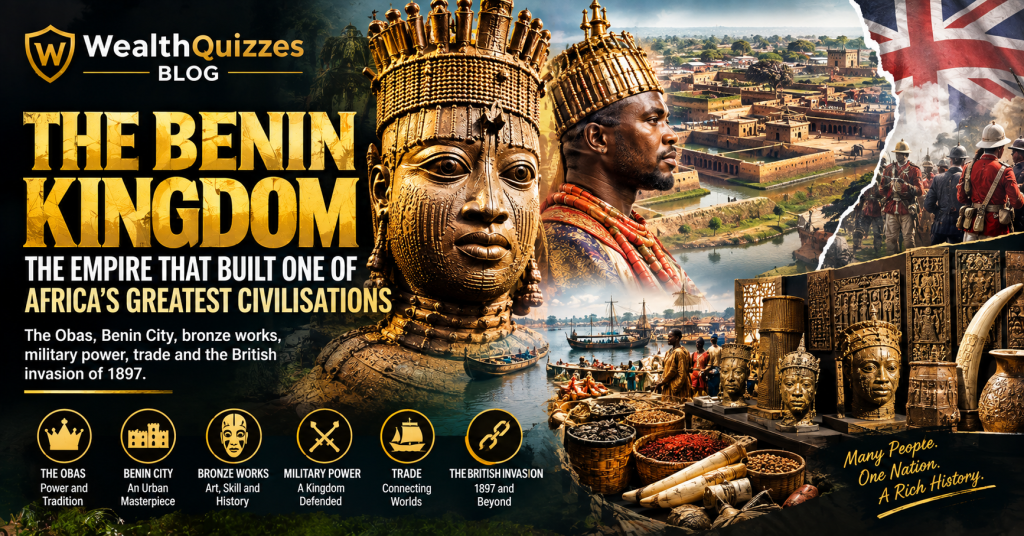
The Benin Kingdom: The Empire That Built One of Africa’s Greatest Civilisations
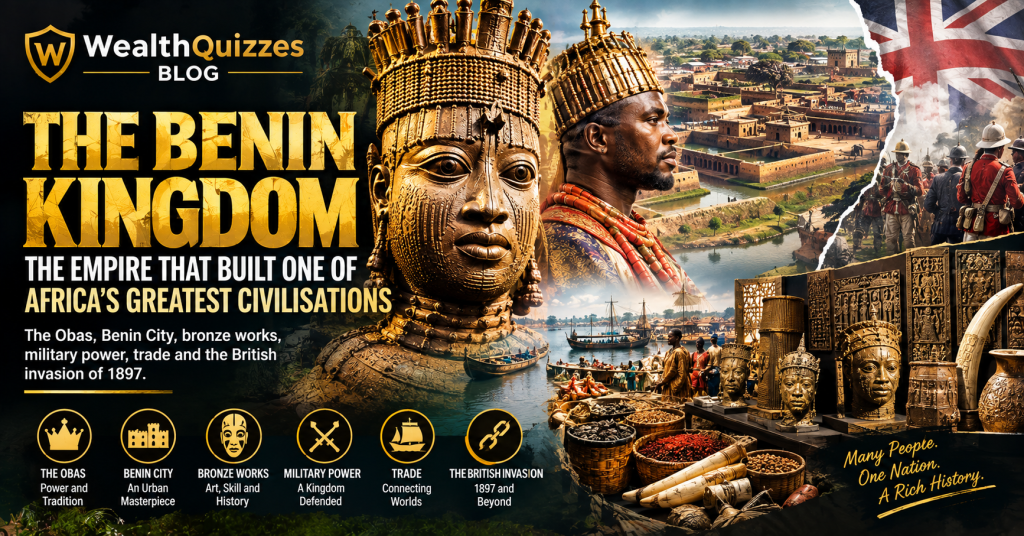
The Obas, Benin City, bronze works, military power, trade and the British invasion of 1897
Long before the creation of Nigeria as a modern state, the Kingdom of Benin had already developed into one of West Africa’s most sophisticated political and cultural powers.
Centred in present-day Edo State, the kingdom was governed by a succession of rulers known as the Obas, maintained an elaborate hierarchy of chiefs and palace officials, developed powerful military institutions, participated in long-distance trade, and produced an artistic tradition whose technical excellence continues to command international recognition.
At its height, Benin was not merely a traditional kingdom in the narrow sense of the word. It was a highly organised state whose capital was a major urban centre, whose rulers exercised authority over extensive territories, and whose craftsmen produced works of art that recorded the kingdom’s history, religion, diplomacy and royal ideology.
The story of Benin is therefore one of state formation, imperial expansion, economic power, technological achievement and cultural resilience. It is also a story of colonial confrontation, culminating in the devastating British invasion of Benin City in 1897.
As historian Stefan Eisenhofer notes, Benin has long been regarded as one of the most important examples of king-centred state formation in sub-Saharan Africa. (Cambridge University Press)
The Origins of the Benin Kingdom
The early history of Benin is complex because it combines archaeology, oral traditions, royal histories and later written accounts.
The Pitt Rivers Museum dates the establishment of the Benin kingdom to around 900 CE, while scholarship on the later Oba dynasty generally places a major transformation of the kingdom’s political system around the thirteenth or fourteenth centuries. (PRM Oxford)
This distinction is important. The history of Benin was not created at a single moment. It developed through successive political transformations.
The early rulers remembered as the Ogiso are traditionally associated with an earlier phase of Benin kingship. They were subsequently succeeded by the dynasty of the Obas. The traditions surrounding the emergence of the Oba dynasty connect Benin with Ife and Oranmiyan, although historians caution that the precise historical chronology and interpretation remain debated. Cambridge historian Dmitri Bondarenko notes that the origin of the second Oba dynasty remains one of the most contested subjects in Benin historiography because different Edo and Yoruba oral traditions do not always agree. (Cambridge University Press)
What is much clearer is the eventual emergence of a powerful, centralised monarchy in which the Oba became the political and spiritual centre of the kingdom.
The Oba: King, Political Authority and Sacred Institution
The Oba was far more than a conventional political ruler.
The institution of kingship was closely connected with religion, ancestral authority, administration and warfare. The Oba presided over an elaborate network of palace officials and chiefs and was central to the kingdom’s political and ritual life.
The Metropolitan Museum of Art describes the Oba as the political and spiritual leader of Benin, governing a complex network of lesser chiefs with political, administrative and ritual responsibilities. (Met Museum Resources)
The authority of the Oba was reinforced through elaborate ceremonies, regalia and royal art. Coral beads, ivory, brass and other prestigious materials were closely associated with royal status. According to the Pitt Rivers Museum, the Oba’s clothing and regalia visibly communicated his authority, while chiefs used ceremonial objects in his presence. (PRM Oxford)
Yet Benin’s political system was not simply the unchecked rule of an individual monarch. The kingdom possessed numerous offices, titles, palace groups and guilds that distributed administrative and specialised functions throughout the state.
This institutional complexity was essential to the durability of Benin.
Oba Ewuare and the Expansion of Benin
Among Benin’s most important rulers was Oba Ewuare, who reigned in the fifteenth century.
His reign is associated with major political and military developments. The Metropolitan Museum records that during Ewuare’s reign, Benin’s armies were organised and the capital was fortified with massive defensive works. (The Metropolitan Museum of Art)
This was more than a defensive programme. It reflected the emergence of Benin as an expansionist regional power.
At its height around 1500, Benin’s authority extended toward the Niger Delta in the east and the coastal lagoon around present-day Lagos in the west, according to the Metropolitan Museum. Its exports included pepper, textiles and ivory, while imported metals—including brass—entered the kingdom through expanding commercial connections. (The Metropolitan Museum of Art)
Military power and economic power consequently reinforced one another.
Expansion provided access to resources and trade routes; trade generated wealth; wealth supported the court and military; and military power enabled the kingdom to protect and expand its political and commercial interests.
Benin City: A Remarkable African Capital
One of the strongest demonstrations of Benin’s sophistication was its capital.
Benin City was not simply a settlement surrounding a royal palace. It developed as an organised urban centre at the heart of the kingdom.
By the sixteenth century, the city possessed planned streets, drainage systems, earthen walls and extensive moats. The Pitt Rivers Museum describes it as a densely populated capital positioned at the centre of a major trade network. (PRM Oxford)
The city’s organisation also reflected the kingdom’s specialised economic structure.
Benin City was divided into quarters associated with different occupational guilds. There were guilds for metalworkers, ivory and wood carvers, weavers, medicine, divination, dancing and other professions. Some occupations were hereditary, with families transmitting specialised knowledge over generations. (PRM Oxford)
This is a crucial aspect of Benin’s history.
Its famous artistic achievements did not emerge spontaneously. They were the product of institutions that organised, trained and preserved specialist knowledge.
The Benin Bronzes: Art, History and Political Memory
Few African artistic traditions have achieved the global recognition of the Benin Bronzes.
The term “Benin Bronzes” is somewhat misleading because many of the objects are actually brass rather than bronze. The category encompasses plaques, commemorative heads, human and animal figures, royal regalia and other objects produced by specialist court artists. (British Museum)
The works were not simply decorative.
They served religious, political and historical purposes.
Brass plaques once decorated parts of the royal palace and depicted Obas, chiefs, warriors, court officials, foreigners and important historical scenes. They therefore functioned as a form of visual historical record.
The British Museum notes that the plaques provide important evidence concerning Benin’s dynastic and social history, as well as the kingdom’s relationships with neighbouring societies. (British Museum)
Commemorative heads served another purpose. When a new Oba succeeded his father, one of his important ritual obligations was to commemorate the deceased ruler through a royal ancestral altar. The cast brass head represented the deceased Oba and helped maintain the connection between the living ruler, his predecessor and the royal ancestors. (The Metropolitan Museum of Art)
Thus, Benin art was deeply integrated into the kingdom’s political philosophy.
The Technology Behind the Bronzes
The technical achievement of Benin’s metalworkers is extraordinary.
The lost-wax casting technique, or cire perdue, allowed artisans to create highly detailed cast-metal sculptures. A wax model was created, encased in clay, heated so that the wax melted away, and then replaced by molten metal. The mould was subsequently broken to release the finished sculpture. (The Metropolitan Museum of Art)
Benin’s artisans became extraordinarily proficient in the technique.
The Metropolitan Museum notes that, according to Benin oral tradition, the technique was associated with artistic knowledge transmitted from Ife around the late fourteenth or early fifteenth century. Once mastered in Benin, it produced a remarkable corpus of royal sculpture. (The Metropolitan Museum of Art)
The importance of the guild system cannot be overstated.
The Igun Eronmwon, the guild of metal casters, preserved specialised technical knowledge through generations. The guild system transformed artistic production into an organised component of the kingdom’s political and cultural infrastructure. (PRM Oxford)
Trade and Benin’s Relationship with Europe
Benin was not isolated from the wider world.
Portuguese traders reached the kingdom in the late fifteenth century, establishing diplomatic and commercial contacts that profoundly influenced Benin’s economy and artistic culture.
The Metropolitan Museum records Portuguese contact with Benin from 1486, after which commercial relations expanded. Under Oba Esigie, Portuguese connections were used to strengthen Benin’s political and military position. (The Metropolitan Museum of Art)
European contact brought new commodities, technologies and artistic subjects into Benin.
Portuguese figures subsequently appeared in Benin’s royal art, demonstrating that the kingdom’s artists were not merely reproducing inherited forms; they were incorporating foreign people and experiences into an established visual language.
Trade nevertheless operated on Benin’s terms for long periods.
The kingdom maintained considerable control over its commercial relationships and attempted to protect royal monopolies over valuable commodities and routes. This policy would eventually become one of the central sources of conflict with British commercial and colonial interests.
Military Power
Benin’s economic and political influence could not have been maintained without military capability.
During the reign of Oba Ewuare, the kingdom developed organised armies and strengthened its fortifications. (The Metropolitan Museum of Art)
Military power served several functions: protecting the capital, suppressing internal rebellion, expanding territory, protecting trade routes and defending Benin’s political autonomy.
The military system was also represented in the kingdom’s art. Benin plaques and sculptures frequently depict warriors, weapons, officials and military ceremonies.
The presence of foreign firearms and Portuguese contacts later added new dimensions to Benin’s military environment, although the kingdom maintained its own military traditions and strategic interests.
Iyoba Idia: The Power of the Queen Mother
The political history of Benin also demonstrates that women could occupy positions of considerable authority.
One of the most famous was Iyoba Idia, mother of Oba Esigie.
According to Benin tradition and museum scholarship, Idia played a major political role in supporting her son and was associated with military intervention during a period of conflict. The office of Iyoba subsequently became one of the most prestigious positions in the Benin royal hierarchy. (The Metropolitan Museum of Art)
The Pitt Rivers Museum records that the Iyoba possessed her own palace and, historically, could command a military regiment. (prm.web.ox.ac.uk)
This complicates simplistic assumptions about gender and political authority in pre-colonial African states.
Ovonramwen and the Road to 1897
By the nineteenth century, the geopolitical environment around Benin had changed dramatically.
European imperial expansion was transforming West Africa. Britain increasingly sought control over territory, trade routes and commercial resources in the region.
The reign of Oba Ovonramwen Nogbaisi unfolded against this increasingly hostile environment.
Benin attempted to preserve its sovereignty and control over its commercial relations, while British officials and traders increasingly sought unrestricted access to the interior.
Historian Philip A. Igbafe, in his influential reassessment of the fall of Benin, argues that economic considerations were central to the eventual British attack. He identifies British and commercial pressure to penetrate the hinterland and Ovonramwen’s resistance to policies threatening Benin’s traditional economic exclusiveness as major factors. (Cambridge University Press)
The conflict therefore cannot be understood simply as a humanitarian intervention.
It formed part of the wider Scramble for Africa, during which European powers competed for political and economic control of African territories.
The British Invasion of 1897
The immediate trigger came in January 1897.
A British party led by Consul-General James Robert Phillips attempted to travel to Benin City despite objections and warnings that the timing was inappropriate. The mission was attacked, resulting in the deaths of British officials and many African members of the party. (British Museum)
Britain responded with a large-scale military expedition.
In February 1897, British forces invaded Benin City.
The consequences were devastating.
The city was captured and burned. The royal palace was looted, and Oba Ovonramwen was eventually captured and exiled to Calabar. British troops seized enormous quantities of royal and religious objects. (British Museum)
The British Museum itself acknowledges that Benin City and its historic palaces were systematically looted by British troops during the expedition. (British Museum)
Thousands of objects entered European museums and private collections.
The famous plaques, royal heads, ivory tusks and other objects were removed from the cultural and ritual environment for which they had been created.
The destruction therefore went beyond the loss of material possessions. It disrupted the historical context and cultural meaning of an enormous body of Benin heritage.
1897: The End of Independence, Not the End of Benin
The British conquest effectively ended the independent political kingdom.
But it did not destroy Benin’s identity.
Following Ovonramwen’s death in 1914, his son Eweka II was restored as Oba within the British colonial system and began rebuilding royal artistic and cultural patronage. (The Metropolitan Museum of Art)
The institution of the Oba survived.
The guild traditions survived.
The artistic tradition survived.
The Edo people survived.
And Benin City survived.
That resilience is perhaps the most important part of the story.
The Benin Bronzes and the Question of Restitution
The history of the Benin Bronzes has also become one of the world’s most important debates about cultural restitution.
Many objects taken in 1897 remain in European and North American museums.
The British Museum currently holds more than 900 objects from the historic Kingdom of Benin. (British Museum)
The Pitt Rivers Museum acknowledges the looted status of its Benin material and has participated in discussions concerning their future. The University of Oxford has also supported in principle the transfer of ownership of 97 objects taken during the 1897 expedition to Nigeria, although the process remains ongoing. (PRM Oxford)
The restitution debate is therefore not simply about ownership of old artworks. It concerns colonial violence, cultural sovereignty, historical memory and the right of communities to control the heritage created by their ancestors.
A Civilisation That Refused to Disappear
The Kingdom of Benin deserves to be remembered for far more than the tragedy of 1897.
It was a civilisation that developed a sophisticated monarchy, complex administrative institutions, specialised guilds, extensive trade networks, military capabilities, urban planning and one of the world’s most extraordinary traditions of court art.
Its Obas exercised authority through political and religious institutions. Its artisans transformed metal and ivory into historical records. Its armies expanded and defended the kingdom. Its merchants participated in regional and international trade. Its capital developed into one of the great urban centres of pre-colonial West Africa.
And when colonial conquest eventually destroyed its political independence, Benin’s civilisation did not disappear.
Its royal institution survived. Its artistic traditions survived. Its historical memory survived.
Contemporary Benin City remains a major cultural centre, and the royal institution continues under the present Oba, Oba Ewuare II. The continuity of the institution demonstrates that the history of Benin did not end when British troops entered the city in 1897. (British Museum)
Conclusion
The history of the Benin Kingdom challenges any interpretation of pre-colonial Africa as politically fragmented, technologically backward or culturally undeveloped.
Benin was a state with institutions.
It was a military power.
It was a commercial centre.
It was an urban civilisation.
And it was an extraordinary centre of artistic and intellectual production.
Its bronze and brass works remain among the most compelling historical records produced anywhere in Africa. Its political institutions demonstrate the sophistication of indigenous state formation. Its relationship with European powers demonstrates that African kingdoms were active participants in international diplomacy and commerce long before colonial conquest.
The British invasion of 1897 brought the independent kingdom to an end, but it could not erase the civilisation that had produced it.
The story of Benin is therefore not simply the story of a kingdom that fell. It is the story of a civilisation that built, created, resisted, endured—and continues to live.
Selected Renowned Authorities and Sources
- Philip A. Igbafe, “The Fall of Benin: A Reassessment,” The Journal of African History — particularly important for understanding the economic and political causes of the 1897 conquest. (Cambridge University Press)
- Stefan Eisenhofer, “The Origins of the Benin Kingship in the Works of Jacob Egharevba,” History in Africa — important scholarship on Benin’s kingship and early political history. (Cambridge University Press)
- Dmitri M. Bondarenko, “Advent of the Second (Oba) Dynasty,” History in Africa — useful for understanding the contested traditions concerning Oranmiyan and the Oba dynasty. (Cambridge University Press)
- The Metropolitan Museum of Art — extensive scholarship on Benin’s political institutions, Obas, royal art, bronze casting, trade and the 1897 invasion. (The Metropolitan Museum of Art)
- British Museum — documentation of the Benin Bronzes, their historical functions, the 1897 expedition and the subsequent dispersal of the royal collections. (British Museum)
- Pitt Rivers Museum, University of Oxford — research on Benin City, guilds, the Oba, the 1897 destruction and the continuing restitution debate. (PRM Oxford)
- Victoria and Albert Museum — historical interpretation of the Benin Bronzes and the 1897 punitive expedition. (vam.ac.uk)
WealthQuizzes Blog takeaway: Before colonial rule, Benin had already built a sophisticated state, a powerful monarchy, an organised military, an international trading system and one of Africa’s greatest artistic traditions. The ruins of 1897 could destroy a capital—but they could not destroy a civilisation.