The British Conquest of Nigeria: How Colonial Rule Was Established
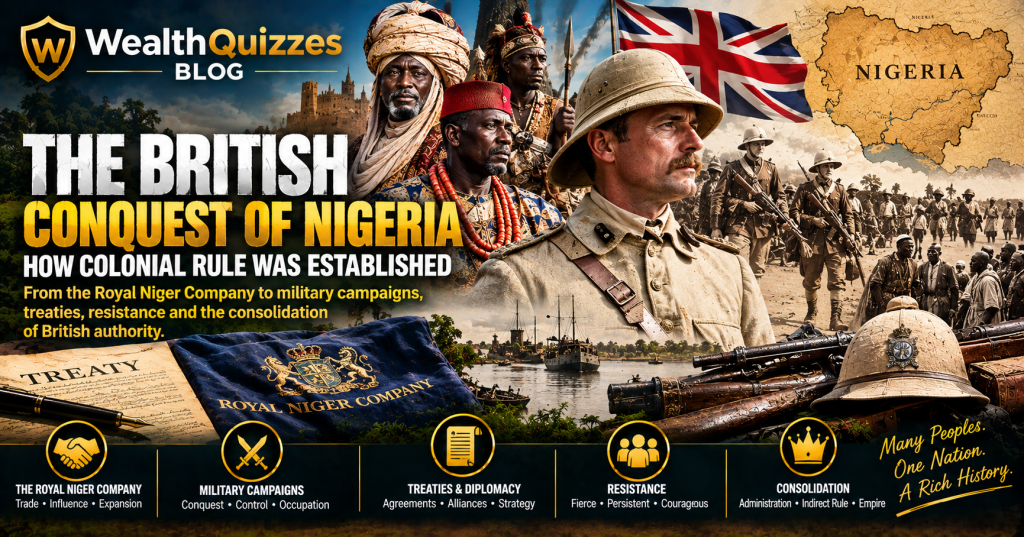
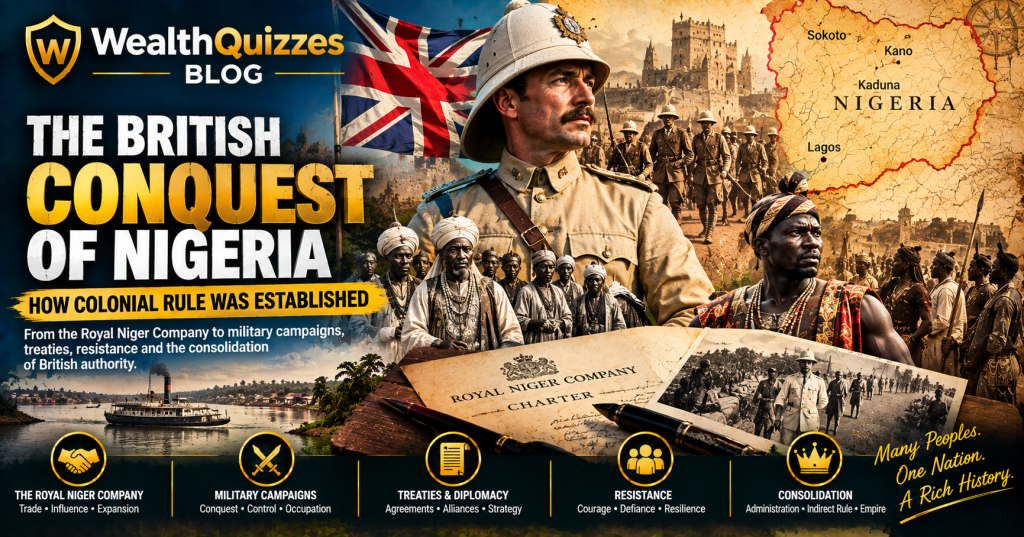
The British conquest of Nigeria was not a single war, nor was it accomplished in a single year. It was a prolonged process of imperial expansion that unfolded over several decades through commercial penetration, diplomatic treaties, political manipulation, military campaigns and the gradual destruction or subordination of indigenous centres of power.
From the annexation of Lagos in 1861 to the defeat of the Sokoto Caliphate in 1903, Britain progressively transformed its influence along the West African coast into territorial sovereignty over an enormous and politically diverse region. The conquest was substantially completed by the early twentieth century, although armed and political resistance continued in different parts of the country well into the colonial period.
As historians Toyin Falola and Matthew M. Heaton observe, the transition to colonial rule was shaped by major political and economic changes already occurring within the Nigerian region, including the transformation of the Sokoto Caliphate, the collapse of Oyo power, changing commercial practices in the Niger Delta and the growing activities of British missionaries, traders and officials. British conquest therefore took place within a complex African political landscape rather than upon an empty political space.
Before the Conquest: A Region of Established Powers
Before British colonial rule, the territory that eventually became Nigeria contained numerous sophisticated political societies.
The Sokoto Caliphate dominated large parts of northern Nigeria through a network of emirates established following the jihad of Usman dan Fodio and his successors. In Yorubaland, although the old Oyo Empire had declined, numerous Yoruba states continued to exercise political authority. In the Niger Delta, powerful trading houses and city-states controlled commerce. Benin remained a formidable kingdom, while Igbo communities operated through highly varied systems of village assemblies, lineage institutions, age grades and title societies.
There were therefore many governments, legal traditions, commercial networks and diplomatic relationships already operating across the region.
This is important because British colonialism did not create political organisation in Nigeria. Rather, it overthrew, appropriated, reorganised and subordinated existing political institutions.
Modern scholarship increasingly emphasizes this point. Abubakar Babajo Sani’s chapter, The Conquest of Nigeria, in the Oxford Handbook of Nigerian History, describes the conquest as a process involving both diplomacy and coercion, followed by the expansion and consolidation of British authority. He also stresses that conquering territory was not the same as immediately controlling it.
Lagos and the First Permanent British Foothold
The first major step in the territorial establishment of British authority was the annexation of Lagos in 1861.
Britain had already established considerable influence in Lagos during the preceding decade. British officials were concerned with suppressing the Atlantic slave trade, expanding legitimate commerce, protecting British commercial interests and countering rival European influence.
Historian Robert Smith’s study of the Lagos Consulate demonstrates that British intervention developed gradually. Britain first established a semi-protectorate, and the consular authorities increasingly became involved in political affairs before formal annexation followed in 1861.
Historian Antony G. Hopkins has further demonstrated that the Lagos episode should be understood within the wider political economy of British imperial expansion. Changing conceptions of property, commercial interests and institutional control were important elements in the annexation.
The significance of Lagos extended beyond the territory itself. It provided Britain with a permanent political and military base from which influence could be projected into the Yoruba hinterland and along the West African coast.
Lagos became one of the principal centres from which the British colonial project in the Nigerian region expanded.
Commerce Becomes Empire: The Royal Niger Company
The next decisive stage occurred along the Niger River.
British commercial interests increasingly sought control over trade routes leading into the interior. George Goldie became one of the central figures in this process. His National African Company acquired extensive commercial influence and entered into treaties with numerous African rulers.
In 1886, the company received a Royal Charter and became the Royal Niger Company.
The company was remarkable because it exercised powers that went far beyond those normally associated with a trading corporation. Through treaties, commercial agreements and armed force, it acquired extensive political influence over territories along the Niger and Benue systems.
As historian Abubakar Babajo Sani and other scholars have demonstrated, the company became an important instrument through which Britain pursued territorial ambitions while avoiding the immediate financial burden of direct administration.
The treaties were particularly important.
British agents presented agreements as treaties of friendship, protection or commercial cooperation. But many of these agreements contained provisions restricting African rulers from dealing with other European powers and, in some instances, transferring extensive territorial rights to the company.
A Cambridge study of British intervention in the Niger Delta shows that treaties concluded in the 1880s promised British protection while requiring African rulers to accept British advice in matters of justice, government and commerce. Company treaties could go even further, purporting to secure extensive territorial concessions and exclusive commercial rights.
Thus, diplomacy became an instrument of territorial expansion.
Treaties and the Scramble for Africa
The British were not operating in isolation.
The late nineteenth century was the era of the Scramble for Africa, during which Britain, France, Germany and other European powers competed for African territories.
The Berlin Conference of 1884–85 intensified the principle of “effective occupation”: European powers increasingly had to demonstrate actual authority over territories they claimed.
This transformed the nature of British activity.
It was no longer sufficient to have merchants trading along the Niger or diplomats signing agreements with coastal rulers. Britain needed to demonstrate that it actually controlled the territory it claimed.
The Royal Niger Company therefore became increasingly involved in political and military activity. But the company lacked the resources necessary to conquer and administer the enormous territories claimed in its name.
By the end of the nineteenth century, the British government increasingly took direct responsibility.
The Military Turn
The transition from commercial influence to outright conquest became particularly pronounced during the 1890s.
British forces conducted campaigns against a succession of African states and communities.
Military superiority was crucial. British and colonial forces possessed modern rifles, artillery, machine guns, disciplined formations and logistical systems that could be deployed against African armies whose military technologies, although sometimes formidable, generally could not match the industrial firepower available to European forces.
But technology alone does not explain British success.
Paul K. MacDonald, in his study of British conquest in the Niger Delta, emphasizes the importance of political fragmentation, rivalries over trade routes and competition among local elites. British authorities could exploit existing divisions, recruit local allies and use intermediaries to advance their interests.
Conquest was therefore achieved through a combination of military superiority and political opportunity.
The Fall of Benin, 1897
One of the most famous episodes was the British conquest of the Benin Kingdom.
Benin had maintained commercial and diplomatic contacts with Europeans for centuries. But by the late nineteenth century, British commercial interests increasingly demanded access to the kingdom’s interior trade.
The relationship deteriorated sharply during the reign of Oba Ovonramwen.
In January 1897, a British party led by Acting Consul-General James Phillips entered Benin territory despite warnings against proceeding at that time. The party was attacked and killed.
Britain responded with a massive punitive expedition.
Benin City was captured and burned in February 1897, and Oba Ovonramwen was eventually captured and exiled.
The event had enormous consequences. The political independence of one of West Africa’s most powerful kingdoms was destroyed, while thousands of royal artworks and sacred objects were looted and dispersed into European collections.
Historian Philip A. Igbafe challenged interpretations that presented the expedition primarily as a humanitarian response. He argued that economic considerations and Britain’s determination to penetrate Benin’s commercial system were central to the conflict.
Recent Cambridge scholarship likewise emphasizes how imperial narratives were subsequently constructed to justify colonial intervention and portray Benin through the ideological language of European “civilization.”
The conquest of Benin demonstrated a central characteristic of British imperialism: when diplomacy and commercial pressure failed, military force could be used to eliminate political obstacles.
The Aro Expedition and the Conquest of Igboland
The extension of British authority into southeastern Nigeria followed a different pattern.
Much of Igboland was characterised by decentralized political organisation. There was no single Igbo monarch whom the British could defeat and replace with a colonial administration.
This presented a major challenge to British colonial strategy.
The British therefore targeted important centres of regional influence. Among the most significant was the Aro network, whose influence extended through commercial, political and religious connections across large parts of southeastern Nigeria.
The Aro Expedition of 1901–1902 became a major stage in British occupation of the region.
Historian A. E. Afigbo, in his study of the expedition, argued that the campaign must be understood within the wider political and economic transformations taking place in the Bights of Benin and Biafra, rather than simply accepting British official explanations.
The campaign weakened Aro power and opened the way for deeper British penetration into the Igbo hinterland.
Yet military victory did not instantly produce complete colonial control. British forces continued to conduct patrols and military operations in different areas as communities resisted the imposition of colonial authority.
This illustrates one of the most important distinctions in Nigerian colonial history: conquest was a process, not an event.
The Northern Conquest: Nupe, Ilorin, Kano and Sokoto
The conquest of northern Nigeria represented the most dramatic phase of British territorial expansion.
The British faced the enormous political structure of the Sokoto Caliphate, which contained numerous emirates and a sophisticated administrative and Islamic legal order.
Frederick Lugard became the central British figure in the conquest and subsequent administration of Northern Nigeria.
British military operations expanded through the northern territories. Kano was captured in 1903, and Sokoto itself fell in March 1903.
The occupation of Sokoto represented a decisive symbolic and political victory.
The British did not simply destroy every existing institution. Instead, they increasingly sought to appropriate existing political structures and place them beneath British sovereignty.
This strategy eventually became associated with Lugard’s system of indirect rule.
The Defeat of the Sultan and the Reorganisation of Power
The British conquest of Sokoto did not mean that every emirate simply surrendered permanently.
Resistance continued.
A Cambridge study by Peter Kazenga Tibenderana demonstrates that the British subsequently intervened directly in the selection of emirs in Sokoto Province. Although candidates often possessed legitimate traditional claims, the final decision increasingly rested with British authorities.
This was an important transformation.
The British could retain the appearance of traditional authority while changing the source of political legitimacy.
An emir might remain on his throne, but his authority now depended upon British recognition.
The British had therefore moved from conquering rulers to controlling the mechanisms through which rulers governed.
From Conquest to Colonial Administration
By 1900, the Royal Niger Company had lost its charter and direct British administration became more prominent.
The Protectorate of Northern Nigeria was established, while Southern Nigeria developed under its own colonial administration.
The conquest was later followed by the amalgamation of Northern and Southern Nigeria in 1914 under Lord Lugard.
But amalgamation should not be confused with the completion of conquest itself. The British still had to establish courts, taxation systems, administrative districts, police forces, labour systems and political institutions capable of enforcing colonial decisions.
The colonial government therefore transformed military conquest into permanent administration.
Indirect rule became particularly important in the North, where British officials could govern through emirs and established political hierarchies.
In much of southern Nigeria, however, the model was more difficult to implement because many communities lacked centralised political structures.
As historian Olufemi Vaughan notes in the Oxford Handbook of Nigerian History, indirect rule had highly varied results across Nigeria and encountered significant difficulties in southern areas.
Resistance Did Not End with Military Defeat
The history of British conquest cannot be understood solely from the perspective of British victories.
Nigerians resisted colonial rule in numerous ways.
Some resistance was military. Some involved refusal to pay taxes, opposition to forced labour, rejection of colonial courts, defence of indigenous political authority and resistance to British economic demands.
In Northern Nigeria, resistance continued in various forms even after the fall of Sokoto. Paul Lovejoy and J. S. Hogendorn, for example, document the Mahdist uprising of 1905–06, which challenged both colonial authority and aspects of the existing aristocratic order.
In southeastern Nigeria, British administrators encountered persistent difficulties in imposing indirect rule on decentralized societies.
The British conquest therefore produced a colonial state that was never as completely uncontested as imperial propaganda sometimes suggested.
The Cost of Conquest
British conquest was accompanied by profound political, economic and social consequences.
Indigenous sovereignty was curtailed. Political authorities were subordinated to colonial officials. Taxes were imposed. Commercial networks were redirected toward the colonial economy. Land and labour relations were altered. European education and Christianity expanded, while colonial legal institutions increasingly displaced indigenous systems.
Toyin Falola and Matthew Heaton argue that colonial rule transformed Nigeria’s political, economic, social and cultural structures while simultaneously producing new forms of Nigerian political consciousness and resistance.
The colonial economy increasingly oriented production toward export markets and British commercial interests.
The British also created a new territorial framework by bringing diverse peoples and political systems under a common colonial administration.
Ironically, therefore, the conquest simultaneously destroyed existing sovereignties and laid the territorial foundations of modern Nigeria.
Conclusion: How Britain Actually Conquered Nigeria
The British conquest of Nigeria was achieved through a combination of commerce, diplomacy, treaty-making, imperial rivalry, military force and administrative reorganisation.
Lagos provided the first permanent British territorial foothold. The Royal Niger Company extended British commercial and political influence along the Niger. Treaties converted commercial relationships into instruments of imperial control. Military expeditions defeated major political powers such as Benin and the Aro network, while campaigns in the north culminated in the conquest of Kano and Sokoto.
Yet the conquest was not simply a story of British military superiority.
British success depended heavily upon political divisions, commercial rivalries, strategic alliances and the ability to exploit differences among indigenous societies. In some areas, British officials negotiated; in others, they threatened; elsewhere, they attacked.
Most importantly, conquest did not end when African armies were defeated. Britain still had to make colonial authority work.
That required taxation, courts, police, administrative districts, appointed rulers and new economic arrangements. Lugard’s indirect rule represented one of the most consequential attempts to accomplish this by governing through selected indigenous institutions while ensuring that ultimate sovereignty remained British.
As Abubakar Babajo Sani argues, the conquest involved both the removal of opposition and the subsequent consolidation of colonial authority. The broader Oxford Handbook of Nigerian History places the occupation within a process that began with Lagos in 1861, was substantially completed with the conquest of the Sokoto Caliphate in 1903, and still encountered pockets of armed resistance into the 1920s.
The British therefore did not simply “take Nigeria.” They constructed colonial Nigeria through a prolonged process of conquest, negotiation, coercion and institutional transformation.
And that distinction matters. Modern Nigeria inherited not only the boundaries created by British imperial expansion, but also many of the political structures, administrative practices, economic relationships and regional tensions produced during the conquest and consolidation of colonial rule.
WealthQuizzes Blog Takeaway
The British conquest of Nigeria was not accomplished by one army defeating one kingdom. It was a decades-long imperial project.
Treaties opened the door. Commerce widened the opening. Military force broke major centres of resistance. Colonial administration then converted conquest into government.
Understanding that process is essential to understanding how the Nigeria that became independent in 1960 was created.