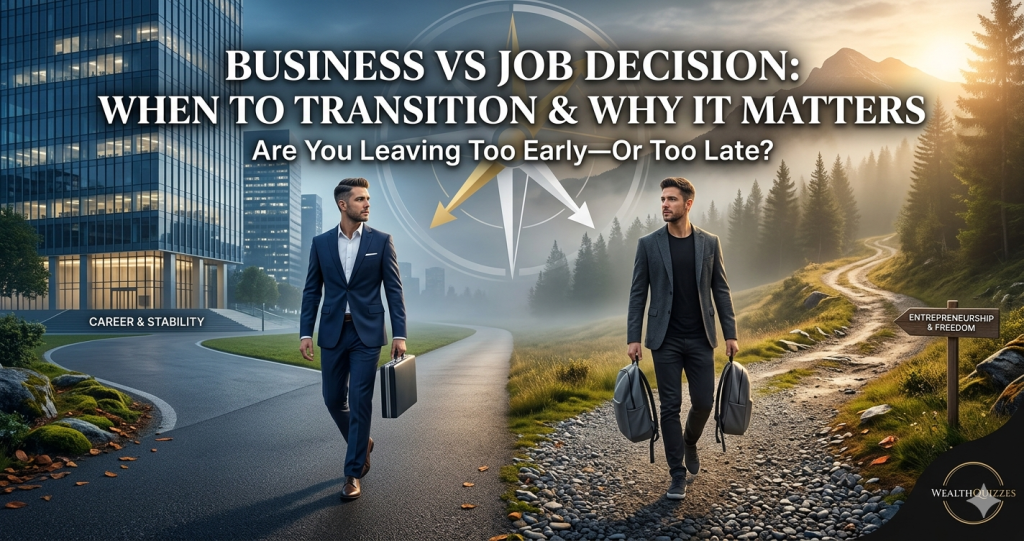
The Business vs Job Decision: When to Transition and Why It Matters
Why the Timing of Your Career or Business Move Can Shape Your Financial Future
Introduction: The Modern Financial Dilemma
One of the biggest decisions many professionals and ambitious young people face today is this:
Should I keep my job—or start a business?
Across social media and entrepreneurial culture, business ownership is often portrayed as:
- Freedom
- Wealth
- Independence
- Status
At the same time, traditional employment is frequently criticized as:
- Limiting
- Uninspiring
- Financially restrictive
As a result, many people:
- Rush into entrepreneurship emotionally
Or: - Remain trapped in careers they have already outgrown
The reality, however, is far more nuanced.
The issue is not simply:
- Job vs business
The real issue is:
Timing, readiness, structure, and strategic positioning.
Because:
Transitioning too early can create instability.
Transitioning too late can limit growth.
The Core Truth
Core Idea: Timing affects outcomes
Mindset Shift: Emotion → Strategy
The decision to move from employment to entrepreneurship should not be driven primarily by emotion, frustration, or social pressure.
It should be guided by:
- Financial readiness
- Strategic planning
- Risk evaluation
- Long-term objectives
The False Narrative Around Entrepreneurship
Modern culture often glorifies entrepreneurship while ignoring:
- Failure rates
- Cash flow instability
- Emotional pressure
- Operational complexity
Social media frequently promotes:
- “Quit your job”
- “Be your own boss”
- “Escape employment”
Without discussing:
- Sustainability
- Timing
- Capital structure
Insight from Authority
As Peter Drucker emphasized:
Entrepreneurship is neither magic nor mystery. It is disciplined work.
The Truth About Jobs
Employment is not automatically a financial trap.
A well-structured career can provide:
- Stability
- Skill development
- Capital accumulation
- Professional networks
- Industry exposure
In many cases:
A job can become:
The foundation for future entrepreneurship.
The Truth About Business
Business ownership offers:
- Scalability
- Autonomy
- Wealth potential
But it also introduces:
- Risk
- Uncertainty
- Responsibility
- Cash flow volatility
The question is not:
- “Which is better?”
The question is:
“Which stage am I currently prepared for?”
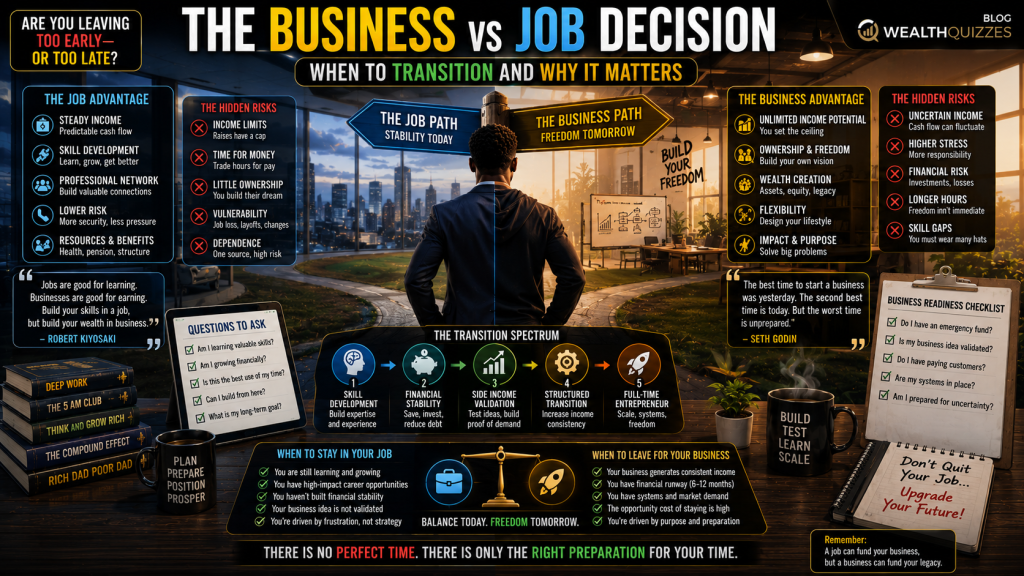
Understanding the Transition Spectrum
The movement from employment to entrepreneurship is rarely binary.
It usually occurs in stages.
Stage 1: Skill Development
Employment often helps individuals:
- Learn systems
- Build expertise
- Understand industries
At this stage:
The primary goal is:
- Competence acquisition
Stage 2: Financial Stabilization
This stage focuses on:
- Emergency savings
- Debt reduction
- Cash flow discipline
Why this matters:
Starting a business without financial stability often creates:
- Panic-driven decisions
- Short-term thinking
- Desperation
Stage 3: Side Income Validation
Before transitioning fully:
- Many successful entrepreneurs validate ideas part-time
This reduces:
- Financial risk
- Uncertainty
- Emotional pressure
Insight from Authority
As Seth Godin explains:
The safest way to take a leap is often to build the bridge first.
Stage 4: Structured Transition
This is where:
- Business income becomes increasingly reliable
- Systems improve
- Operational consistency develops
At this point:
Transition becomes strategic rather than emotional.
Why Timing Matters
Timing affects:
- Financial survival
- Stress levels
- Long-term success probability
Transitioning Too Early
Leaving employment too early may lead to:
- Cash flow instability
- Poor business decisions
- Debt accumulation
- Burnout
Common reasons people transition prematurely:
- Social pressure
- Frustration at work
- Entrepreneurial hype
- Emotional exhaustion
The danger:
Emotion replaces strategy.
Transitioning Too Late
However, staying too long in an unaligned career also has risks.
It may lead to:
- Lost opportunities
- Delayed growth
- Reduced flexibility
- Regret
The key is balance.
The Nigerian Context: Why Strategic Timing Matters
Nigeria presents unique economic realities:
- Employment uncertainty
- Inflation pressure
- Business infrastructure challenges
- High entrepreneurial participation
This environment creates both:
- Opportunity
And: - Risk
Many Nigerians start businesses out of necessity rather than preparation.
While entrepreneurship can create growth:
- Poor timing increases vulnerability.
The Financial Readiness Checklist
Before transitioning fully into business, important questions include:
1. Do You Have Emergency Reserves?
Experts often recommend:
- Several months of living expenses saved
2. Is the Business Model Proven?
Has the idea:
- Generated consistent revenue?
3. Do You Have Market Demand?
Are people already:
- Paying for the solution?
4. Are Systems in Place?
Can operations function:
- Reliably and repeatedly?
5. Are You Emotionally Prepared?
Entrepreneurship involves:
- Pressure
- Uncertainty
- Delayed rewards
Insight from Authority
As Warren Buffett repeatedly emphasizes:
Risk comes from not knowing what you are doing.
Career vs Entrepreneurship: Different Strengths
Employment Strengths
- Stability
- Predictable cash flow
- Lower operational stress
- Skill acquisition opportunities
Entrepreneurship Strengths
- Scalability
- Ownership
- Wealth potential
- Greater autonomy
Neither path is automatically superior.
Success depends on:
- Alignment
- Timing
- Execution
The Hybrid Model: A Growing Strategy
Increasingly, many people adopt:
Hybrid financial models
This involves:
- Maintaining employment
While: - Building scalable income systems gradually
Advantages include:
- Reduced pressure
- Capital availability
- Strategic flexibility
The Identity Shift
To make wise transition decisions, you must move from:
- “I want freedom immediately”
To:
“I want sustainable long-term financial positioning.”
Emotional Decisions vs Strategic Decisions
Emotional decisions focus on:
- Escape
- Frustration
- Excitement
Strategic decisions focus on:
- Timing
- Readiness
- Sustainability
- Risk management
The Real Goal
The ultimate goal is not merely:
- Leaving employment
The real goal is:
Financial independence and scalable value creation.
The Hard Truth
Some people:
- Leave too early and struggle unnecessarily
Others:
- Stay too long and suppress growth potential
Wisdom lies in:
Strategic timing.
Conclusion: Timing Shapes Financial Outcomes
The decision between:
- Job
And: - Business
Is not a simple battle between security and freedom.
It is:
A strategic transition process.
The strongest financial moves are rarely impulsive.
They are:
- Calculated
- Prepared
- Timed correctly
Because in wealth building:
Timing often matters as much as effort.
Final Thought
Ask yourself honestly:
“Am I making my career or business decisions emotionally—or strategically?”
Because the difference between financial progress and financial pressure is often not ambition—
It is:
Timing and preparation.
👉 Are you leaving too early—or too late? Find out on WealthQuizzes