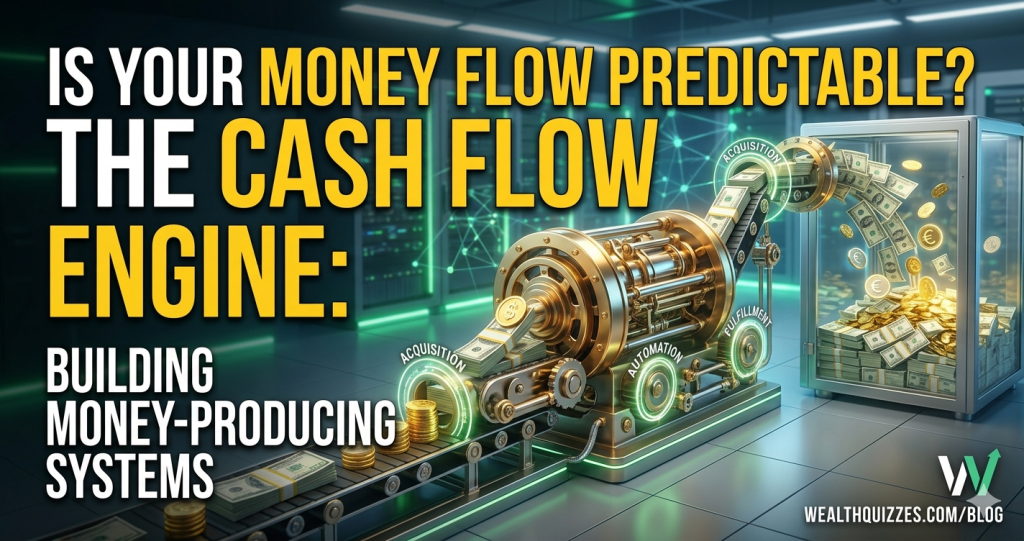
The Cash Flow Engine: Building Money-Producing Systems
Why Financial Stability Depends on Repeatable Income, Not Occasional Earnings
Introduction: The Problem With Unpredictable Money
Many people work extremely hard yet remain financially unstable because their income system depends entirely on:
- Constant effort
- Daily labor
- One-time transactions
- Unpredictable opportunities
The result is a frustrating cycle:
- Earn money
- Solve immediate expenses
- Lose momentum
- Start over again
This creates financial exhaustion.
One month may feel productive.
The next month may feel uncertain.
This instability explains why many people experience:
- Anxiety around money
- Difficulty planning long-term
- Inconsistent financial growth
The issue is not always:
- Lack of ambition
Or: - Lack of effort
Very often, the issue is:
Lack of repeatable cash flow systems.
Wealthy individuals and resilient businesses understand an important principle:
Financial stability increases when income becomes structured, repeatable, and system-driven.
This is where the concept of:
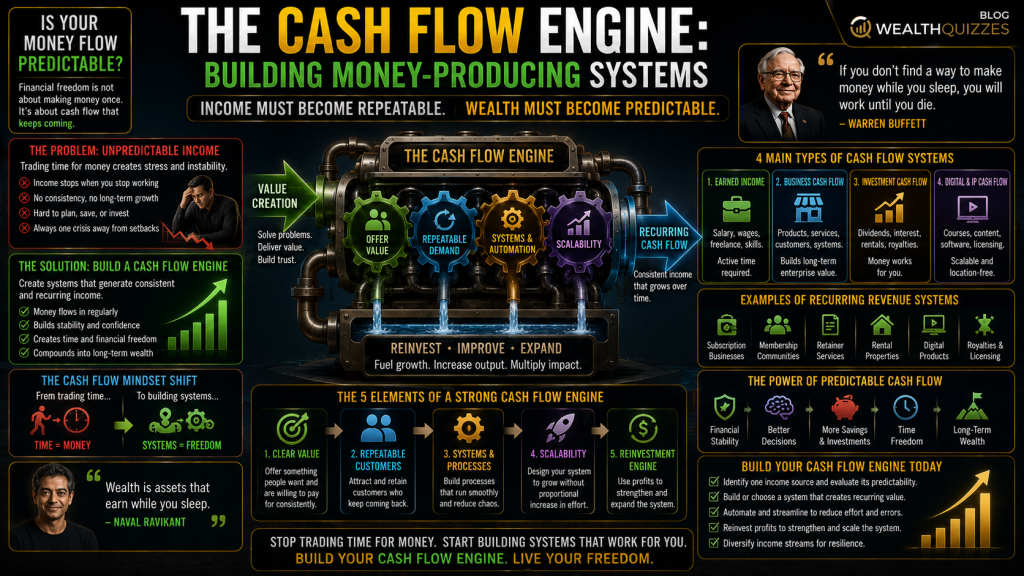
The Cash Flow Engine
becomes essential.
The Core Truth
Core Idea: Income must become repeatable
Angle: Recurring revenue systems
True financial strength is not merely about making money occasionally.
It is about building:
- Predictable
- Sustainable
- Repeatable cash flow systems.
What Is a Cash Flow Engine?
A cash flow engine is:
A structured financial system designed to generate consistent and recurring income over time.
Unlike random income:
- A cash flow engine produces financial continuity.
It transforms income from:
- Reactive
To: - Predictable
Why Cash Flow Matters More Than Big Income
Many people mistakenly focus only on:
- Large income spikes
But large one-time earnings do not automatically create:
- Stability
- Wealth
- Financial resilience
Example:
Someone may earn:
- ₦5 million once
But if:
- Spending remains uncontrolled
And: - No recurring system exists
The money eventually disappears.
Meanwhile:
A smaller but consistent income engine may create:
- Long-term sustainability
- Predictable growth
- Compounding opportunities
Insight from Authority
As Robert Kiyosaki repeatedly emphasized:
Cash flow is more important than capital gains.
Whether in business or personal finance:
Consistency often matters more than occasional financial wins.
The Difference Between Income and Cash Flow
Income simply means:
- Money earned
Cash flow refers to:
- The movement and consistency of money entering a system.
Many people earn income.
Fewer people build:
Reliable cash flow systems.
Why Predictability Matters
Predictable cash flow creates:
- Financial confidence
- Better planning
- Reduced stress
- Long-term investment ability
Without predictable cash flow:
People often struggle to:
- Save consistently
- Invest strategically
- Build assets
- Manage emergencies
Cash flow stability changes financial behavior dramatically.
The Four Types of Cash Flow Systems
1. Employment-Based Cash Flow
This is:
- Salary income
- Wage income
Advantage:
- Relative stability
Limitation:
- Usually tied directly to time and labor
If work stops:
- Income often stops.
2. Business Cash Flow
Business systems generate revenue through:
- Products
- Services
- Customers
- Operations
Strong businesses build:
- Repeat customers
- Subscription systems
- Scalable processes
The goal is:
Revenue continuity.
3. Investment Cash Flow
Examples include:
- Dividends
- Rental income
- Interest income
- Royalties
These systems allow money to:
Produce additional money.
4. Digital and Intellectual Property Cash Flow
Modern technology has expanded recurring income opportunities through:
- Online courses
- Software
- Content monetization
- Membership systems
- Digital products
These systems can scale beyond:
- Physical labor limitations.
Insight from Authority
As Naval Ravikant explains:
“Seek wealth, not money or status. Wealth is assets that earn while you sleep.”
This reflects the central idea behind recurring cash flow:
Systems should continue generating value beyond direct labor.
The Nigerian Context: Why Cash Flow Systems Matter
Nigeria’s economic environment presents:
- Inflation pressure
- Employment instability
- Business uncertainty
- Currency challenges
In this environment:
Dependence on:
- Single-source income
Creates vulnerability.
Increasingly, financially resilient Nigerians are building:
- Side income systems
- Small businesses
- Investment structures
- Digital monetization channels
Why?
Because:
Multiple structured cash flow systems reduce financial fragility.
The Cash Flow Instability Trap
Many people experience:
- High effort
But: - Low predictability
Example:
Freelancers, traders, and entrepreneurs may:
- Earn inconsistently
- Face irregular revenue cycles
Without systems:
Financial pressure increases.
This is why:
Structure matters more than hustle alone.
The Recurring Revenue Advantage
Recurring revenue systems are powerful because they:
- Reduce uncertainty
- Improve forecasting
- Create operational stability
Examples include:
- Subscription businesses
- Membership platforms
- Retainer services
- Rental systems
- Automated digital sales
Recurring systems create:
Financial momentum.
Insight from Authority
Business strategist Peter Drucker emphasized:
The purpose of business is to create and keep a customer.
Repeat customers and recurring revenue create:
- Sustainable business cash flow.
The Wealth Difference Between Earners and Builders
Earners focus mainly on:
- Making money today
Builders focus on:
- Creating systems that continue generating money tomorrow.
This distinction changes:
- Financial trajectory
- Stress levels
- Wealth scalability
The Psychology of Cash Flow
Predictable cash flow improves:
- Decision-making
- Emotional stability
- Long-term planning
Financial instability often creates:
- Reactive spending
- Poor investment choices
- Desperation-driven decisions
Stable systems create:
- Patience
- Strategic thinking
- Better financial control
The Cash Flow Engine Formula
A sustainable cash flow engine generally includes:
1. Reliable Income Source
There must be:
- Consistent value generation.
2. Repeatable Customer Demand
The system should solve:
- Ongoing problems
Or: - Recurring needs.
3. Operational Structure
The process should function:
- Systematically
Not: - Randomly.
4. Scalability
The system should have potential to:
- Expand over time.
5. Reinforcement Through Reinvestment
Strong cash flow systems improve through:
- Strategic reinvestment.
The Common Mistake: Chasing Random Income
Many people constantly chase:
- New opportunities
- Quick wins
- Temporary money spikes
Result:
Financial instability continues.
Why?
Because:
Random income is not the same as structured cash flow.
The Identity Shift
To build a cash flow engine, you must move from:
- “How can I make money today?”
To:
“How can I build systems that generate money consistently?”
The Real Transformation
Cash flow systems transform:
- Financial anxiety into predictability
- Hustling into structure
- Effort into momentum
Over time:
Financial growth becomes:
- More stable
- More scalable
- More resilient
The Hard Truth
Many people are financially stressed not because:
- They cannot earn money
But because:
Their income lacks structure and predictability.
Conclusion: Wealth Requires Repeatable Systems
True financial growth is rarely built through:
- Occasional income spikes
It is built through:
- Consistent
- Repeatable
- System-driven cash flow.
The strongest financial systems are those capable of:
- Producing value repeatedly over long periods of time.
Because in wealth building:
Predictability creates power.
Final Thought
Ask yourself honestly:
“Is my money flow predictable—or am I constantly starting over financially?”
Because real financial stability begins when:
Income becomes a system rather than a struggle.
👉 Is your money flow predictable? Find out on WealthQuizzes