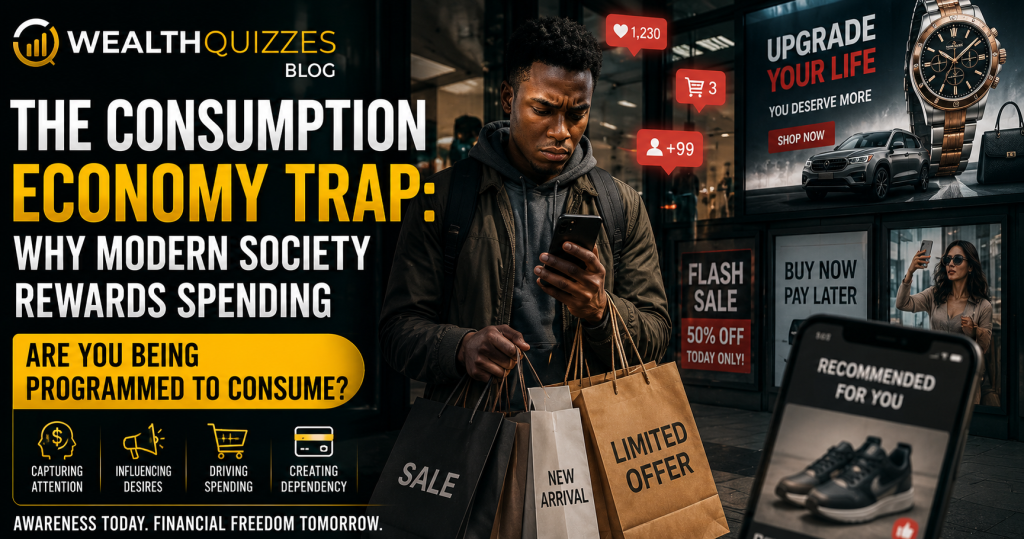
The Consumption Economy Trap: Why Modern Society Rewards Spending
How Attention, Advertising, and Consumer Psychology Quietly Shape Financial Behavior
Introduction: The Economy Built Around Consumption
Modern economies are heavily driven by:
- Spending
- Consumption
- Advertising
- Attention capture
- Behavioral influence
Every day, billions of dollars are spent globally to persuade people to:
- Buy more
- Upgrade constantly
- Consume emotionally
- Stay digitally engaged
- Desire newer lifestyles
This creates a powerful reality many people fail to recognize:
Modern systems are designed to encourage consumption.
From:
- Social media platforms
To: - Advertising networks
To: - Retail algorithms
To: - Entertainment ecosystems
Much of society operates around one central objective:
Capturing attention and converting it into spending.
This does not necessarily mean consumption itself is evil.
The danger arises when people unconsciously become:
- Emotionally programmed consumers
Rather than: - Intentional financial decision-makers.
Many financial struggles today are not caused only by:
- Low income.
They are also driven by:
- Constant psychological pressure to consume.
This is what creates:
The Consumption Economy Trap.
The Core Truth
Core Idea: Systems are designed to extract attention and money
Angle: Consumer psychology
Modern consumer systems profit most when:
- People remain distracted, impulsive, and consumption-driven.
Understanding the Consumption Economy
A consumption economy depends heavily on:
- Continuous consumer spending.
Businesses grow when people:
- Buy more products
- Upgrade frequently
- Remain engaged
- Increase lifestyle spending
Therefore:
Entire industries are built around:
- Influencing consumer behavior.
This includes:
- Advertising
- Social media
- Influencer culture
- Entertainment systems
- Digital algorithms
- Retail psychology
Insight from Authority
As Thorstein Veblen explained through the concept of:
“Conspicuous consumption,”
People often spend money not merely for utility, but to:
- Signal status
- Display identity
- Gain social approval
The Attention Economy
Attention has become one of the most valuable economic assets in the modern world.
Companies compete aggressively for:
- Screen time
- Engagement
- Emotional reactions
- Consumer focus
Why?
Because:
Attention eventually drives spending.
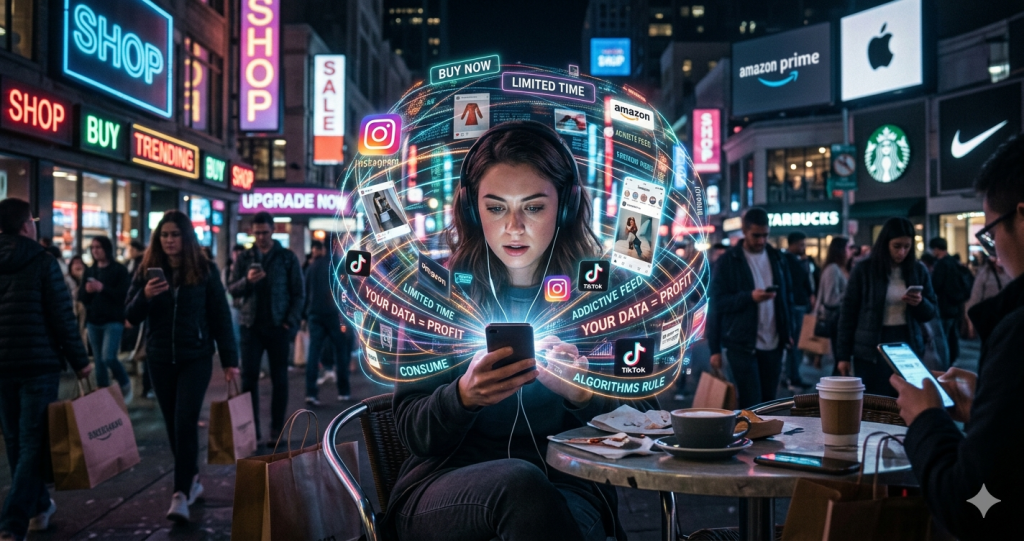
Social media platforms use:
- Notifications
- Algorithms
- Infinite scrolling
- Personalized recommendations
To sustain:
- User engagement.
The longer attention is captured:
- The greater the opportunity for monetization.
Insight from Authority
As Tim Wu explains:
Modern industries increasingly monetize:
- Human attention itself.
Consumer Psychology: Why People Spend Emotionally
Human spending behavior is often deeply emotional.
People frequently purchase things because of:
- Stress
- Comparison
- Status pressure
- Fear of missing out
- Social validation
- Temporary pleasure
Many purchases are not driven by:
- Need.
They are driven by:
Psychological triggers.
Behavioral economists have extensively studied this phenomenon.
Insight from Authority
Psychologist Daniel Kahneman demonstrated how human decisions are frequently shaped by:
- Cognitive biases
- Emotional shortcuts
- Impulsive thinking
This applies strongly to:
- Financial behavior.
The Social Comparison Trap
One major driver of consumption is:
- Comparison.
Social media constantly exposes people to:
- Luxury lifestyles
- Expensive vacations
- Designer products
- Financial appearances
Result:
Many individuals feel pressured to:
- Spend in order to appear successful.
Unfortunately:
Visible lifestyle does not always equal:
- Actual wealth.
Insight from Authority
As Morgan Housel explains:
Wealth is what you don’t see.
Many people spend heavily trying to:
- Look rich
While quietly weakening: - Long-term financial stability.
The Nigerian Context: Consumption Pressure and Financial Identity
Nigeria has strong social and cultural spending pressures.
Examples include:
- Event culture
- Fashion signaling
- Luxury phone competition
- Social celebration expectations
- Lifestyle comparison
Many people experience pressure to:
- “Appear successful” publicly.
This often leads to:
- Debt-driven consumption
- Financial overextension
- Lifestyle inflation
- Weak savings culture
In some cases:
People spend large percentages of income on:
- Appearances rather than assets.
The Lifestyle Inflation Problem
Lifestyle inflation occurs when:
- Spending rises automatically with income increases.
Instead of increasing:
- Investments
- Savings
- Assets
People often increase:
- Consumption habits.
Result:
Income rises, but:
- Financial freedom remains stagnant.
Insight from Authority
Research by Thomas Stanley showed that many wealthy individuals live:
- Far below their means.
Why?
Because:
Wealth accumulation often requires controlled consumption.
The Subscription Economy Trap
Modern economies increasingly operate through:
- Subscription systems.
Examples include:
- Streaming services
- Monthly apps
- Digital memberships
- Financing plans
- Buy-now-pay-later systems
Small recurring expenses gradually accumulate into:
- Significant long-term financial leakage.
Many people underestimate:
- The compounding effect of recurring consumption.
Consumerism and Identity
Modern marketing frequently connects:
- Products with identity.
Advertisements subtly suggest:
- “This product makes you successful.”
- “This lifestyle defines your value.”
- “Consumption equals happiness.”
Over time:
People may unconsciously associate:
- Self-worth with consumption.
This creates:
- Emotional spending patterns.
The Scarcity and Reward Cycle
Consumption often provides:
- Temporary emotional reward.
Especially during:
- Stress
- Boredom
- Anxiety
- Frustration
This activates psychological reward systems.
Unfortunately:
The satisfaction is often:
- Short-lived.
Result:
People continue consuming repeatedly without:
- Long-term fulfillment.
The Wealth Drain Nobody Notices
Many financial leaks are:
- Small individually
But: - Massive collectively.
Examples include:
- Impulse purchases
- Subscription accumulation
- Frequent upgrades
- Social spending
- Emotional shopping
Over years:
These behaviors significantly reduce:
- Investment potential
- Asset accumulation
- Financial flexibility
The Difference Between Consumers and Builders
One major distinction in finance is between:
- Consumption-focused thinking
And: - Wealth-building thinking.
Consumers prioritize:
- Immediate satisfaction
- Lifestyle signaling
- Short-term pleasure
Builders prioritize:
- Assets
- Investments
- Systems
- Long-term leverage
This does not mean:
- Wealth builders never enjoy money.
It means:
Their spending is usually more intentional.
The Financial Awareness Advantage
Escaping the consumption trap requires:
- Awareness.
People must begin asking:
- Why am I buying this?
- Is this solving a real need?
- Is this expense building my future?
- Am I consuming emotionally?
- Who benefits most from this spending behavior?
Strategic consumption creates:
- Financial control.
The Consumption Resistance Framework
To resist destructive consumer conditioning:
1. Control Attention Exposure
Reduce:
- Excessive marketing influence.
2. Delay Impulse Purchases
Create:
- Decision pauses before spending.
3. Focus on Asset Building
Prioritize:
- Ownership over appearances.
4. Track Financial Leakage
Audit:
- Small recurring expenses.
5. Redefine Success
Separate:
- Wealth from visible consumption.
The Identity Shift
To escape the Consumption Economy Trap, you must move from:
- “What can I buy next?”
To:
“What financial structure am I building?”
The Real Transformation
Financial awareness changes:
- Spending behavior
- Emotional discipline
- Wealth accumulation
- Long-term priorities
Eventually:
Money becomes:
- A strategic tool
Rather than: - A reaction to external influence.
The Hard Truth
Many people are not financially trapped because:
- They earn too little.
They are trapped because:
Modern systems continuously encourage them to consume more than they strategically build.
Conclusion: Consumption Is Engineered
Modern economies are highly sophisticated at:
- Capturing attention
And: - Stimulating spending.
Without awareness:
- Financial behavior becomes reactive.
True wealth-building requires:
- Conscious decision-making
- Emotional discipline
- Long-term thinking
- Resistance to unnecessary consumption pressure
Because in the modern economy:
Your attention is constantly being monetized.
And if you do not intentionally direct your money:
Consumer systems will gladly direct it for you.
Final Thought
Ask yourself honestly:
“Am I making intentional financial decisions—or am I being programmed to consume?”
Because financial freedom often begins when:
You stop spending automatically and start thinking strategically.
👉 Are you being programmed to consume? Find out on WealthQuizzes