
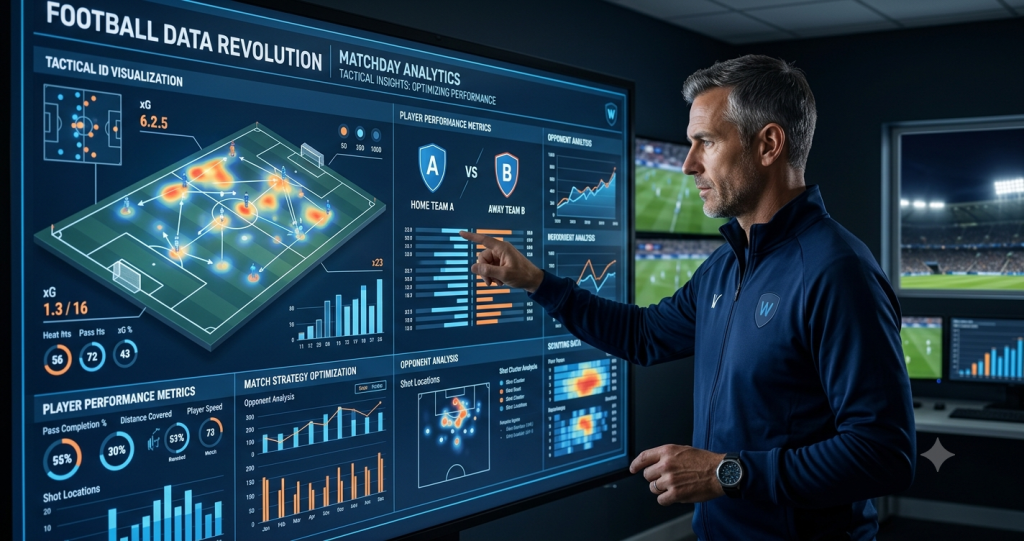
The Data Revolution: How Analytics Changed Football: Numbers Now Influence Decisions: Statistics and Performance Analysis
Has Data Become Football’s Secret Weapon?
Football has always been a game of instinct, creativity and emotion. For generations, managers relied primarily on experience, intuition and observation to make tactical decisions. Scouts travelled thousands of miles to identify talent with little more than notebooks and keen eyes. Coaches adjusted formations based on what they saw rather than what computers calculated. While those traditional methods remain invaluable, the modern game has undergone a profound transformation. Today, football is increasingly driven by one powerful force: data.
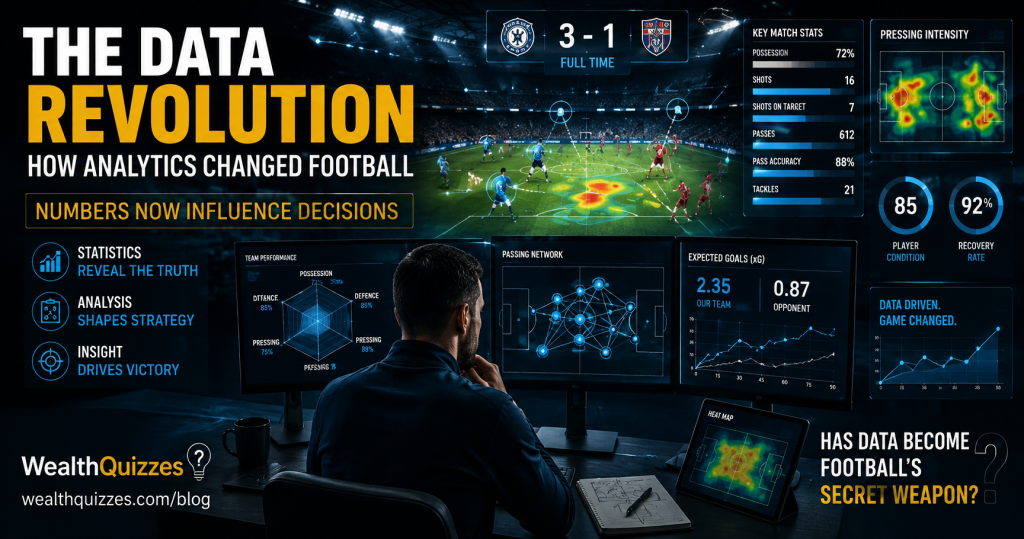
From player recruitment and tactical planning to injury prevention and match-day strategy, analytics now influence nearly every aspect of elite football. Every sprint, tackle, pass, shot and movement can be measured, analysed and interpreted. Clubs invest millions of dollars in performance analysts, data scientists and artificial intelligence to gain even the smallest competitive advantage.
The recently concluded FIFA World Cup 2026, jointly hosted by the United States, Canada and Mexico, provided compelling evidence that football has entered a new analytical era. As the first World Cup featuring 48 teams and 104 matches, it generated an unprecedented volume of performance data, allowing coaches and analysts to evaluate tactical trends with remarkable precision.
This evolution raises an important question:
Has data become football’s secret weapon?
The answer lies not in replacing the human element of football but in enhancing it.
From Instinct to Information
Football coaching has evolved dramatically over the past three decades.
In the past, managers primarily relied on intuition developed through years of playing and coaching experience. Decisions regarding substitutions, player selection or tactical adjustments were often based on observation alone.
Today, however, information supplements instinct.
According to FIFA’s Football Technology and Innovation Department, modern elite football relies heavily on sophisticated tracking systems capable of recording thousands of data points during every match. These systems analyse player positioning, sprint frequency, passing networks, pressing intensity, defensive compactness and transition speed.
Rather than replacing experienced coaches, analytics provide them with better evidence upon which to base decisions.
Former Arsenal manager and FIFA Chief of Global Football Development Arsène Wenger has consistently argued that technology should support football decision-making without diminishing its human character. Through FIFA’s Technical Study Group (TSG), Wenger has championed the responsible use of data to improve player development, tactical understanding and overall performance.
The Rise of Football Analytics
Football analytics emerged gradually before becoming an essential component of elite competition.
Companies such as Opta, Stats Perform, StatsBomb, Hudl, Catapult Sports and Second Spectrum now collect millions of data points from professional matches worldwide.
These organisations provide clubs with detailed insights including:
- Passing accuracy under pressure.
- Ball progression through different zones.
- Defensive recovery speed.
- High-intensity running distances.
- Pressing efficiency.
- Set-piece effectiveness.
- Shot quality through Expected Goals (xG).
- Possession value models.
According to sports economist Stefan Szymanski, co-author of the influential book Soccernomics, football has increasingly embraced statistical analysis because small performance improvements often determine success at the highest level.
Elite competition rewards marginal gains.
Expected Goals (xG): Measuring Opportunity
Few analytical concepts have influenced modern football more significantly than Expected Goals (xG).
Developed through statistical modelling, xG estimates the probability that a particular shot will result in a goal based upon historical outcomes.
Variables include:
- Distance from goal.
- Shooting angle.
- Type of assist.
- Body part used.
- Defensive pressure.
- Goalkeeper positioning.
A shot from six yards directly in front of goal carries a much higher expected-goal value than an ambitious effort from thirty metres.
While xG does not predict individual results, it provides coaches with valuable insight into the quality of chances their teams create and concede.
Former Liverpool manager Jürgen Klopp has acknowledged the usefulness of xG while emphasizing that football remains too complex to be explained entirely through numbers.
Statistics reveal patterns.
Players determine outcomes.
FIFA World Cup 2026: A Data-Driven Tournament
The FIFA World Cup 2026 represented one of the most technologically advanced tournaments ever organised.
Every participating nation employed extensive analytical support teams.
Match preparation included:
- Opponent tactical profiling.
- Set-piece analysis.
- Pressing simulations.
- Player workload monitoring.
- Recovery optimisation.
- Real-time video review.
Spain’s successful campaign exemplified the effective integration of analytics and coaching.
Manager Luis de la Fuente combined technical excellence with intelligent tactical planning supported by detailed performance data.
Spain consistently demonstrated:
- Superior positional discipline.
- Efficient defensive pressing.
- Controlled possession.
- Intelligent transition play.
- Excellent physical conditioning.
These characteristics reflected meticulous preparation informed by evidence rather than intuition alone.
Artificial Intelligence Is Changing Tactical Preparation
Artificial intelligence has accelerated football analysis significantly.
Machine-learning systems now identify recurring tactical behaviours that previously required countless hours of manual video review.
These systems detect:
- Preferred attacking channels.
- Defensive weaknesses.
- Passing tendencies.
- Pressing triggers.
- Transition patterns.
- Set-piece routines.
Rather than watching hundreds of hours of footage, analysts can now isolate specific tactical situations within minutes.
Former Germany coach Joachim Löw frequently emphasized meticulous opponent preparation during his managerial career.
Artificial intelligence now makes that preparation faster, deeper and more accurate.
GPS Technology Has Revolutionised Fitness
Physical performance represents another area transformed by data.
Wearable GPS devices produced by companies such as Catapult Sports measure:
- Total distance covered.
- Sprint frequency.
- Acceleration.
- Deceleration.
- Maximum speed.
- Player workload.
- Fatigue indicators.
According to FIFA’s Medical Network, workload monitoring significantly assists injury prevention by helping coaching staffs manage player fatigue during congested tournaments.
At World Cup 2026, sports scientists worked closely with coaches to determine optimal training intensity and recovery schedules.
Fitness decisions increasingly rely upon objective evidence.
Recruitment Has Become Smarter
Modern football recruitment extends far beyond traditional scouting.
Elite clubs increasingly combine human observation with sophisticated statistical modelling.
One of the most influential examples remains Brentford FC in England, whose owner Matthew Benham, a professional statistician, pioneered the extensive use of analytics in recruitment.
Similarly, clubs such as Brighton & Hove Albion, Liverpool FC and Danish side FC Midtjylland have gained reputations for identifying undervalued talent through data-driven scouting.
Author Michael Lewis, whose bestselling book Moneyball transformed discussions about sports analytics, demonstrated that intelligent use of statistics can challenge wealthier competitors.
Although football differs from baseball, the underlying principle remains remarkably similar.
Better information often produces better decisions.
Goalkeepers Have Become Data Specialists
Few positions illustrate football’s analytical revolution better than goalkeeping.
Modern goalkeepers receive detailed reports covering opponents’ penalty preferences, shooting tendencies and finishing habits.
Penalty preparation now includes:
- Historical placement patterns.
- Run-up analysis.
- Preferred striking foot.
- Body positioning.
- Psychological tendencies.
Spain’s Unai Simón, winner of the Golden Glove at the FIFA World Cup 2026, benefited from extensive analytical preparation before every knockout-stage encounter.
Preparation begins long before kick-off.
Data Cannot Measure Everything
Despite remarkable technological advances, football remains fundamentally human.
No algorithm can fully quantify:
- Leadership.
- Courage.
- Creativity.
- Determination.
- Emotional resilience.
- Team chemistry.
These qualities often determine championship success.
Legendary Manchester United manager Sir Alex Ferguson consistently argued that understanding personalities mattered as much as tactical knowledge.
Similarly, renowned sports psychologist Dr. Steve Peters, author of The Chimp Paradox, emphasizes that emotional regulation frequently separates champions from talented underachievers.
Football’s greatest moments still emerge from human decisions rather than computer calculations.
Ethical Challenges of Football Analytics
The rapid expansion of data collection raises important ethical questions.
These include:
- Ownership of player data.
- Biometric privacy.
- Artificial intelligence transparency.
- Competitive fairness.
- Cybersecurity.
- Responsible use of performance information.
FIFA has increasingly emphasised ethical governance regarding football technology, recognising that innovation must be balanced with respect for player rights and sporting integrity.
As technology evolves, governance will remain essential.
Lessons for Business and Leadership
Football’s analytical transformation offers valuable lessons beyond sport.
Modern businesses increasingly depend upon:
- Predictive analytics.
- Artificial intelligence.
- Business intelligence dashboards.
- Customer data.
- Performance metrics.
- Machine learning.
Management pioneer Peter Drucker famously stated:
“What gets measured gets managed.”
Football demonstrates the wisdom of this observation.
However, measurement alone never guarantees success.
Leadership, judgment and experience remain indispensable.
Successful organisations combine data with wisdom.
Elite football teams do the same.
The Future of Football Analytics
The analytical revolution is only beginning.
Experts anticipate several future developments, including:
- More sophisticated artificial intelligence.
- Enhanced injury prediction.
- Virtual reality tactical training.
- Real-time strategic recommendations.
- Advanced biometric monitoring.
- Predictive player development models.
As these innovations mature, football will become even more scientifically informed.
Yet one reality is unlikely to change.
The game’s unpredictability will remain its greatest attraction.
No algorithm can perfectly forecast the next stunning goal, dramatic comeback or unforgettable World Cup final.
Conclusion
Football has entered an era where numbers influence almost every important decision.
From recruitment and tactical planning to fitness management and performance evaluation, analytics have fundamentally reshaped the world’s most popular sport.
The FIFA World Cup 2026 demonstrated that elite success increasingly depends upon combining traditional football intelligence with cutting-edge scientific analysis. Champions no longer rely solely on talent and intuition; they also rely upon evidence, preparation and technology.
Nevertheless, data is not football’s ultimate decision-maker.
It is football’s most powerful adviser.
As Arsène Wenger has repeatedly observed through FIFA’s Technical Study Group, technology should enhance football rather than replace its essential human qualities.
The greatest teams will therefore never be those with the most data alone.
They will be the teams that interpret that data wisely, inspire their players effectively and retain the courage, creativity and passion that have always defined the beautiful game.
In football, numbers may guide decisions, but people still create history.