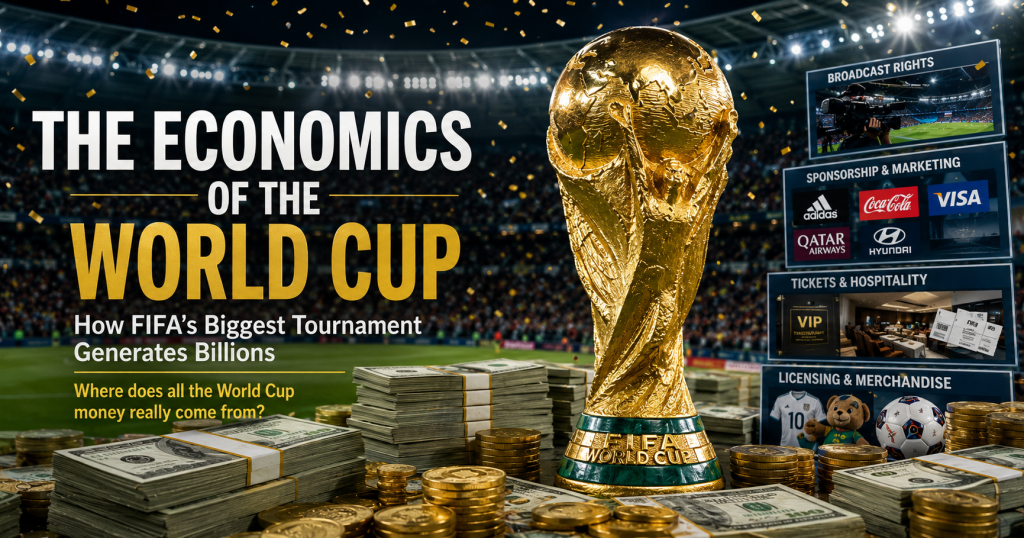
The Economics of the World Cup: How FIFA’s Biggest Tournament Generates Billions
Where Does All the World Cup Money Really Come From?
The FIFA World Cup is often presented as the purest expression of football’s global power: nations united by a ball, stadiums overflowing with emotion, and players carrying the hopes of millions. Yet behind the drama on the pitch lies one of the most sophisticated commercial machines in world sport. The modern World Cup is not only a tournament; it is a financial ecosystem that drives broadcasting deals, sponsorship contracts, ticketing income, hospitality sales, licensing revenue, tourism spending, and long-term political and commercial influence.
That reality has become even clearer in the ongoing FIFA World Cup 2026. The first 48-team edition of the men’s World Cup, staged across the United States, Canada, and Mexico, is not merely the biggest tournament in football history by participation and match volume. It is also the most commercially ambitious. FIFA’s own 2024 financial planning shows that the 2023–2026 cycle is expected to generate USD 13 billion in total revenue, with USD 8.911 billion budgeted for 2026 alone—the year of the World Cup itself. That is a scale of sports income unmatched by almost any single event in global competition.
So where does all the World Cup money really come from?
The short answer is that FIFA monetises attention at every level. It sells the right to show the tournament, the right to associate with it, the right to attend it, the right to experience it in premium form, and the right to buy products, hospitality, and local commercial inventory built around it. The longer answer is that the World Cup has evolved into a multi-layered business model in which media rights remain the single biggest engine, but sponsorship, ticketing, hospitality, and licensing have become so powerful that the tournament now functions as a global commercial platform as much as a sporting competition.
Broadcasting Rights: The Financial Engine of the World Cup
The largest source of FIFA’s World Cup income is still television and media rights. In simple terms, broadcasters around the world pay enormous sums for the right to show World Cup matches because the tournament reliably delivers one of the largest live audiences in world media. Unlike many forms of entertainment, live sport retains scarcity and urgency. Fans want to watch it in real time, and advertisers will pay a premium for that attention.
FIFA’s revised 2023–2026 budget projects USD 3.925 billion in 2026 revenue from television broadcasting rights alone, making media rights the single biggest line item in the World Cup year. FIFA’s 2024 annual report also confirmed that the organisation had already awarded 2026 World Cup media rights in more than 20 territories, including the United Kingdom, France, Sub-Saharan Africa, Türkiye, the Netherlands, and Korea Republic, well before the tournament kicked off.
This matters because the 2026 tournament is structurally more valuable to broadcasters than previous editions. There are 48 teams instead of 32 and 104 matches instead of 64, which means dramatically more live inventory to sell. More matches create more ad slots, more subscription value, more shoulder programming, more studio analysis, more highlights packages, and more digital clips. In commercial terms, the expanded format gives FIFA and its media partners more product to monetise.
Sports economist Stefan Szymanski has long argued that football’s commercial power rests heavily on its ability to aggregate attention at scale. The World Cup does that better than almost any other event on earth. For broadcasters, it is not just football content; it is a global audience event capable of lifting ratings, subscriptions, ad rates, and cross-platform engagement.
Sponsorship and Marketing Rights: Selling Association With the World Cup
If broadcasting sells the right to show the World Cup, sponsorship sells the right to be seen alongside it. FIFA’s commercial model has always relied heavily on corporate partners, but the 2026 tournament has shown just how far this segment has grown. According to FIFA’s revised budget, marketing rights are expected to generate USD 1.786 billion in 2026.
These marketing rights include global FIFA partners, World Cup sponsors, and tournament supporters, each paying for different levels of association, branding access, activation rights, hospitality, and category exclusivity. FIFA’s 2024 financial disclosures show how aggressively it has built this portfolio ahead of the tournament. New World Cup sponsors added in 2024 included Bank of America, Lay’s, and Verizon, while Rock-it Cargo and The Home Depot joined as tournament supporters. FIFA also highlighted broader commercial partnerships across its event ecosystem, including the likes of Aramco and Lenovo.
What sponsors are really buying is not merely logo placement. They are buying cultural relevance, customer data opportunities, hospitality inventory, digital activation, and the ability to attach their brand to one of the few events that can dominate global conversation for an entire month. Reuters reported during the tournament that Bank of America’s “fan band” activation—essentially a free charm bracelet distributed at fan festivals and stadiums—had already become one of the most talked-about sponsor activations of the competition, with more than 700,000 distributed and resale interest appearing online. That is a vivid example of how modern sponsorship is no longer limited to perimeter boards or television idents; it is about creating fan rituals, collectible experiences, and social media visibility.
Football finance expert Kieran Maguire has frequently noted that sponsorship value in elite football increasingly depends on access to emotional attention rather than just raw audience numbers. The World Cup offers both: scale and emotional intensity.
Ticketing and Hospitality: Monetising Attendance at Scale
One of the most important commercial shifts in modern mega-events is the increasing importance of premium in-person revenue. FIFA’s budget for 2026 allocates USD 3.017 billion to hospitality rights and ticket sales—an extraordinary figure that makes match-going revenue almost as important as broadcasting.
This is where the North American hosting model matters. The United States, Canada, and Mexico offer enormous stadium capacity, high consumer purchasing power in key markets, and a corporate hospitality culture that FIFA can monetise aggressively. The 2026 World Cup features 104 matches across 16 host cities, which means millions of seats and a vast amount of premium inventory.
On Location, FIFA’s official hospitality provider, has said that the 2026 World Cup is already the largest hospitality programme in the history of the tournament. Reporting discussed in the sports business space indicates that more than 500,000 hospitality packages had already been allocated by late May 2026, with hospitality sales exceeding previous World Cup records and potentially reaching up to one million seats of inventory across the competition. While not every such figure comes directly from FIFA, the trend is unmistakable: hospitality has become a central pillar of World Cup economics.
Ticket pricing has also become a major commercial story in the current tournament. Business Insider reported that Category 1 final tickets in open sale reached $10,990 in April, far above the figures once envisaged in the host bid documents, and that many fans felt priced out of attending. FIFA has defended its approach by pointing to variable pricing and reinvestment in football development, but the episode reveals an important truth: the World Cup is now being monetised with the logic of premium live entertainment as much as the logic of a public sporting festival.
That tension sits at the heart of the 2026 tournament. Commercially, high ticket prices and premium hospitality drive revenue. Politically and culturally, they risk alienating ordinary supporters. FIFA is therefore managing a balancing act between maximising income and preserving the legitimacy of the World Cup as a global people’s event.
Licensing, Merchandising, and Secondary Commercial Streams
Although media, sponsorship, and matchday revenues dominate, the World Cup also earns substantial money from licensing and related commercial streams. FIFA’s 2026 budget projects USD 111 million in licensing rights revenue for the year, with total cycle licensing income budgeted at USD 400 million.
Licensing includes the sale of rights for official merchandise, branded products, collectibles, video game tie-ins, retail collaborations, and tournament-specific intellectual property. Every official jersey, mascot product, pin badge, trading card, replica ball, and branded fan item sits somewhere within a licensing ecosystem that FIFA either controls directly or monetises through partnerships.
The point is not that licensing is the largest revenue stream. It is that the World Cup has become a 360-degree commercial property. Every consumer touchpoint can be monetised.
Why 2026 Is Bigger Than Previous World Cups
The current tournament is especially lucrative for four reasons.
First, it is bigger. Forty-eight teams and 104 matches mean more broadcast inventory, more ticket inventory, more sponsor exposure, and more hospitality opportunities.
Second, it is being staged in North America, where large stadiums, deep corporate markets, and high-value media territories support premium pricing.
Third, FIFA has become more sophisticated commercially. The governing body now packages rights more aggressively, sells more categories of sponsorship, and treats hospitality as a major business rather than a secondary add-on.
Fourth, the World Cup now exists inside a digital attention economy. Sponsors and broadcasters are not monetising only the live match. They are monetising highlights, social content, fan festivals, branded activations, second-screen engagement, and data-driven digital campaigns.
A recent Deutsche Bank Research Institute perspective, cited by the Economic Times, described the 2026 World Cup as a kind of economic laboratory—one that illuminates pricing strategy, behavioural demand, tourism flows, and market dynamics in real time.
Who Actually Benefits Financially?
This is where the economics become more complicated. FIFA benefits directly because it owns the tournament rights and captures the bulk of event revenue. Host cities and host countries can benefit too, but their financial picture is much less straightforward.
FIFA’s own materials cite positive economic projections for host markets. For example, the organisation’s annual-report materials note Deloitte Canada estimates suggesting that the tournament could generate CAD 2.9 billion in positive economic output for Canada, CAD 1.5 billion in GDP contribution, and more than 17,000 jobs overall.
But host-city economics are never simple. Local governments often shoulder significant costs around security, transport, crowd management, and public-space activation, while FIFA retains most of the core tournament revenue streams. That asymmetry is one of the enduring controversies of mega-event economics. The World Cup can create tourism, hospitality, restaurant, and branding benefits for host cities, but it also imposes costs that do not automatically show up in FIFA’s own balance sheet.
The Real Business Model: Monetising Scarcity, Emotion, and Global Reach
At its core, the World Cup business model is built on three things: scarcity, emotion, and scale.
It is scarce because it happens only once every four years, making every rights package and every ticket more valuable.
It is emotional because fans do not consume the World Cup neutrally; they consume it with identity, patriotism, memory, and urgency. That makes them more valuable to sponsors, broadcasters, and hospitality sellers.
And it is global because no other football event combines such massive audience reach with such intense national investment.
That is why FIFA can generate billions. It is not simply selling football matches. It is selling access to one of the most powerful concentrations of global attention in sport.
Conclusion: The World Cup Is Football’s Greatest Sporting Event and One of Its Greatest Commercial Machines
So where does all the World Cup money really come from?
It comes primarily from broadcasting rights, which remain FIFA’s biggest revenue engine. It comes from sponsorship and marketing deals, as brands pay for access to football’s most emotionally charged audience. It comes from ticketing and hospitality, especially in a tournament like 2026 where scale, pricing power, and premium inventory are unprecedented. And it comes from licensing and commercial extensions that turn the World Cup into a retail and branding ecosystem, not just a month-long competition.
The ongoing FIFA World Cup 2026 has made that structure more visible than ever. With USD 8.911 billion budgeted for 2026 revenue and USD 13 billion expected across the 2023–2026 cycle, FIFA’s flagship tournament is no longer merely the pinnacle of international football. It is one of the most powerful revenue-generating properties in world sport.
That does not diminish the beauty of the World Cup. If anything, it explains why the event sits at the centre of modern football’s political and economic universe. The goals, the songs, the flags, the fan zones, the television spectacle, the hospitality lounges, the corporate activations, the sold-out stadiums, and the streaming clips are all part of the same machine.
The World Cup is still about glory. But in 2026, more than ever, it is also about business on a truly global scale.