
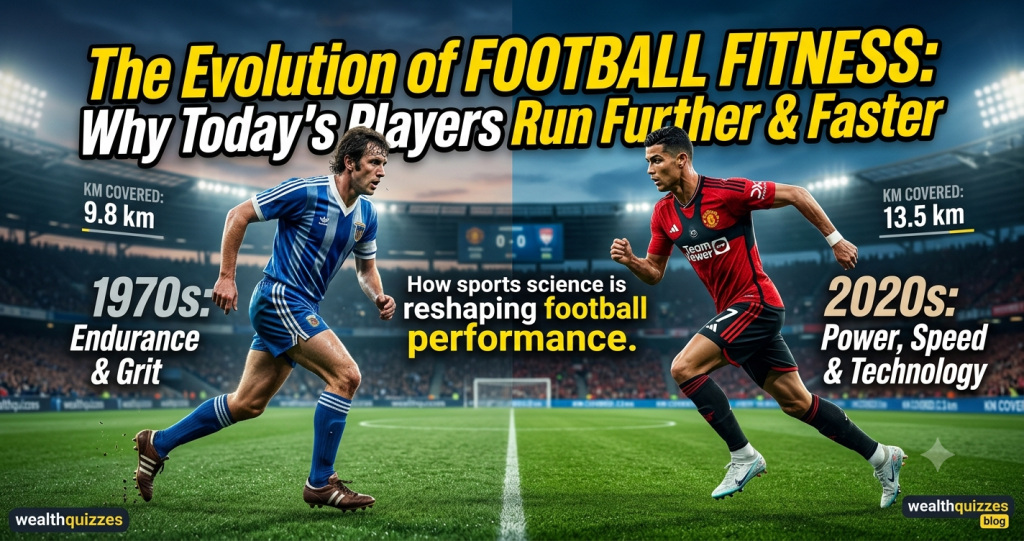
The Evolution of Football Fitness: Why Today’s Players Run Further and Faster
How Sports Science Is Reshaping Football Performance
Football has always been celebrated as the beautiful game, where technical brilliance, tactical intelligence, and teamwork combine to produce unforgettable moments. Yet beneath the dazzling dribbles, pinpoint passes, and spectacular goals lies an equally important factor that has undergone a dramatic transformation over the past few decades—physical fitness.
Compare a FIFA World Cup match from the 1970s with one played today, and the difference is immediately apparent. Modern footballers cover significantly greater distances, sprint more frequently, recover faster between high-intensity efforts, and maintain remarkable levels of performance throughout ninety minutes. Today’s game is quicker, more demanding, and more physically intense than ever before.
This transformation has not occurred by chance. It is the result of decades of progress in sports science, nutrition, biomechanics, physiology, data analytics, and performance psychology. Football is no longer simply a contest of talent and tactics; it is also a science of optimizing the human body.
The FIFA World Cup 2026 has once again highlighted this evolution. Across the tournament, players are demonstrating extraordinary athleticism, pressing relentlessly, making repeated explosive runs, and maintaining tactical discipline deep into matches. Such performances would have been almost unimaginable several generations ago.
This raises an intriguing question: How has sports science enabled today’s footballers to run further, move faster, and perform more consistently than ever before?
The answer reveals one of the greatest revolutions in the history of football.
Football Has Become a High-Intensity Sport
Modern football bears little resemblance to the slower-paced game played decades ago.
Today’s tactical systems demand constant movement.
Players are expected to:
- Press aggressively without possession.
- Recover quickly after losing the ball.
- Attack with speed.
- Defend collectively.
- Transition rapidly between attack and defense.
Sports scientist Tim Gabbett has demonstrated that elite football increasingly consists of repeated high-intensity actions rather than continuous moderate activity.
While total distance remains important, the ability to perform explosive sprints repeatedly often determines match outcomes.
Fitness has therefore become a decisive competitive advantage.
Sports Science Has Revolutionized Training
One of the most significant changes in modern football has been the integration of sports science into everyday training.
Previously, coaching focused largely on technical drills and physical conditioning.
Today, performance departments include specialists in:
- Exercise physiology.
- Biomechanics.
- Nutrition.
- Recovery science.
- Performance analysis.
- Strength and conditioning.
- Sports psychology.
According to renowned sports scientist Professor Yannis Pitsiladis, elite athletic performance now depends upon optimizing every aspect of human physiology rather than relying solely on natural talent.
Football clubs and national teams increasingly employ multidisciplinary performance teams to maximize player development.
GPS Technology Has Changed Everything
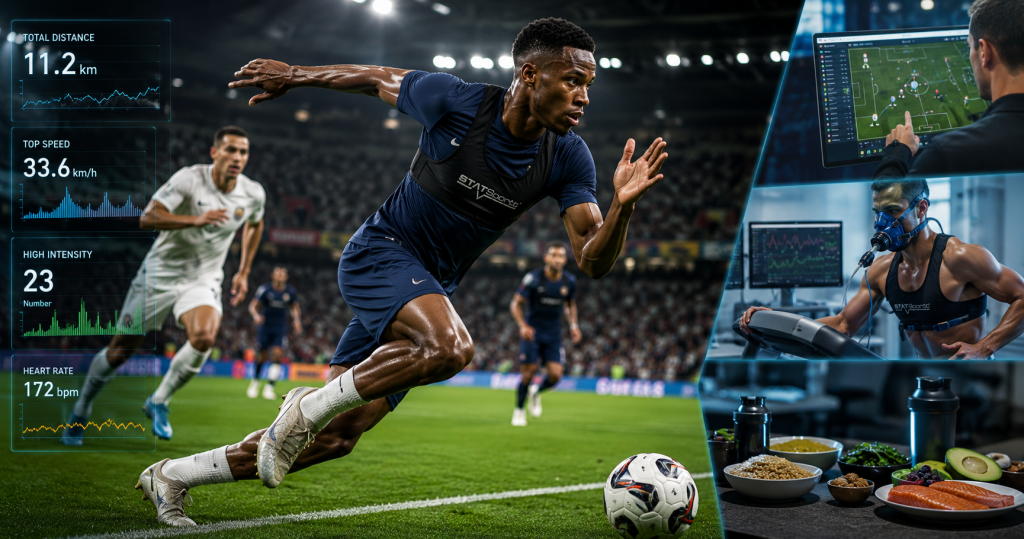
Perhaps no innovation has influenced football fitness more than wearable GPS technology.
During training sessions, players wear lightweight tracking devices that measure:
- Total distance covered.
- Sprint frequency.
- Maximum speed.
- Acceleration.
- Deceleration.
- Heart rate.
- Workload.
These data allow coaches to individualize training with unprecedented precision.
Sports scientist Tim Gabbett has consistently argued that managing training load effectively reduces injury risk while maximizing performance.
Rather than training every player identically, coaches now tailor programs according to individual physical demands.
Nutrition Fuels Elite Performance
Nutrition has become one of football’s most important competitive tools.
Modern footballers follow carefully designed dietary programs based upon:
- Energy expenditure.
- Match schedules.
- Recovery needs.
- Body composition.
- Hydration.
Sports nutrition expert Louise Burke has demonstrated that appropriate nutritional strategies significantly improve endurance, recovery, and repeated high-intensity performance.
Elite footballers now consume meals scientifically designed to optimize:
- Glycogen storage.
- Muscle repair.
- Hydration.
- Cognitive function.
Nutrition has evolved from a secondary consideration into a central component of performance.
Recovery Is Now as Important as Training
Football professionals increasingly recognize that improvement occurs not only during training but also during recovery.
Recovery methods now include:
- Ice baths.
- Compression garments.
- Massage therapy.
- Sleep monitoring.
- Active recovery sessions.
- Hydration protocols.
- Mobility exercises.
Professor Shona Halson has emphasized that effective recovery enables athletes to sustain consistently high performance throughout congested tournament schedules.
During the FIFA World Cup, recovery often becomes as important as tactical preparation.
Teams capable of maintaining freshness frequently outperform equally talented opponents suffering from accumulated fatigue.
Strength Training Has Evolved
Older generations sometimes believed strength training reduced footballers’ flexibility.
Modern research has disproved that assumption.
Today’s players undertake sophisticated strength programs emphasizing:
- Explosive power.
- Core stability.
- Injury prevention.
- Sprint mechanics.
- Jump performance.
- Functional movement.
Former Arsenal manager and FIFA Chief of Global Football Development Arsène Wenger has repeatedly highlighted the growing importance of physical preparation alongside technical excellence.
Modern football requires both.
Data Analytics Improves Physical Performance
Data has transformed football fitness.
Performance analysts now combine physical tracking with tactical analysis.
Coaches evaluate:
- Sprint timing.
- Pressing intensity.
- Positional movement.
- Defensive recovery.
- Transition speed.
These metrics reveal not only how much players run but also whether they move efficiently.
Sports economist Stefan Szymanski argues that information has become one of football’s most valuable competitive resources.
The teams that analyze performance most effectively often gain significant advantages.
Injury Prevention Through Science
One of sports science’s greatest achievements has been reducing preventable injuries.
Although football remains physically demanding, medical teams now identify injury risks earlier.
Modern screening evaluates:
- Muscle imbalance.
- Joint mobility.
- Running mechanics.
- Previous injury history.
- Fatigue indicators.
By adjusting training accordingly, clubs reduce the likelihood of serious injuries.
Sports medicine specialists emphasize that maintaining player availability often contributes more to success than signing additional players.
Healthy squads win more matches.
The Psychology of Physical Performance
Fitness extends beyond muscles.
Mental resilience significantly influences physical output.
Sports psychologist Bob Rotella argues that athletes frequently reach perceived physical limits before reaching actual physiological limits.
Confidence influences endurance.
Motivation affects effort.
Focus improves efficiency.
Elite football increasingly integrates psychological preparation into physical training.
The mind and body operate together.
Tactical Systems Demand Greater Fitness
Modern tactical philosophies require extraordinary athleticism.
High-pressing systems popularized by coaches such as Jürgen Klopp demand repeated sprinting throughout matches.
Similarly, positional football requires continuous movement to create passing angles.
Football journalist Jonathan Wilson notes that tactical innovation has dramatically increased physical demands across every position.
Even central defenders now cover greater distances than many midfielders from previous generations.
Artificial Intelligence Is Shaping the Future
Artificial intelligence increasingly assists performance departments.
AI systems can:
- Predict injury risk.
- Analyze fatigue.
- Recommend recovery protocols.
- Optimize training schedules.
- Evaluate physical trends.
These technologies allow coaches to make evidence-based decisions rather than relying solely on intuition.
The FIFA World Cup 2026 showcases the growing integration of technology into elite football preparation.
Footballers Are Becoming Complete Athletes
Today’s elite footballer combines multiple attributes.
Technical ability alone is insufficient.
Modern players require:
- Speed.
- Strength.
- Endurance.
- Agility.
- Tactical intelligence.
- Emotional resilience.
- Recovery discipline.
Football historian David Goldblatt argues that professional football has become one of the world’s most scientifically managed sports.
Success increasingly depends upon optimizing every aspect of human performance.
Lessons Beyond Football
The evolution of football fitness has influenced sport more broadly.
Training principles developed in elite football now benefit athletes across numerous disciplines.
Concepts such as:
- Periodization.
- Load management.
- Recovery optimization.
- Performance analytics.
- Injury prevention.
are increasingly applied throughout professional sport.
Football continues serving as a laboratory for human performance.
What the Future Holds
Sports science continues advancing rapidly.
Future developments may include:
- More sophisticated wearable technology.
- Enhanced artificial intelligence.
- Personalized genetic insights.
- Improved rehabilitation methods.
- Advanced biomechanical analysis.
While talent will always remain fundamental, scientific preparation will increasingly separate excellent players from exceptional ones.
The footballer of tomorrow will likely be even faster, stronger, and more resilient than today’s elite professionals.
Conclusion: Science Has Redefined the Beautiful Game
How has sports science reshaped football performance?
The answer is evident every time the FIFA World Cup 2026 takes center stage. Today’s players run farther, sprint faster, recover more efficiently, and sustain elite performance for longer because football has embraced scientific innovation at every level.
Advances in physiology, nutrition, biomechanics, recovery science, data analytics, psychology, and artificial intelligence have fundamentally transformed player preparation. Modern football is no longer driven solely by natural talent; it is powered by evidence-based performance optimization.
As Arsène Wenger has often observed, football continually evolves, and those who fail to adapt are left behind.
The evolution of football fitness demonstrates that the future of the beautiful game will not belong only to the most technically gifted players, but also to those who best combine athletic excellence with scientific preparation.
In the modern era, every sprint, every recovery run, and every decisive moment reflects not only years of practice with the ball, but also the extraordinary advances of sports science working behind the scenes.
The result is a faster, stronger, more exciting game—one in which human potential continues to be pushed to new heights.