
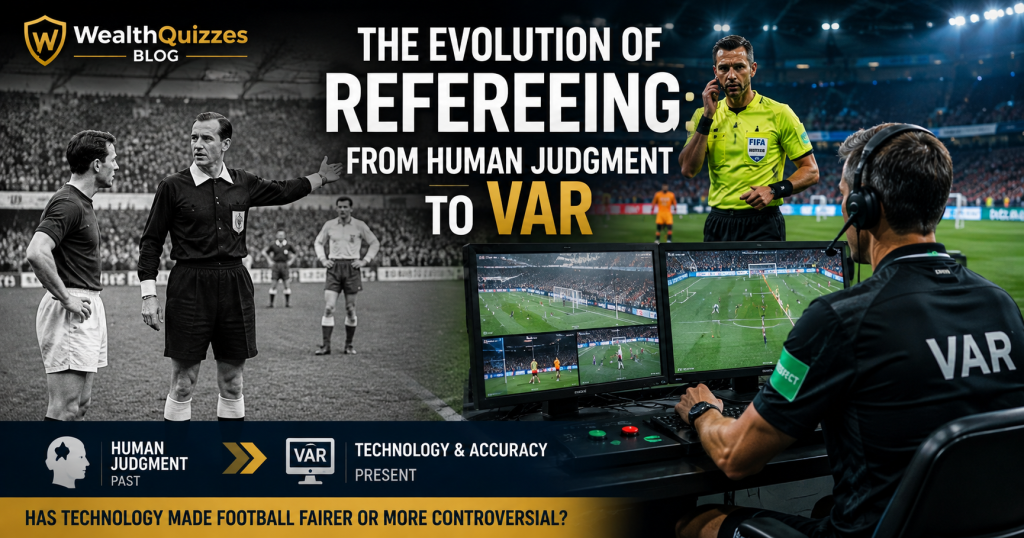
The Evolution of Refereeing: From Human Judgment to VAR: Officiating and technology
Has technology made football fairer or more controversial?
Football is often described as a game of skill, tactics, passion and unpredictability. Yet behind every match is another contest that receives considerably less attention: the contest to interpret and enforce the Laws of the Game accurately, consistently and fairly.
For more than a century, that responsibility rested almost entirely on human judgment. Referees had to make instantaneous decisions while running alongside highly conditioned athletes, often from imperfect angles, under immense pressure from players, coaches, supporters and the media. A fraction of a second could determine whether a goal stood, whether a penalty was awarded or whether a player was sent off.
Today, football has entered a very different era. Video Assistant Referees (VAR), goal-line technology (GLT), semi-automated offside technology (SAOT), connected match balls and increasingly sophisticated camera systems have transformed the way important decisions are made.
But technology has created an intriguing paradox. It has made some decisions dramatically more precise while making other decisions more controversial. The question, therefore, is no longer simply whether technology can reduce mistakes. It is whether football can use technology without sacrificing the human judgment, immediacy and emotional character that have always defined the sport.
The Referee Before Technology
Modern refereeing developed alongside the codification and expansion of football in the nineteenth century. As the sport became increasingly competitive and organised, informal arrangements for settling disputes became inadequate. Football needed independent officials capable of enforcing common rules.
The referee eventually became the central authority on the field, supported by assistant referees and other match officials. This structure established a fundamental principle that remains intact today: football is not simply governed by written laws; those laws must be interpreted by people in real time.
That distinction is important.
Many incidents in football are factual. Did the entire ball cross the goal line? Was a player in an offside position? Did the ball touch a player’s hand?
Others involve judgment. Was the contact reckless? Did a player deliberately handle the ball? Was the force of a challenge sufficient to constitute serious foul play?
Human referees have always been required to make both kinds of decisions.
The challenge was that the human eye has limitations.
A referee can be perfectly positioned and still miss an incident because another player obstructs the view. An assistant referee can correctly judge an offside situation from their perspective and yet be wrong by a few centimetres. A referee may see contact but misinterpret its intensity in the speed of a match.
Former elite referees such as Pierluigi Collina and Howard Webb became symbols of the extraordinary concentration and judgment required at the highest level. Yet even the greatest officials were never expected to be infallible.
That imperfection was historically accepted as part of football.
When a Mistake Could Change History
Football history contains countless controversial refereeing decisions. Some disappeared from collective memory. Others became permanent parts of the sport’s mythology.
The 1966 World Cup final remains one of the most famous examples. Geoff Hurst’s shot in extra time struck the underside of the crossbar and bounced down near the goal line before being cleared. The goal was awarded, although debate over whether the ball crossed the line continued for decades.
Then came the 2010 World Cup.
Frank Lampard’s shot against Germany struck the underside of the crossbar and clearly appeared to bounce over the line before coming back into play. The goal was not awarded.
The controversy intensified calls for technological assistance. FIFA subsequently revisited goal-line technology, while The International Football Association Board (IFAB), the body responsible for the Laws of the Game, began a formal technological pathway.
Testing began in 2011, and IFAB approved goal-line technology in 2012. (Inside FIFA)
The lesson was powerful: some errors were simply too consequential to leave entirely to human perception when technology could provide a definitive answer.
Goal-Line Technology: The First Major Breakthrough
Goal-line technology represented a relatively simple proposition.
Did the whole ball cross the goal line?
Unlike VAR, it was not designed to invite a debate. It was designed to provide an immediate factual answer.
Under the Laws of the Game, GLT is used solely to determine whether the ball has completely crossed the goal line. The information is transmitted to the match officials within one second, normally through the referee’s watch or communication system. (IFAB)
This distinction explains why GLT has generally encountered less resistance than VAR.
There is little room for philosophical disagreement about whether a ball is entirely over the line. The technology is essentially measuring a physical fact.
FIFA reports that GLT made its official competition debut at the 2012 FIFA Club World Cup in Japan before being used at the 2014 World Cup. (Inside FIFA)
It was an important precedent.
Technology could assist referees without replacing them.
The Birth of VAR
VAR was considerably more ambitious.
Instead of answering one narrowly defined question, VAR introduced video review into several categories of potentially match-changing incidents.
The IFAB approved live VAR experiments in March 2016. The experiments were conducted across competitions in countries including Australia, Brazil, Germany, Portugal, the Netherlands and the United States. (Inside FIFA)
The underlying philosophy was deliberately restrained.
The objective was not to turn football into a constantly interrupted video-review exercise. IFAB described the philosophy as “minimum interference – maximum benefit.” (IFAB)
That principle remains central to the modern VAR framework.
VAR is intended to intervene only when there is a clear and obvious error or a serious missed incident concerning specified match-changing situations.
Under the current IFAB protocol, these include:
- Goal or no goal
- Penalty or no penalty
- Direct red-card incidents
- Mistaken identity
(IFAB)
Crucially, VAR does not become the referee.
The referee remains the final decision-maker.
That distinction is frequently misunderstood by supporters. A VAR can recommend a review, but the referee retains ultimate authority. Where an on-field review is necessary, the referee examines the footage before deciding whether the original decision should stand or change. (IFAB)
The 2018 World Cup and Football’s Technological Turning Point
The 2018 FIFA World Cup in Russia represented the moment VAR moved from experiment to global football reality.
After years of trials, FIFA and IFAB had concluded that video assistance could be incorporated into elite football. FIFA subsequently described the tournament as a historic implementation of VAR. (Inside FIFA)
The significance went beyond the tournament itself.
Once VAR entered the world’s most prestigious football competition, its legitimacy was fundamentally established. Domestic leagues and continental competitions increasingly adopted the system.
But widespread adoption did not mean universal approval.
Indeed, the introduction of VAR created an entirely new category of football argument.
Before VAR, supporters argued about whether the referee had seen an incident correctly.
After VAR, they could argue about whether the referee had interpreted the replay correctly.
That is a profound difference.
Has VAR Made Football Fairer?
In one important sense, unquestionably.
VAR gives officials access to information that simply did not exist before.
A referee who misses a serious incident can now be alerted to it. A wrongly awarded penalty can potentially be overturned. A goal resulting from an obvious attacking infringement can be cancelled. A case of mistaken identity can be corrected.
IFAB’s framework is specifically designed to correct clear and obvious errors rather than second-guess every subjective decision. (IFAB)
That means VAR can reduce a particular class of injustice: the kind produced by an obvious error that could have been corrected if the referee had access to appropriate video evidence.
The technology is especially powerful when dealing with objective facts.
Offside is a good example.
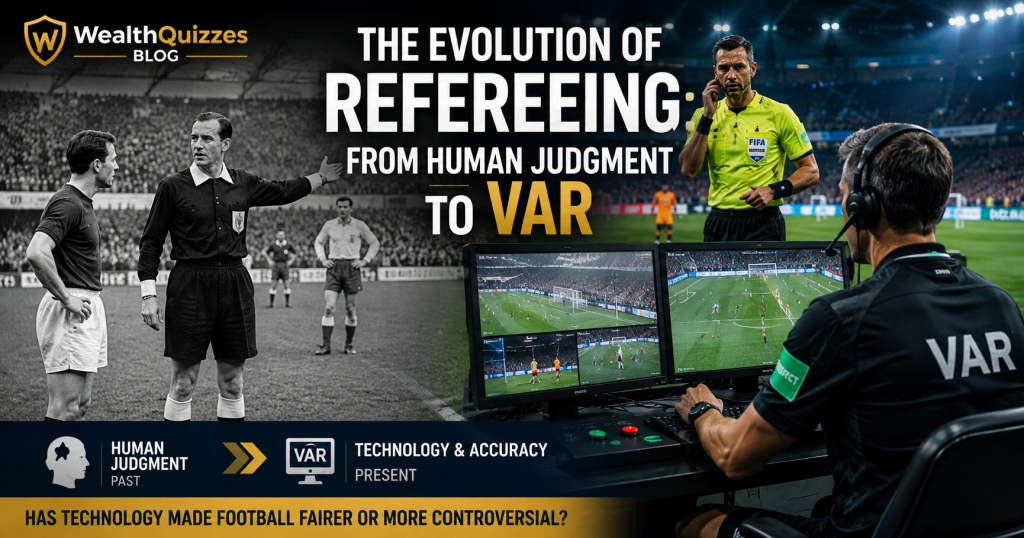
Semi-Automated Offside Technology
Offside decisions are among the most difficult for human officials because they involve several moving objects at once.
The assistant referee must simultaneously judge the moment the ball is played and the position of the relevant attacker. At elite level, the difference between onside and offside can be measured in centimetres.
Semi-automated offside technology attempts to solve this problem through sophisticated tracking systems.
UEFA states that SAOT uses specialised cameras capable of tracking 29 body points for each player. The system was introduced into the UEFA Champions League from 2022 and has subsequently been used across major UEFA competitions. (UEFA.com)
At UEFA EURO 2024, connected-ball technology added another layer. The match ball transmitted precise data to video match officials, helping identify the exact point at which the ball was touched and assisting the offside process. (UEFA.com)
This represents a major transformation.
Football officials are increasingly moving from simply watching the match to operating within a sophisticated information ecosystem.
But Technology Does Not Eliminate Judgment
This is perhaps the most important point in the entire debate.
Technology can establish facts.
It cannot eliminate interpretation.
Consider a tackle.
A replay can show the point of contact. It can show the speed of the challenge. It can show whether the player’s studs made contact with an opponent.
But whether that challenge deserves a yellow card, a red card or no card may still require interpretation.
Similarly, a video can show that the ball struck a player’s arm. But determining whether the contact constitutes an offence depends upon the applicable Law and the circumstances of the incident.
This is why slow-motion footage can sometimes create as many arguments as it resolves.
IFAB explicitly recognises the problem. Its protocol states that slow motion should generally be used for factual questions such as the location of contact, while normal-speed footage should be used when assessing matters such as the intensity of an offence. (IFAB)
That is a remarkably important distinction.
Slow motion can make ordinary football contact appear extraordinary.
Normal speed often provides better context.
The Paradox of Greater Accuracy
VAR has therefore produced an interesting paradox.
It can make football more accurate but not necessarily more satisfying.
A decision that would once have been accepted within seconds may now take several minutes to resolve.
A goal can be celebrated passionately, only for supporters to wait anxiously while an incident is examined.
The emotional rhythm of football can consequently be interrupted.
This is not necessarily evidence that VAR has failed. It demonstrates that technological accuracy and sporting experience are not identical objectives.
Football is both a competitive contest and a cultural spectacle.
The challenge is to protect the integrity of the competition without destroying the spontaneity of the spectacle.
Why VAR Remains Controversial
Much of the controversy surrounding VAR comes from expectations.
Some supporters initially assumed that video technology would produce perfect decisions.
It cannot.
The technology may produce better evidence, but the evidence still has to be interpreted.
Furthermore, the phrase “clear and obvious error” introduces a threshold that itself requires judgment.
Two highly qualified officials can watch the same incident and disagree about whether the original decision represents a clear and obvious error.
That is not necessarily technological failure.
It is the unavoidable consequence of applying human laws to complex human behaviour.
Football cannot become completely objective without fundamentally changing the nature of its Laws.
Referees Have Not Become Less Important
Ironically, the technological revolution may have made elite refereeing more sophisticated rather than less important.
The modern referee must understand not only the Laws of the Game but also VAR protocols, communication procedures, review techniques and the appropriate use of video evidence.
The referee must remain decisive despite knowing that an entire video operation team is examining the match.
IFAB’s current Laws expressly maintain the referee’s authority. VAR and other video match officials assist the referee, but the final decision remains with the referee. (IFAB)
Technology, therefore, has not replaced the referee.
It has created another layer of officiating around the referee.
The Next Stage: A More Connected Game
The direction of travel is clear.
Football is becoming increasingly data-driven.
Cameras track players. Artificial intelligence assists analysis. Connected balls can identify touches. Semi-automated systems assist offside decisions. Goal-line technology can determine whether a ball crossed the line.
UEFA’s continuing development of standardised VAR procedures illustrates another important trend: the future is not simply about acquiring more technology but about establishing more consistent processes for using it. In August 2026, UEFA introduced its Clear Line repository, containing more than 150 refereeing scenarios intended to promote greater consistency and transparency in the interpretation of Laws and VAR interventions. (UEFA.com)
This may ultimately be more important than the cameras themselves.
Technology is only as effective as the framework governing its use.
Has Technology Made Football Fairer or More Controversial?
The most accurate answer is: both.
Football is fairer in certain respects because technology can correct mistakes that were previously almost impossible to rectify.
A ball that has clearly crossed the goal line should not be denied a goal because the referee’s view was obstructed. A blatant missed red-card offence can now be identified. A significant refereeing error can be reconsidered with evidence unavailable to officials of previous generations.
But football is also more controversial because technology has moved disagreement from the question of what happened to the question of what the evidence means.
VAR has not abolished controversy.
It has changed the nature of controversy.
And perhaps that is inevitable.
Football’s Laws are applied to human beings in a dynamic, emotional and unpredictable environment. No technological system can completely remove interpretation from that equation.
The real achievement of modern officiating, therefore, should not be the pursuit of a fantasy in which every decision becomes perfectly objective.
It should be the creation of a system in which technology supports excellent human judgment, corrects clear and consequential errors, preserves the flow of the game and increases confidence in the integrity of competition.
The evolution from the solitary referee to the modern referee supported by assistants, VAR, SAOT, goal-line technology and connected-ball systems is not the end of human officiating.
It is its transformation.
The referee of the future will still carry the whistle.
But increasingly, behind that whistle will stand an extraordinary technological infrastructure designed to ensure that when the biggest moments arrive, football has the best possible evidence upon which to make the biggest decisions.
And that leaves football with a fascinating question for the next generation:
If technology can help us get almost every decision right, how much uncertainty should football preserve to remain football?