
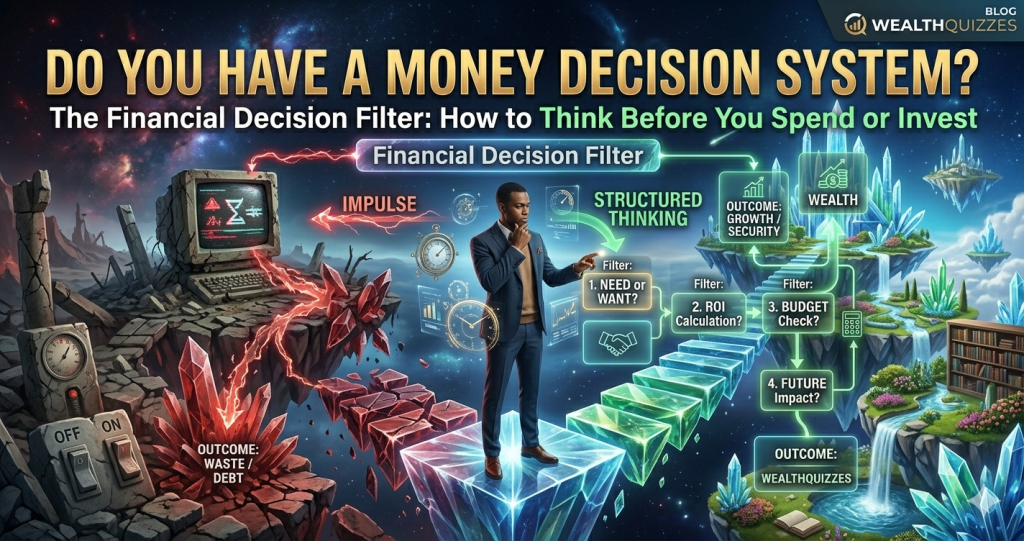
The Financial Decision Filter: How to Think Before You Spend or Invest
Building a Structured System That Turns Every Money Choice Into a Strategic Move
Introduction: The Hidden Driver of Financial Outcomes
Every financial result—good or bad—can be traced back to a series of decisions:
- What you chose to spend
- What you chose to save
- What you chose to invest—or ignore
Most people focus on outcomes:
- “I don’t have enough money”
- “My investments didn’t work”
- “I need to earn more”
But the real issue lies deeper:
Financial outcomes are the cumulative effect of repeated decisions.
Without a structured way to make those decisions, money is handled reactively rather than strategically.
The Core Truth
Core Idea: Decisions create outcomes
Mindset Shift: Impulse → Structured thinking
If your decision-making process is weak, your financial results will be inconsistent—regardless of how much you earn.
What Is the Financial Decision Filter?
The Financial Decision Filter is:
A structured mental framework used to evaluate every spending or investment decision before action is taken.
It ensures that:
- Emotions do not override logic
- Short-term impulses do not undermine long-term goals
- Each financial move aligns with a broader strategy
Why Most People Make Poor Financial Decisions
1. Emotional Spending
People often spend based on:
- Mood
- Pressure
- Immediate desire
2. Lack of Clear Criteria
Without a framework:
- Decisions are inconsistent
- Justifications replace logic
3. Social Influence
Spending and investing decisions are often driven by:
- Trends
- Peer behavior
- Social expectations
Insight from Authority
As Daniel Kahneman explains, human thinking is divided into:
- Fast, emotional decisions (System 1)
- Slow, logical decisions (System 2)
Most financial mistakes occur when:
System 1 dominates financial choices
The Cost of Impulsive Decisions
Every impulsive decision carries:
An opportunity cost
Example:
- Spending ₦50,000 impulsively
- Instead of investing or saving it
Result:
- Immediate satisfaction
- Long-term financial loss
Over Time:
These small decisions accumulate into:
Significant financial consequences
The Decision Gap
Many people:
- Know what to do
- But fail to do it consistently
Why?
Because:
- There is no structured decision process
- Choices are made in the moment
Insight from Authority
As Richard Thaler highlights in behavioral economics:
Small, repeated decisions significantly shape long-term financial outcomes.
The Financial Decision Filter Framework
To move from impulse to structure, every financial decision should pass through a filter.
The 5-Step Decision Filter
1. Purpose Check
Ask:
“Why am I making this decision?”
Clarify:
- Need vs want
- Short-term vs long-term benefit
2. Alignment Check
Ask:
“Does this align with my financial goals?”
If it does not:
- It should be reconsidered

3. Opportunity Cost Check
Ask:
“What am I giving up by choosing this?”
Consider:
- Alternative uses of the money
- Potential future value
4. Timing Check
Ask:
“Is this the right time?”
Sometimes:
- The decision is valid
- But the timing is wrong
5. Impact Check
Ask:
“Will this move me forward—or hold me back?”
Evaluate:
- Long-term effect
- Financial trajectory
The Power of Structured Thinking
When decisions are filtered:
- Impulses are reduced
- Clarity increases
- Outcomes improve
The Compounding Effect of Good Decisions
Just as money compounds:
Decisions compound
Good Decisions:
- Reinforce discipline
- Build momentum
- Improve future choices
Bad Decisions:
- Create setbacks
- Reinforce poor habits
- Delay progress
Insight from Authority
As Morgan Housel explains:
Financial success is less about intelligence and more about consistent, reasonable decisions over time.
The Nigerian Context: Why a Decision Filter Is Critical
In Nigeria:
- Financial pressure is high
- Social influence is strong
- Economic conditions are unpredictable
Without a Decision Filter:
- Money is spent reactively
- Financial progress is inconsistent
With a Decision Filter:
- Decisions become intentional
- Resources are optimized
- Growth becomes structured
Common Scenarios Where the Filter Applies
Spending Decisions:
- Gadgets
- Clothing
- Social outings
Investment Decisions:
- Business opportunities
- Financial instruments
- Partnerships
Lifestyle Decisions:
- Housing
- Transportation
- Travel
The Identity Shift
To use a Financial Decision Filter effectively, you must move from:
- “I decide based on how I feel”
To:
“I decide based on a structured process.”
Practical Implementation
Step 1: Write Down Your Filter
- Make it visible
- Refer to it regularly
Step 2: Pause Before Major Decisions
- Create a delay
- Avoid instant action
Step 3: Review Past Decisions
- Identify patterns
- Improve your framework
Step 4: Build Habit Consistency
- Apply the filter repeatedly
- Make it automatic
The Long-Term Impact
Using a Financial Decision Filter leads to:
- Better financial control
- Reduced waste
- Increased investment capacity
- Accelerated wealth building
The Real Transformation
You move from:
- Reactive financial behavior
To:
Intentional financial strategy
The Hard Truth
Most financial problems are not caused by:
- Low income
But by:
Unstructured decision-making
Conclusion: Decisions Shape Destiny
Every naira you control represents:
- A decision point
Handled randomly:
- It disappears
Handled strategically:
It builds your future
Final Thought
Before your next financial move, ask yourself:
“Did I think this through—or did I just react?”
Because the difference between financial struggle and financial control is not income—
It is how you decide.
👉 Do you have a money decision system? Find out on WealthQuizzes