

The Financial Energy Principle: Where Attention Creates Wealth
Why Your Focus May Be the Most Valuable Financial Asset You Have
Introduction: The Hidden Link Between Attention and Wealth
Most people think wealth is created primarily through:
- Hard work
- High income
- Business ownership
- Investments
- Education
While all these matter, there is a deeper force quietly shaping financial outcomes:
Attention.
In today’s world, attention has become one of the most valuable economic resources.
Where people consistently direct their:
- Time
- Mental energy
- Focus
- Emotional attention
Often determines:
- Productivity
- Opportunities
- Financial growth
- Long-term success
This is why two people with similar:
- Intelligence
- Education
- Opportunities
Can produce dramatically different financial results.
One becomes:
- Focused
- Productive
- Financially strategic
The other becomes:
- Distracted
- Reactive
- Financially stagnant
The difference is not always:
- Talent.
Very often, the difference is:
Attention management.
This is the foundation of:
The Financial Energy Principle.
The Core Truth
Core Idea: Focus determines outcomes
Angle: Productivity and money psychology
Your financial life often grows in the direction of:
Your repeated attention.
Understanding Financial Energy
Financial energy refers to:
The mental, emotional, and productive capacity directed toward wealth-building activities.
This includes:
- Thinking
- Planning
- Learning
- Building
- Solving problems
- Creating systems
- Managing opportunities
Why Attention Matters Financially
Every person has:
- Limited time
- Limited mental bandwidth
- Limited energy
Therefore:
What you focus on repeatedly becomes extremely important.
Insight from Authority
Psychologist William James famously stated:
“My experience is what I agree to attend to.”
This principle applies strongly to finance.
Because:
Financial outcomes are often shaped by repeated patterns of attention and behavior.
The Attention Economy
Modern society aggressively competes for human attention.
Social media platforms, entertainment systems, advertisements, and digital algorithms are designed to:
- Capture focus
- Sustain distraction
- Maximize engagement
Why?
Because:
Attention has economic value.
The danger is that:
People may spend enormous mental energy on:
- Entertainment
- Comparison
- Online distraction
- Emotional reactions
While spending very little energy on:
- Skill development
- Financial planning
- Investment education
- Business building
Result:
Attention becomes consumed without producing:
- Financial leverage.
The Wealth Gap in Attention Allocation
One major difference between financially successful individuals and financially struggling individuals is often:
- Attention allocation.
Wealth builders frequently direct attention toward:
- Opportunities
- Learning
- Systems
- Long-term planning
- Productivity
- Asset growth
Meanwhile:
Many people operate under constant distraction cycles.
Insight from Authority
As Cal Newport explains:
The ability to focus without distraction is becoming increasingly rare and increasingly valuable.
In economic terms:
Focus itself has become a competitive advantage.
Productivity and Financial Growth
Productivity is not merely about:
- Being busy.
It is about:
Producing meaningful outcomes.
Many people confuse:
- Activity
With: - Progress.
However:
Financial growth usually rewards:
- High-value output
Not merely: - Constant movement.
Example:
A person may spend:
- 10 hours distracted
While another spends:
- 3 focused hours building valuable systems.
Over time:
Focused productivity compounds dramatically.
The Psychology of Financial Focus
Behavioral psychology shows that:
- Humans naturally drift toward immediate stimulation.
This creates challenges such as:
- Procrastination
- Impulse behavior
- Short-term thinking
- Inconsistent execution
Insight from Authority
Psychologist Daniel Kahneman demonstrated how human decision-making is often influenced by:
- Cognitive biases
- Emotional shortcuts
- Mental distractions
Without intentional control:
- Attention becomes fragmented.
Fragmented attention often leads to:
- Weak financial execution.
The Financial Cost of Distraction
Distraction is not merely:
- A productivity issue.
It is also:
A financial issue.
Why?
Because distraction reduces:
- Learning depth
- Execution quality
- Strategic thinking
- Consistency
Over time:
This affects:
- Income potential
- Business growth
- Skill monetization
- Wealth accumulation
The Nigerian Context: Attention Under Economic Pressure
Nigeria’s fast-changing environment creates:
- Economic uncertainty
- Information overload
- Social pressure
- High emotional stress
Social media intensifies:
- Comparison culture
- Lifestyle pressure
- Consumption temptation
Many people become trapped in:
- Reactive attention cycles.
Instead of focusing on:
- Wealth-building systems
They become consumed by: - Entertainment
- Online validation
- Financial comparison
Result:
Mental energy becomes exhausted without:
- Productive financial output.
Financial Energy Leakage
Financial energy leakage occurs when:
- Attention is constantly diverted away from productive goals.
Examples include:
- Endless scrolling
- Constant notifications
- Toxic comparison
- Emotional financial decisions
- Unfocused multitasking
These behaviors reduce:
- Cognitive efficiency
- Long-term consistency
The Power of Directed Attention
Focused attention creates:
- Learning depth
- Skill mastery
- Better opportunities
- Strategic thinking
- Financial momentum
Wealth creation often rewards:
Sustained focus over scattered effort.
Insight from Authority
As James Clear explains:
Every action you take is a vote for the type of person you wish to become.
Repeated attention shapes:
- Identity
- Habits
- Financial outcomes.
The Link Between Focus and Income
Focused individuals often:
- Learn faster
- Execute better
- Build systems more efficiently
- Solve problems more effectively
These abilities increase:
- Economic value.
In modern economies:
The highest-paid individuals are often those who can:
- Concentrate deeply
- Produce high-value results
- Sustain strategic thinking
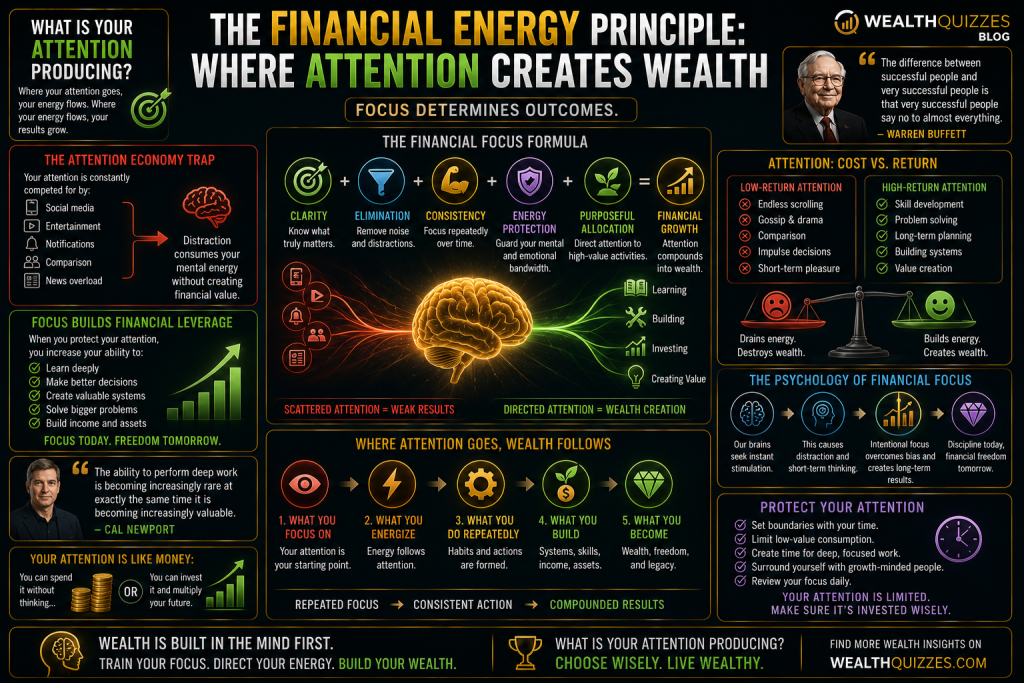
The Financial Energy Formula
Strong financial focus generally requires:
1. Clarity
Know:
- What matters financially.
2. Elimination of Noise
Reduce:
- Unnecessary distractions.
3. Consistency
Focus repeatedly over long periods.
4. Energy Protection
Protect:
- Mental bandwidth
- Emotional stability
- Productive capacity
5. Purposeful Allocation
Direct attention toward:
- Growth-producing activities.
The Difference Between Consumption and Creation
One of the biggest financial distinctions is between:
- Consumers
And: - Creators/builders.
Consumers primarily absorb:
- Content
- Entertainment
- External stimulation
Builders focus on:
- Producing value
- Solving problems
- Creating systems
- Expanding capability
Wealth tends to flow more strongly toward:
- Value creators.
The Identity Shift
To apply the Financial Energy Principle, you must move from:
- “What is distracting me?”
To:
“What is my attention producing financially?”
The Real Transformation
Directed financial energy creates:
- Better execution
- Improved opportunities
- Greater consistency
- Stronger productivity systems
Eventually:
Focus compounds into:
- Skill
- Income
- Assets
- Financial leverage
The Hard Truth
Many people are not failing financially because:
- They lack ability.
They are failing because:
Their attention is scattered across too many low-value distractions.
Conclusion: Attention Is a Financial Asset
Your focus is not merely:
- Mental activity.
It is:
Economic power.
Where attention goes:
- Energy flows.
Where energy flows:
- Results emerge.
The financially successful are often not merely:
- Smarter
Or: - Luckier
They are frequently:
More intentional with their attention.
Because in modern finance:
Focus itself has become a form of capital.
Final Thought
Ask yourself honestly:
“What is my attention producing financially?”
Because your future wealth may depend less on:
- How hard you work
And more on:
What consistently receives your focus.
👉 What is your attention producing? Find out on WealthQuizzes