
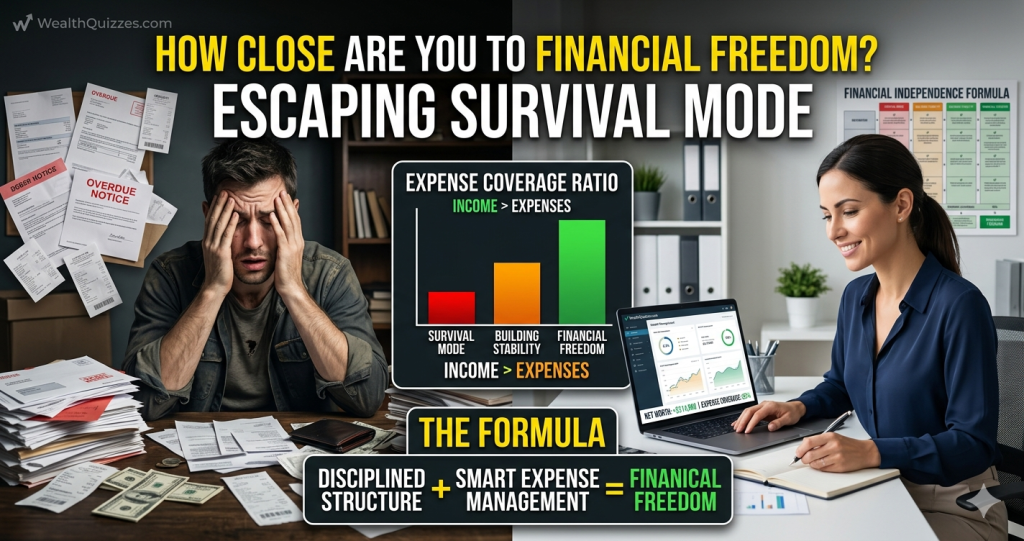
The Financial Independence Formula: Escaping Survival Mode
Why Financial Freedom Is Less About Luxury—and More About Structure
Introduction: The Trap of Permanent Survival Mode
Millions of people work hard every day yet remain trapped in a financial cycle that feels impossible to escape.
The pattern is familiar:
- Earn money
- Pay bills
- Solve urgent problems
- Start over again next month
Despite years of effort, financial peace remains distant.
Many people assume financial independence is reserved only for:
- Millionaires
- Celebrities
- High-income earners
- Business tycoons
But true financial independence is not merely about becoming extremely rich.
At its core, financial independence is about:
Control.
It is the point where:
- Your financial system can sustain your lifestyle without constant financial panic.
The problem is that many people are not living strategically.
They are living reactively.
This creates:
- Stress
- Anxiety
- Burnout
- Financial vulnerability
The transition from survival mode to financial independence begins with understanding a crucial principle:
Freedom requires structure.
The Core Truth
Core Idea: Freedom requires structure
Angle: Expense coverage ratio
Financial independence is fundamentally a mathematical and behavioral system.
It occurs when:
Your assets and income systems consistently cover your essential financial obligations.
What Is Financial Independence?
Financial independence means:
Your income-producing systems can sustain your living expenses without total dependence on active labor.
Important Clarification
Financial independence does not necessarily mean:
- Never working again
It means:
- Having the ability to work from choice rather than desperation.
The Survival Mode Problem
Survival mode occurs when:
- Income barely keeps pace with expenses.
Characteristics include:
- Constant financial pressure
- No emergency reserves
- Dependence on monthly salary
- High stress levels
- Limited long-term planning
- Inability to absorb financial shocks
Survival mode creates:
Financial fragility.
Why So Many People Remain Stuck
One major reason is:
- Lack of financial structure.
Many people focus primarily on:
- Increasing income
While ignoring:
- Expense control
- Capital allocation
- Asset accumulation
- Cash flow systems
As a result:
Even income increases often fail to create:
- Real financial freedom.
Insight from Authority
As Morgan Housel explains:
The highest form of wealth is the ability to wake up every morning and say, “I can do whatever I want today.”
Financial independence ultimately creates:
- Flexibility
- Control
- Reduced financial anxiety
Understanding the Expense Coverage Ratio
One of the simplest ways to measure financial independence is through:
The Expense Coverage Ratio.
This ratio measures:
How much of your living expenses are covered by:
- Investments
- Passive income
- Recurring income systems
- Assets
Formula Concept
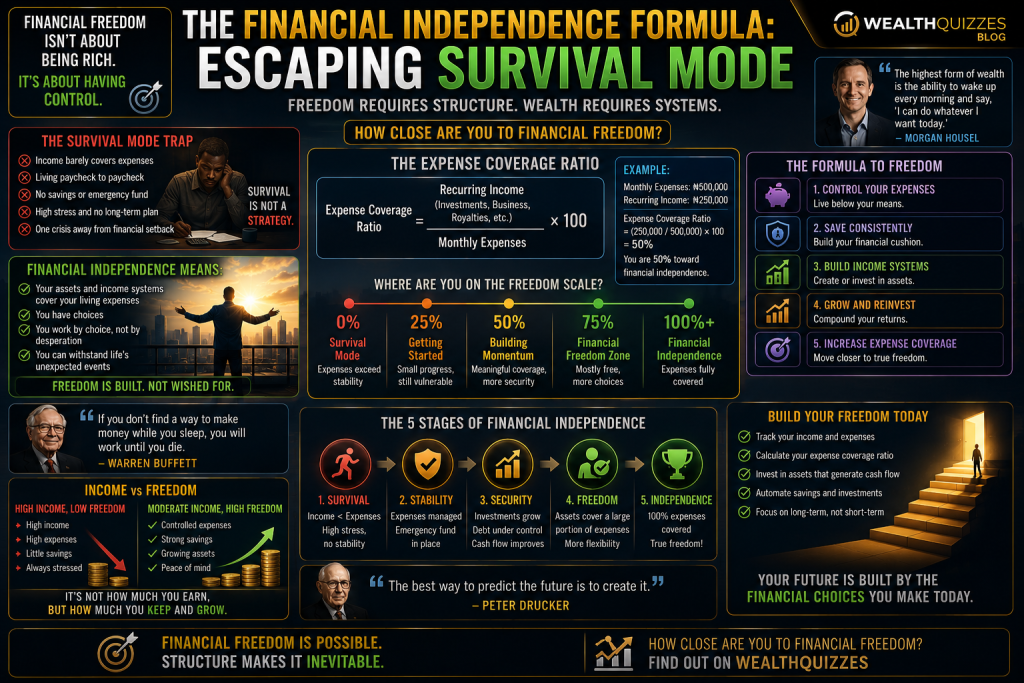
\text{Expense Coverage Ratio} = \frac{\text{Recurring Income}}{\text{Monthly Expenses}} \times 100
Example
If your:
- Monthly expenses = ₦500,000
And: - Recurring investment/business income = ₦250,000
Then:
- Your expense coverage ratio is 50%.
Meaning:
Half of your lifestyle is already financially covered.
Why This Ratio Matters
The closer your ratio moves toward:
- 100%
The closer you move toward:
- Financial independence.
This changes your relationship with:
- Work
- Risk
- Opportunities
- Life decisions
Financial Independence Is a Spectrum
Many people mistakenly think financial independence is:
- All or nothing.
In reality:
It exists in stages.
Stage 1: Financial Survival
- Expenses exceed stability
- Little or no savings
- High vulnerability
Stage 2: Financial Stability
- Expenses are manageable
- Emergency reserves exist
- Budget structure improves
Stage 3: Financial Security
- Investments begin producing income
- Debt becomes controlled
- Cash flow stabilizes
Stage 4: Partial Financial Independence
- Assets cover meaningful portions of expenses
Stage 5: Full Financial Independence
- Income-producing systems fully sustain lifestyle needs.
Insight from Authority
As Robert Kiyosaki emphasized:
Financial freedom is available to those who learn about it and work for it.
The key phrase is:
“work for it.”
Financial independence requires:
- Deliberate structure
- Long-term consistency
The Difference Between Income and Freedom
High income does not automatically create:
- Financial independence.
Why?
Because:
- High earners may also maintain extremely high expenses.
Example:
A person earning:
- ₦5 million monthly
But spending:
- ₦4.8 million monthly
May remain financially fragile.
Meanwhile:
Someone earning:
- Less income
But maintaining:
- Strong investments
- Controlled expenses
- Recurring cash flow systems
May possess greater financial resilience.
The Role of Asset Building
Financial independence depends heavily on:
- Assets.
Assets include:
- Investments
- Businesses
- Dividend-producing shares
- Rental properties
- Royalties
- Digital products
These systems gradually reduce dependence on:
- Active labor alone.
The Nigerian Context: Why Financial Structure Matters
Nigeria’s economic realities include:
- Inflation
- Currency instability
- Rising living costs
- Employment uncertainty
This makes financial independence increasingly important.
Without:
- Emergency systems
- Asset growth
- Structured financial planning
Many people remain highly exposed to:
- Economic shocks.
Increasingly, financially aware Nigerians are focusing on:
- Investment participation
- Business systems
- Digital income opportunities
- Structured budgeting
Why?
Because:
Survival mode is becoming increasingly unsustainable.
The Psychological Shift
Financial independence is not only:
- Financial
It is also:
- Psychological.
Constant financial instability creates:
- Fear
- Stress
- Desperation
- Short-term thinking
Financial structure creates:
- Confidence
- Strategic thinking
- Long-term planning capacity
Insight from Authority
Behavioral economist Daniel Kahneman demonstrated how scarcity pressure affects decision-making.
People under constant financial stress often:
- Make poorer long-term decisions.
This is why:
Stability improves financial judgment.
The Financial Independence Formula
Escaping survival mode generally requires:
1. Controlled Expenses
You cannot outgrow financial chaos while:
- Spending remains uncontrolled.
2. Consistent Savings
Savings create:
- Stability
- Optionality
- Emergency protection
3. Asset Accumulation
Assets gradually increase:
- Expense coverage capacity.
4. Recurring Cash Flow Systems
Income should become:
- More predictable
And: - Less labor-dependent over time.
5. Long-Term Consistency
Financial independence rarely happens quickly.
It usually compounds slowly.
The Lifestyle Inflation Trap
One major obstacle to independence is:
- Lifestyle drift.
As income rises:
Expenses often rise equally—or faster.
Result:
Financial dependence continues indefinitely.
Wealth builders often focus instead on:
- Increasing their expense coverage ratio
Not merely: - Increasing visible lifestyle.
The Identity Shift
To escape survival mode, you must move from:
- “I earn to survive”
To:
“I build systems that increase financial freedom over time.”
The Real Transformation
Financial independence changes:
- Stress levels
- Opportunity access
- Career flexibility
- Life choices
Eventually:
Work becomes:
- More intentional
Rather than: - Purely survival-driven.
The Hard Truth
Many people are not trapped because:
- They lack income
They are trapped because:
Their financial systems lack structure.
Conclusion: Financial Freedom Is Built, Not Wished For
Financial independence is not an accident.
It is usually the result of:
- Structured planning
- Controlled spending
- Asset accumulation
- Consistent financial behavior
Freedom does not begin when:
- You become rich overnight.
It begins when:
Your financial systems gradually reduce dependence on survival-based living.
Because true wealth is not merely:
- Having money.
It is:
Having control over your financial life.
Final Thought
Ask yourself honestly:
“How much of my life is financially covered without constant struggle?”
Because financial independence begins the moment:
Your money systems start carrying more weight than your stress.
👉 How close are you to financial freedom? Find out on WealthQuizzes