
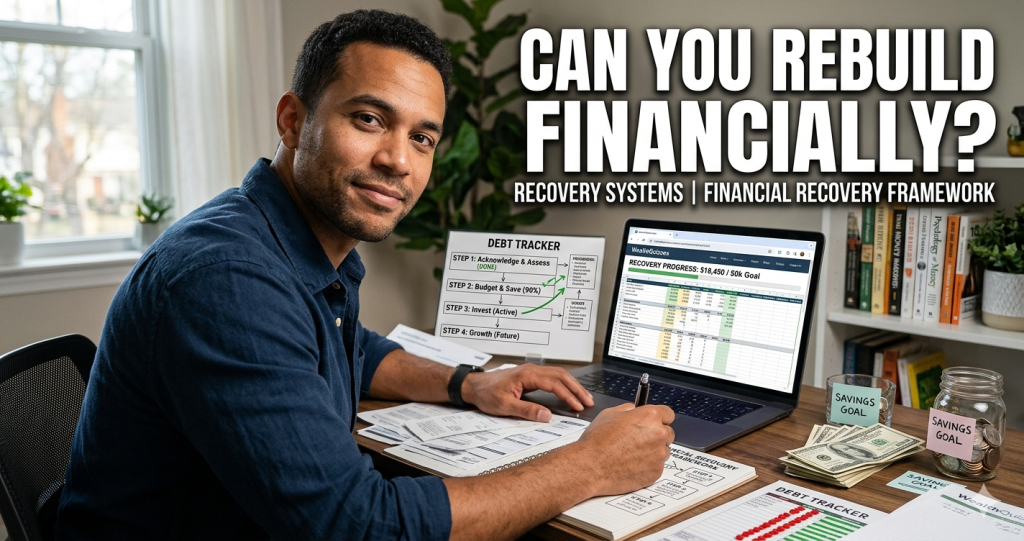
The Financial Recovery Framework: Rebuilding After Money Mistakes
Why Financial Setbacks Do Not Have to Define Your Future
Introduction: Everyone Makes Financial Mistakes
At some point in life, almost everyone experiences:
- Financial setbacks
- Bad decisions
- Losses
- Debt problems
- Failed investments
- Business collapse
- Overspending
- Economic hardship
Some mistakes are small.
Others can feel devastating.
A failed business venture may wipe out years of savings.
Poor investment decisions may create deep regret.
Debt may become emotionally overwhelming.
Unexpected crises such as:
- Medical emergencies
- Job loss
- Inflation
- Economic instability
Can destabilize even disciplined individuals.
In these moments, many people begin to believe:
Their financial future is permanently ruined.
But history repeatedly proves otherwise.
Many financially successful individuals have experienced:
- Bankruptcy
- Major losses
- Career failures
- Economic collapse
- Severe financial setbacks
Yet eventually rebuilt stronger financial systems.
The critical difference is not that they never failed.
The difference is:
They developed recovery systems.
This is the foundation of:
The Financial Recovery Framework.
The Core Truth
Core Idea: Financial setbacks are survivable
Angle: Recovery systems
A financial mistake does not have to become:
- A permanent financial identity.
Why Financial Recovery Matters
Many people focus heavily on:
- Wealth creation.
But far fewer understand:
- Wealth recovery.
Financial recovery is important because:
Life is unpredictable.
Even intelligent individuals can experience:
- Economic downturns
- Poor timing
- Business losses
- Emotional financial decisions
- Unexpected crises
Therefore:
Financial resilience becomes just as important as:
- Financial growth.
Insight from Authority
Investor Warren Buffett once stated:
“Risk comes from not knowing what you’re doing.”
However, even highly skilled investors occasionally experience:
- Significant losses.
The key is:
Survival and recovery.
The Emotional Weight of Financial Mistakes
Financial setbacks often create:
- Shame
- Anxiety
- Fear
- Self-doubt
- Emotional exhaustion
Many individuals internalize financial failure as:
- Personal failure.
This creates dangerous psychological patterns such as:
- Avoidance
- Financial paralysis
- Hopelessness
- Emotional spending
- Fear-based decision-making
Unfortunately:
Emotional collapse often worsens:
- Financial recovery speed.
Insight from Authority
Psychologist Carol Dweck explains the importance of:
Growth mindset.
People who view setbacks as:
- Temporary and improvable
Recover more effectively than those who view setbacks as:
- Permanent identity judgments.
Financial Mistakes Are Common
One major misconception is that:
- Successful people never fail financially.
In reality:
Many wealthy individuals experienced:
- Business failures
- Investment losses
- Bankruptcy
- Major financial reversals
Before achieving long-term success.
Examples throughout history include:
- Entrepreneurs who failed multiple ventures
- Investors who suffered market collapses
- Business owners who rebuilt after debt crises
The lesson is clear:
Financial mistakes are survivable.
The Nigerian Context: Recovery Under Economic Pressure
Nigeria’s economic environment presents additional recovery challenges such as:
- Inflation
- Currency instability
- Unemployment fluctuations
- Business unpredictability
- Rising living costs
Many people experience financial strain from:
- Failed businesses
- Job instability
- Family obligations
- Debt pressure
- Economic shocks
Social pressure can worsen recovery because:
- Financial struggles are often hidden publicly.
Some individuals therefore continue:
- Maintaining appearances
While internally facing: - Financial instability.
Recovery requires:
Honesty before rebuilding becomes possible.
The Financial Recovery Framework
Effective financial recovery generally follows several stages.
1. Acceptance Without Self-Destruction
The first step is:
- Accepting reality clearly.
Many people delay recovery because they:
- Deny financial problems
- Avoid numbers
- Ignore debt
- Continue destructive spending patterns
Recovery begins when:
- Financial reality is faced honestly.
This does not mean:
- Self-condemnation.
It means:
Objective assessment.
Insight from Authority
As Brené Brown emphasizes:
Shame often prevents constructive recovery.
Financial mistakes should become:
- Lessons
Not: - Permanent identity labels.

2. Stop Financial Bleeding
Before rebuilding wealth:
- Financial damage must stop increasing.
This may involve:
- Reducing unnecessary expenses
- Pausing risky investments
- Restructuring debt
- Cutting lifestyle inflation
- Stabilizing cash flow
Recovery requires:
Stability before expansion.
3. Rebuild Financial Clarity
Many financial crises create:
- Confusion
- Emotional overwhelm
- Mental fatigue
Therefore:
Clear financial visibility becomes essential.
Recovery systems often include:
- Expense tracking
- Debt assessment
- Income analysis
- Asset review
- Cash flow monitoring
Clarity reduces:
- Fear-driven thinking.
4. Restore Income Stability
Income recovery becomes critical after financial setbacks.
This may involve:
- Skill monetization
- Additional income streams
- Temporary work adjustments
- Business restructuring
- Career upgrades
Stable income creates:
- Recovery momentum.
5. Rebuild Financial Confidence Gradually
After financial mistakes, many people become:
- Fearful of decisions.
Some avoid:
- Investing
- Business opportunities
- Financial planning altogether.
Recovery requires:
- Gradual rebuilding of confidence through disciplined actions.
Small wins matter.
Insight from Authority
As James Clear explains:
Small repeated actions gradually transform:
- Identity
And: - Long-term outcomes.
The Role of Financial Discipline During Recovery
Recovery periods require stronger discipline than:
- Expansion periods.
Why?
Because recovery involves:
- Limited resources
- Emotional pressure
- Higher consequences for poor decisions
Discipline becomes:
Financial protection.
Avoiding Recovery Traps
Many people sabotage recovery by:
- Chasing quick money
- Entering scams
- Gambling financially
- Making emotional investments
- Comparing themselves socially
Financial desperation often increases vulnerability.
Insight from Authority
Behavioral economist Daniel Kahneman demonstrated how stress and fear can distort:
- Decision-making quality.
Recovery therefore requires:
- Emotional control.
The Importance of Financial Reserves
One major lesson from financial setbacks is:
- The importance of reserves.
Emergency funds provide:
- Stability during uncertainty.
Without reserves:
- Small crises can become major disruptions.
Recovery often teaches:
The value of financial protection systems.
Rebuilding Identity After Financial Failure
Many individuals suffer more from:
- Identity collapse
Than: - The financial loss itself.
They begin believing:
- “I failed.”
Instead of: - “I experienced a setback.”
This distinction matters psychologically.
Financial recovery requires:
- Identity reconstruction.
The goal becomes:
Becoming wiser, stronger, and more disciplined after the setback.
The Recovery Growth Principle
Some individuals emerge from financial setbacks with:
- Better systems
- Greater discipline
- Improved decision-making
- Stronger emotional control
In some cases:
Recovery becomes:
- A turning point toward long-term financial maturity.
The Identity Shift
To recover financially, you must move from:
- “My mistakes define me”
To:
“My response to setbacks will define my future.”
The Real Transformation
Strong financial recovery systems create:
- Resilience
- Emotional maturity
- Better financial structure
- Improved decision-making
- Long-term discipline
Eventually:
Setbacks become:
- Educational experiences rather than permanent destruction.
The Hard Truth
Many people are not permanently damaged by:
- Financial mistakes.
They are damaged because:
They stop rebuilding after the mistake.
Conclusion: Recovery Is Part of Wealth-Building
Financial recovery is not:
- Evidence of weakness.
It is often:
- Part of the wealth-building journey itself.
Because long-term financial success is not merely about:
- Avoiding all mistakes.
It is also about:
- Recovering intelligently when mistakes occur.
The financially resilient understand:
Setbacks are temporary when systems improve.
And sometimes:
- The strongest financial wisdom emerges after failure.
Final Thought
Ask yourself honestly:
“If everything financially went wrong today, would I know how to rebuild?”
Because true financial strength is not merely:
- The ability to build wealth.
It is also:
The ability to recover when life becomes unstable.
👉 Can you rebuild financially? Find out on WealthQuizzes