
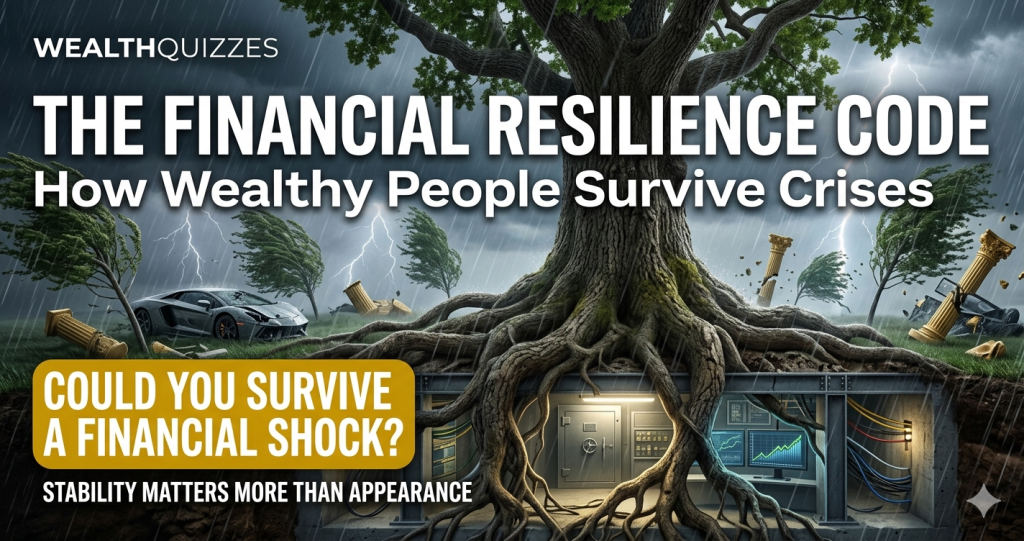
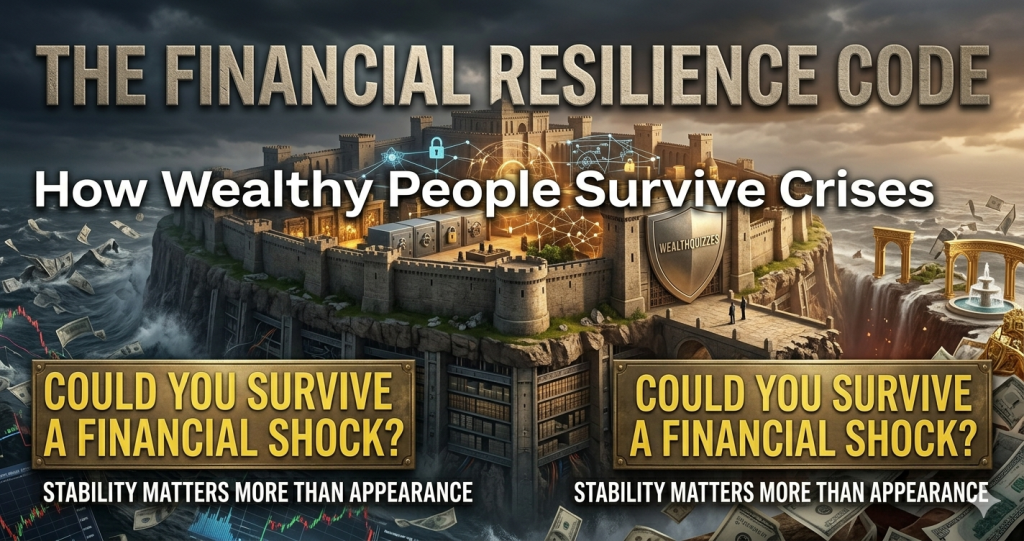
The Financial Resilience Code: How Wealthy People Survive Crises
Why Stability Matters More Than Appearance
Introduction: Wealth Is Not Tested During Good Times
Anyone can appear financially successful during periods of economic growth.
When:
- Income is flowing
- Markets are rising
- Businesses are expanding
- Opportunities are abundant
Financial confidence comes easily.
The real test of financial strength occurs during:
- Recessions
- Inflation shocks
- Job losses
- Business failures
- Health emergencies
- Economic downturns
- Unexpected crises
History repeatedly demonstrates a powerful truth:
Wealth is not defined by how much money you make during good times.
It is often defined by how well you survive difficult times.
Many individuals who appear wealthy collapse financially when conditions become unfavorable.
Meanwhile, others emerge stronger despite severe economic challenges.
Why?
Because they understand something many people overlook:
Financial resilience is a system.
The financially resilient do not merely focus on growth.
They focus on survival.
They understand that preserving financial stability during crises creates the opportunity to build wealth afterward.
This is the foundation of:
The Financial Resilience Code.
The Core Truth
Core Idea: Stability matters more than appearance
Angle: Economic survival systems
True financial strength is measured not by:
- Lifestyle
But by:
- Stability under pressure.
What Is Financial Resilience?
Financial resilience refers to the ability to:
- Absorb financial shocks
- Recover from setbacks
- Maintain stability during uncertainty
- Continue progressing despite disruptions
Financial resilience allows individuals to:
- Survive crises
- Protect assets
- Avoid financial collapse
- Preserve opportunities
In simple terms:
Resilience answers the question:
“What happens when things go wrong?”
Why Crises Are Inevitable
One of the biggest mistakes people make is assuming:
Today’s conditions will continue indefinitely.
History shows otherwise.
Every economy experiences cycles.
Examples include:
- Recessions
- Inflation spikes
- Market crashes
- Business disruptions
- Political uncertainty
- Technological shifts
Insight from Authority
Economist Hyman Minsky argued that periods of stability often encourage behavior that eventually creates instability.
In other words:
Economic shocks are not unusual.
They are normal parts of economic systems.
The Difference Between Rich and Resilient
Many people confuse:
- Wealth
with - Financial resilience
They are not the same.
A person may have:
- Expensive cars
- Luxury homes
- Visible status
Yet remain financially vulnerable.
Conversely:
Another person may appear modest but possess:
- Strong reserves
- Low debt
- Diversified income
- Strategic investments
During a crisis:
The second individual often performs far better.
Insight from Authority
Author Morgan Housel explains:
Wealth is what you don’t see.
Many indicators of financial strength remain invisible until adversity arrives.
The Nigerian Context
Financial resilience is particularly important in Nigeria.
Citizens frequently face challenges such as:
- Inflation
- Currency fluctuations
- Business uncertainty
- Rising living costs
- Economic volatility
These realities mean that financial stability requires:
- Planning
- Adaptability
- Preparation
Individuals who depend entirely on one source of income often face greater vulnerability during economic disruptions.
Wealthy People Think Differently About Risk
One major difference between financially resilient individuals and others is:
Their relationship with risk.
Many people focus primarily on:
- Potential rewards
Wealthy and resilient individuals also consider:
- Potential losses
Before making decisions they often ask:
- What could go wrong?
- How much could I lose?
- Can I survive the downside?
Insight from Authority
Investor Howard Marks repeatedly emphasizes:
Successful investing requires understanding risk, not merely pursuing returns.
The Emergency Reserve Principle
One of the most important resilience systems is:
- Liquidity
Cash reserves provide:
- Flexibility
- Protection
- Time
During difficult periods.
Emergency funds help individuals:
- Cover expenses
- Avoid panic decisions
- Prevent destructive debt
Financial resilience often begins with:
Having options.
And liquidity creates options.
Income Diversification
A single income source creates concentration risk.
If that income disappears:
Financial pressure can become immediate.
This is why many financially resilient individuals develop:
- Multiple income streams
- Investment income
- Business income
- Professional income
- Asset-based income
Diversification does not eliminate risk.
However:
It reduces dependence on any one source.
Insight from Authority
Investor Ray Dalio frequently emphasizes diversification as a key risk-management strategy.
Low Debt Creates Strength
Debt can amplify both:
- Gains
and - Losses
During economic expansion:
Debt may appear manageable.
During crises:
Debt obligations remain.
Even when:
- Income declines
This creates vulnerability.
Financially resilient individuals often prioritize:
- Sustainable debt levels
- Manageable obligations
- Strong cash flow
The Flexibility Advantage
Financial resilience requires adaptability.
Economic environments change.
Industries evolve.
Technology disrupts old systems.
Resilient individuals continuously develop:
- Skills
- Knowledge
- Competence
This allows them to adjust when circumstances change.
Insight from Authority
Management expert Peter Drucker famously stated:
The greatest danger in times of turbulence is acting with yesterday’s logic.
Adaptability is a resilience advantage.
The Psychological Component of Resilience
Financial resilience is not purely mathematical.
It is also psychological.
Crises create:
- Fear
- Anxiety
- Uncertainty
- Emotional decision-making
Individuals who remain calm often make better choices.
Insight from Authority
Psychologist Daniel Kahneman demonstrated how stress can distort decision-making.
Resilient individuals often prepare systems in advance to reduce emotional reactions.
The Wealth Preservation Mindset
Many people focus entirely on:
- Accumulating wealth
Wealthy individuals often focus equally on:
- Preserving wealth
Preservation strategies include:
- Insurance
- Legal structures
- Diversification
- Liquidity
- Risk management
Why?
Because:
Wealth lost is often harder to rebuild than wealth protected.
The Opportunity Principle
Crises do not only create problems.
They also create opportunities.
Individuals with:
- Cash reserves
- Stable finances
- Strong systems
Often find themselves able to:
- Invest
- Expand
- Acquire assets
When others are forced to retreat.
This is why resilience frequently becomes:
- A competitive advantage
The Financial Resilience Framework
To strengthen financial resilience:
1. Build Emergency Reserves
Create liquidity before it becomes necessary.
2. Diversify Income Sources
Reduce dependence on one income stream.
3. Control Debt
Avoid obligations that threaten survival.
4. Invest in Skills
Maintain adaptability.
5. Protect Assets
Use insurance and legal safeguards where appropriate.
6. Plan for Downside Scenarios
Prepare before crises occur.
The Identity Shift
To become financially resilient, you must move from:
“I want to look wealthy.”
To:
“I want to remain financially stable regardless of circumstances.”
This shift changes:
- Spending
- Saving
- Investing
- Risk management
The Hard Truth
Many people are not financially destroyed by crises.
They are destroyed by:
Being unprepared for crises.
The crisis simply reveals weaknesses that already existed.
Conclusion: Survival Comes Before Growth
Every financial journey eventually encounters:
- Uncertainty
- Volatility
- Adversity
The individuals who thrive are rarely those with the most impressive lifestyles.
They are often those with the strongest systems.
Because financial resilience is not about avoiding every crisis.
It is about surviving crises without losing the ability to move forward.
The financially resilient understand a powerful principle:
Stability creates opportunity.
And opportunity creates wealth.
Final Thought
Ask yourself honestly:
“If my income stopped tomorrow, how long could my financial system survive?”
Because true wealth is not measured by what people see during prosperity.
It is measured by what remains standing when adversity arrives.
👉 Could you survive a financial shock? Find out on WealthQuizzes.