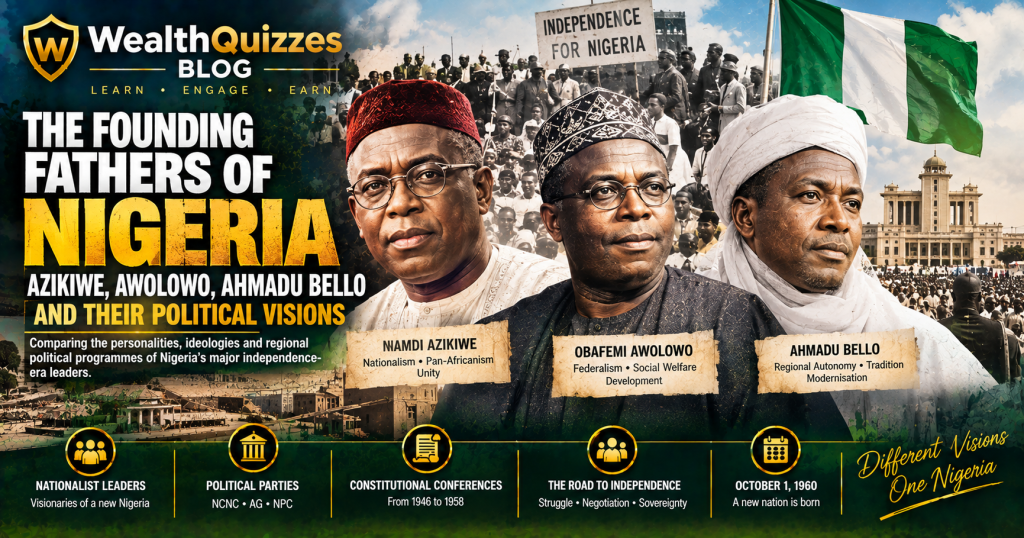
THE FOUNDING FATHERS OF NIGERIA: AZIKIWE, AWOLOWO, AHMADU BELLO AND THEIR POLITICAL VISIONS
Comparing the Personalities, Ideologies and Regional Political Programmes of Nigeria’s Major Independence-Era Leaders
Nigeria’s independence in 1960 was not the achievement of a single politician, party or region. It was the product of a complex nationalist movement involving journalists, lawyers, trade unionists, traditional rulers, intellectuals, students, women, workers and, above all, a generation of political leaders who transformed opposition to colonial rule into organised constitutional politics.
Among the most influential were Dr Nnamdi Azikiwe, Chief Obafemi Awolowo and Sir Ahmadu Bello, the Sardauna of Sokoto. They are frequently described as three of the principal “founding fathers” of modern Nigeria. A fourth figure, Sir Abubakar Tafawa Balewa, must also be acknowledged as the federal statesman who became Nigeria’s first Prime Minister at independence.
Yet the significance of Azikiwe, Awolowo and Bello lies not merely in their individual achievements. They represented different answers to the fundamental question confronting Nigeria before independence: how should a country composed of numerous peoples, political traditions, religions and regions be governed?
Historian Wale Adebanwi observes that, in the decade preceding independence, Nigeria’s major political blocs became organised principally around the NCNC in the East, Action Group in the West and Northern People’s Congress in the North. The political contest was therefore simultaneously a struggle for independence and a struggle over the character of the Nigerian state. (Cambridge University Press)
Nnamdi Azikiwe: The Nationalist and Pan-African Visionary
Nnamdi Benjamin Azikiwe (1904–1996) was perhaps the most internationally oriented of Nigeria’s major nationalist leaders.
His political formation was strongly influenced by his experiences in the United States, where he encountered African-American intellectual traditions, Pan-Africanism, Garveyism and debates about racial equality. Cambridge historian Michael J. C. Echeruo has demonstrated the importance of these intellectual influences in understanding Azikiwe’s political thought. (Cambridge University Press)
Azikiwe returned to West Africa with an ambitious conception of African emancipation. Through journalism, particularly the West African Pilot, he attacked colonialism, racial discrimination and political inequality. His newspapers extended beyond Lagos into other Nigerian cities, helping to spread nationalist ideas to a much wider audience. Cambridge scholarship describes his journalism as combining radical nationalism with an aggressive challenge to colonial authority. (Cambridge University Press)
His major political organisation, the National Council of Nigeria and the Cameroons (NCNC), founded in 1944 with Herbert Macaulay, initially presented itself as a broad Nigerian nationalist movement.
Azikiwe’s political philosophy was therefore strongly associated with nationalism, African unity, political equality and mental emancipation.
His Renascent Africa presented a philosophical conception of an African renaissance. Its central concern was not merely the replacement of British officials with African officials, but the transformation of the African psychologically, intellectually, economically and politically.
His ideas included concepts such as spiritual balance, social regeneration, economic self-reliance, mental emancipation and nationalist revival. Later scholarship has described this philosophy as combining elements of African nationalism, humanism and social-welfare thinking rather than fitting neatly into one conventional European ideological category. (AfricaBib)
Interestingly, Azikiwe was also an early advocate of federalism. Nigerian constitutional scholarship records that his 1943 Political Blueprint of Nigeria proposed a federal commonwealth consisting of several constituent units with substantial powers. (Nigeria Repository)
Thus, Azikiwe’s nationalism was not necessarily synonymous with political centralisation. He could simultaneously advocate Nigerian unity and recognise the need to accommodate regional diversity.
Azikiwe’s political strength
Azikiwe’s greatest political asset was his ability to imagine Nigeria within a wider African and global context.
He was a communicator, intellectual and symbol of modern African nationalism.
His weakness, however, was that the NCNC’s claim to be a truly pan-Nigerian organisation increasingly collided with the realities of regional politics. By the 1950s, the NCNC had become principally associated with the Eastern Region. Cambridge scholarship notes this transformation from an initially national organisation into a party increasingly identified with the East. (Cambridge University Press)
This was one of the great paradoxes of Azikiwe’s career: the politician who most passionately articulated Nigerian nationalism eventually became identified primarily with one region.
Obafemi Awolowo: Federalism, Development and the Welfare State
If Azikiwe was the great nationalist communicator, Obafemi Jeremiah Oyeniyi Awolowo (1909–1987) was arguably the most systematic political organiser and policy thinker among the three.
Awolowo approached Nigeria’s political problem from a different starting point.
He believed that Nigeria’s diversity was too substantial to be ignored or simply dissolved into a centralised state. His answer was federalism.
In Path to Nigerian Freedom (1947), Awolowo argued that federal government was the appropriate constitutional arrangement for Nigeria. Nigerian constitutional scholarship identifies this work as one of the earliest systematic Nigerian arguments for federalism. (Nigeria Repository)
His reasoning was essentially that different Nigerian communities needed sufficient autonomy to manage their own affairs while participating in a larger federation.
This position eventually became closely associated with the Action Group (AG), established in 1951.
The Action Group dominated the Western Region and developed an unusually ambitious programme of social and economic development.
The Western Region as Awolowo’s Laboratory
Awolowo’s political philosophy became most visible when he governed the Western Region.
His government placed extraordinary emphasis on:
- education;
- healthcare;
- agricultural development;
- industrialisation;
- infrastructure;
- local government;
- economic planning; and
- social welfare.
One of the most famous policies was the introduction of free, universal and compulsory primary education in the Western Region in 1955.
Research on the development of free primary education records that the Western Region’s education programme involved a massive expansion of schools and teacher-training facilities. (African Journals Online)
This was more than an educational policy. Awolowo regarded education as an instrument for dismantling poverty, ignorance and colonial dependency.
His political vision was therefore heavily developmental and programme-driven.
While Azikiwe inspired through nationalist rhetoric and Pan-African imagination, Awolowo increasingly sought to demonstrate that political independence should produce measurable improvements in people’s lives.
His federalism also had an economic dimension: autonomous regions, in his conception, would be able to develop according to their own resources and priorities.
Awolowo’s paradox
Awolowo’s greatest political strength was also one of his greatest controversies.
He was an uncompromising federalist, but his political machine was deeply rooted in Yoruba political and cultural networks.
Cambridge scholarship notes that the Action Group developed links with existing local structures of authority in the Western Region and that regional political parties became embedded in local networks of power. (Cambridge University Press)
Thus, Awolowo’s politics contained two simultaneous ideas:
a strong belief in federal Nigeria, and a strong commitment to Western/Yoruba political interests.
This tension would become increasingly important in the political crises of the First Republic.
Ahmadu Bello: Northern Autonomy, Tradition and Modernisation
Sir Ahmadu Bello (1910–1966), the Sardauna of Sokoto, represented a very different political tradition.
Bello’s political worldview was shaped by the history of the Sokoto Caliphate, the institutions of the northern emirates, Islamic scholarship and the political concerns of Northern Nigeria.
He became the dominant political figure in the North and Premier of the Northern Region in 1954.
His principal political organisation was the Northern People’s Congress (NPC).
Where Azikiwe emphasised national and African unity, and Awolowo emphasised federal autonomy and developmental planning, Bello placed considerable emphasis on Northern political security, gradual political change, traditional institutions, Islamic identity and regional development.
Recent scholarship by historian Matthew M. Heaton describes Bello’s political positioning as involving both his role as a defender of Islam and his programme of “northernisation”, which sought greater political and economic parity for the North. (Cambridge University Press)
Northernisation and the Politics of Development
Northernisation was partly a response to the enormous educational and administrative disparities between Northern and Southern Nigeria.
The North had entered Western-style education and colonial administrative structures more cautiously than the South. Consequently, there were fewer qualified Northerners available for senior positions in the modern civil service.
The Northernisation programme sought to increase the participation of Northerners in government and expand educational opportunities.
Scholarship describes the policy as an attempt to reduce the North’s dependence on southern civil servants and professionals by expanding opportunities for Northerners. (Cambridge University Press)
Bello therefore did not simply seek to preserve the traditional northern order.
His politics represented an attempt to modernise Northern Nigeria without destroying its traditional and Islamic foundations.
His government expanded education, infrastructure, administration and economic development while maintaining close relationships with the emirate establishment.
Historian B. J. O. Dudley illustrates the complexity of Bello’s political conservatism: Bello could defend traditional institutions and customs while simultaneously participating in the development of modern regional government. (Cambridge University Press)
This combination led some scholars to characterise his politics as a form of reformist or progressive conservatism.
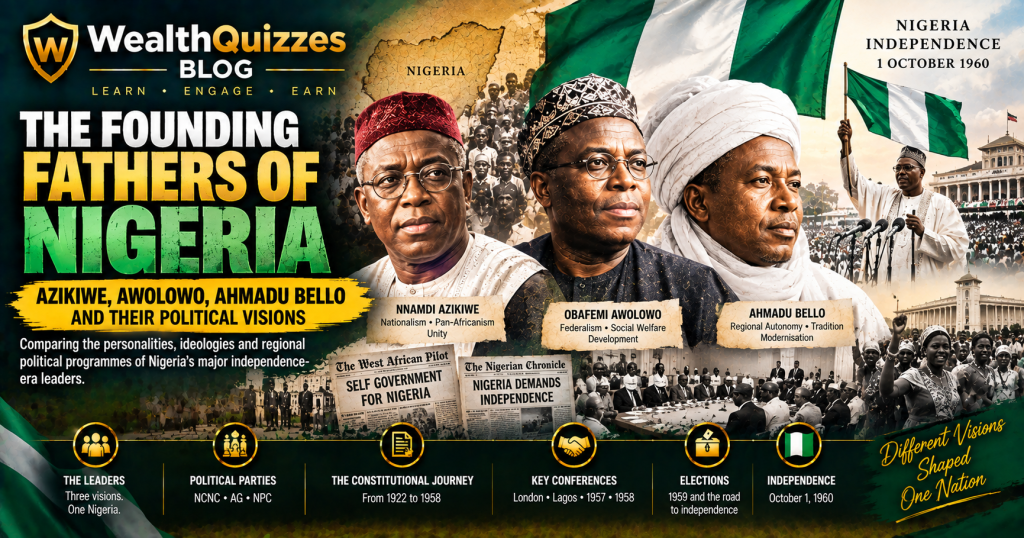
Three Visions of One Nigeria
The differences among the three leaders can be summarised broadly:
| Leader | Principal Party | Political Emphasis | Regional Base | Major Programme |
|---|---|---|---|---|
| Nnamdi Azikiwe | NCNC | Nationalism, Pan-Africanism, political equality | Eastern Region | National integration, education, African emancipation |
| Obafemi Awolowo | Action Group | Federalism, social welfare, economic planning | Western Region | Free education, healthcare, infrastructure, regional development |
| Ahmadu Bello | NPC | Regional autonomy, tradition, Islamic identity, gradual reform | Northern Region | Northernisation, education, administrative and economic development |
These distinctions should not, however, be treated as absolute.
All three supported independence.
All three recognised the importance of constitutional government.
All three understood that Nigeria needed modern institutions.
And all three, in different ways, sought to protect the interests of the people who supported them.
The fundamental disagreement concerned how national unity should be organised.
Nationalism Versus Regionalism
The most important contradiction in their political careers was that the struggle for Nigerian independence increasingly became organised through regional political parties.
Adebanwi’s research shows that the NCNC, NPC and Action Group became associated with the Eastern, Northern and Western political blocs respectively. (Cambridge University Press)
At independence, this regional structure remained.
The NCNC entered into an alliance with the NPC, producing the federal government under the parliamentary system. Tafawa Balewa became Prime Minister and Azikiwe became Governor-General, while Awolowo and the Action Group became the principal opposition. (Cambridge University Press)
The arrangement demonstrated both the possibilities and limitations of their political visions.
Azikiwe’s nationalism had not completely erased regional loyalties.
Awolowo’s federalism had not eliminated competition between regions.
Bello’s regional programme had not prevented participation in the Nigerian federation.
Instead, Nigeria’s independence settlement became a negotiated coexistence of these competing visions.
Their Personalities and Political Styles
Their personalities were remarkably different.
Azikiwe was charismatic, intellectual, rhetorical and cosmopolitan. He was comfortable addressing mass audiences and discussing Nigeria within the larger African struggle against racism and colonialism.
Awolowo was more methodical, disciplined and policy-oriented. He was a prolific writer and developed detailed constitutional and economic arguments. His political career was characterised by organisation, planning and ideological consistency.
Bello was deeply rooted in Northern traditional authority. His political legitimacy derived partly from the Sokoto establishment and his relationship with the emirate system. Yet he was also a modern administrator who sought to strengthen the North economically and educationally.
These different personalities corresponded to different political cultures.
Azikiwe’s political language was often that of national emancipation.
Awolowo’s was frequently that of constitutional engineering and social development.
Bello’s was largely that of regional security, gradual reform and institutional continuity.
The Larger Legacy
Modern scholarship increasingly cautions against treating these men as simple heroes or villains.
A 2018 University of Sheffield doctoral study by R. A. Adekoya examines precisely how Azikiwe, Awolowo and Bello constructed both national and sub-national identities between 1945 and 1967, reflecting the continuing complexity of their political legacies. (White Rose eTheses Online)
A 2026 study by Oluwatosin Orimolade similarly argues that the three leaders drew upon different intellectual foundations: Awolowo drew heavily upon ideas of Yoruba descent and political community; Bello upon the historical and religious imagination of the Sokoto Caliphate; and Azikiwe upon a more universalistic conception of indigenous democracy and national community. (Makerere Institute of Social Research)
This helps explain why their political legacies remain so powerful.
They were not simply competing personalities.
They represented different theories of what Nigeria was and what Nigeria ought to become.
Conclusion
The founding generation of Nigerian nationalism did not agree on everything.
Azikiwe imagined an African and Nigerian political community built around national emancipation, racial dignity, education and broad political inclusion.
Awolowo believed Nigeria’s unity required federalism, regional autonomy and aggressive investment in human development.
Ahmadu Bello sought to protect Northern political and cultural interests while modernising the region through education, administration, economic development and a carefully managed relationship between tradition and modernity.
Their differences were real, sometimes bitter and occasionally destabilising.
Yet their political competition also helped shape the constitutional architecture of independent Nigeria.
Perhaps their most enduring significance is therefore not that they shared one identical vision of Nigeria. It is that Nigeria emerged from the interaction of their competing visions.
The Nigeria inherited on 1 October 1960 was simultaneously nationalist, federal, regional, traditional, modernising and deeply plural.
Azikiwe, Awolowo and Bello each helped define one part of that inheritance.
And the political question they left behind remains remarkably contemporary:
How can a country with many identities preserve its unity while allowing its different peoples sufficient space to develop, govern and determine their own political future?
That question was already at the heart of Nigerian politics when the Union Jack came down in 1960.
It remains at the heart of Nigeria’s political history today.
Renowned Authorities and Primary Works
- Toyin Falola & Matthew M. Heaton, A History of Nigeria, Cambridge University Press.
- James S. Coleman, Nigeria: Background to Nationalism — a foundational scholarly study of Nigerian nationalism and regionalisation. (JSTOR)
- Michael J. C. Echeruo, “Nnamdi Azikiwe and Nineteenth-Century Nigerian Thought,” Journal of Modern African Studies. (Cambridge University Press)
- Wale Adebanwi, Nation as Grand Narrative: The Nigerian Press and the Politics of Meaning. (Cambridge University Press)
- B. J. O. Dudley, scholarship on traditionalism and politics in Northern Nigeria. (Cambridge University Press)
- Matthew M. Heaton, “Sir Alhaji Ahmadu Bello and the Politics of Pilgrimage in Northern Nigeria, 1954–63.” (Cambridge University Press)
- Nnamdi Azikiwe, Zik: A Selection from the Speeches of Nnamdi Azikiwe.
- Obafemi Awolowo, Awo: The Autobiography of Chief Obafemi Awolowo and Path to Nigerian Freedom.
- Ahmadu Bello, My Life: The Autobiography of Alhaji Sir Ahmadu Bello, Sardauna of Sokoto.
Cambridge records confirm the publication of the autobiographical works of all three leaders—Azikiwe’s Zik, Awolowo’s Awo, and Bello’s My Life—making their own writings particularly important primary sources for understanding how they presented their political visions. (Cambridge University Press)