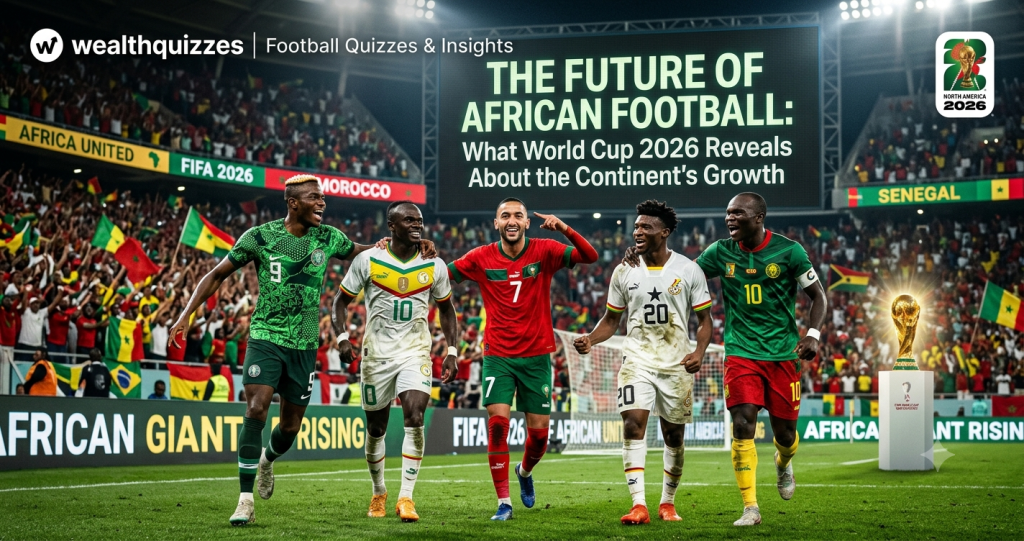
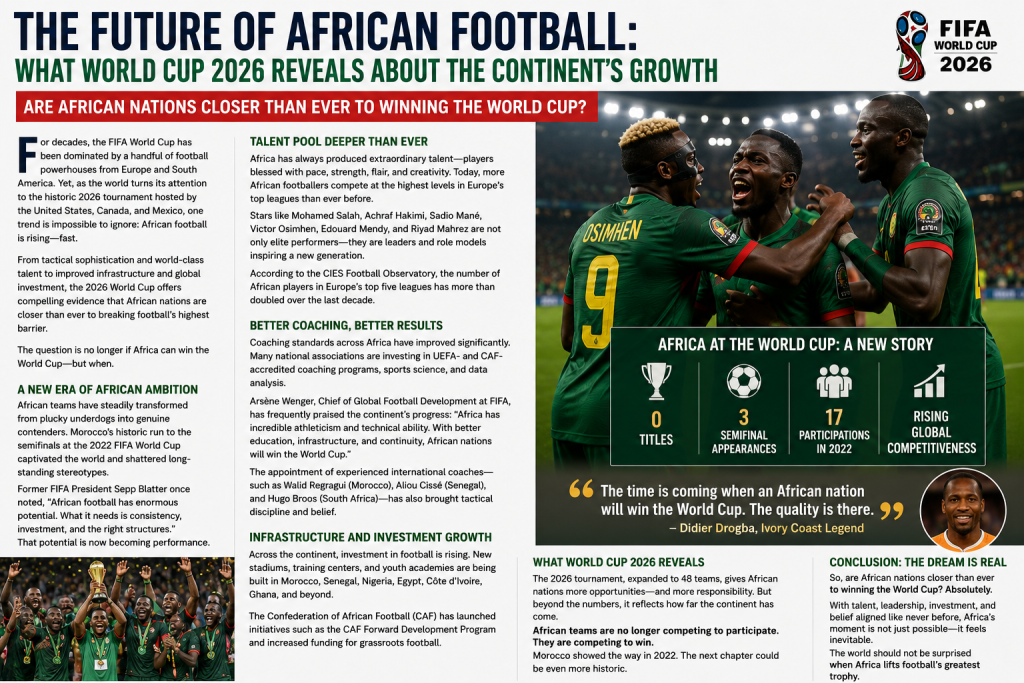
The Future of African Football: What World Cup 2026 Reveals About the Continent’s Growth
Are African Nations Closer Than Ever to Winning the World Cup?
For decades, African football has been celebrated for its flair, athleticism, creativity, and passion. From the electrifying performances of Cameroon in 1990 to Senegal’s remarkable run in 2002, Ghana’s dramatic quarterfinal appearance in 2010, and Morocco’s historic journey to the semi-finals in 2022, African nations have repeatedly demonstrated that they possess the talent to compete with the world’s best.
Yet one achievement has remained elusive: winning the FIFA World Cup.
As the FIFA World Cup 2026 unfolds across the United States, Canada, and Mexico, however, the conversation surrounding African football has shifted significantly. The question is no longer whether African teams belong among football’s elite. Instead, analysts, coaches, and supporters are asking whether the continent is now closer than ever to producing its first world champion.
The answer appears increasingly optimistic.
African football has undergone profound transformation over the past two decades. Investment in youth development, improved coaching standards, modern sports science, enhanced football administration, and greater exposure to elite European competitions have fundamentally changed the competitive landscape. Today’s African national teams are more tactically disciplined, technically refined, and mentally resilient than ever before.
World Cup 2026 offers compelling evidence that African football has entered a new era—one defined not merely by participation, but by genuine ambition to conquer the world’s biggest sporting stage.
From Promise to Performance
Africa’s football history has been filled with memorable moments that inspired millions.
Cameroon shocked the football world by reaching the quarter-finals of the 1990 FIFA World Cup under the leadership of legendary striker Roger Milla.
Twelve years later, Senegal defeated defending champions France in the opening match of the 2002 World Cup before reaching the quarter-finals.
In 2010, Ghana came within a penalty shootout of becoming Africa’s first World Cup semi-finalist.
Then came the defining breakthrough.
At the 2022 FIFA World Cup, Morocco became the first African and Arab nation ever to reach the semi-finals, defeating several European football powers along the way.
Football historian David Goldblatt has argued that Morocco’s achievement represented not an isolated miracle but the culmination of years of sustained investment in football infrastructure and youth development.
The continent had finally demonstrated that it could consistently compete with the world’s elite.
Talent Has Never Been Africa’s Problem
Africa has always produced extraordinary footballers.
Icons such as George Weah, Didier Drogba, Samuel Eto’o, Yaya Touré, Mohamed Salah, Sadio Mané, Victor Osimhen, and Achraf Hakimi have excelled at the highest levels of club football.
These players have won domestic league titles, continental championships, individual awards, and international recognition.
The issue has rarely been talent.
Rather, the challenge has been transforming individual excellence into sustained national team success.
Former Confederation of African Football President Issa Hayatou frequently emphasized that African football possessed abundant natural talent but required stronger institutions, long-term planning, and improved administration.
Recent developments suggest meaningful progress has been made in each of these areas.
Youth Development Is Changing the Future
One of the greatest reasons for optimism lies in youth development.
Across the continent, football academies have expanded significantly.
Countries including Morocco, Senegal, Egypt, South Africa, Ivory Coast, Nigeria, Ghana, and Algeria have invested heavily in structured player development programs.
Former Arsenal manager and FIFA Chief of Global Football Development Arsène Wenger has repeatedly praised Africa’s enormous football potential.
He has argued that with improved coaching education, infrastructure, and continuity, African nations possess every ingredient necessary to compete for the World Cup.
Modern academies now emphasize:
- Technical excellence.
- Tactical education.
- Sports science.
- Nutrition.
- Psychological preparation.
- Academic development.
These comprehensive systems are producing more complete footballers than previous generations.
European Experience Strengthens African Teams
Another major development is the increasing number of African players competing in Europe’s strongest leagues.
Today’s African internationals regularly feature in the:
- Premier League.
- La Liga.
- Bundesliga.
- Serie A.
- Ligue 1.
Competing weekly against the world’s finest players exposes African footballers to elite tactical systems, high-performance environments, and intense competitive standards.
Football journalist Jonathan Wilson notes that modern tactical knowledge spreads globally because players carry ideas learned at their clubs back to their national teams.
This exchange has significantly raised the tactical sophistication of African football.
Coaching Standards Have Improved
For many years, inconsistent coaching structures limited some African national teams.
That situation has changed considerably.
Many African football associations now employ highly qualified local and international coaches while investing in coaching education programs recognized by both FIFA and CAF.
Legendary Italian coach Arrigo Sacchi consistently argued that football success depends less on individual brilliance than on collective organization.
Modern African teams increasingly reflect that philosophy.
Compact defensive structures, coordinated pressing, intelligent transitions, and disciplined tactical execution have become defining characteristics of several African national teams.
Morocco’s remarkable World Cup campaign demonstrated precisely how tactical organization can overcome more individually gifted opponents.
Sports Science Has Closed the Gap
Elite football increasingly depends upon sports science.
African federations have expanded investment in:
- Physical conditioning.
- GPS performance monitoring.
- Recovery protocols.
- Injury prevention.
- Nutrition.
- Performance analytics.
Sports scientist Tim Gabbett has shown that marginal improvements in preparation often produce significant competitive advantages.
African teams now enjoy access to performance resources previously available primarily to Europe’s strongest football nations.
The gap continues to narrow.
Infrastructure Is Improving
Modern football requires modern facilities.
Across Africa, governments, private investors, and football associations have increased investment in:
- Stadiums.
- Training centres.
- Youth academies.
- Medical facilities.
- High-performance institutes.
Morocco’s extensive football infrastructure, developed partly in preparation for hosting major international competitions, has become an example for many other African countries.
Improved infrastructure creates sustainable long-term development rather than temporary success.
Mental Belief Has Changed
Perhaps the most important transformation is psychological.
African teams no longer approach World Cup matches hoping to compete respectably.
They increasingly expect to win.
Sports psychologist Bob Rotella argues that elite performance begins with belief.
Confidence influences decision-making, resilience, leadership, and composure under pressure.
Morocco’s performances in 2022 changed perceptions not only outside Africa but also within the continent itself.
Future generations now possess tangible evidence that African teams can defeat football’s traditional giants.
Belief has become one of Africa’s greatest competitive strengths.
World Cup 2026 Reveals Continued Progress
The expanded 48-team FIFA World Cup provides African nations with greater representation and more opportunities to compete at the highest level.
Greater participation accelerates development by exposing players and coaches to elite international competition.
FIFA President Gianni Infantino has argued that expanding the tournament encourages football growth across every confederation by increasing investment and competitive experience.
For Africa, this expanded platform represents both opportunity and responsibility.
Each successful campaign strengthens the continent’s football reputation.
Challenges Still Remain
Despite impressive progress, important challenges persist.
Some national associations continue to face issues involving:
- Administrative instability.
- Financial management.
- Inconsistent youth development.
- Coaching continuity.
- Domestic league competitiveness.
Long-term success requires stable institutions alongside talented players.
Football economist Stefan Szymanski has consistently emphasized that sustainable sporting success depends upon effective governance as much as financial investment.
Addressing these structural issues will further strengthen Africa’s position.
The Road to a First World Cup Title
Can an African nation realistically win the FIFA World Cup?
Increasingly, many respected observers believe the answer is yes.
Former Ivory Coast captain Didier Drogba has repeatedly expressed confidence that Africa possesses all the necessary ingredients to produce a future world champion.
Those ingredients include:
- Elite talent.
- World-class coaching.
- Improved infrastructure.
- Tactical sophistication.
- International experience.
- Growing confidence.
The remaining challenge is assembling these strengths consistently throughout an entire World Cup tournament.
Conclusion: Africa’s Golden Era May Be Approaching
Are African nations closer than ever to winning the World Cup?
The evidence strongly suggests they are.
The FIFA World Cup 2026 reflects a continent that has evolved dramatically in every aspect of football development. African teams are no longer admired solely for flair and athleticism. They are respected for tactical intelligence, disciplined organization, elite player development, and professional preparation.
From Morocco’s historic breakthrough to the continued emergence of world-class players across Europe’s biggest leagues, African football has established itself as one of the fastest-growing forces in international sport.
As Arsène Wenger has observed, Africa possesses extraordinary football potential. Increasingly, that potential is being transformed into consistent performance.
The dream of an African nation lifting the FIFA World Cup trophy once seemed distant.
Today, it feels not like an impossible ambition, but an approaching reality.
When that historic moment finally arrives, it will not be viewed as a surprise.
It will be recognized as the natural culmination of decades of growth, investment, resilience, and unwavering belief across an entire continent.