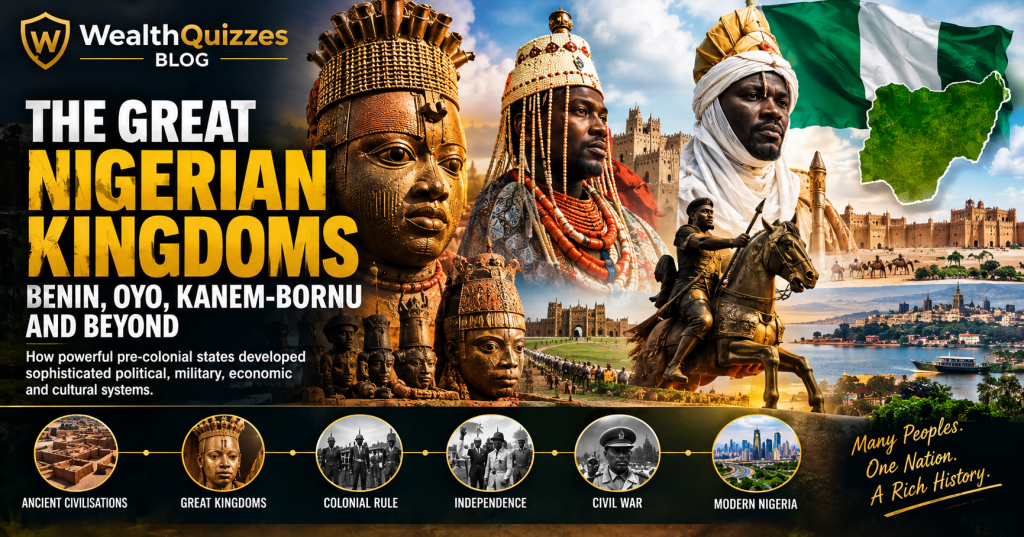
The Great Nigerian Kingdoms: Benin, Oyo, Kanem-Bornu and Beyond
How Powerful Pre-Colonial States Developed Sophisticated Political, Military, Economic and Cultural Systems
Long before the emergence of Nigeria as a modern state, the territory now known as Nigeria was home to powerful kingdoms, empires, city-states and complex societies. Across the forests of the south, the savannahs of the north and the Middle Belt, communities developed political institutions, economic networks, military organisations, religious systems and artistic traditions capable of sustaining large populations and extensive territories.
Among the most remarkable were the Kingdom of Benin, the Oyo Empire and the Kanem-Bornu Empire. They were not identical. Each developed in response to its own geography, resources, neighbours and historical circumstances. Alongside them were Ife, the Hausa city-states, Borgu and numerous decentralised societies, each contributing to the extraordinary political and cultural mosaic of pre-colonial Nigeria.
As historians Toyin Falola and Matthew Heaton observe, societies in the territory of modern Nigeria initially included many decentralised communities, but from roughly the end of the first millennium CE some developed increasingly centralised political structures based on kingship and the concentration of resources in important urban centres. In the south, Ife and Benin became major centres, while Kanem and later Bornu rose to prominence in the northern savannah.
The history of these states therefore provides an important corrective to the misconception that sophisticated political organisation in Africa began with European colonialism.
Benin: The Kingdom of the Oba
The Kingdom of Benin, centred in present-day Edo State, became one of the most sophisticated political and artistic powers of West Africa. Its origins are generally traced to the first millennium CE, with the kingdom developing into a highly organised monarchy under the authority of the Oba. The Pitt Rivers Museum describes Benin as one of the most important kingdoms in West Africa, with Benin City at the centre of extensive commercial and political networks.
The strength of Benin rested partly on the ability of its monarchy to organise political authority through a hierarchy of officials, palace institutions and specialised guilds. The Oba was not simply a ceremonial ruler. Kingship was closely connected with administration, warfare, religion, diplomacy and the economic life of the kingdom.
Benin City itself demonstrated the kingdom’s capacity for large-scale urban organisation. By the sixteenth century, historical evidence indicates that the city possessed planned streets, drainage systems, earthen walls and extensive moats. Its surrounding landscape was integrated into an agricultural and defensive system that supported the capital.
Benin also possessed a remarkable military capacity. Its expansion brought neighbouring territories and communities into relationships of tribute, political dependence or direct control. Warfare was therefore not merely destructive; it was one of the mechanisms through which the kingdom expanded its political influence.
But perhaps Benin’s most internationally recognised achievement is its art.
Benin’s bronze, brass, ivory and other works were produced by highly skilled specialists organised into guilds. The famous cast-brass plaques and commemorative heads were not simply decorative objects. They recorded royal history, represented courtly hierarchy and preserved the memory of important political events and personalities.
The sophistication of Benin’s artistic tradition also demonstrates the connection between political power and cultural production. A strong central authority could support specialist artisans, maintain royal workshops and create institutions capable of transmitting technical knowledge across generations.
Benin’s commercial system was equally significant. Its location connected forest resources and agricultural production with wider regional and Atlantic trade networks. Goods associated with the kingdom included cloth, pepper, ivory and other commodities.
The kingdom survived for centuries until British military intervention culminated in the 1897 British invasion of Benin City. The destruction and looting that followed resulted in the dispersal of thousands of objects, many of which are now held in museums around the world.
The history of Benin therefore represents a powerful combination of centralised kingship, military organisation, commerce, urban planning and artistic excellence.
Oyo: The Military Power of the Yoruba Savannah
Further west was the Oyo Empire, the largest and most influential of the major Yoruba imperial states.
The geography of Oyo was particularly important. Unlike the forest environment surrounding much of Benin, Oyo’s political heartland extended into the savannah north of the forest belt. This position facilitated interaction with northern states and provided access to important trade routes.
According to historian B.A. Agiri, Old Oyo achieved prominence particularly during the seventeenth and eighteenth centuries and became the largest and best-known of the Yoruba kingdoms before its collapse in the early nineteenth century.
Oyo’s political system was notable because the authority of the Alaafin, the ruler, was not entirely unlimited. The empire developed institutions that placed important checks on royal power. The Oyo Mesi, a council of senior political figures, played an important role in governance, while the Bashorun was a leading political office.
This arrangement demonstrates that pre-colonial African governance could incorporate sophisticated ideas about political accountability and institutional restraint.
The political structure of Oyo also extended beyond the capital. Provincial rulers and subordinate authorities helped connect the central government to territories incorporated into the empire.
Military organisation was fundamental to Oyo’s success. The empire became particularly renowned for its cavalry. Horses and military technology were strategically important because the savannah environment was more favourable to mounted warfare than the dense forest regions farther south.
The Are-Ona-Kakanfo, traditionally associated with the military leadership of the empire, represented the importance of warfare within Oyo’s political system.
Yet military strength alone cannot explain Oyo’s longevity. The empire was supported by agriculture, tribute, trade and the movement of goods between the forest and savannah zones.
Oyo’s eventual decline demonstrates an important principle in political history: powerful states can be weakened when their military, political and economic institutions fail to adapt to changing circumstances.
Internal political tensions, changes in regional power and military developments contributed to the empire’s disintegration in the early nineteenth century. The Oxford Handbook of Nigerian Politics similarly identifies military technology as an important factor in both the rise and eventual fall of Old Oyo.
Kanem-Bornu: The Long-Lived Empire of the Lake Chad Basin
If Benin represented the sophistication of a forest kingdom and Oyo demonstrated the military and political power of a Yoruba empire, Kanem-Bornu represented one of the most remarkable long-duration state systems in African history.
Centred initially around the Lake Chad basin, Kanem-Bornu eventually incorporated territories stretching across parts of present-day Nigeria, Chad, Niger, Cameroon and the wider central Sahel.
Historian Vincent Hiribarren describes Kanem-Bornu as an empire that existed for more than a thousand years in the Lake Chad basin and identifies its enduring state structure, extensive written and oral sources, early adoption of Islam and participation in trans-Saharan trade as four of its defining characteristics.
The empire’s longevity was closely connected to its geographical position.
Lake Chad was situated within a network connecting sub-Saharan Africa with North Africa. Through the trans-Saharan trade, Kanem-Bornu became involved in the movement of salt, livestock, agricultural products, ivory, textiles and other commodities.
Trade generated wealth, but it also encouraged diplomatic relationships, technological exchange and the movement of ideas.
Islam became particularly important in the political and intellectual development of Kanem-Bornu. The adoption of Islam by the ruling establishment strengthened the empire’s connections with North African and Islamic centres of learning and commerce.
The empire also demonstrated considerable military adaptability. Its rulers employed cavalry and other military technologies suited to the savannah environment. Political authority was exercised through a central monarchy supported by administrative structures and provincial relationships.
The movement of the political centre from Kanem to Bornu illustrates another characteristic of successful states: institutional resilience. When political and military pressures made the original centre increasingly difficult to maintain, the ruling dynasty relocated and reconstructed its political base.
Historian Dierk Lange’s research, for example, places the shift of the Sayfawa court toward Bornu in the context of disturbances in Kanem during the thirteenth century.
Kanem-Bornu consequently survived political crises that would have destroyed many shorter-lived states.
Beyond the “Big Three”
Benin, Oyo and Kanem-Bornu were not isolated examples.
Ile-Ife was one of the most important political, religious and artistic centres of the Yoruba world. The Oxford Research Encyclopedia describes Ife as the source from which a broader Yoruba political tradition developed, with the city occupying a major political, economic and religious position between approximately 1000 and 1500 CE.
The Hausa city-states—including Kano, Katsina, Zaria and Gobir—developed powerful urban and commercial institutions in the northern savannah. Their importance was connected to agriculture, crafts and long-distance trade. Cambridge historians Falola and Heaton identify these states as among the major northern political formations whose influence grew particularly strongly from the fifteenth century.
The Borgu states of the Middle Belt also formed part of this complex political landscape. Meanwhile, many societies, particularly in southeastern Nigeria and parts of the Middle Belt, developed decentralised political systems rather than centralised monarchies.
The latter point is particularly important.
A sophisticated society does not necessarily require an emperor or king.
Among the Igbo, for example, political organisation in many communities was decentralised and based on villages, lineage institutions, councils, age grades, titled societies and other mechanisms of social authority. Oxford scholarship characterises traditional Igbo political organisation as largely decentralised or acephalous, while emphasising its complex political economy and achievement-based social structure.
Thus, pre-colonial Nigeria contained kingdoms, empires, city-states and decentralised societies. There was no single African model of government.
What Made These States Powerful?
Several common factors help explain the rise of Nigeria’s great pre-colonial states.
1. Agriculture
Agriculture provided the demographic and economic foundation upon which political authority rested. Surplus food enabled rulers to support soldiers, administrators, artisans and urban populations.
2. Trade
Long-distance trade connected communities across ecological zones and beyond the region. Kanem-Bornu benefited from trans-Saharan commerce, while southern states participated in regional and Atlantic networks.
3. Military Technology
States that could organise effective armies gained advantages over rivals. Oyo’s cavalry and the military institutions of other states demonstrate the importance of adapting warfare to geography and technology.
4. Political Institutions
Successful states required more than powerful rulers. They developed councils, officials, provincial structures, palace institutions and systems of tribute and administration.
5. Religion and Ideology
Political legitimacy was frequently connected to religion, ancestry and sacred kingship. In other cases, as in Kanem-Bornu, Islam became an important component of political and intellectual life.
6. Culture and Knowledge
Art, architecture, oral traditions, craftsmanship and scholarship were not peripheral to state development. They helped preserve political legitimacy, collective memory and social identity.
A Sophisticated Political Landscape Before Colonialism
The most important lesson from these kingdoms is not simply that Nigeria once had powerful rulers.
It is that complex state formation was an indigenous historical process.
The Oxford Handbook of Nigerian History emphasises that the region witnessed multiple trajectories of state formation, influenced by geography, social complexity, external contacts and changing economic circumstances. It specifically identifies Benin, Oyo and Kanem-Borno among the major empire-building states.
Historian Nonso Obikili similarly argues that pre-colonial Nigerian state formation cannot be reduced to one model: geography, agriculture, international trade, military technology and the transatlantic slave trade all influenced the emergence, expansion and decline of different political systems.
This diversity is essential to understanding Nigerian history.
The modern Nigerian state was created through colonial territorial consolidation, particularly with the 1914 amalgamation. But the political communities brought together within that territory possessed histories that were centuries—and in some cases more than a millennium—older.
Conclusion: Before Nigeria, There Were Nations and Civilisations
The story of pre-colonial Nigeria is therefore a story of statecraft.
Benin demonstrated the possibilities of centralised monarchy, urban organisation, specialist craftsmanship and imperial administration. Oyo demonstrated the power of institutionalised kingship, cavalry warfare, tribute and regional commerce. Kanem-Bornu demonstrated extraordinary political resilience, trans-Saharan commerce, Islamic scholarship and imperial continuity.
Beyond them stood Ife, the Hausa city-states, Borgu and numerous decentralised societies whose political systems followed entirely different paths.
Together, they reveal a historical landscape far more sophisticated than the simplistic image of scattered communities awaiting European rule.
The kingdoms and empires of pre-colonial Nigeria built cities, organised armies, administered territories, regulated commerce, produced extraordinary works of art and developed institutions for governing complex societies.
Their histories also teach a broader lesson: great states rise not merely because they possess wealth or military power, but because they create institutions capable of converting resources, knowledge and human organisation into durable political authority.
The modern Nigerian nation inherited this extraordinarily diverse historical foundation.
Understanding Benin, Oyo, Kanem-Bornu and the many societies beyond them is therefore not merely an exercise in looking into the past. It is an essential part of understanding how the Nigerian peoples became the peoples of Nigeria.
Selected Renowned Authorities
- Toyin Falola & Matthew M. Heaton, A History of Nigeria — a major scholarly synthesis of Nigerian history, including the development of early states and societies.
- Vincent Hiribarren, The Origins of Kingdoms and Empires in Precolonial Nigeria, The Oxford Handbook of Nigerian History — a multidisciplinary examination of state formation in Benin, Borno, Hausa states, Borgu and Oyo.
- Osarhieme Benson Osadolor, State Management and Political Institutions in Nigeria before 1800, The Oxford Handbook of Nigerian History — analysis of political authority, governance and empire-building.
- Nonso Obikili, State Formation in Precolonial Nigeria, The Oxford Handbook of Nigerian Politics — analysis of geography, agriculture, trade and military technology in state formation.
- B.A. Agiri, “Early Oyo History Reconsidered,” History in Africa — important scholarship on the origins and development of Old Oyo.
- Dierk Lange, scholarship on Kanem and the Sayfawa dynasty — important work on Kanem-Bornu’s political development and relocation to Bornu.
- Ayodeji Ogunnaike, “Precolonial Yoruba States,” Oxford Research Encyclopedia of African History — scholarship on Ife and the wider Yoruba political tradition.
- Pitt Rivers Museum, University of Oxford, research on the Kingdom of Benin — documentation of Benin’s urban organisation, political history, trade and artistic guilds.
WealthQuizzes Blog takeaway: Before the map called Nigeria existed, powerful African states had already built institutions, economies, armies and cultures that commanded regional influence. Nigeria’s history did not begin with colonialism—it inherited a much older civilisation story.