The History of Nigeria: From Ancient Civilisations to the Modern Nation
From Nok terracotta and the great kingdoms of Ife, Benin, Oyo, Kanem-Bornu and Sokoto to British colonialism, independence, civil war and the Fourth Republic, Nigeria’s history is not the story of one people—but of many peoples whose histories eventually converged within one state.
What is now called Nigeria did not begin in 1914. The territory contains evidence of human habitation stretching back thousands of years, and long before the British created the political entity known as Nigeria, the region was home to sophisticated societies, cities, kingdoms, empires, trading networks, religious traditions and systems of government.
Understanding Nigerian history therefore requires more than memorising dates. It requires understanding how different peoples developed independently, interacted with one another, encountered external influences, resisted foreign domination, adapted to profound changes and eventually became citizens of a single modern state.
As historians Toyin Falola and Matthew M. Heaton emphasise in A History of Nigeria, the histories of the peoples occupying the geographical area of modern Nigeria go back centuries before the creation of Nigeria’s present borders by British colonial authorities in 1914. Their comprehensive history deliberately begins with human habitation and early societies rather than with colonialism. (Cambridge University Press)
That distinction is fundamental.
1. Before Nigeria: The Ancient Peoples of the Region
There was no single “Nigeria” in ancient times.
The region contained numerous communities with different political structures and cultural traditions. Some were decentralised village societies; others eventually developed powerful kingdoms and empires.
Cambridge historians Falola and Heaton trace human habitation across the territory of modern Nigeria to the Late Stone Age and note that archaeological evidence demonstrates continuous human settlement for thousands of years. Over time, some societies developed centralised political institutions and urban centres, while others retained decentralised forms of governance well into the colonial period. (Cambridge University Press)
One of the most important archaeological traditions is the Nok culture of central Nigeria.
Archaeological research places Nok’s characteristic terracotta tradition in the first millennium BCE, with evidence extending into the second millennium BCE. The culture is particularly famous for sophisticated terracotta sculptures and evidence of early iron production. Recent research, however, cautions against older assumptions that Nok necessarily represented a highly centralised state. Archaeologist Gabriele Franke, writing in the Oxford Research Encyclopedia of African History, describes Nok communities as dispersed agricultural settlements with complex ritual traditions, including mortuary practices, while noting that current evidence does not establish a centralised political system. (OUP Academic)
This is an important lesson in historical scholarship: archaeological evidence can overturn assumptions previously treated as fact.
2. Ile-Ife and the Rise of Urban Civilisation
Among the most important early centres of civilisation in the region was Ile-Ife, the historic heartland of Yoruba civilisation.
The Metropolitan Museum of Art traces Ife’s origins to at least the sixth century and describes it as a major urban centre whose artistic traditions became among the most remarkable in West Africa. Its naturalistic bronze, terracotta and stone sculptures challenged long-standing European misconceptions about African artistic achievement. (The Metropolitan Museum of Art)
By the first and second millennia CE, Ife had become a major political, religious and commercial centre.
Its artistic achievements were extraordinary.
The famous Ife heads and other sculptures demonstrate sophisticated knowledge of human anatomy, casting and artistic representation. The city also developed extensive trading connections.
The history of Ife is significant because it demonstrates that complex urban and artistic civilisation existed in the Nigerian region long before European colonial rule.
3. Benin: A Powerful Kingdom of Art, Trade and Government
Another extraordinary civilisation was the Kingdom of Benin, centred in present-day Edo State.
The British Museum describes Benin as one of the major powers of West Africa before the end of the nineteenth century. From the arrival of European merchants on the West African coast from the fifteenth century, Benin became an important intermediary in regional and international trade. (Khan Academy)
Benin developed sophisticated institutions, specialised guilds and an extraordinary artistic tradition.
The Pitt Rivers Museum of the University of Oxford records specialised guilds for metal casting, ivory carving, wood carving, weaving, medicine and other occupations. The famous Benin bronzes and brass plaques were produced through highly developed technical traditions, including the lost-wax casting process. (Oxford PRM)
But Benin’s history also illustrates the violence of colonial conquest.
In 1897, British forces attacked Benin City. The city was captured and burned, and large quantities of artworks were seized. The Oba, Ovonramwen, was eventually exiled. The Oxford museum records that the British expedition was connected not only with retaliation for the killing of British officials but also with Britain’s wider effort to extend economic control over the region. (Oxford PRM)
The episode remains central to contemporary debates about cultural restitution and the return of African artefacts.
4. Oyo and the Political Power of the Yoruba
The Oyo Empire became another major political force in West Africa.
Its strength rested partly on its political organisation, military capabilities and strategic position within regional trade networks.
The nineteenth-century collapse of Oyo dramatically altered political relations in Yorubaland. Cambridge historians describe the nineteenth century as a period of profound political transformation, including the decline of Oyo and the emergence of new Yoruba states and centres of power. (Cambridge University Press)
The significance of Oyo lies not merely in its territorial expansion.
It demonstrated that political authority in pre-colonial Nigeria could involve complex institutions, military organisation, taxation, diplomacy and relationships between rulers and councils.
Nigeria’s political history therefore did not begin with colonial government.
5. Kanem-Bornu, the Hausa States and Northern Civilisations
In northern Nigeria, another historical trajectory developed.
The Kanem-Bornu Empire became one of the major political formations of the central and western Sudan. Meanwhile, Hausa city-states such as Kano, Katsina, Zaria and Gobir developed into important centres of trade, scholarship and political authority.
Falola and Heaton note that Kanem and Borno became increasingly powerful from around the eleventh century, while Hausa states expanded their influence in later centuries. (Cambridge University Press)
Islam became particularly important in northern political and intellectual life through trans-Saharan networks.
Trade connected communities across enormous distances, carrying goods, ideas, technologies, religious beliefs and scholarly traditions.
The history of northern Nigeria therefore cannot be separated from the wider history of the Sahara and the Islamic world.
6. The Sokoto Caliphate and the Nineteenth-Century Transformation
One of the most consequential events in nineteenth-century West Africa was the Fulani-led jihad associated with Usman dan Fodio.
Beginning in the early nineteenth century, the movement transformed the political structure of much of the northern Nigerian region and contributed to the emergence of the Sokoto Caliphate.
Falola and Heaton describe the Sokoto Caliphate as an expansive political formation that brought numerous Hausa states and other territories under a new Islamic political order. By the time British forces conquered Sokoto in 1903, the political and cultural landscape of northern Nigeria had been profoundly reshaped. (Cambridge University Press)
The caliphate became a major centre of Islamic scholarship, administration and commerce.
Its legacy remains important to understanding northern Nigerian history.
7. Trade, Slavery and the Atlantic World
From roughly the sixteenth century onward, the Nigerian region became increasingly connected to the Atlantic economy.
European merchants established commercial relationships along the West African coast, while existing African states and trading communities participated in regional networks.
The Atlantic slave trade had devastating human consequences. People were captured, sold and transported through complex African and European commercial networks.
At the same time, African political actors were not merely passive observers. Kingdoms, city-states and trading communities participated in, resisted and were transformed by these economic systems.
By the nineteenth century, the abolition of the transatlantic slave trade encouraged a shift toward what Europeans called “legitimate commerce”, especially palm oil.
Historian K. O. Dike, in his classic Trade and Politics in the Niger Delta, 1830–1885, demonstrated how the transformation from slave trading to palm-oil commerce affected political power in the Niger Delta and progressively increased British commercial and political influence. (Google Books)
The economic history of Nigeria was therefore already being transformed before formal colonial conquest.
8. Christianity, Education and the Emergence of a New Elite
Christian missionaries became increasingly active in southern Nigeria during the nineteenth century.
One of the most important historians of this period was J. F. Ade Ajayi, whose seminal Christian Missions in Nigeria, 1841–1891: The Making of a New Elite examined the interaction between Christianity, education, European influence and Nigerian society.
Ajayi argued that the missionary movement helped create a Western-educated Christian middle class whose influence would later become significant in Nigerian political and intellectual life. (Nigeria Repository)
Among the most celebrated figures of this era was Samuel Ajayi Crowther, the first African bishop of the Anglican Church.
The emergence of Western education was eventually crucial to Nigerian nationalism.
The same educational institutions that introduced European intellectual traditions also produced Nigerians who would later challenge colonial political authority.
9. The British Conquest
By the second half of the nineteenth century, Britain’s commercial, missionary and political interests in the region had expanded substantially.
Cambridge’s account of the transition to colonial rule explains that British influence grew through traders, missionaries and officials, eventually culminating in the occupation of the territories that would become Nigeria. (Cambridge University Press)
Colonial conquest was neither instantaneous nor uniformly peaceful.
Different peoples responded differently.
Some negotiated treaties.
Others resisted militarily.
The British defeated or subordinated several major political formations, including the Sokoto Caliphate and Benin Kingdom.
By the beginning of the twentieth century, Britain had established effective colonial control over most of the territory.
10. The Amalgamation of 1914
The year 1914 is one of the most important dates in Nigerian history.
Lord Frederick Lugard amalgamated the Northern and Southern Protectorates with the Colony of Lagos to create the territorial entity known as Nigeria.
But the significance of 1914 must be properly understood.
The peoples incorporated into Nigeria did not suddenly become a single nation in 1914. They already possessed distinct histories, political institutions, languages, religions and identities.
The colonial government created a single administrative framework over these diverse territories.
Falola and Heaton consequently describe Nigeria’s modern borders as a creation of British colonialism, while stressing that the histories of the constituent peoples predated the colonial state by centuries. (Cambridge University Press)
That distinction would become one of the central challenges of post-independence nation-building.
11. Colonial Rule and the Transformation of Nigerian Society
British colonial rule changed Nigeria profoundly.
Railways and roads expanded.
Cash-crop agriculture grew.
Christian missionary education expanded in many southern areas.
Islamic institutions remained influential in the north.
Urban centres grew.
A new educated elite emerged.
But colonialism also imposed economic and political structures designed largely around British interests.
Falola and Heaton observe that colonial policies transformed Nigerian societies, particularly political institutions and economic orientation. The British also relied extensively on indirect rule, governing through traditional rulers and institutions where possible. (Cambridge University Press)
Yet indirect rule worked very differently in different parts of Nigeria.
Historian A. E. Afigbo famously examined the experience of indirect rule in southeastern Nigeria, where the British created or empowered “warrant chiefs” in societies whose traditional political authority was often more diffuse and less centralised than British administrators expected. (AfricaBib)
This mismatch between colonial administrative assumptions and indigenous political structures contributed to resistance.
The Aba Women’s War of 1929, for example, demonstrated that colonial authority could provoke powerful popular opposition.
12. The Rise of Nigerian Nationalism
By the twentieth century, Nigerians increasingly demanded political participation and eventually self-government.
Newspapers, trade unions, professional associations, women’s organisations, student groups and political movements became vehicles for nationalist mobilisation.
Figures such as Herbert Macaulay, Nnamdi Azikiwe, Obafemi Awolowo and Ahmadu Bello emerged as major political personalities, although they represented different regions, constituencies and visions of Nigeria.
Cambridge historians Falola and Heaton describe the nationalist movement from the 1930s onward as increasingly organised and assertive. Pressure from nationalists helped drive constitutional reforms that progressively expanded Nigerian self-government. (Cambridge University Press)
The process was not simple.
Questions of federalism, regional autonomy, minority protection and political representation were central.
Nigeria’s diversity was simultaneously its strength and one of its greatest political challenges.
13. Independence: 1 October 1960
After years of political negotiation and constitutional reform, Nigeria became independent on 1 October 1960.
The new country adopted a federal parliamentary system within the Commonwealth.
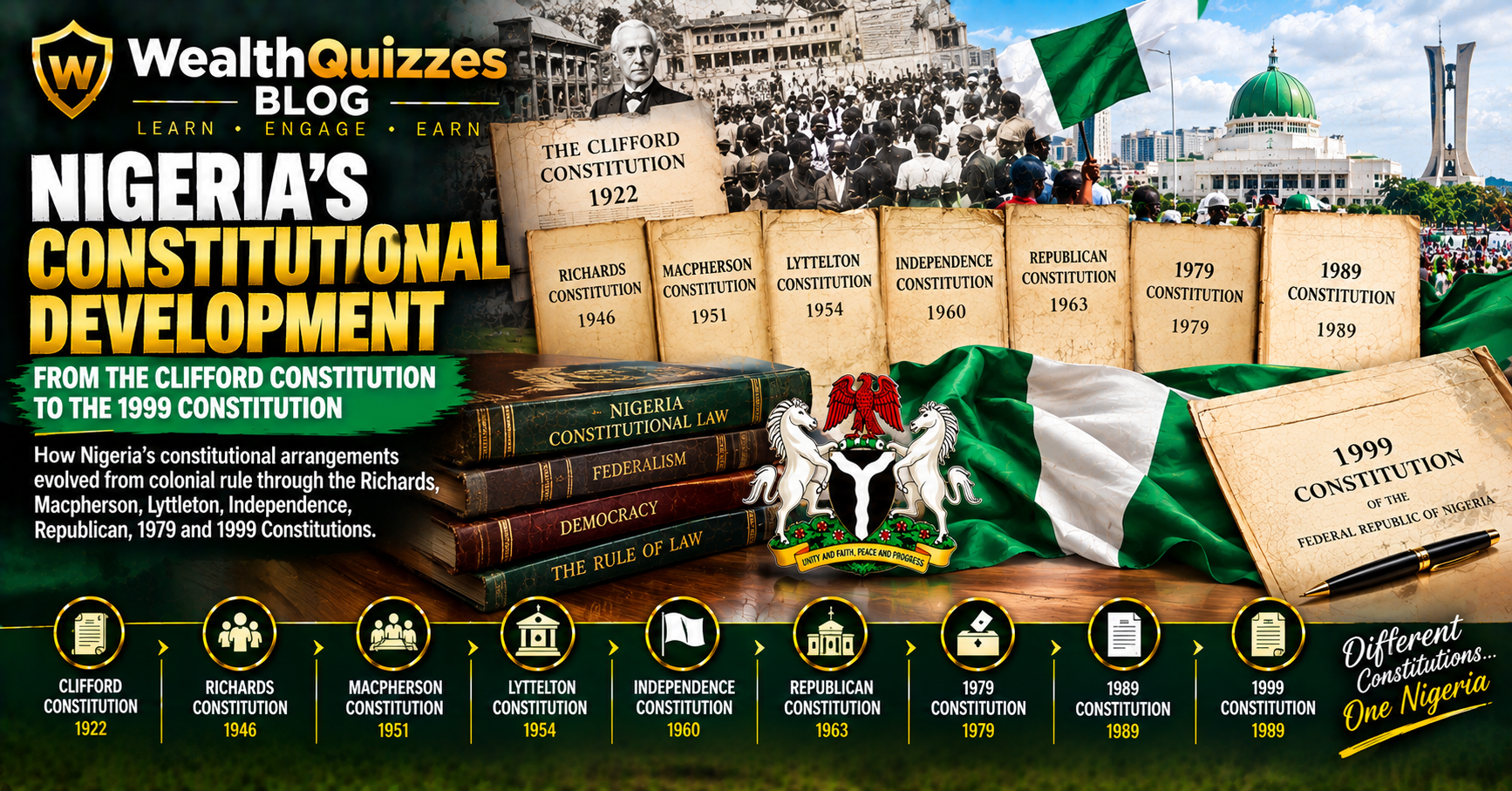
Abubakar Tafawa Balewa became Prime Minister, while Nnamdi Azikiwe became Governor-General and later Nigeria’s first President under the 1963 Republican Constitution.
The United States formally recognised Nigerian independence on October 1, 1960. (Office of the Historian)
Independence was a historic achievement.
But it also exposed a difficult question:
Could the political structure inherited from colonialism successfully accommodate Nigeria’s extraordinary diversity?
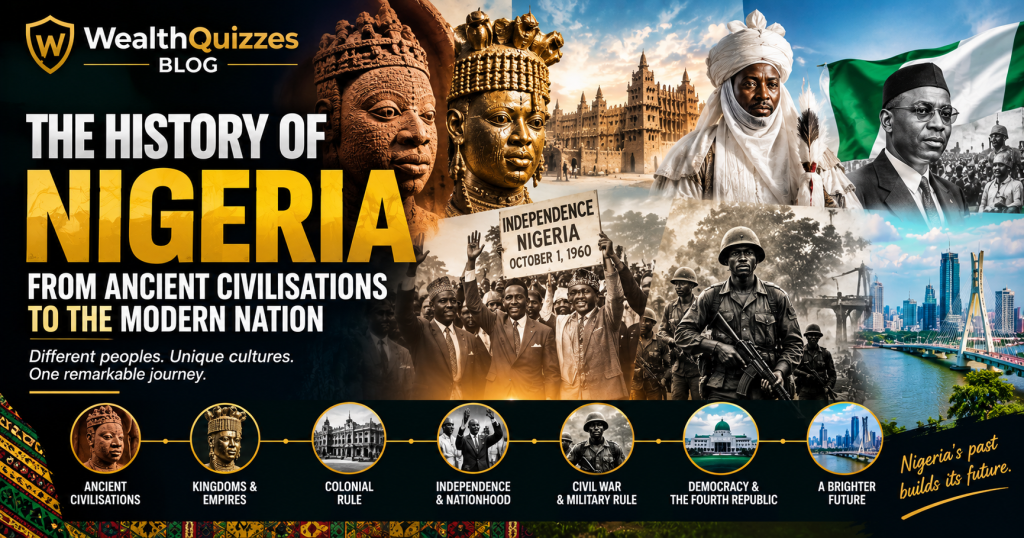
14. The First Republic and the Crisis of Nation-Building
The First Republic was dominated by strong regional political structures.
The Northern People’s Congress, Action Group and National Council of Nigeria and the Cameroons represented different political constituencies.
Competition became increasingly intense.
The 1964 federal election was controversial, and the political crisis deepened.
Then came the military coup of 15 January 1966.
The political order collapsed.
Subsequent counter-coup, ethnic violence and mass displacement intensified the crisis.
The Nigerian state entered its most dangerous period.
15. The Nigerian Civil War
On 30 May 1967, Lieutenant Colonel Chukwuemeka Odumegwu Ojukwu, military governor of the Eastern Region, declared the independence of the Republic of Biafra.
War followed.
The Nigeria-Biafra conflict lasted approximately 30 months and ended in January 1970.
Historians continue to debate its precise causes, but the crisis cannot be reduced to a single explanation. Ethnic violence, political instability, military coups, competing visions of federalism, fears of domination and economic interests all formed part of the wider context.
Cambridge scholarship stresses the complexity of these causes and warns against simplistic interpretations. (Cambridge University Press)
The human cost was catastrophic.
Falola and Heaton estimate that the wider crisis and civil war resulted in between one and three million deaths, while other scholarship has produced different estimates. (Cambridge University Press)
The war remains one of the defining events in Nigerian history.
16. Oil and the Transformation of Nigeria
The discovery of commercially viable petroleum in the Niger Delta in 1958 fundamentally altered Nigeria’s economic future.
After the Civil War, petroleum increasingly became the backbone of government revenue and foreign exchange earnings.
Nigeria’s relationship with oil would produce enormous opportunities while also creating difficult questions concerning environmental degradation, resource control, federalism, corruption and equitable distribution.
The political economy of oil became inseparable from the political economy of the Nigerian state.
17. Military Rule and the Struggle for Democracy
Following the Civil War, Nigeria experienced prolonged periods of military government interrupted by attempts at civilian rule.
Military leaders included Yakubu Gowon, Murtala Mohammed, Olusegun Obasanjo, Muhammadu Buhari, Ibrahim Babangida and Sani Abacha.
The military justified intervention at various times on grounds including political instability, corruption and national unity.
But military rule also restricted democratic participation and generated its own institutional problems.
Nigeria’s struggle for democracy therefore became a defining theme of the second half of the twentieth century.
18. June 12 and the Democratic Struggle
The 12 June 1993 presidential election became one of the most important episodes in Nigeria’s democratic history.
The election, widely associated with M. K. O. Abiola, was annulled by the military government of Ibrahim Babangida.
The resulting crisis contributed to years of political instability and intensified demands for democratic government.
The subsequent military government of Sani Abacha further delayed democratic transition.
Abacha’s death in 1998 opened the way for a transition that eventually produced a return to civilian government.
19. The Fourth Republic
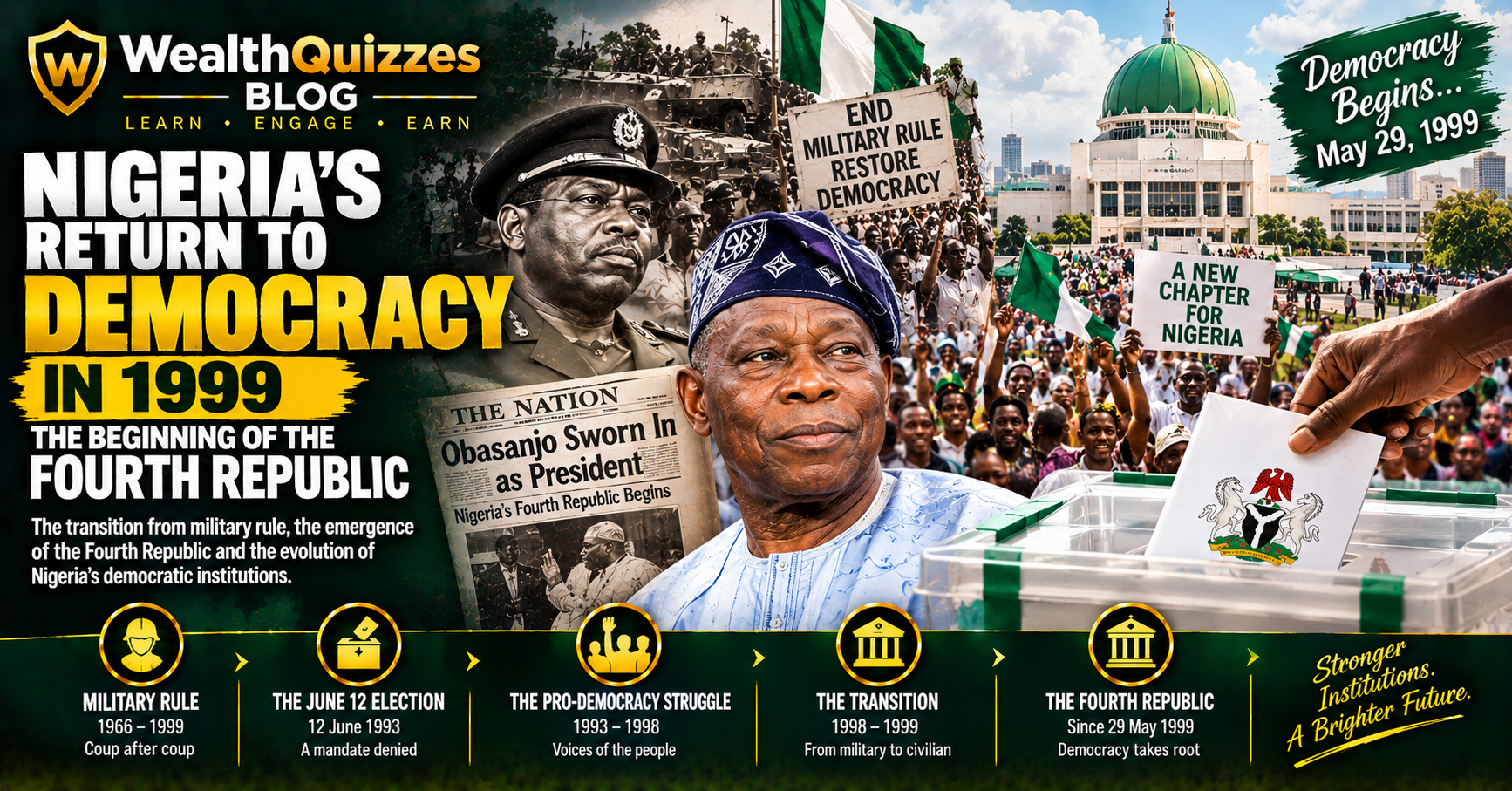
Nigeria returned to civilian democratic government on 29 May 1999, with former military ruler Olusegun Obasanjo becoming President.
The World Bank described the 1999 transition as the beginning of Nigeria’s first period of continuous democratic governance after 16 years of military rule. (World Bank)
The Fourth Republic has since survived multiple electoral cycles and peaceful transfers of presidential power.
Yet democracy has not eliminated Nigeria’s challenges.
Questions concerning electoral credibility, corruption, insecurity, economic inequality, federalism, resource control, ethnic politics and institutional capacity continue to shape national debate.
20. Nigeria Today: An Unfinished Historical Project
Nigeria today is the product of all these layers.
The ancient societies remain visible in its languages, kingdoms, art, religious traditions and cultural institutions.
The colonial period remains visible in its borders, legal and administrative structures, railways, educational traditions and political institutions.
The independence era lives on through its constitutional debates and political traditions.
The Civil War remains part of the country’s collective memory.
Oil transformed the economy.
Military rule shaped the state’s institutions.
Democratic struggles produced the Fourth Republic.
Nigeria’s history is therefore not a straight line from “primitive” society to modern state.
It is a story of continuity, disruption, adaptation and reinvention.
Conclusion: One Country, Many Histories
Perhaps the most important lesson of Nigerian history is that Nigeria was not born as a blank slate in 1914.
The territory already contained ancient communities and sophisticated civilisations.
Ife produced extraordinary art.
Benin developed powerful political and artistic institutions.
Oyo constructed an influential imperial system.
Kanem-Bornu and the Hausa states connected the region to wider Saharan and Islamic networks.
Sokoto reshaped northern political and religious life.
Niger Delta societies became important actors in international commerce.
Colonialism then imposed a new political framework over these diverse histories.
Nationalists subsequently transformed that colonial territory into an independent state.
The independence project survived coups, civil war and military dictatorship before eventually entering the Fourth Republic in 1999.
The historian Toyin Falola and his collaborators remind us that understanding contemporary Nigeria requires understanding this long historical trajectory—from early human settlement and state formation through colonialism, nationalism, independence, conflict and democratic transition. (Cambridge University Press)
Nigeria’s history is therefore much older than Nigeria itself.
And that may be the most important fact for every Nigerian to understand:
The country is young, but the histories of its peoples are ancient.
The challenge of nation-building is not to erase those histories, but to understand them, preserve them and build a common future from them.
Selected Authorities and Scholarly Works
- Toyin Falola & Matthew M. Heaton, A History of Nigeria — a major general history spanning early habitation, pre-colonial states, colonial rule, nationalism, civil war, oil politics and democratic transition. (Cambridge University Press)
- J. F. Ade Ajayi, Christian Missions in Nigeria, 1841–1891: The Making of a New Elite — a foundational study of missionary activity, education and the emergence of a Western-educated Nigerian elite. (Nigeria Repository)
- K. O. Dike, Trade and Politics in the Niger Delta, 1830–1885 — a landmark study of commerce and political transformation in the Niger Delta. (Google Books)
- A. E. Afigbo, studies on indirect rule and warrant chiefs — particularly important for understanding colonial administration in southeastern Nigeria. (AfricaBib)
- Gabriele Franke, research on Nok archaeology — important for understanding the limits of older interpretations of early Nigerian civilisation. (OUP Academic)
- Cambridge University Press, Writing the Nigeria-Biafra War — a multidisciplinary examination of the causes, experiences and contested memories of the Civil War. (Cambridge University Press)
- UNESCO World Heritage Centre, documentation on the Sukur Cultural Landscape — evidence of longstanding political institutions, iron production, agriculture and spiritual traditions in northeastern Nigeria. (whc.unesco.org)