
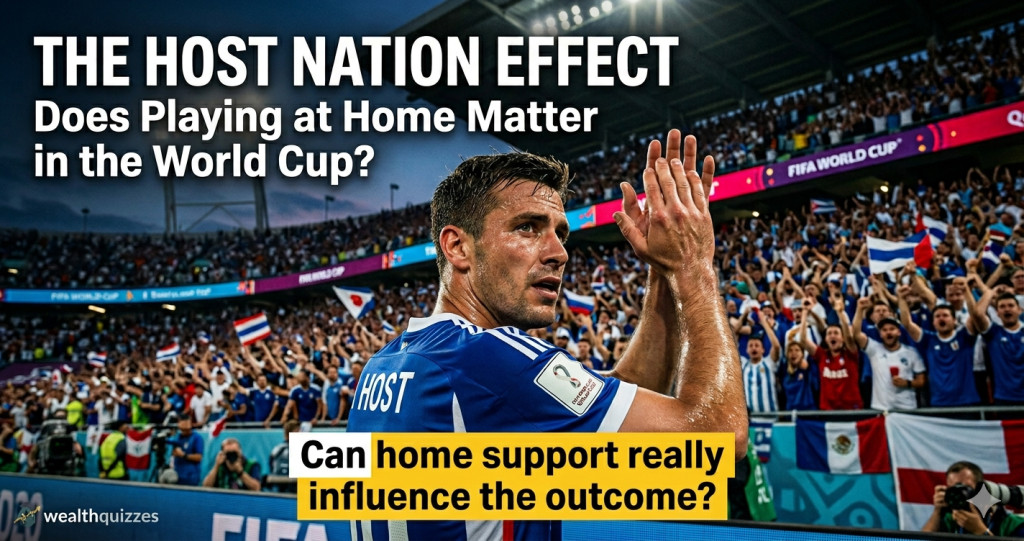
The Host Nation Effect: Why Playing at Home Matters in the World Cup
Can Home Support Really Influence the Outcome of Football’s Biggest Tournament?
Few advantages in sport are discussed as frequently—or debated as passionately—as home advantage. From local league matches to international tournaments, teams often perform better when competing in familiar surroundings and in front of supportive crowds. Yet nowhere is this phenomenon more visible than at the FIFA World Cup, where entire nations unite behind a single team carrying their hopes, pride, and expectations.
As the FIFA World Cup 2026 unfolds across the United States, Canada, and Mexico, the role of the host nations has once again become a major talking point. Mexico’s strong opening performance reignited a long-standing question among football analysts, coaches, and sports scientists: Does playing at home genuinely influence World Cup success, or is the so-called host nation effect merely a myth?
History, statistics, psychology, and sports science all point toward a clear answer. While hosting a World Cup does not guarantee victory, it often provides significant advantages that can influence performances, results, and even the destiny of entire tournaments.
Understanding Home Advantage
Home advantage refers to the tendency of teams to perform better when playing in familiar environments and before their own supporters.
According to sports psychologist Samuele Marcora and numerous studies in sports performance, home advantage is one of the most consistently observed phenomena in competitive sport. Across football, teams generally win more matches at home than away.
The reasons are varied and interconnected:
- Crowd support.
- Familiarity with playing conditions.
- Reduced travel fatigue.
- Psychological confidence.
- Referee influence.
- Environmental adaptation.
When these factors combine during a World Cup, the effects can become even more pronounced.
The Historical Evidence
History strongly supports the existence of a host nation advantage.
Since the inaugural FIFA World Cup in 1930, host nations have consistently outperformed expectations.
Consider some notable examples:
- Uruguay won the 1930 World Cup as hosts.
- Italy won in 1934.
- England won its only World Cup in 1966 on home soil.
- Argentina lifted the trophy in 1978 as hosts.
- France won in 1998 while hosting.
- Germany reached the semifinals in 2006.
- Russia exceeded expectations by reaching the quarterfinals in 2018.
According to analyses conducted by FIFA and football historians, host nations frequently progress deeper into tournaments than their pre-tournament rankings would predict.
Football historian David Goldblatt has argued that hosting often transforms a team’s competitive outlook because it combines sporting preparation with national momentum.
The evidence suggests that home advantage is not merely anecdotal—it is measurable.
The Power of the Crowd
Perhaps the most visible aspect of home advantage is crowd support.
World Cup crowds are unlike ordinary football audiences.
Supporters do not simply attend matches; they create an atmosphere capable of influencing players emotionally and psychologically.
Former Manchester United manager Sir Alex Ferguson frequently emphasized the importance of crowd energy, noting that supporters can inspire players to maintain intensity even during difficult moments.
At a World Cup, the effect is amplified.
Entire stadiums often become seas of national colors, songs, chants, and emotion.
Players frequently describe these experiences as energizing and motivational.
Sports psychologist Dr. Bob Rotella has noted that confidence can be reinforced by positive external environments. When players feel supported, they are often more willing to take risks, maintain composure, and recover from setbacks.
In high-pressure tournaments, that psychological boost can be invaluable.
Familiarity Creates Comfort
Another major advantage involves familiarity.
Host nations spend years preparing for World Cup matches in stadiums, cities, and climates they already understand.
Visiting teams must adapt quickly to:
- Weather conditions.
- Altitude differences.
- Pitch characteristics.
- Travel schedules.
- Local environments.
Hosts often enjoy a smoother experience.
During the 2014 FIFA World Cup, Brazil players were already familiar with many stadiums and climatic conditions across the country. Similarly, Germany benefited from local knowledge during the 2006 tournament.
Sports scientists have long recognized that familiarity reduces uncertainty and allows athletes to focus more completely on performance.
The fewer distractions players face, the greater their ability to execute tactical plans effectively.
Travel Fatigue Matters
Modern World Cups cover vast geographical areas.
The 2026 tournament spans three nations and numerous cities across North America.
Travel can significantly affect performance.
Research published by sports performance experts has repeatedly demonstrated that long-distance travel can contribute to:
- Physical fatigue.
- Sleep disruption.
- Reduced recovery quality.
- Decreased cognitive sharpness.
Host nations often experience less travel-related stress because they are accustomed to local transportation systems, time zones, and logistical arrangements.
While this advantage may appear small, tournament football is often decided by narrow margins.
Even slight improvements in recovery can influence outcomes.

The Referee Factor
One of the most controversial aspects of home advantage concerns officiating.
Researchers studying football have occasionally found evidence suggesting that referees may be influenced—consciously or unconsciously—by crowd pressure.
Professor Richard H. Thaler and other behavioral scientists have demonstrated that human decision-making can be affected by environmental influences, even among highly trained professionals.
In football, loud crowd reactions may subtly influence perceptions of fouls, penalties, and disciplinary decisions.
It is important to note that modern officiating technologies such as VAR have reduced some of these concerns.
Nevertheless, the psychological influence of a passionate home crowd remains a topic of academic interest.
The Weight of National Expectations
While home advantage provides benefits, it also introduces challenges.
Playing before millions of fellow citizens creates enormous pressure.
Expectations can become overwhelming.
Former England manager Gareth Southgate has spoken extensively about the psychological burden associated with representing one’s country in major tournaments.
Host nations often experience this burden more intensely.
Players become symbols of national aspiration.
Every performance is scrutinized.
Every mistake is magnified.
Every success becomes a national celebration.
Some teams thrive under these conditions.
Others struggle.
The host nation effect therefore includes both positive and negative psychological dimensions.
When Home Advantage Becomes a Catalyst
Certain World Cup victories illustrate how hosting can transform a team’s fortunes.
England 1966
England’s only World Cup triumph occurred on home soil.
The support of English crowds and familiarity with local conditions contributed to a memorable campaign culminating in victory over West Germany.
France 1998
France entered the tournament with a talented squad but exceeded expectations by defeating Brazil in the final.
The unity between team and nation became one of the defining stories of the competition.
Argentina 1978
Argentina leveraged home support to secure its first World Cup title, creating one of the most significant moments in the country’s football history.
These examples demonstrate that home advantage can sometimes elevate already strong teams into champions.
Cases Where Hosting Was Not Enough
Home advantage is powerful, but it is not magical.
Several host nations have failed despite enjoying all the benefits associated with hosting.
South Africa became the first host nation eliminated during the group stage in 2010.
Qatar exited the 2022 World Cup without winning a match.
These examples remind us that crowd support cannot compensate for deficiencies in talent, preparation, or tactical quality.
Football remains fundamentally determined by performance on the pitch.
Home advantage increases opportunities but does not guarantee success.
World Cup 2026 and the Three-Host Experiment
The 2026 World Cup presents a unique situation.
For the first time, three nations are jointly hosting the tournament:
- United States
- Canada
- Mexico
This arrangement creates an intriguing variation of the traditional host nation effect.
Each host benefits from home crowds during selected matches, but the tournament’s geographical scale reduces some of the centralized advantages historically enjoyed by single-host nations.
Nevertheless, Mexico’s strong opening performance demonstrated that home support remains highly influential even within this expanded format.
The experiences of Canada and the United States will provide further insight into how hosting affects performance in a multi-nation tournament.
What Sports Science Says
Sports science largely supports the existence of home advantage.
Research conducted by leading institutions consistently identifies several contributing factors:
- Increased confidence.
- Reduced stress.
- Familiar surroundings.
- Improved recovery.
- Stronger social support.
Professor Tim Gabbett has emphasized that elite performance often depends on optimizing numerous small factors.
Home advantage works because it improves several of those factors simultaneously.
No single element guarantees success.
Together, however, they can create a meaningful competitive edge.
Conclusion: More Than Just Crowd Noise
Can home support really influence the outcome of football’s biggest tournament?
The evidence suggests that it can.
History, psychology, sports science, and tournament results all indicate that host nations enjoy genuine advantages.
Crowd energy boosts confidence.
Familiarity reduces uncertainty.
Travel demands are minimized.
Recovery improves.
National momentum inspires players.
Yet home advantage is not a substitute for quality.
The most successful host nations combine passionate support with talented squads, effective coaching, tactical preparation, and mental resilience.
The FIFA World Cup remains a competition won on the pitch, but hosting can help create the conditions for success.
As World Cup 2026 continues, the performances of Mexico, Canada, and the United States will once again test the power of the host nation effect.
History suggests that playing at home matters.
The question is not whether it matters—but how much it will matter when football’s greatest prize is ultimately decided.