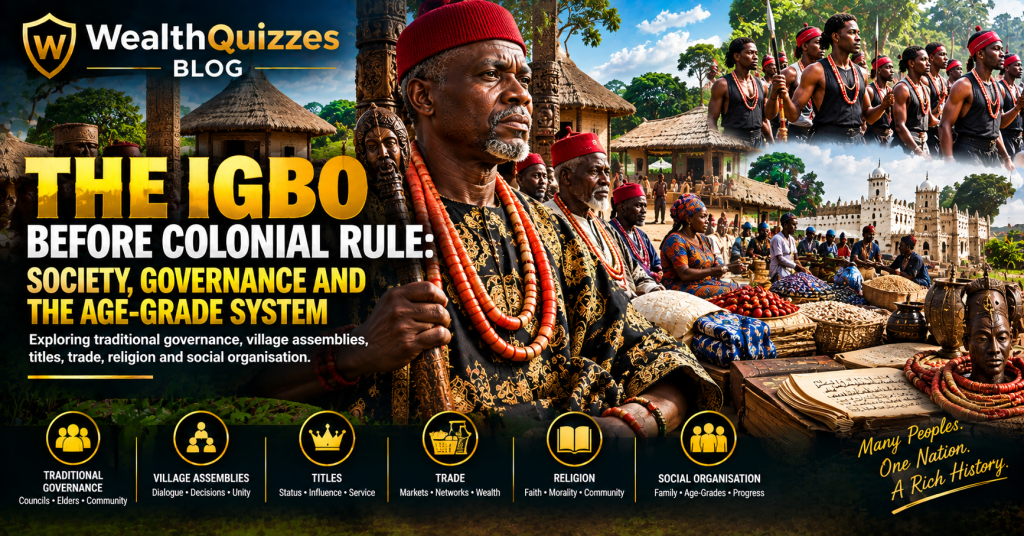
The Igbo Before Colonial Rule: Society, Governance and the Age-Grade System
Before British colonial rule transformed the political geography of southeastern Nigeria, the Igbo-speaking peoples lived in a remarkably diverse network of autonomous communities governed through kinship, assemblies, title institutions, age grades, religious authorities, market organisations and other associations. There was no single Igbo kingdom, emperor or central government exercising authority over the entire Igbo-speaking world. Yet the absence of a centralised monarchy did not mean the absence of government.
On the contrary, precolonial Igbo society developed an intricate system of distributed authority and participatory governance in which political power was dispersed among families, lineages, village assemblies, councils of elders, titled men, age grades, women’s organisations, religious specialists and other community institutions. Modern scholarship increasingly stresses this diversity rather than reducing all Igbo communities to one political model. Historian and anthropologist Ebere Nwaubani, for example, identifies several broad forms of Igbo political organisation, including systems based on segmentary lineages, age grades and associations. (Journals)
This political tradition is one of the most important features of precolonial Nigerian history. It demonstrates that sophisticated government does not necessarily require a king, palace or central bureaucracy.
A Society of Communities Rather Than a Single Kingdom
The first point that must be understood about precolonial Igbo society is its political diversity.
The term “Igbo” describes a broad cultural and linguistic community whose constituent societies developed distinctive institutions and traditions. Communities in Awka, Nri, Onitsha, Asaba, Arochukwu, Nsukka, Afikpo, Ohafia, Owerri and elsewhere did not necessarily organise themselves in exactly the same way.
Victor Chikezie Uchendu, in The Igbo of Southeast Nigeria, emphasised the importance of kinship, property, social status, economic activity, religion and government in understanding Igbo society. His work remains one of the important anthropological foundations for the study of Igbo social organisation. (eHRAF World Cultures)
Historian Elizabeth Isichei, whose extensive work on Igbo history combined oral traditions, documentary evidence and social history, similarly demonstrated that individual Igbo communities could experience significant political change. Her study of Asaba, for instance, shows a community whose political organisation changed over time rather than conforming permanently to one fixed model. (Cambridge University Press)
Thus, it is more accurate to speak of precolonial Igbo societies rather than a single uniform precolonial Igbo state.
The Family and the Umunna
At the foundation of Igbo social organisation stood the family and the wider patrilineage, commonly associated with the Umunna—people descended from a common male ancestor.
The lineage was not simply a biological unit. It was a political, economic, judicial and religious institution.
The senior male, commonly known as the Okpara or Okpala, possessed important moral and representational authority. He could arbitrate disputes, represent the lineage in external affairs and participate in wider community decision-making.
A crucial symbol of this authority was the Ofo, a sacred staff associated with ancestral authority and legitimate political action.
The Ofo represented more than personal power. It symbolised the continuity between the living community, its ancestors and its moral order. Scholars of Igbo political organisation have therefore stressed that political authority could not easily be separated from religion and customary law. (National Digital Library of Ethiopia)
This explains an important characteristic of Igbo governance: political decisions were often understood not merely as administrative acts but as matters affecting the moral and spiritual integrity of the community.
The Village Assembly: Government Through Deliberation
At the village level, one of the most important institutions was the general assembly, often described in the literature through terms such as Oha-na-eze or Ama-ala, although terminology and institutional details varied between communities.
The assembly provided a forum in which important public matters could be debated.
Issues might include:
- land disputes;
- relations with neighbouring communities;
- market regulation;
- communal projects;
- security;
- compensation;
- breaches of custom;
- marriage and family disputes;
- and questions of war and peace.
The American Historical Association, in its teaching resource on Igbo village democracy, describes how decisions could move from family and kindred structures into town assemblies and how age-grade organisations performed important executive and public-service functions. (AHA)
Victor Uchendu famously characterised government at the village level as “an exercise in direct democracy.” The formulation should not be interpreted as meaning that precolonial Igbo society was identical to a modern liberal democracy. Political participation was structured by age, gender, lineage, wealth, title and status. Nevertheless, it captures something important: political decisions were not monopolised by a hereditary king. (Kent State University Press)
The assembly was therefore an arena of argument, persuasion and negotiation.
Consensus Rather Than Simple Majority Rule
Igbo political culture placed considerable emphasis on discussion and consensus.
Important questions could be debated extensively before an acceptable position was reached. Elders, lineage heads and titled persons exercised influence, but their authority depended heavily upon persuasion and customary legitimacy.
This created a system of checks and balances.
The senior elder could not simply govern the community as a personal possession. Age grades could enforce communal decisions; titled institutions possessed recognised authority; religious sanctions could constrain behaviour; and the wider assembly could resist decisions considered unacceptable.
Political power was consequently distributed rather than concentrated.
This helps explain why historians such as A. E. Afigbo have used concepts such as the “village republic” to describe important forms of Igbo political organisation. Scholarship drawing on Afigbo’s work notes that decisions made through village assemblies could subsequently be implemented and enforced by age grades and other community institutions. (UP Repository)
The Age-Grade System: Society Organised by Generation
Perhaps the most distinctive institution in many Igbo communities was the age-grade system.
An age grade consisted of people who entered a recognised age cohort within a particular period. The precise method of formation, age interval, terminology and responsibilities differed between communities, so the institution should not be treated as completely uniform throughout Igboland.
Nevertheless, its underlying principle was powerful:
people of approximately the same generation were organised into a corporate group with collective responsibilities.
Elizabeth Isichei regarded age-grade organisation as one of the most important institutions in traditional Igbo society, particularly as an instrument of socialisation and communal service. Later scholarship similarly emphasises its functions in security, sanitation, administration and community development. (ResearchGate)
Age grades effectively transformed age from a biological fact into a political and social institution.
Young people were not merely expected to wait until they became elders before participating in community affairs. They acquired responsibilities appropriate to their stage in life.
Age Grades as the Executive Arm of the Community
The importance of the age grades becomes especially clear when examining their practical responsibilities.
They could be responsible for:
Community labour: clearing paths, maintaining roads, constructing communal facilities and performing other public works.
Security: guarding the community, policing public spaces and responding to external threats.
Enforcement: ensuring compliance with decisions made by recognised community institutions.
Military service: providing organised manpower when the community faced war.
Socialisation: teaching younger members discipline, responsibility and acceptable communal behaviour.
The American Historical Association’s account of Igbo village democracy notes that age-grade organisations performed both civic and military functions, including night watch duties and public works such as clearing forests and maintaining paths. (AHA)
The age grade was therefore simultaneously a social club, labour organisation, security institution, civic organisation and political mechanism.
That multifunctionality helps explain its extraordinary durability.
Elders, Age Grades and Checks on Power
The relationship between elders and younger age grades was particularly important.
Elders possessed experience, ritual authority and knowledge of custom. Younger age grades possessed physical energy, labour capacity and, in many circumstances, military strength.
Neither could function effectively without the other.
This produced a generational balance.
The elders deliberated and provided institutional continuity; the age grades executed many communal decisions.
In this sense, the age-grade system helped solve a fundamental problem of decentralised government: how does a community implement decisions when there is no standing central bureaucracy?
The answer was community organisation itself.
The people became the administrative machinery.
Titles and the Rise of Achieved Status
Igbo society also recognised forms of achieved status through traditional titles.
Among the most famous was the Ozo title, although titles varied significantly between communities.
Unlike a hereditary kingship, the acquisition of an important title could depend upon wealth, achievement, generosity, moral reputation, ritual preparation and the ability to meet the obligations associated with the institution.
A 1998 study by A. Ikechukwu Okpoko and E. U. Ezeadiechie, published in the West African Journal of Archaeology, emphasises that Igbo title systems varied from one locality to another. Their study identifies the Ozo institution as particularly significant and notes its political, social and ritual importance at lineage, village and village-group levels. (Africabib)
Titles consequently provided another route through which individuals could acquire influence.
A person’s authority might therefore derive from several sources simultaneously:
age, lineage, wealth, personal achievement, moral reputation, ritual status and community service.
This was very different from a political system in which power was determined exclusively by birth.
Women and Political Authority
Any serious account of traditional Igbo governance must avoid presenting it as exclusively male.
Women possessed important collective institutions of their own, including organisations associated with Umuada—daughters of a lineage or community—and married women’s associations, although terminology and functions varied between communities.
Women’s organisations could intervene in disputes, regulate social behaviour, organise collective action and represent women’s interests.
The existence of these institutions demonstrates that Igbo society contained multiple political constituencies, not simply one male governing hierarchy.
At the same time, it would be historically inaccurate to describe precolonial Igbo society as fully gender-equal in the modern sense. Many formal political offices and assembly structures were strongly male dominated.
The more accurate conclusion is that women exercised significant collective power through gender-specific institutions, while men dominated many of the principal formal political structures.
Religion: The Moral Foundation of Society
Politics in precolonial Igbo society cannot be separated from religion.
Igbo cosmology recognised Chukwu as a supreme creative power, while numerous communities maintained relationships with deities, earth forces, ancestors and other spiritual beings.
The concept of Ala, the earth deity or moral force in many Igbo communities, was particularly important.
Serious offences against community morality could therefore be understood not merely as crimes against individuals but as disturbances of the relationship between society, ancestors and the spiritual order.
Scholars of precolonial Igbo social control have documented the roles of councils of elders, age grades, title associations, oracles, Dibia specialists, secret societies, ancestral traditions and other institutions in maintaining social order. (TSU Digital Scholarship)
Religion consequently strengthened customary law.
The fear of supernatural consequences could reinforce rules that could not always be enforced through physical coercion.
Markets and Trade
Precolonial Igbo society was also deeply commercial.
Trade occurred through local markets as well as longer-distance networks.
Agricultural products, salt, textiles, metal goods, livestock and other commodities circulated between communities. Specialist producers developed reputations beyond their immediate villages.
David Northrup’s influential study, The Growth of Trade among the Igbo before 1880, demonstrates the antiquity and sophistication of southeastern Nigerian commercial networks. His research identifies regional trade in salt, cloth and metal and argues for considerable continuity in the basic patterns of lower Niger commerce from roughly the sixteenth century into the nineteenth century. (ResearchGate)
The evidence of Igbo-Ukwu provides an even deeper historical perspective. Archaeological discoveries at Igbo-Ukwu revealed sophisticated metalwork, glass beads and other materials associated with long-distance exchange, demonstrating that complex craft production and external connections existed in the region centuries before European colonial rule.
Trade was therefore not an activity introduced by Europeans.
It was already an important part of southeastern Nigeria’s economic history.
Craft Specialisation and Long-Distance Networks
Certain Igbo communities became particularly renowned for specialised production.
Awka became famous for itinerant blacksmithing and metalworking. Skilled craftsmen travelled considerable distances, carrying their technical knowledge beyond their home communities.
The Aro developed extensive commercial networks, linking communities across southeastern Nigeria and beyond.
These networks show that decentralisation did not mean isolation.
An autonomous village could be politically independent while being economically interdependent with dozens of other communities.
That distinction is fundamental to understanding precolonial Igbo civilisation.
Nri and Other Centralised Traditions
The common description of the Igbo as “acephalous” or “stateless” must also be used carefully.
There were important variations.
The Nri polity, for example, developed a distinctive religious and ritual authority centred around the Eze Nri. Onitsha, Asaba and some other communities likewise developed forms of kingship or more centralised political authority.
Elizabeth Isichei’s work on Asaba demonstrates that its political structure changed historically and that it moved from an earlier form of Eze authority toward a system in which personal titles became increasingly important. (Cambridge University Press)
Thus, there was no single “Igbo political system.”
There were multiple Igbo political systems sharing overlapping cultural principles.
Social Control and the Protection of Community Order
Without modern police forces, prisons and bureaucracies, Igbo communities developed other mechanisms for maintaining order.
These included:
- family authority;
- lineage sanctions;
- public opinion;
- age-grade enforcement;
- title associations;
- religious sanctions;
- compensation;
- mediation;
- ostracism;
- oath-taking;
- oracles;
- and, in serious cases, severe customary penalties.
The system relied heavily on the fact that individuals were embedded in dense networks of kinship and community relationships.
A person who violated community norms risked losing not merely freedom but social standing, family support and economic relationships.
Social control was therefore collective.
Colonial Rule and the Disruption of Indigenous Institutions
British colonialism profoundly altered this system.
The colonial government attempted to fit Igbo communities into administrative structures designed around the assumption that effective government required recognised “chiefs.”
This created serious difficulties in communities where political authority had traditionally been distributed.
The British subsequently experimented with forms of warrant-chief administration, most notoriously in parts of southeastern Nigeria.
Because the warrant chiefs did not always derive authority from established indigenous institutions, the system could generate resentment and resistance.
The famous Women’s War of 1929, centred particularly in southeastern Nigeria, was partly a reaction to colonial taxation, administrative abuses and the disruption of established social and political relationships.
Colonial administration therefore did not merely add another layer of government.
It reconfigured the balance among institutions that had governed community life for generations.
The Enduring Legacy of the Age Grade
Perhaps no precolonial Igbo institution demonstrates continuity more clearly than the age grade.
Modern Igbo communities continue to maintain age-grade associations that raise funds, support infrastructure, organise ceremonies, provide assistance to members and contribute to community development.
Contemporary scholarship continues to examine the age grade as a surviving institution with implications for grassroots development and local governance. (AJOL)
Its endurance is understandable.
The age grade embodies several enduring principles:
collective responsibility, generational solidarity, public service, mutual accountability and community development.
It converts social identity into practical civic responsibility.
Conclusion
The history of the Igbo before colonial rule cannot be reduced to the assertion that the Igbo “had no government.”
They had government—but government organised differently from the centralised monarchies of the Hausa and Yoruba worlds.
In many Igbo communities, political authority was distributed across families, lineages, councils, assemblies, age grades, title societies, religious institutions and women’s organisations.
The village assembly provided a forum for deliberation. The elders preserved custom and mediated disputes. The Okpala represented lineage authority. The Ofo symbolised legitimate ancestral power. Title holders acquired prestige through achievement and social standing. Age grades supplied labour, security and enforcement. Women organised collectively to defend social and economic interests. Religious institutions supplied the moral framework within which law and social order operated.
The result was an extraordinarily resilient form of decentralised governance.
Its genius lay not in concentrating power in one ruler but in distributing responsibility throughout the community.
As Victor Uchendu’s influential formulation suggests, governance at the village level could operate as an exercise in direct participation. Afigbo’s concept of the village republic similarly captures the importance of communal political institutions, while Elizabeth Isichei’s work demonstrates the historical diversity and adaptability of Igbo societies. (Kent State University Press)
The age-grade system was perhaps the clearest expression of this philosophy.
It taught that belonging to a community carried obligations—and that every generation had a role to play in protecting, maintaining and developing that community.
The precolonial Igbo world was therefore not a political vacuum waiting for European government.
It was a complex civilisation of autonomous communities, vibrant markets, sophisticated social institutions and participatory traditions of governance that had evolved long before colonial rule.
WealthQuizzes Blog Takeaway
The great lesson of precolonial Igbo society is that government does not always require a king. The Igbo developed a system in which political authority was distributed among families, elders, assemblies, age grades, title holders, religious institutions and other associations. Its strength lay in participation, negotiation, social accountability and communal responsibility.
The Age-Grade System was particularly remarkable because it transformed each generation into an organised instrument of civic responsibility—providing labour, security, socialisation and public service.
In that sense, the Igbo did not simply build communities.
They built a system in which the community itself was the government.
Renowned Authorities and Works for Further Reading
- Victor C. Uchendu, The Igbo of Southeast Nigeria (1965) — a foundational anthropological study of Igbo social organisation, political institutions, economy, property, religion and worldview. (eHRAF World Cultures)
- Elizabeth Isichei, A History of the Igbo People and her wider studies of Igbo communities — among the most influential historical treatments of Igbo society and historical change.
- A. E. Afigbo, especially his work on the indigenous political systems of the Igbo and the concept of the “village republic.” (UP Repository)
- Daryll Forde and G. I. Jones, The Ibo and Ibibio-Speaking Peoples of South-Eastern Nigeria — an important early anthropological study of lineage and political organisation.
- Elizabeth Isichei, Historical Change in an Ibo Polity: Asaba to 1885 — an important demonstration of political diversity and historical change within Igbo society. (Cambridge University Press)
- David Northrup, The Growth of Trade among the Igbo before 1880 — a major study of precolonial Igbo commercial networks. (ResearchGate)
- M. A. Onwuejeogwu, whose work on Igbo social institutions and Nri civilisation is important for understanding the diversity of Igbo political and religious organisation.
- A. Ikechukwu Okpoko and E. U. Ezeadiechie, “The Igbo Traditional Titles: An Overview” — a useful scholarly examination of title systems, especially Ozo, and their social and political significance. (Africabib)
- Emmanuel C. Onyeozili and Obi N. I. Ebbe, “Social Control in Precolonial Igboland of Nigeria” — useful for understanding how age grades, elders, title associations, religious institutions and other bodies maintained social order. (TSU Digital Scholarship)
Historical caution: It is preferable to describe the precolonial Igbo political order as decentralised and institutionally plural rather than simply “stateless” or “without government.” Scholarship has repeatedly demonstrated substantial variation between Igbo communities, including communities with stronger centralised or monarchical traditions. (Journals)