

The Income Allocation Mistake: Why Most People Misuse Salary Increases
Why Earning More Often Leads to Spending More—and Not Building Wealth
Introduction: The Raise That Changed Nothing
For many professionals, a salary increase feels like progress:
- A promotion is secured
- Income rises
- Lifestyle improves
But months later, a troubling realization sets in:
- Savings have not increased significantly
- Financial stress still exists
- Wealth has not grown
This paradox reveals a critical but often overlooked issue:
More income does not automatically translate into more wealth.
In fact, without structure, increased income can worsen financial behavior.
The Core Truth
Core Idea: More income magnifies poor structure
Mindset Shift: Earn more → Structure more
If your financial system is weak at a lower income level, a higher income will not fix it—
It will expose and amplify it.
The Income Allocation Mistake Defined
The Income Allocation Mistake occurs when:
An increase in income leads to a proportional or greater increase in spending, rather than improved allocation toward savings and investments.
This is commonly driven by:
- Lifestyle inflation
- Social pressure
- Lack of financial structure
The Psychology Behind Salary Increases
When people earn more, they often feel:
- Entitled to spend more
- Rewarded for their effort
- Pressured to “upgrade” their lifestyle
Insight from Authority
As Daniel Kahneman explains, humans are influenced by cognitive biases such as:
- Present bias (valuing immediate rewards)
- Hedonic adaptation (quickly adjusting to improved circumstances)
These biases drive individuals to:
Convert increased income into increased consumption
Lifestyle Inflation: The Silent Wealth Killer
Lifestyle inflation refers to:
The tendency to increase spending as income increases
Common Examples:
- Moving into more expensive housing
- Upgrading cars or gadgets
- Increasing social and leisure spending
Why It Feels Justified
Because:
- Income has increased
- Expenses appear “affordable”
The Hidden Problem
Lifestyle upgrades:
- Raise your financial baseline
- Reduce your ability to save
- Lock you into higher recurring costs
Insight from Authority
As Thomas J. Stanley discovered:
Many high-income earners fail to build wealth because they spend in proportion to their earnings.
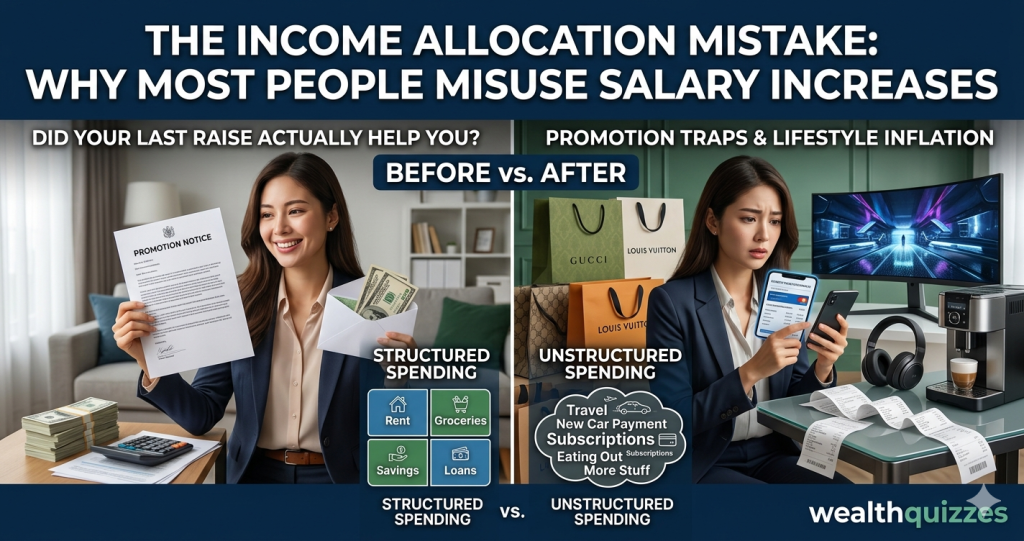
The Promotion Trap
A promotion is often seen as:
A signal to upgrade life
But without structure, it becomes:
A trap that increases financial obligations without increasing wealth
The Trap Cycle:
- Income increases
- Lifestyle expands
- Expenses rise
- Savings remain stagnant
- Financial pressure persists
The Result:
You earn more—but feel no richer
Why More Income Magnifies Problems
At lower income levels:
- Poor habits have limited impact
At higher income levels:
- The same habits operate at larger scale
Example:
- Impulse spending at ₦5,000 → minor
- Impulse spending at ₦50,000 → significant
The Key Insight
Income does not fix behavior—it scales it.
The Allocation Solution
The solution is not to avoid earning more—
It is to:
Structure how additional income is used
The Allocation Rule for Salary Increases
When income increases, it should be divided intentionally:
Example Structure:
- 50% → Savings and investments
- 30% → Lifestyle improvement
- 20% → Skill or income growth
Why This Works
It ensures:
- You enjoy some benefits of your raise
- But prioritize long-term financial growth
Insight from Authority
As Warren Buffett advises:
“Do not save what is left after spending, but spend what is left after saving.”
The Discipline Gap
Many people know they should:
- Save more
- Invest more
But fail to act.
Why?
Because:
- There is no system
- Decisions are emotional
- Spending is reactive
The Role of Structure
Structure removes:
- Guesswork
- Emotional decision-making
- Inconsistency
It replaces them with:
- Predictability
- Control
- Growth
The Nigerian Context: Why This Matters Even More
In Nigeria:
- Social expectations increase with income
- Family obligations may rise
- Cost of living is volatile
Without Allocation:
- Raises are absorbed quickly
- Financial progress is minimal
With Allocation:
- Income growth translates into wealth growth
- Financial resilience improves
The Identity Shift
To avoid the Income Allocation Mistake, you must move from:
- “I earn more, so I spend more”
To:
“I earn more, so I structure more”
Practical Implementation Guide
Step 1: Freeze Your Lifestyle Temporarily
When your income increases:
- Maintain your current lifestyle for a period
Step 2: Allocate the Increase
Divide the additional income into:
- Savings
- Investments
- Growth
Step 3: Automate the Process
- Set up automatic transfers
- Remove manual decision-making
Step 4: Upgrade Strategically
Only increase lifestyle spending:
- After securing financial growth
The Long-Term Impact
Proper allocation of income increases leads to:
- Faster capital accumulation
- Greater investment capacity
- Reduced financial stress
- Accelerated wealth building
The Compounding Effect
Each properly allocated raise:
- Builds financial momentum
- Strengthens your system
- Moves you closer to independence
The Real Transformation
When you master income allocation:
You move from:
- Earning more → Staying the same
To:
- Earning more → Building wealth
The Hard Truth
Most people are not financially stuck because:
- They don’t earn enough
They are stuck because:
They misuse the income they already earn.
Conclusion: Structure Determines Outcome
A salary increase is:
- An opportunity
- Not a guarantee
Without structure:
- It disappears
With structure:
It compounds into wealth
Final Thought
Before your next raise—or if you recently received one—ask yourself:
“Did my income increase… or did my expenses just grow with it?”
Because the difference between financial progress and stagnation is not how much you earn—
It is what you do with the increase.
👉 Did your last raise actually help you? Find out on WealthQuizzes